
Kai Spears wins $9.25M Alabama defamation verdict
A federal jury in Tuscaloosa found The New York Times defamed former Alabama basketball walk-on Kai Spears and awarded $9.25 million for a 2023 article naming him as the passenger in Brandon Miller's car on a single anonymous source's account. The record tracks the verified trial timeline, the unresolved post-verdict steps — Alabama's damages cap and an anticipated 11th Circuit appeal — and what the case signals about the cost of identity assertions built on one source.
- Jurisdiction
- United States (N.D. Alabama)
- Court
- U.S. District Court for the Northern District of Alabama, Tuscaloosa Division
- Judge
- Annemarie Carney Axon
- AI tool named
- No AI tool implicated
- Ruling date
- Aug 20, 2026
- Source document
- View primary court order ↗
- Last verified
- Aug 26, 2026
Lex Machina Review is an independent risk-tracking and reference resource. Nothing on this site is legal advice, and using it does not create an attorney-client relationship. Every record is reviewed against primary sources but may not reflect the most current status of a matter — always verify directly against the cited court order, rule text, or a licensed attorney before relying on it.
Companion explanation — secondary to the source document above
For anyone checking the Kai Spears defamation trial outcome in Alabama, the short record answer is this: Kai Spears won at trial, an eight-person federal jury awarded $9.25 million, the case was tried in the Northern District of Alabama before Judge Annemarie Carney Axon, and the award is not yet a final collectible judgment. The verdict is the risk signal; post-trial procedure is still the part to watch.
| Record field | Current entry |
|---|---|
| Case | Spears v. The New York Times Company |
| Court | U.S. District Court for the Northern District of Alabama, Tuscaloosa Division |
| Docket | 7:23-cv-00692-ACA [1] |
| Judge | Annemarie Carney Axon [1] |
| Complaint filed | May 30, 2023 [1] |
| Trial | Nine-day jury trial, Aug. 10–20, 2026 [1] |
| Verdict | Aug. 20, 2026; jury found The New York Times defamed Kai Spears and awarded $9.25 million [2] |
| Claim posture | Defamation claim reached trial after partial dismissal and summary-judgment denial |
| Harm type | Person-specific identity assertion tying Spears to a car-passenger role in coverage of a fatal shooting |
| Status | Post-verdict motions, statutory damages-cap issues, and expected appellate review remain unresolved |
| Appeal | Expected, but no 11th Circuit appeal located on the docket as of last verification |
| Risk Digest flag | Exceptional non-AI matter: verification-risk benchmark, not an AI-hallucination, sanction, or tool-failure record |
| Last verified | 2026-08-26 UTC |

CBS News reported that the Times called the verdict “contrary to law and not supported by the evidence” and said Alabama law would reduce the award by more than $2 million.[2] That matters. The $9.25 million number is the jury’s number, not the last word on the judgment amount. The docket, as checked on 2026-08-26, did not yet show an 11th Circuit appeal, although one is expected.
The durable part of the outcome is narrower and more useful than the headline: a jury put a dollar figure on the publication of a specific identity claim, about a specific person, in a criminal-news setting, where the disputed assertion rested on one anonymous source and was formally corrected only after Spears sued.
What the jury decided, and what it has not settled
The jury found for Spears on his defamation claim and awarded $9.25 million after a trial that ran from Aug. 10 through Aug. 20, 2026.[1][2] The case was not a default, not a sanctions order, and not a pleading-stage ruling. It was tried to a federal jury in Tuscaloosa.
The precise damages split should still be handled carefully. Tuscaloosa Patch and the Tuscaloosa Thread reported that about $7.5 million of the award was punitive damages, with the remainder compensatory.[3][4] The publicly available materials reviewed for this record did not include the verdict form, and local reports are not a substitute for the form or for a later judgment applying any statutory cap.
Nor should the verdict be described as finally collected money. The Times has disputed the verdict, Alabama damages-cap questions remain live, and appellate review is expected. For risk purposes, the case is already significant because a jury was willing to assign a large number to the error. For collection and precedent purposes, the record is still moving.
The publication sequence that carried the case to trial
The article at issue was Billy Witz’s March 15, 2023 New York Times story, “A Shooting That Ensnared Alabama Players Could Have Been Deadlier.” The story reported on the January 2023 shooting near the University of Alabama’s campus that killed Jamea Harris and became entangled with coverage of Alabama basketball players and personnel.[5]
The disputed sentence identified Spears, a former Alabama basketball walk-on, as the passenger in Brandon Miller’s car during the events surrounding the shooting. Later reporting and the litigation record identified the passenger as Alabama team manager Cooper Lee, not Spears. That is the identity point that drove the defamation claim: not a loose implication that Spears knew someone involved, but a concrete placement of him in a car at a highly charged moment in a fatal-shooting narrative.
Spears and his father denied the assertion. The story was updated after those denials, but the formal editor’s note was dated June 3, 2023, after Spears filed suit on May 30, 2023.[1][6] That sequence is not a cosmetic timing point. In a verification-risk record, the order of operations is the record: publication, denial, update, lawsuit, formal note.
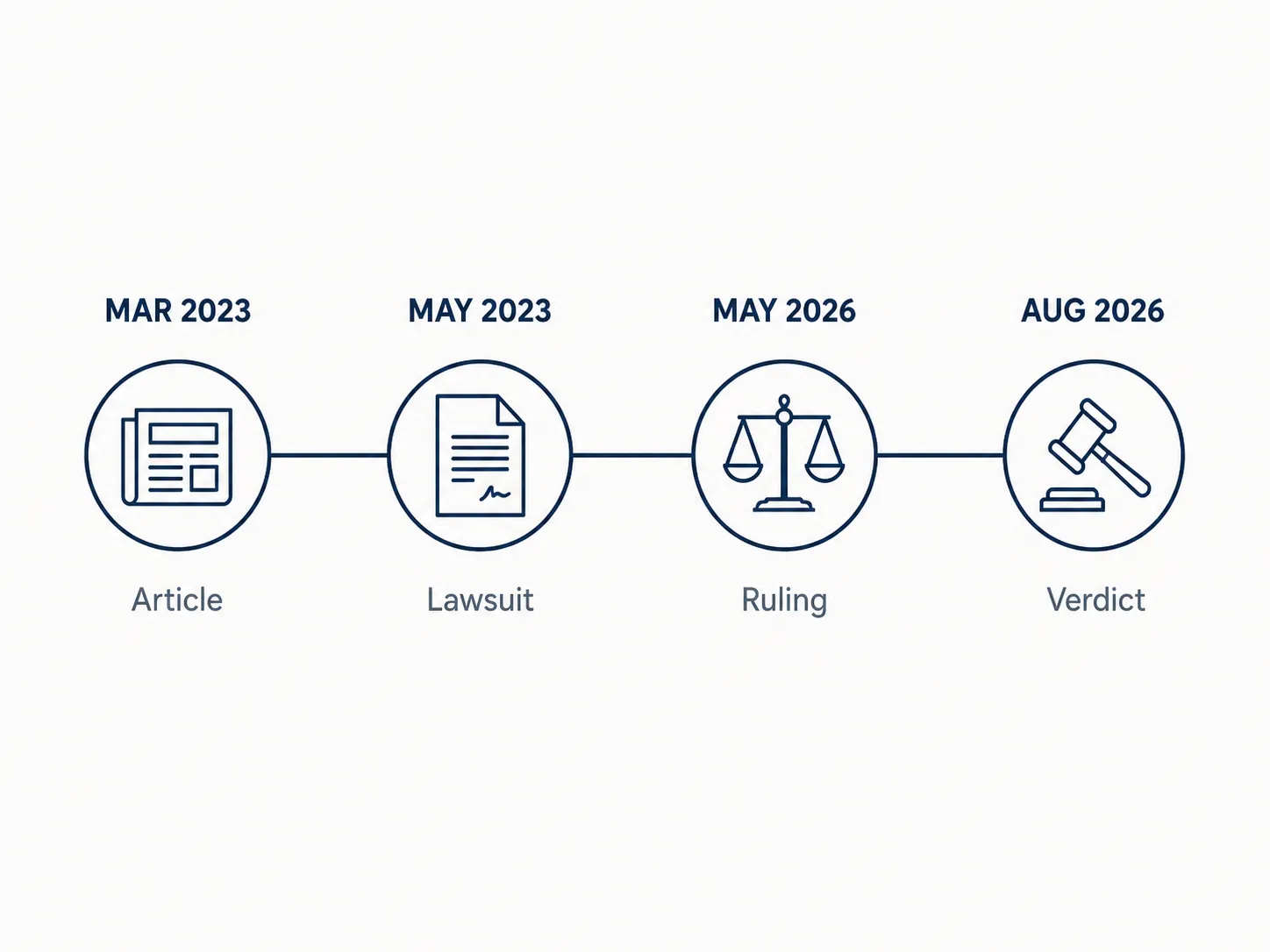
Spears sued the Times on May 30, 2023.[1] In December 2023, the court partially dismissed the case, including false-light claims, while allowing the defamation claim to continue. The case was reassigned to Judge Axon in January 2025. In May 2025, shield-law questions were certified to the Alabama Supreme Court, and the federal case later returned to the path toward dispositive motions and trial.[1]
The decisive pretrial ruling came on May 28, 2026, when Judge Axon denied both sides’ summary-judgment motions. The memorandum opinion did not hand Spears a judgment, but it did reject the idea that the record could be resolved as a matter of law before trial.[7] After that, the claim went to a jury.
The verification evidence reported at trial
The trial record matters here because the verdict is not just about an inaccurate sentence. It is about how that sentence reached publication. The central verification issue was whether the Times had enough support to identify Spears as the passenger in Miller’s car, and whether the paper acted with the required fault when it published the claim.
According to Tuscaloosa Patch’s courtroom reporting, trial testimony described the disputed passenger identification as resting on one anonymous “person familiar with the case,” without independent confirmation before publication.[3] Patch also reported testimony that there had been no pre-publication consultation with the Times standards department and that Spears’s father denied the claim before publication.[3] Those are reported trial details, not appellate findings and not a substitute for a transcript. They are still the details that explain why this verdict belongs in a verification-risk file.
Anonymous sourcing is not inherently reckless, and courts do not treat anonymity as automatic liability. But an anonymous source does not become stronger simply because the disputed fact is dramatic. The asserted fact here was binary and person-specific: was Kai Spears the passenger, or was he not? Once the identified person and his father denied it, the verification burden became harder to wave away.
Patch separately reported trial testimony and courtroom discussion about the article’s reach, including a figure of 258,000 page views, and about internal communications around the story.[3] Those items may matter in post-trial briefing over harm, fault, and damages, but they should be kept in their proper lane. The publicly durable facts are that the claim survived summary judgment, was tried, and produced a plaintiff’s verdict.
Why the underlying shooting context is serious, but limited
The underlying event was the Jan. 15, 2023 shooting near the Strip in Tuscaloosa in which Jamea Harris was killed. Darius Miles and Michael Davis were charged, and Davis was later convicted of capital murder. The Times article appeared in the middle of intense scrutiny of Alabama basketball and the people connected to the program.[5]
That context explains why the passenger identification carried weight. It does not require this record to reconstruct the criminal case or every surrounding basketball controversy. Spears’s claim turned on a publication-specific question: whether the Times falsely identified him as a person present in Miller’s car during the episode described in the March 2023 story, and whether the circumstances of publication and correction supported defamation liability.
Correction timing is part of the risk record
The editor’s note is dated June 3, 2023 and states that the March article had “misidentified” the person in Miller’s car, naming Cooper Lee as the passenger rather than Spears.[6] The important litigation fact is that the formal note came after the May 30 complaint.[1][6]
For newsroom and legal-risk workflows, that lag is not just a public-relations problem. A correction may mitigate harm, but a late formal correction can also become evidence in the story of what the publisher knew, when it knew it, and how fast it acted once the subject denied the assertion. The jury’s verdict does not by itself answer every legal question about the correction, but it shows that the correction sequence did not prevent liability at trial.
How this differs from other Times defamation litigation
The Spears verdict should not be blurred together with every high-profile complaint filed against the Times. The site’s separate record on the Trump v. NYT $15 billion defamation ruling is a useful contrast precisely because it was a motion-to-dismiss posture, not a plaintiff’s jury verdict. Spears is the actual verdict-outcome record.
CBS reported the Times’ statement that this was its first U.S. defamation loss over one of its articles in more than 50 years.[2] That claim should be attributed to the Times rather than independently certified from this record. It is notable, but the case does not need that superlative to matter. The verified sequence is enough.
What happens next
The next procedural steps are the ones that will determine how much of the verdict becomes a judgment and how long the verdict remains intact. The Times can pursue post-trial motions. Alabama’s damages cap will have to be addressed before anyone treats the $9.25 million as the final payable amount. Appellate review in the 11th Circuit is expected, but no appeal was found on the docket as of the 2026-08-26 verification check.[1]
That is the current procedural edge. Spears has a jury verdict. The Times disputes it. The cap issue matters. The appeal is expected but not yet docketed. The safest reading is not that $9.25 million is the final number; it is that a single-anonymous-source identity assertion, published in a criminal-news setting and formally corrected only after suit, now has a rare quantified jury-risk marker.
References
- Spears v. The New York Times Company, CourtListener.
- New York Times defamed Kai Spears, owes millions in damages, jury finds, CBS News.
- Jury Sides With Kai Spears In NYT Defamation Trial, Awards $9.25M In Damages, Tuscaloosa Patch.
- Kai Spears Awarded Millions In Times Lawsuit, Tuscaloosa Thread.
- A Shooting That Ensnared Alabama Players Could Have Been Deadlier, The New York Times, Mar. 15, 2023.
- Editors’ Note: June 3, 2023, The New York Times, June 3, 2023.
- Spears v. New York Times Company, Justia, May 28, 2026.
Related records
Tool profile
How Meta's AI Spending Reshapes Law Firm ProfitabilityGoverning regulation
Browse the obligations tracker →Preventive workflow
Browse verification workflows →
Report a correction or tip
Spotted an outdated figure, a misstated fact, or a ruling this case record should reflect? Public comments are disabled for this content given the professional cost of a misreported case outcome, penalty amount, or rule text — use the structured correction channel instead.
Report a correction or tip for this record →