
Utah ruling keeps Kalshi's sports betting under state law
The Aug. 4, 2026 ruling in KalshiEx LLC v. Cox (D. Utah) grants the state summary judgment, rejects all three CEA preemption theories, and closes the case — the first federal merits-stage win in the anti-preemption line. The docket-linked record explains the holding and what it signals for CFTC-regulated sports event contracts in total-ban states.
- Jurisdiction
- Utah, United States
- Court
- U.S. District Court for the District of Utah
- Judge
- Robert J. Shelby
- AI tool named
- No AI tool named
- Ruling date
- Aug 4, 2026
- Source document
- View primary court order ↗
- Last verified
- Aug 5, 2026
Lex Machina Review is an independent risk-tracking and reference resource. Nothing on this site is legal advice, and using it does not create an attorney-client relationship. Every record is reviewed against primary sources but may not reflect the most current status of a matter — always verify directly against the cited court order, rule text, or a licensed attorney before relying on it.
Companion explanation — secondary to the source document above
| Case record item | Detail |
|---|---|
| Court | U.S. District Court for the District of Utah |
| Case | KalshiEx LLC v. Cox, No. 2:26-cv-00151-RJS-CMR |
| Judge | Judge Robert J. Shelby |
| Order | Memorandum Decision and Order, ECF No. 65 |
| Decision date | Aug. 4, 2026 |
| Last verified | Aug. 5, 2026, UTC |
| Disposition | Summary judgment granted to the state defendants; Kalshi’s preliminary-injunction motion denied as moot; case closed |
| One-sentence holding | The Commodity Exchange Act did not preempt Utah’s anti-gambling enforcement against Kalshi’s sports event contracts expressly, by field, or by conflict. |
The Utah ruling on Kalshi’s sports betting contracts is not just another preliminary-injunction entry in the prediction-market docket pile. On Aug. 4, 2026, Judge Robert J. Shelby granted summary judgment to Utah officials in KalshiEx LLC v. Cox, rejected Kalshi’s Commodity Exchange Act preemption theories, denied the requested preliminary injunction as moot, and closed the district-court case. That makes the order a merits-stage ruling, not a temporary enforcement-management order, subject of course to whatever appellate path follows. [1]

That posture matters. A temporary restraining order can tell a platform whether state enforcement is paused for a few days. A preliminary injunction can signal how a judge sees likelihood of success before a fuller record. This order did something different: it resolved the state defendants’ summary-judgment position and entered judgment for them at the district-court level. The immediate district-court consequence is plain enough: Kalshi did not obtain an injunction barring Utah from applying its anti-gambling laws to the challenged sports event contracts. [1]
What the Utah court actually held
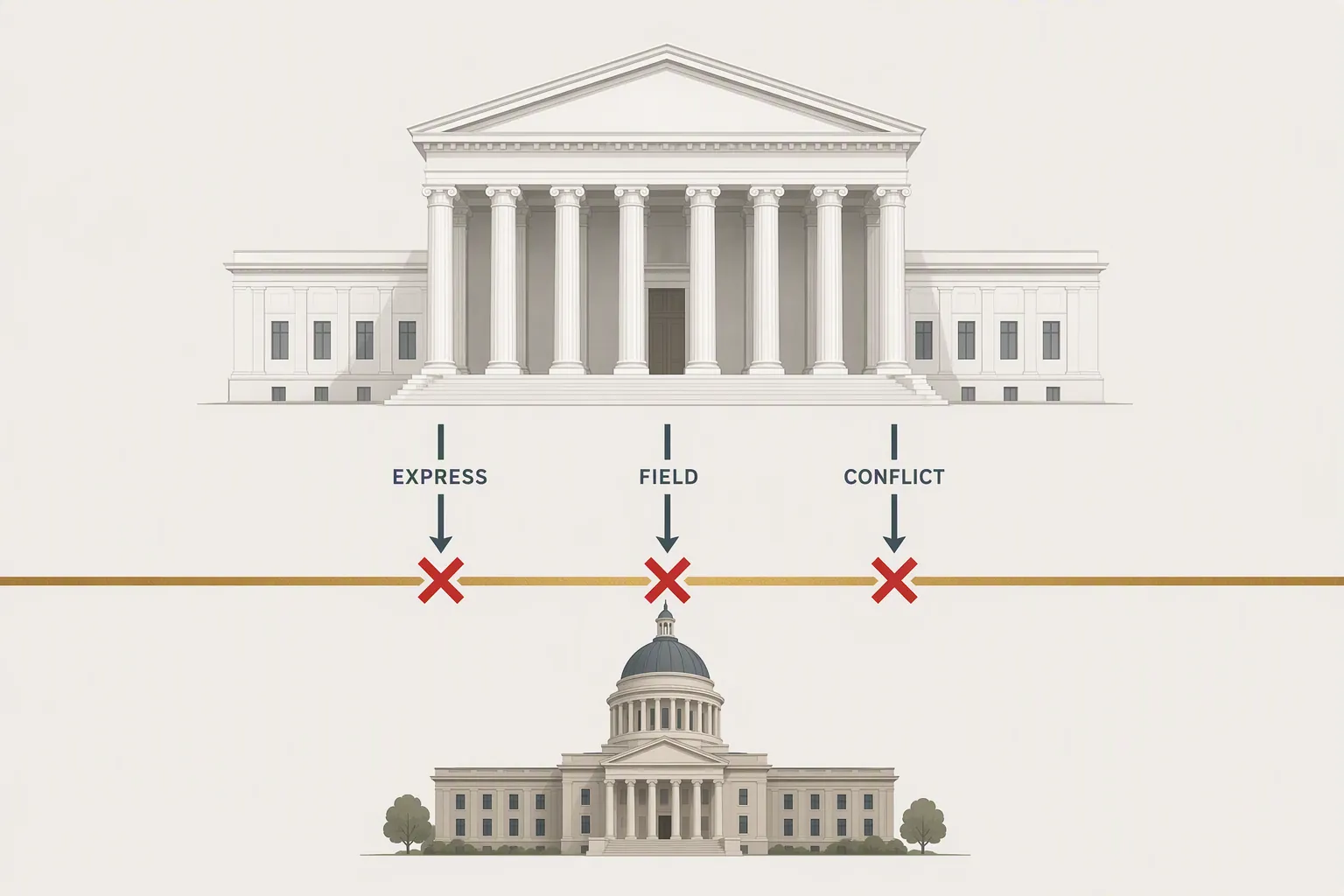
Kalshi’s central federal-law position was that its status as a CFTC-regulated designated contract market displaced Utah’s ability to enforce state gambling restrictions against the sports event contracts at issue. Judge Shelby rejected that position across the full preemption menu presented to the court: express preemption, field preemption, and conflict preemption. [1]
The order therefore should not be reduced to a failed argument over one stray statutory phrase. The court held that the CEA did not expressly preempt Utah enforcement; that Congress had not occupied the relevant field so completely that Utah was pushed out; and that Utah’s enforcement position did not create the kind of conflict with federal law that made simultaneous compliance or federal objectives impossible in the way Kalshi needed to show. [1]
The practical holding is narrower than a national rule about every event contract, but sharper than a procedural shrug. In this case, under Utah’s anti-gambling framework, federal registration did not operate as a shield against state enforcement for these sports event contracts. [1]
The three preemption losses
Preemption arguments often travel under the same label while doing very different work. Here, the difference matters because the court rejected all three theories, not merely the easiest one.
| Preemption theory | What Kalshi needed in substance | What the court did |
|---|---|---|
| Express preemption | A statutory command in the CEA that displaced Utah’s enforcement authority over the challenged contracts | Rejected; the court held the CEA did not expressly preempt Utah’s anti-gambling enforcement in this case |
| Field preemption | A showing that federal commodities regulation occupied the relevant field so completely that Utah could not regulate there | Rejected; the court did not treat CFTC market oversight as exclusive field occupation barring Utah’s gambling-law application |
| Conflict preemption | A conflict between Utah enforcement and federal law sufficient to make state law give way | Rejected; the court held the CEA did not preempt Utah law on conflict grounds |
The express-preemption ruling is the first place to look because it addresses the cleanest version of Kalshi’s boundary claim: once a market is federally registered and the contracts sit inside the CFTC-regulated system, state gambling enforcement must stand down. Judge Shelby did not read the CEA to contain that displacement command for Utah’s anti-gambling enforcement against these sports event contracts. [1]
The field-preemption ruling is important for a different reason. Federal supervision can be dense without being exclusive. The order did not treat the CFTC’s oversight of designated contract markets as proof that Congress had occupied the entire regulatory field relevant to Utah’s gambling-law claim. That distinction is where many platform-side summaries are likely to overread federal registration: regulation by a federal agency is not automatically immunity from every state-law regime touching the same transaction. [1]
The conflict-preemption ruling then closes the loop. Kalshi needed more than inconvenience, duplication, or a harder state-by-state operating environment. The court held that the CEA did not create the kind of federal-state conflict that required Utah’s law to yield in this dispute. [1]
Why Utah’s total-ban framing does real work
The safest reading of the order stays close to Utah. The ruling arose in a state-law frame described as a total-ban gambling regime, and the court assessed whether the CEA displaced that enforcement position. That is a different question from whether a more permissive state, a differently drafted licensing system, or another category of event contract would produce the same result.
For risk purposes, the significant move is that the court refused to convert CFTC designation into a categorical answer to state gambling law. If a platform’s operating assumption was that federal commodities-market status alone prevents restrictive-state enforcement, this order is adverse authority. It does not say every state can always enforce every gambling-related restriction against every CFTC-regulated contract. It says Utah could defeat Kalshi’s preemption challenge on this record and at this stage. [1]
That distinction is not lawyerly trimming for its own sake. It identifies who has to act tomorrow. In Utah, after this district-court ruling, the state defendants are no longer blocked by the requested federal injunction in this case. For platforms and partners looking at similarly restrictive jurisdictions, the order is a live enforcement-exposure signal, not a settled national map.
What the disposition changes
The order is the first federal merits-stage win in the anti-preemption line concerning Kalshi-style sports event contracts. Its force comes from that merits posture. The court was not merely forecasting likelihood of success; it granted summary judgment to the state defendants and closed the case. [1]
That does not make it appellate law. It also does not erase other pending disputes or decide how another judge will read another state’s gambling statute. But it gives state defendants a district-court order they can cite for the proposition that the CEA does not, by itself, bar anti-gambling enforcement against sports event contracts in a total-ban state. Kalshi and similarly situated platforms now have to account for that authority when assessing whether federal registration is enough to keep state regulators, attorneys general, or gambling-enforcement officials out of the transaction.
The closed-case point should not be missed. Because the preliminary-injunction motion was denied as moot after summary judgment, the district court did not leave the parties in a temporary holding pattern. It entered a final district-court disposition for the state defendants, subject to appeal. [1]
What not to overread
The order is important because it rejects a broad immunity theory in a concrete enforcement setting. It is limited because that rejection is tied to the CEA arguments presented, Utah’s anti-gambling law posture, the sports event contracts at issue, and a single district-court judgment.
A clean internal brief should therefore avoid two errors. The first is to call the order merely procedural, as if summary judgment and case closure did not alter the enforcement landscape for this dispute. The second is to treat it as a nationwide final answer to prediction-market sports contracts. The order does neither. It gives Utah a merits-stage win against Kalshi’s CEA preemption challenge and leaves broader appellate and state-by-state questions for the next filings.
The supported takeaway is direct: in KalshiEx LLC v. Cox, Kalshi’s CFTC registration did not shield the challenged sports event contracts from Utah anti-gambling enforcement, and restrictive-state exposure remains live unless appellate authority changes the rule. [1]
References
- Memorandum Decision and Order — #65 in KalshiEx LLC v. Cox, U.S. District Court for the District of Utah, Aug. 4, 2026
Related records
Tool profile
How Meta's AI Spending Reshapes Law Firm ProfitabilityGoverning regulation
Browse the obligations tracker →Preventive workflow
Browse verification workflows →
Report a correction or tip
Spotted an outdated figure, a misstated fact, or a ruling this case record should reflect? Public comments are disabled for this content given the professional cost of a misreported case outcome, penalty amount, or rule text — use the structured correction channel instead.
Report a correction or tip for this record →