
What Karp's wealth inequality prediction means for AI legal teams
Alex Karp's warning that AI will vastly widen the wealth gap has already been cited by Congress to justify two bills creating new obligations for AI companies. This article maps those bills—the 50% equity tax in S.4825 and the data center moratorium—onto a practical risk calendar for in-house counsel.
- Jurisdiction
- US Federal
- Court
- United States Congress
- AI tool named
- AI
- Ruling date
- Jun 18, 2026
- Source document
- View primary court order ↗
- Last verified
- Jul 25, 2026
Lex Machina Review is an independent risk-tracking and reference resource. Nothing on this site is legal advice, and using it does not create an attorney-client relationship. Every record is reviewed against primary sources but may not reflect the most current status of a matter — always verify directly against the cited court order, rule text, or a licensed attorney before relying on it.
Companion explanation — secondary to the source document above
The legal significance of Alex Karp's AI wealth inequality prediction is not that a technology executive forecasted a wider gap between owners and workers. It is that the forecast now sits close to statutory design. In July 2026, Karp told Fortune that AI could make him "20x" richer while workers' salaries might only double, and called wealth inequality "the biggest problem in this country."[1] A month earlier, he warned that executives boasting about AI-driven headcount reductions "might as well sign up for the Bernie Sanders manifesto."[2] By mid-June, Senator Bernie Sanders had already introduced legislation using that distributional premise to justify a federal ownership fund for major AI companies, and a separate data-center moratorium proposal would pause construction until federal safety and workforce-impact standards are in place.[3][4]
For legal teams, that chain matters more than the biography. A prediction about AI making capital owners dramatically richer has become legislative scaffolding for equity taxation, business-unit separation, commission oversight, construction pauses, export restrictions, and workforce-impact review. None of those duties is current compliance law. But they are concrete enough to place on a board-facing risk calendar without pretending that either bill has already cleared Congress.

The near-term obligations map
The fastest way to misread these bills is to treat them either as inevitable law or as campaign theater with no planning value. The safer approach is narrower: identify the obligation types, assign owners inside the company, and monitor the legislative trigger points that would turn a proposal into an implementation problem.
| Proposal | Companies or assets in scope | Proposed obligation | Legal team planning question | Current status |
|---|---|---|---|---|
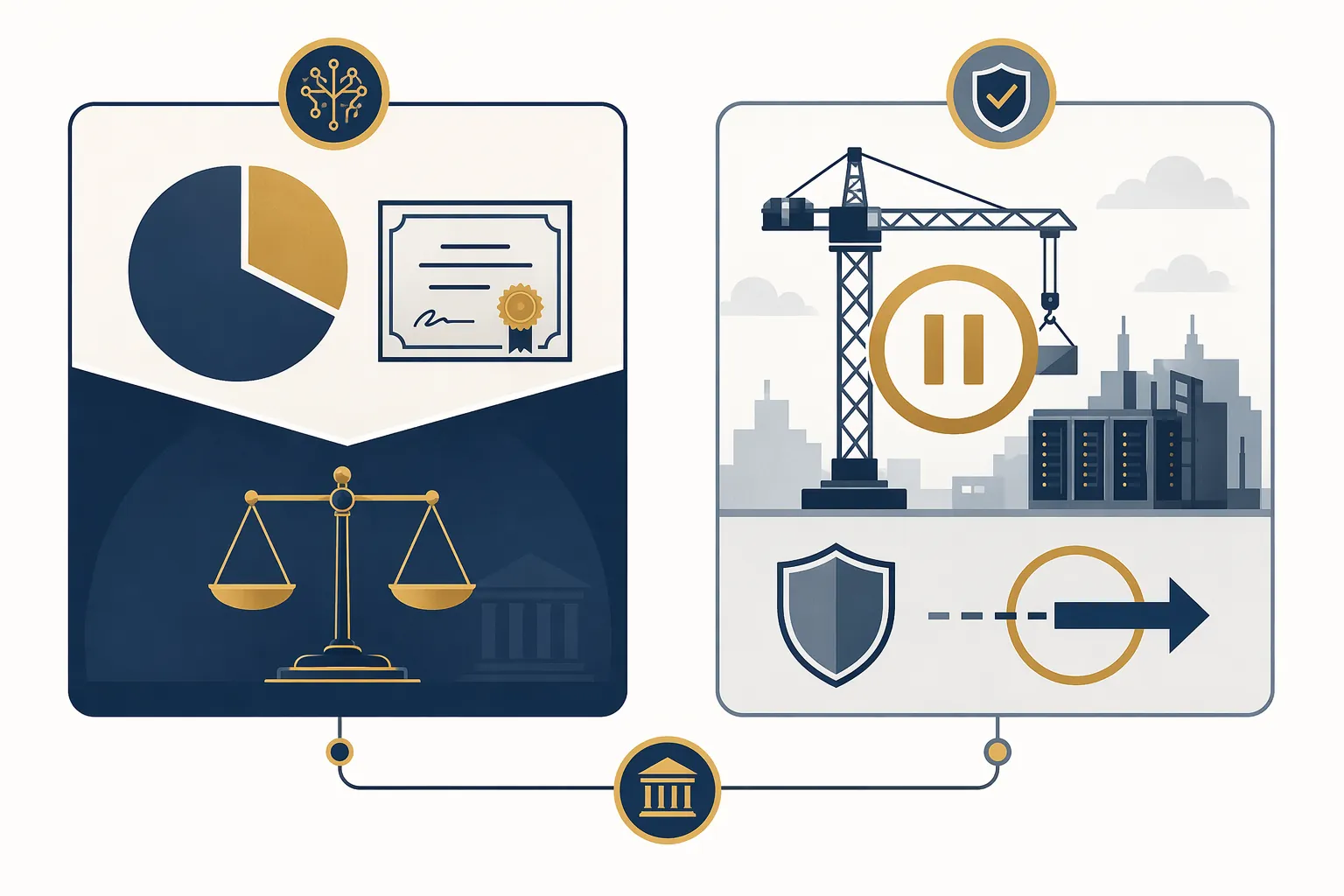
| American AI Sovereign Wealth Fund Act, S.4825 | AI companies with $200 million or more in annual sales, as described by the Sanders release and Roll Call | 50% one-time equity tax; structural separation of AI and non-AI business units; oversight by a seven-member Independent Commission | Can the company map AI revenue, valuation exposure, share classes, subsidiaries, and AI/non-AI operational boundaries quickly enough for a board contingency review? | Introduced bill; not enforceable law |
| AI Data Center Moratorium Act | New AI data center construction and related export activity described in the sponsors' release | Federal construction halt pending safety and workforce-impact standards; export bans | Which projects, contracts, permits, power commitments, and equipment flows would be exposed if a federal pause attached to pending or planned facilities? | Announced proposal; not enforceable law |
That matrix should be read with one important limitation. The full S.4825 text on Congress.gov could not be directly reviewed here through the available crawl path, so the operational discussion relies on the Sanders press release, Roll Call's analysis, and the Congress.gov bill page for bill identity and status.[3][4][5] Any company moving from monitoring to formal contingency design should verify the section-by-section materials and statutory text before assigning legal conclusions to specific provisions.
Why wealth distribution became a compliance issue
The wealth-distribution premise did not arrive with Karp's July interview. Oxfam reported in January 2026 that billionaire wealth rose 16% in 2025 to $18.3 trillion, three times faster than the prior year.[6] Brookings has separately examined how AI could affect income inequality in the United States and how tax policy might respond to AI-driven changes in returns to labor and capital.[7][8] Those materials do not prove that any particular AI bill will work. They do explain why lawmakers are receptive to mechanisms that redirect gains from firms, shareholders, or infrastructure operators toward a broader public claim.
Karp's comments are useful to sponsors because they come from inside the industry most likely to resist redistribution. His June warning about layoff bragging gave the politics a management-facing vocabulary: if executives celebrate AI as a payroll-reduction tool, they make a Sanders-style response easier to sell.[2] His July prediction supplied the sharper distributional image: owner wealth compounding far faster than wages.[1] The legal consequence is not that Congress has accepted his forecast as economics. It is that the forecast helps frame AI gains as a taxable, separable, and reviewable pool.
S.4825: equity taxation as an operational problem
S.4825 is the more novel corporate-law planning problem. The Sanders release describes the American AI Sovereign Wealth Fund Act as creating an estimated $7 trillion fund through a 50% one-time equity tax on AI companies with at least $200 million in annual sales, with a proposed 5% annual dividend that the release characterizes as roughly $1,000 per person.[3] Roll Call reported the same core design and described the political split around the mechanism, including bipartisan interest in a public-stake concept but disagreement over how to implement it.[4]
For an in-house team, the first question is not whether the dividend estimate is persuasive. It is how the company would determine whether it is inside the $200 million threshold, which revenue counts as AI sales, which entity bears the tax, and how equity would be valued if the obligation attached to a parent, subsidiary, business line, or class of shares. A public company, a private model developer, and an enterprise software group with embedded AI functionality would not face the same evidence problem.
The valuation exercise would also pull legal, finance, tax, and corporate-secretary functions into the same file. A 50% one-time equity tax is not a conventional reporting update. It would require a defensible capitalization table, treatment of preferred rights and convertible instruments, review of debt covenants and change-in-control provisions, securities disclosure analysis, and a board record showing how management assessed dilution or transfer consequences. Even if later compromise legislation abandoned the exact percentage, the planning muscles would be the same.
The structural-separation issue is harder than a revenue label
The Sanders materials and Roll Call analysis also describe a structural-separation requirement for AI and non-AI business units.[3][4] That phrase deserves attention because it moves the bill from tax collection into corporate architecture. A company that treats AI as a feature across products may not have a clean unit to separate. Product teams may share model infrastructure, customer data, cloud commitments, security tooling, sales channels, and licensing rights. The harder the company has worked to embed AI across its stack, the harder it may be to document separability after the fact.
Legal teams should therefore model separation as a document and governance exercise before treating it as a reorganization. The immediate work is to identify which corporate entities own AI assets, which contracts restrict assignment or operational changes, which employees work across AI and non-AI products, which data sets are shared, and which customer commitments depend on integrated delivery. If a future bill defines separation narrowly, much of that work becomes evidence for non-applicability. If it defines separation broadly, the same work becomes the opening inventory for compliance.
The proposed Independent Commission creates a different kind of uncertainty. The release describes a seven-member body, but the exact scope of reporting, valuation review, enforcement, and exemption authority needs verification against statutory text and section-by-section materials.[3] Counsel should avoid drafting procedures around assumed commission powers. They can still prepare a commission-readiness file: board minutes, AI revenue methodology, valuation memos, entity charts, model-governance policies, and records showing how management distinguished AI-enabled activity from non-AI activity.
Board materials should separate passage odds from readiness costs
A useful board memo would not announce that S.4825 is likely to pass. Roll Call's reporting points to divided government and deep disagreement over mechanism, even while noting bipartisan interest in public stakes or redistribution.[4] The memo should instead separate three judgments: the bill is not current law; its exact mechanism faces political resistance; and its obligation types are specific enough to justify low-cost readiness work.
- Quarterly: monitor S.4825 status, amendments, committee activity, and any section-by-section updates.
- Within one reporting cycle: map AI-related revenue against the $200 million threshold described by sponsors.
- Before the next financing, acquisition, or major restructuring: test how a large equity-transfer obligation would affect capitalization, covenants, investor rights, and disclosure.
- Before product integration deepens: preserve documentation showing where AI and non-AI operations are separable, partially shared, or fully integrated.
- If amendment text narrows the bill: update the inventory rather than discarding it; thresholds and definitions often move before obligation types disappear.
The data-center bill turns inequality politics into permitting risk
The AI Data Center Moratorium Act translates the same distributional concern into a more familiar legal workflow. According to the Sanders and Ocasio-Cortez release, the bill would halt new AI data center construction pending federal safety and workforce-impact standards, and it includes export bans.[9] That is not a capitalization-table problem. It is a siting, construction, procurement, energy, labor, and trade-control problem.
The practical sequence begins with project classification. Legal and regulatory teams need to know which planned facilities would be treated as AI data centers, which projects are new construction rather than expansion or retrofit, which permits are pending, and which construction commitments would become stranded if a federal pause attached before groundbreaking or commissioning. The bill's current public description does not answer every boundary question, so project files should preserve the facts that future definitions are likely to ask for: compute purpose, customer base, power draw, ownership structure, construction status, and use of imported equipment.
The standards trigger is just as important as the moratorium itself. A pause pending safety and workforce-impact standards means legal exposure would not end when the government publishes rules. It would shift into proof. Companies would need to show how a facility satisfies safety requirements, how workforce effects were assessed, who reviewed mitigation, and whether procurement or deployment decisions implicate export restrictions. That is a recordkeeping problem before it is a litigation problem.
This also makes the federal proposal easier to compare with state-level data-center controls. Companies already tracking New York's two-track data center moratorium debate should treat the federal bill as a second layer, not a replacement. State permitting exposure can affect where and how a project is built; a federal moratorium could affect whether a category of AI construction proceeds at all. The same internal team should own both calendars, because power procurement, environmental review, local approvals, construction milestones, and public commitments rarely stay in separate legal boxes.
| Planning stage | Legal action | Reason to do it now |
|---|---|---|
| Site selection | Tag projects that could plausibly be classified as AI data centers. | Classification disputes are easier to handle before public announcements, lease commitments, and utility agreements lock in facts. |
| Permitting | Track federal, state, and local approvals in one calendar. | A federal pause could interact with state-level moratoriums and local construction timelines. |
| Construction contracts | Review delay, force majeure, termination, and change-in-law provisions. | A moratorium creates commercial exposure even before enforcement penalties are defined. |
| Workforce review | Document projected staffing, displacement assumptions, contractor use, and mitigation steps. | The bill's standards concept expressly points toward workforce-impact scrutiny. |
| Equipment and export controls | Map critical hardware flows and cross-border commitments. | The sponsors' release describes export bans as part of the proposal. |
Political uncertainty changes the memo, not the calendar
The divided-government caveat is real. Roll Call's June analysis does not support treating S.4825 as imminent law, and it highlights disagreement over the mechanism even where the public-stake idea has some bipartisan resonance.[4] That distinction should appear clearly in advice to management. A legal team that labels the bills "pending obligations" overstates the law. A legal team that ignores them because the sponsor is Sanders misses the more durable signal.
The signal is that lawmakers are experimenting with ways to claim part of AI's upside before the labor-market effects are fully settled. One version reaches the equity of large AI companies. Another reaches the physical infrastructure needed to scale AI. Brookings' tax-policy work is relevant here not because it endorses either bill, but because it treats AI as a public-finance problem: if AI shifts returns toward capital, tax design becomes part of the policy response.[8]
That is enough for scenario planning. Counsel can keep the probability assessment modest while still assigning internal owners. Corporate should own capitalization and structural-separation mapping. Tax should model valuation and transfer consequences. Regulatory affairs should track bill movement and agency-design language. Infrastructure counsel should own data-center exposure. Employment and policy teams should prepare workforce-impact records. Trade counsel should watch export language. None of that requires assuming enactment.
A risk calendar for the next version
The most useful calendar is not keyed only to congressional votes. It should track the points at which the company's facts become harder to change: financing rounds, acquisitions, product integrations, data-center site commitments, public workforce announcements, and major hardware procurement. Those are the moments when a later redistribution or moratorium bill would find a record already built.
- Now: create a privileged legislative-risk file for S.4825 and the AI Data Center Moratorium Act, with source documents separated from internal legal analysis.
- Next board cycle: brief directors on proposed obligation types, not just passage odds.
- Before major corporate transactions: test whether AI revenue, AI assets, or AI subsidiaries would change threshold analysis or structural-separation feasibility.
- Before new data-center commitments: add federal moratorium language to permitting, construction-delay, and change-in-law review.
- When revised text appears: compare definitions and enforcement powers against the existing inventory rather than rebuilding the analysis from scratch.
Karp's wealth-inequality prediction may or may not prove economically accurate. The legal point is narrower and more immediate. Congress has already converted the same concern into two proposed frameworks that would reach ownership, separation, oversight, construction, workforce review, and exports. They are not present compliance law, but they are credible enough regulatory signals that AI legal teams should model the obligations before a narrower, more passable version arrives.
References
- Palantir CEO Alex Karp says AI will make him 20x richer while middle-class workers are left behind, Fortune, July 17, 2026
- Palantir CEO Alex Karp says massive AI layoffs may be bad for industry future of work, Fortune, June 9, 2026
- NEWS: Sanders Introduces Legislation to Create $7 Trillion AI Sovereign Wealth Fund, U.S. Senator Bernie Sanders
- Sovereign wealth fund, tax on AI companies unveiled by Sanders, Roll Call, June 18, 2026
- S.4825 - American AI Sovereign Wealth Fund Act, Congress.gov
- Billionaire wealth jumps three times faster in 2025 to highest peak ever, sparking calls for global action, Oxfam, January 2026
- AI's impact on income inequality in the US, Brookings
- Future tax policy: A public finance framework for the age of AI, Brookings
- NEWS: Sanders, Ocasio-Cortez Announce AI Data Center Moratorium Act, U.S. Senator Bernie Sanders
Related records
Tool profile
How Meta's AI Spending Reshapes Law Firm ProfitabilityGoverning regulation
Browse the obligations tracker →Preventive workflow
Browse verification workflows →
Report a correction or tip
Spotted an outdated figure, a misstated fact, or a ruling this case record should reflect? Public comments are disabled for this content given the professional cost of a misreported case outcome, penalty amount, or rule text — use the structured correction channel instead.
Report a correction or tip for this record →