
What Are the Kash Patel v. Stewartson Dismissal Details?
A docket-verified procedural record of the July 25, 2026 dismissal in Patel v. Stewartson: the Rule 12(b)(2) personal-jurisdiction grounds, the vacated $250,000 default judgment, and what remains open, including the appeal deadline and the possibility of refiling in California.
- Jurisdiction
- US – Nevada
- Court
- U.S. District Court for the District of Nevada
- Judge
- Andrew P. Gordon
- AI tool named
- No AI tool named
- Ruling date
- Jul 25, 2026
- Source document
- View primary court order ↗
- Last verified
- Aug 1, 2026
Lex Machina Review is an independent risk-tracking and reference resource. Nothing on this site is legal advice, and using it does not create an attorney-client relationship. Every record is reviewed against primary sources but may not reflect the most current status of a matter — always verify directly against the cited court order, rule text, or a licensed attorney before relying on it.
Companion explanation — secondary to the source document above
Verified status as of August 1, 2026
Last verified: August 1, 2026, UTC. This is a docket-based case record, not legal advice. The case is Patel and the Kash Foundation v. Stewartson, No. 2:23-cv-00873, in the U.S. District Court for the District of Nevada, before Chief Judge Andrew P. Gordon. The nature-of-suit code was 320, for assault, libel, and slander; the jurisdictional basis was diversity; and the complaint concerned statements allegedly made from June 2021 through May 2023 on X and Substack. The demand at filing was $10 million. The controlling answer to the dismissal question is narrower than much of the public shorthand: the July 25, 2026 order dismissed the case under Rule 12(b)(2) for lack of personal jurisdiction and vacated the August 5, 2025 default judgment as void under Rule 60(b)(4). It did not decide whether the challenged statements were true, false, protected opinion, or defamatory. [1]

That distinction matters because a vacated default judgment is not the same event as a merits win. The Nevada court had entered a $250,000 default judgment on August 5, 2025—$100,000 in compensatory damages and $100,000 in punitive damages to Patel, plus $25,000 in compensatory damages and $25,000 in punitive damages to the Kash Foundation. On July 25, 2026, the court unwound that judgment because it concluded it lacked personal jurisdiction over Stewartson. [1]
The procedural path that made vacatur possible
The useful version of the dismissal details starts with service, not with the insult terms. Default practice is unforgiving, but it is also layered: filing a complaint, serving a defendant, obtaining a clerk’s default, proving up damages, entering judgment, and later attacking that judgment are separate procedural events. In this docket, those separations did real work.
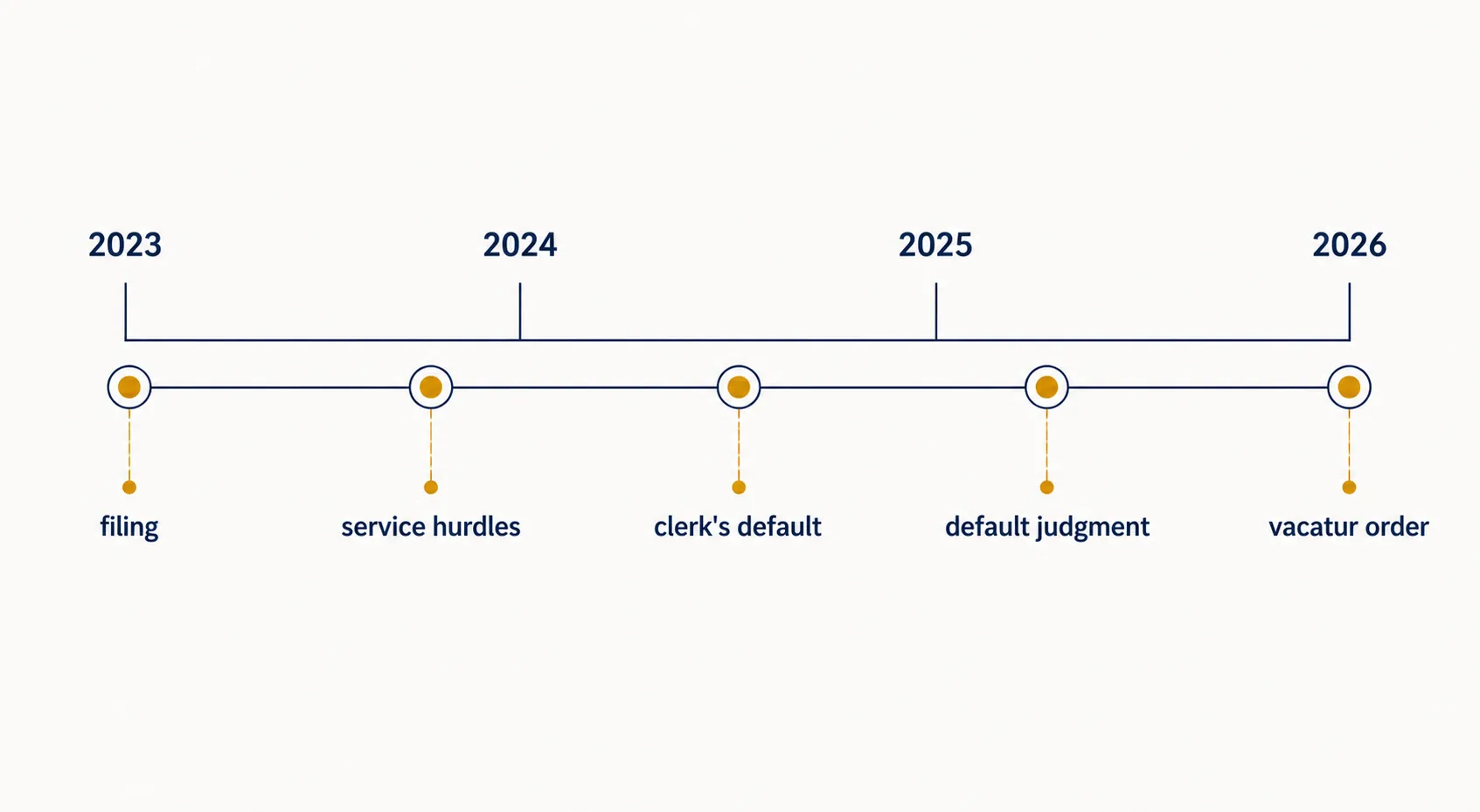
| Date | Docket event | Why it mattered |
|---|---|---|
| June 3/5, 2023 | The complaint was filed in the District of Nevada. | The plaintiffs alleged defamation-related claims over statements from June 2021 through May 2023 and sought $10 million. [1] |
| June 30, 2023 | A summons was returned unexecuted. | The case had not yet reached the point where the defendant was properly before the court. [1] |
| August 3, 2023 | A second summons was returned unexecuted. | The service problem persisted, putting Rule 4(m) timing in view. [1] |
| September 12, 2023 | The court issued a Rule 4(m) notice. | The court warned that dismissal could follow if service was not completed, with an October 12 deadline later extended to December 27, 2023. [1] |
| October 7, 2023 | Service was recorded. | This was the service event on which later default proceedings rested. [1] |
| December 22, 2023 | The clerk entered default. | Stewartson had not appeared or defended in time, so the plaintiffs moved into default posture. [1] |
| March 4, 2025 | The court issued an order to show cause. | The case had been in default posture, but judgment had not yet been entered; the court required further action before closing the loop. [1] |
| August 5, 2025 | The court entered default judgment for $250,000. | The award was far below the $10 million demand: $100,000 in compensatory damages and $100,000 in punitive damages to Patel, plus $25,000 in compensatory damages and $25,000 in punitive damages to the Kash Foundation. [1] |
| September 5, 2025 | Stewartson filed motions through counsel Maggie McLetchie and Leo Wolpert. | The post-judgment challenge put service, jurisdiction, and relief from judgment before the court. [1] |
| April 19, 2026 | The court partially denied relief and ordered supplemental briefing. | The court did not simply erase the judgment at the first motion stage; it required additional briefing on issues including personal jurisdiction. [1] |
| July 25, 2026 | The court entered the final order dismissing the case and vacating the judgment. | The court held that Nevada lacked personal jurisdiction over Stewartson and that the default judgment was void under Rule 60(b)(4). [1] |
The long gap between clerk’s default and default judgment is not filler. It explains why the August 2025 judgment was vulnerable to a later jurisdictional attack. A default establishes that a defendant failed to plead or otherwise defend; it does not cure a court’s lack of personal jurisdiction. If the defendant was never subject to the forum court’s authority, the judgment is not merely harsh or procedurally regrettable. It is void.
The court did not reward Stewartson’s litigation conduct. Judge Gordon wrote that Stewartson “wasted the plaintiffs’ and the court’s time,” and also stated that Stewartson “knew of the suit and may have attempted to avoid service.” The order further said the court would have awarded attorney’s fees if it had discretion to do so. Those findings sit in the same order as the jurisdiction ruling; they do not cancel it. [1]
That is the uncomfortable part of the case record. A defendant can behave badly in the court’s view and still be outside the personal jurisdiction of the forum. Default is a consequence for not appearing. Personal jurisdiction is a precondition to imposing that consequence.
Where the Nevada jurisdiction theory failed
The dismissal turned on Rule 12(b)(2) and the Calder effects test. In practical terms, the court looked for conduct expressly aimed at Nevada, not merely online statements about a Nevada-resident plaintiff that could be read anywhere. [1]
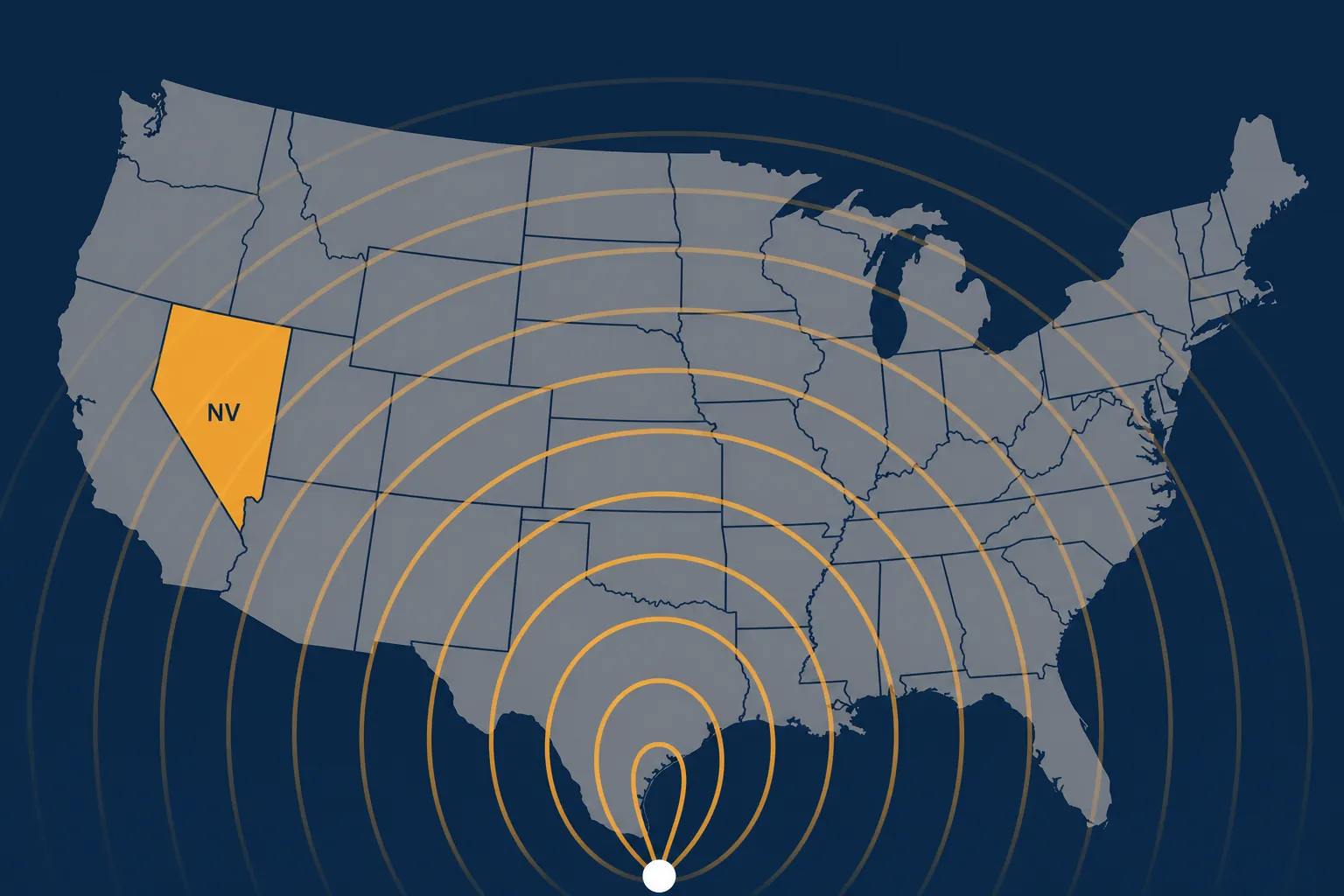
The order treated the challenged posts as aimed at “the American body politic writ large,” not at a Nevada audience. It also rejected the idea that tagging Patel, a Nevada-resident plaintiff, itself created a Nevada contact. Stewartson had not visited Nevada since 2016, and the record did not allege that he had Nevada Substack or podcast subscribers. [1]
Those findings are doing the decisive work. An online defamation case can feel geographically unbounded because publication is technically everywhere a post can be accessed. The jurisdiction question is different: what connects this defendant’s conduct to this forum? On this record, the answer was not enough. The alleged audience was national, the alleged targeting was not Nevada-specific, and the remaining facts did not supply the missing forum contact.
That is why Rule 60(b)(4) mattered after default judgment. If a court lacks personal jurisdiction, the judgment it entered against that defendant is void. The July 25 order therefore did two linked things: it dismissed for lack of personal jurisdiction under Rule 12(b)(2), and it vacated the August 5, 2025 default judgment under Rule 60(b)(4). [1]
What the order did not decide
The order did not decide whether the challenged labels and statements were true or false, protected by the First Amendment, actionable as defamation, or capable of supporting damages after adversarial litigation on the merits. The case ended in Nevada because the court found no personal jurisdiction over Stewartson, not because it adjudicated the substance of the speech dispute. [1]
That is also why “case dismissed” is an incomplete description. It is accurate only if the next sentence explains the ground. A Rule 12(b)(2) dismissal after a vacated default judgment carries different meaning from summary judgment, trial judgment, anti-SLAPP relief, or a Rule 12(b)(6) merits dismissal. Here, the docket shows a jurisdictional endpoint.
The damages figure that disappeared with the judgment
The damages history is easy to misstate because three figures are in play. The complaint sought $10 million. The default judgment awarded $250,000. The July 25, 2026 order vacated that $250,000 judgment. The vacated judgment consisted of $100,000 in compensatory damages and $100,000 in punitive damages to Patel, plus $25,000 in compensatory damages and $25,000 in punitive damages to the Kash Foundation. [1]
Once the judgment was vacated as void, the award no longer stood as an enforceable Nevada judgment unless the dismissal and vacatur are later reversed. The court’s reason was not that the dollar amount was too high or too low. The reason was that the court concluded it lacked power over the defendant.
What remains open
As of August 1, 2026, the Nevada case is dismissed on personal-jurisdiction grounds unless the July 25 order is overturned on appeal. The ordinary 30-day appeal window from the July 25, 2026 order runs roughly to August 24, 2026. A California refiling remains possible because the Nevada dismissal did not resolve the merits of the alleged defamation. [1]
The important procedural result is therefore precise: the Nevada default judgment could not stand because the court found no personal jurisdiction over Stewartson. The public defamation fight may continue elsewhere, but this docket closed on forum power, not on truth.
References
- CourtListener docket for Patel v. Stewartson — CourtListener
Related records
Tool profile
How Meta's AI Spending Reshapes Law Firm ProfitabilityGoverning regulation
Browse the obligations tracker →Preventive workflow
Browse verification workflows →
Report a correction or tip
Spotted an outdated figure, a misstated fact, or a ruling this case record should reflect? Public comments are disabled for this content given the professional cost of a misreported case outcome, penalty amount, or rule text — use the structured correction channel instead.
Report a correction or tip for this record →