
The legal plan behind Ken Paxton's Texas AI promise
Ken Paxton's AI-accountability promise is backed by a dated enforcement record — the June 2024 Data Privacy and Security Initiative, the Pieces settlement, and probes into Character.AI, DeepSeek, and Meta AI Studio — but TRAIGA concentrates civil AI enforcement in the AG's office, so the Nov 3, 2026 election will decide whether that posture survives. The result is a statute-by-statute picture of Texas AI enforcement risk for vendors and in-house counsel.
- Jurisdiction
- US-Texas
- Court
- Texas Attorney General (OAG)
- AI tool named
- Pieces Technologies
- Ruling date
- Sep 18, 2024
- Source document
- View primary court order ↗
- Last verified
- Aug 5, 2026
Lex Machina Review is an independent risk-tracking and reference resource. Nothing on this site is legal advice, and using it does not create an attorney-client relationship. Every record is reviewed against primary sources but may not reflect the most current status of a matter — always verify directly against the cited court order, rule text, or a licensed attorney before relying on it.
Companion explanation — secondary to the source document above
As of August 5, 2026, the legal plan behind Ken Paxton’s Texas AI-accountability promise is best read in three columns: one settled generative-AI matter, several unresolved investigations, and a new AI statute that puts civil enforcement in the attorney general’s hands. The apparatus began on June 4, 2024, when the Texas attorney general’s office announced a Data Privacy and Security Initiative inside its Consumer Protection Division, naming a dedicated enforcement team and a stack of privacy and consumer-protection statutes it expected to use against misuse of Texans’ data.[1] The cleanest proof of concept came three months later, in the Pieces Technologies settlement over healthcare generative-AI accuracy claims.[2][3] The rest of the visible record — Character.AI and 14 other companies, DeepSeek, and Meta AI Studio/Character.AI — remains investigative, not adjudicated.[4][5][6]
That distinction matters because a civil investigative demand is not a finding, a press release is not a pleading, and an announced investigation is not a win. But it also matters in the other direction: this is not merely a campaign phrase about “AI accountability.” It is a dated enforcement record, tied to identifiable legal tools — the Texas Data Privacy and Security Act, the Securing Children Online through Parental Empowerment Act, the Deceptive Trade Practices Act, and now the Texas Responsible Artificial Intelligence Governance Act.
TRAIGA changes the weight of the whole file. Signed on June 22, 2025 and effective January 1, 2026, the enacted law gives the attorney general exclusive civil enforcement authority, creates an online complaint portal, authorizes civil investigative demands, provides a cure window, sets penalty ranges, and builds in both a NIST AI Risk Management Framework safe harbor and a regulatory sandbox.[7][8] So the enforcement question for Texas-facing AI vendors is no longer just what Paxton promised. It is which parts of this machinery survive the handoff after the November 3, 2026 attorney general election.[9]
The dated record: from privacy initiative to AI probes
The June 2024 initiative is the hinge. The office did not announce a free-floating AI task force. It placed the initiative in the Consumer Protection Division and listed statutes already capable of reaching data and technology conduct: the Texas Data Privacy and Security Act, the Identity Theft Enforcement and Protection Act, the Texas Data Broker Law, the Capture or Use of Biometric Identifier Act, the Deceptive Trade Practices Act, the Children’s Online Privacy Protection Act, and HIPAA.[1] That list explains why later AI matters look less like a separate AI docket than an extension of privacy, child safety, and deceptive-practices enforcement.
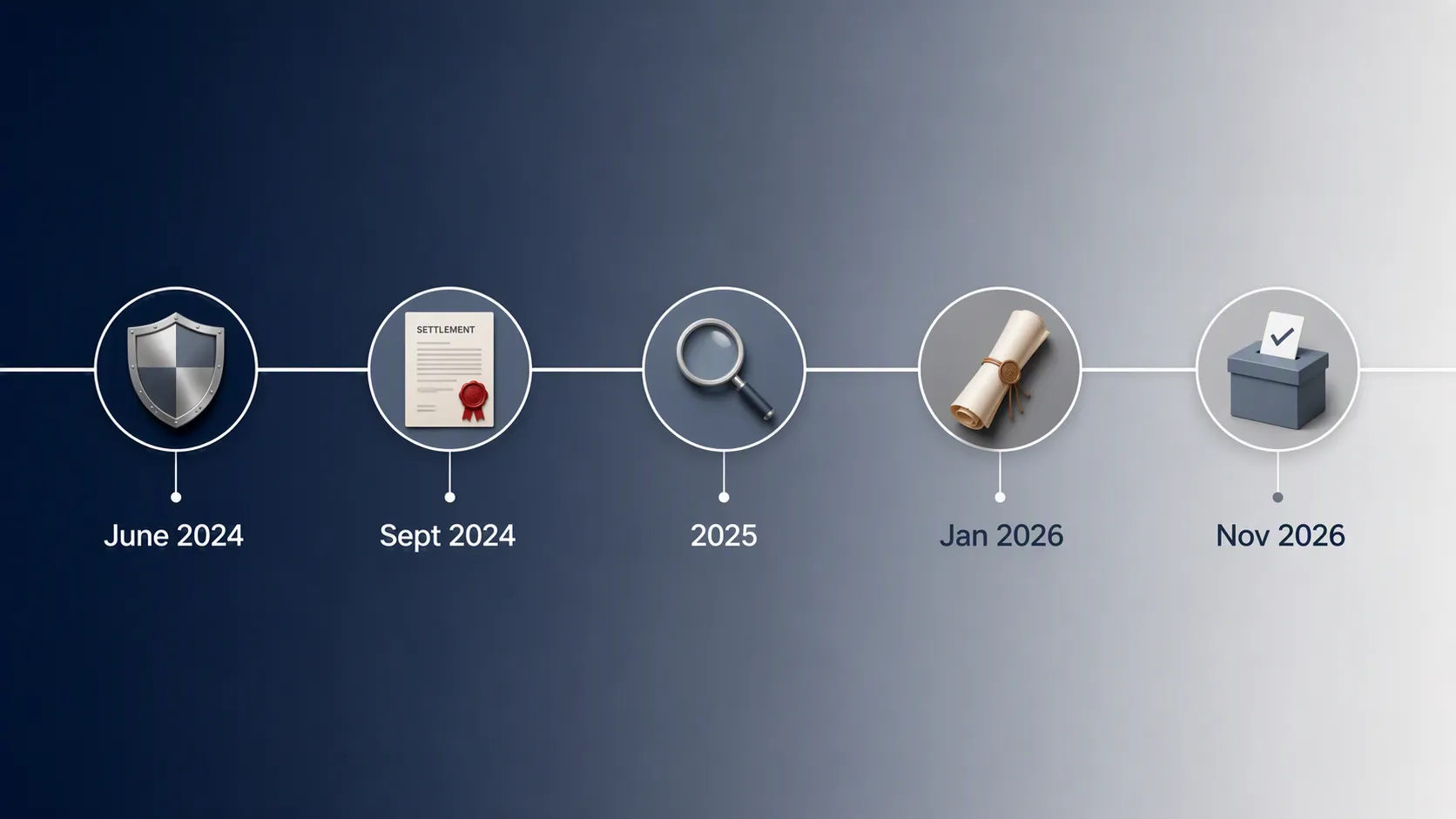
| Date | OAG action | Status as of Aug. 5, 2026 | Primary legal hook |
|---|---|---|---|
| June 4, 2024 | Launch of Data Privacy and Security Initiative in the Consumer Protection Division | Operational initiative | TDPSA, Identity Theft Enforcement and Protection Act, Data Broker Law, Biometric Identifier Act, DTPA, COPPA, HIPAA |
| Sept. 18, 2024 | Settlement with Pieces Technologies over marketed healthcare GenAI accuracy claims | Settled | DTPA theory; accuracy and hallucination-rate representations |
| Dec. 12, 2024 | Investigations into Character.AI and 14 other companies, including Reddit, Instagram, and Discord | Pending investigation | SCOPE Act and TDPSA |
| Feb. 14, 2025 | DeepSeek investigation, TDPSA-violation notice, and third-party CIDs to Google and Apple | Pending investigation | TDPSA |
| Aug. 18, 2025 | Investigation of Meta AI Studio and Character.AI over alleged marketing of AI chatbots as mental-health tools | Pending investigation | DTPA; CIDs issued |
| Jan. 1, 2026 | TRAIGA effective date | Enacted enforcement framework | Exclusive AG civil enforcement, complaint portal, CIDs, cure window, penalties, safe harbor, sandbox |
| Nov. 3, 2026 | Open Texas attorney general election | Future enforcement-handoff event | Succession risk for AG-centered enforcement |
The chronology is important because it keeps the legal posture in order. Pieces is a settlement. Character.AI, DeepSeek, and Meta AI Studio are investigations. TRAIGA is an enacted enforcement statute. The election is neither enforcement nor law; it is the point at which an office-centered system becomes politically exposed.
Pieces is the settlement that gives the promise teeth
The Pieces matter deserves more weight than the open investigations because it shows the attorney general’s office turning a generative-AI reliability claim into an enforceable consumer-protection issue. On September 18, 2024, Paxton announced what the office called a first-of-its-kind healthcare generative-AI settlement with Pieces Technologies. The OAG said Pieces had marketed its products with a “severe hallucination rate” of “<1 per 100,000,” a representation the office found “likely inaccurate.”[2]
The setting sharpened the claim. The OAG said at least four major Texas hospitals had fed real-time patient data into the products.[2] That does not, by itself, prove patient harm. It does make the accuracy representation more than a benchmark boast on a vendor slide. In a hospital procurement file, a hallucination-rate claim can become part of the risk assessment that clinicians, privacy lawyers, and purchasing teams rely on before allowing a system into workflows that touch patient information.
Baker Donelson’s account of the settlement describes the state’s theory under the Texas Deceptive Trade Practices Act and notes the related marketing formulation as “<.001%.”[3] That is the same general representation as the OAG’s “<1 per 100,000” phrasing, but the two should not be casually merged into a new number. The legally useful point is narrower: Texas treated a marketed hallucination-rate representation as the sort of AI accuracy claim that can attract consumer-protection scrutiny when the state believes the support is inadequate.
For vendor counsel, Pieces translates quickly into diligence language. If a company quotes a hallucination rate, error rate, sensitivity figure, benchmark score, or “clinician-grade” performance claim in sales materials, the support for that claim should be preserved, versioned, and tied to the product actually deployed. If the model, prompt chain, retrieval layer, or customer configuration changes, the old performance claim may stop describing the system being sold. That is a litigation problem even before anyone debates whether the product is “AI” under a newer AI-specific statute.
There is a useful connection here to the broader problem of testing AI outputs before legal or regulated use. A benchmark can sound precise while measuring something narrower than the procurement team assumes. For a worked example of statute-first verification rather than confidence-by-interface, see How to Verify AI Answers on HOA Foreclosure Laws. For background on how model-evaluation claims can mislead when the benchmark is doing less work than the marketing suggests, see What the 1933 double Reveals About ChatGPT Benchmarks.
The pending investigations show the same toolkit moving into child safety, foreign AI, and chatbot marketing
After Pieces, the visible docket widened. On December 12, 2024, the attorney general announced investigations into Character.AI and 14 other companies, including Reddit, Instagram, and Discord, under the SCOPE Act and TDPSA.[4] The office framed those inquiries around children’s online safety and data privacy. That posture fits the June initiative: AI-related conduct does not need a bespoke AI statute if the enforcement theory is that the company mishandled children’s data, failed to protect minors, or violated privacy obligations.
The DeepSeek matter followed on February 14, 2025. The OAG announced an investigation, said it had notified DeepSeek of alleged TDPSA violations, and issued third-party civil investigative demands to Google and Apple. The office also said it had banned DeepSeek on OAG devices on January 28, 2025.[5] The third-party CIDs are the practical detail worth pausing over. A target may be outside Texas or outside the state’s immediate practical reach, but app stores, infrastructure providers, payment processors, analytics vendors, and enterprise customers may still hold information the attorney general wants.
Then, on August 18, 2025, the office announced a deceptive-trade-practices investigation of Meta AI Studio and Character.AI for allegedly misleading children by marketing AI chatbots as mental-health tools, and said it had issued CIDs.[6] Again, the public record does not establish liability. It does show the office testing chatbot representations through an older consumer-protection lens: what was said to users, how the product was positioned, who the vulnerable audience was, and what documents the company must produce.
These pending matters should not be described as victories. They are better understood as signals about intake, targets, and legal theories. The signal is still useful. Texas is not waiting for every AI dispute to fit neatly under TRAIGA. The OAG has already been using privacy statutes, children’s online safety law, and deceptive-practices authority to examine AI-adjacent conduct.
What each statute is doing in the enforcement plan
A statute-by-statute view is more useful than a single “Texas AI law” label. The attorney general’s office has not relied on one instrument. It has assembled a toolkit in which each statute reaches a different part of the vendor file: data collection, child access, marketing claims, biometric or health information, and now AI-governance duties under TRAIGA.
| Authority | What it reaches in the AI file | How it appears in the record |
|---|---|---|
| TDPSA | Consumer data practices, privacy notices, rights, and processing obligations | Named in the June 2024 initiative; used in the Character.AI-plus-14 investigations and DeepSeek notice |
| SCOPE Act | Children’s online safety and platform duties | Named in the December 2024 investigations into Character.AI and 14 other companies |
| DTPA | Misleading or deceptive marketing, including AI accuracy or mental-health-tool representations | Used in the Pieces settlement theory and the Meta AI Studio/Character.AI investigation |
| Biometric Identifier Act, Data Broker Law, Identity Theft Enforcement and Protection Act | Specific data categories and data-market conduct | Enumerated in the June 2024 initiative as part of the privacy and security enforcement stack |
| HIPAA and COPPA | Health information and children’s privacy baselines | Enumerated in the June 2024 initiative; relevant to the healthcare and child-safety posture |
| TRAIGA | AI-system governance, prohibited conduct, enforcement process, complaint intake, penalties, safe harbor, and sandbox | Effective January 1, 2026, with exclusive civil enforcement by the Texas attorney general |
That division affects how a company should answer the first board-level question: “What is our Texas AI exposure?” A hospital-facing summarization product with accuracy claims raises a DTPA and health-data diligence problem before TRAIGA even enters the room. A youth-facing chatbot raises SCOPE Act, TDPSA, and marketing questions. A foreign model app collecting Texans’ data may trigger privacy and third-party discovery risk even if the company itself is hard to reach.
The Texas Tribune has described Paxton’s broader use of Texas consumer-protection law against major technology companies, which is relevant background for why the AI matters should not be treated as isolated press events.[10] The caution is that background posture is not outcome. It explains why the office has been structurally willing to use consumer-protection tools against technology companies; it does not prove that every AI investigation will end in a settlement, penalty, or injunction.
TRAIGA centralizes the next phase in the attorney general’s office
TRAIGA is the reason the succession question has legal weight rather than just political color. The enacted law provides exclusive civil enforcement by the attorney general and no private right of action.[7][8] In ordinary compliance terms, that means plaintiffs’ lawyers do not get to build a parallel civil docket under TRAIGA. The attorney general’s office decides whether complaints become investigations, whether CIDs issue, whether violations are cured, and whether penalty demands are made.
The enforcement mechanics are concrete. TRAIGA requires an online complaint portal, authorizes the attorney general to issue civil investigative demands that can include training-data information, provides a 60-day cure window, and sets civil penalties of $10,000 to $12,000 per curable violation and $80,000 to $200,000 per non-curable violation, plus $2,000 to $40,000 per continuing day.[7][8] Those are the enacted ranges. Draft-stage figures reported during the legislative process, including earlier descriptions of fines up to $100,000, should be treated as superseded by the enacted statute.
Two features deserve special attention in procurement and audit planning. First, the law’s safe harbor is tied to the NIST AI Risk Management Framework.[7][8] That does not make a NIST-branded policy binder a defense to every Texas claim, but it does give counsel a reason to ask whether governance artifacts are actually mapped to the framework rather than merely citing it. Second, the sandbox can provide up to a 36-month bar on attorney general enforcement for approved participants.[7][8] For a product team testing a high-risk use case, that may be more than a policy experiment; it may be a controlled path for reducing state-enforcement uncertainty.
TRAIGA also uses an intent-based discrimination standard.[7][8] That is narrower than a regime built around disparate impact alone. For legal teams, the distinction changes the evidence file: internal design choices, warnings, testing results, known limitations, deployment decisions, and post-launch responses may matter more than abstract fairness commitments. A vendor that discovers a harmful pattern and keeps selling into the same use case without escalation has a different record from one that documents testing, limits deployment, and remediates.
What a Texas-facing AI vendor should be ready to show
The enforcement record points to a practical document set. It is not enough to know which statute might apply; the company needs the records it would want in hand when a CID arrives, when a hospital customer asks for substantiation, or when a board committee asks whether Texas exposure has changed.
- Marketing substantiation for AI performance claims, including the exact product version, evaluation method, test population, benchmark limitations, and date range supporting the claim.
- A change-control record showing when model updates, retrieval changes, fine-tuning, prompt revisions, or customer-specific configurations could make older accuracy claims stale.
- Texas privacy mapping under TDPSA, including categories of personal data collected, purposes of processing, consumer-rights workflows, processor contracts, and third-party disclosures.
- Child-safety and age-related design review for products that minors can access, especially chatbots, social features, companion systems, and mental-health-adjacent interfaces.
- CID response playbooks that identify likely custodians, third-party dependencies, app-store relationships, training-data documentation, and privilege-review procedures.
- TRAIGA governance records, including NIST AI RMF mapping where the company intends to rely on the safe harbor and sandbox analysis where testing in Texas presents unusual risk.
Law-firm alerts after Pieces have recommended measures such as third-party auditing of hallucination-rate data and tighter vendor-management checklists.[3] Those are advisory recommendations, not settlement findings. They are still sensible because the Texas record is already document-driven. The obvious question after Pieces is not whether a vendor believes its model is good. It is who can prove what was claimed, when, to whom, and on what evidence.
For buyers, the same record changes the procurement conversation. A Texas hospital, school-facing platform, employer, insurer, or public-sector entity should not accept “AI accuracy” as a single vendor representation. It should ask for the claim’s evidentiary basis, whether Texas personal data is processed, whether minors can interact with the system, whether mental-health or professional-advice language appears in the interface, and whether the vendor can support a prompt CID response without improvising.
The handoff problem
Paxton is not running for a fourth term as Texas attorney general. The open general election is scheduled for November 3, 2026, between Republican Sen. Mayes Middleton and Democratic Sen. Nathan Johnson; a July 15–17, 2026 Texas Public Opinion Research poll showed the race at 39% to 38%.[9] That polling number should be treated only as a snapshot. The harder legal fact is that TRAIGA concentrates civil enforcement in the attorney general’s office.
That concentration has two opposing consequences. It gives Texas a clear enforcement channel: one office, named powers, CIDs, complaint intake, cure process, penalties, safe harbor, and sandbox. It also makes enforcement intensity unusually dependent on the officeholder. A private-right-of-action statute can generate cases even when an attorney general loses interest. TRAIGA does not work that way.
No reliable public record establishes how Middleton or Johnson would administer this specific AI docket after taking office. The safer analysis stops before prediction. A successor could keep the Paxton-era posture, redirect it, narrow it to child-safety or privacy matters, emphasize the sandbox, or let complaint intake outrun enforcement resources. The statute would remain on the books, but the cadence of CIDs and settlements would be set by the next attorney general’s priorities, staffing, and appetite for technology litigation.
That is the legal detail behind the promise. Texas AI enforcement risk is already grounded in more than rhetoric: the June 2024 initiative named the unit and statutes, Pieces showed how an AI accuracy claim could become a DTPA settlement, the pending chatbot and DeepSeek matters show how the office uses CIDs and privacy or child-safety theories, and TRAIGA now supplies an AI-specific civil-enforcement framework. But for Texas-facing AI vendors, the 2027 question is not only whether conduct fits TDPSA, the SCOPE Act, DTPA, or TRAIGA. It is whether the post-election attorney general keeps using those tools with Paxton-era intensity.
References
- Attorney General Ken Paxton Launches Data Privacy and Security Initiative to Protect Texans’ Sensitive Data, Texas Attorney General, June 4, 2024.
- Attorney General Ken Paxton Reaches Settlement in First-of-Its-Kind Healthcare Generative AI Investigation, Texas Attorney General, September 18, 2024.
- AI Firm Reaches Settlement with Texas Attorney General Over Misleading Accuracy Claims, Baker Donelson.
- Attorney General Ken Paxton Launches Investigations into Character.AI, Reddit, Instagram, Discord, and Other Technology Companies Over Child Privacy and Safety Concerns, Texas Attorney General, December 12, 2024.
- Attorney General Ken Paxton Announces Investigation into DeepSeek and Notifies Chinese AI Company of Its Violation of Texas Data Privacy Law, Texas Attorney General, February 14, 2025.
- Attorney General Ken Paxton Investigates Meta and Character.AI for Misleading Children with Deceptive AI Mental Health Tools, Texas Attorney General, August 18, 2025.
- Texas Responsible Artificial Intelligence Governance Act, Wikipedia.
- Texas Responsible AI Governance Act Enacted, Wiley Rein.
- 2026 Texas Attorney General election, Wikipedia.
- Big Tech finds a foe in Texas’ robust consumer protection laws and AG Ken Paxton, The Texas Tribune, June 3, 2026.
Related records
Tool profile
Browse tool evaluations →Governing regulation
Browse the obligations tracker →Preventive workflow
Browse verification workflows →
Report a correction or tip
Spotted an outdated figure, a misstated fact, or a ruling this case record should reflect? Public comments are disabled for this content given the professional cost of a misreported case outcome, penalty amount, or rule text — use the structured correction channel instead.
Report a correction or tip for this record →