
What Is the Legal Process to Remove Kenya's Deputy President?
This article provides a verified, source-cited walkthrough of the only two constitutionally available routes to remove Kenya's Deputy President under Article 150, the exact thresholds and timelines required for impeachment, and the structural gaps revealed by the Gachagua case and the June 8, 2026 High Court judgment — applied forward to Kithure Kindiki.
- Jurisdiction
- Kenya
- Court
- High Court of Kenya
- Judge
- Ogola, Mrima, Mugambi
- AI tool named
- No AI tool
- Ruling date
- Jun 8, 2026
- Source document
- View primary court order ↗
- Last verified
- Aug 3, 2026
Lex Machina Review is an independent risk-tracking and reference resource. Nothing on this site is legal advice, and using it does not create an attorney-client relationship. Every record is reviewed against primary sources but may not reflect the most current status of a matter — always verify directly against the cited court order, rule text, or a licensed attorney before relying on it.
Companion explanation — secondary to the source document above
Current to August 3, 2026, the legal answer is narrow. Kenya’s Deputy President can be removed only through Article 150: either for physical or mental incapacity, or by impeachment. Article 150 then imports the presidential removal machinery in Articles 144 and 145 “with the necessary modifications.” [1] For any current question about removing Deputy President Kithure Kindiki, the practical route tested in court is impeachment, and the controlling record is the June 8, 2026 High Court judgment in Gachagua & 57 others v Speaker, National Assembly & 35 others. [2]
This is a jurisdiction reference record, not legal advice. It treats the Constitution and the 2026 Gachagua judgment as the starting point, and it date-stamps later uncertainties rather than filling them with political shorthand.

Article 150 has only two routes
Article 150(1) does not create a general loss-of-confidence process for a Deputy President. It names two grounds: physical or mental incapacity, and impeachment. Article 150(2) then tells the reader where to find the working machinery: the provisions on removal of a President under Articles 144 and 145 apply to removal of a Deputy President, with the necessary modifications. [1]
| Route | Imported machinery | What the record supports |
|---|---|---|
| Physical or mental incapacity | Article 144, applied to a Deputy President through Article 150(2) | A constitutionally available route, but not the route tested in the Gachagua removal record. |
| Impeachment | Article 145, applied to a Deputy President through Article 150(2) | The route used against Rigathi Gachagua in October 2024 and reviewed by the High Court in June 2026. |
The incapacity route should not be ignored, but the available record does not make it a live controversy. The tested route is impeachment. That is where the thresholds, dates, parliamentary conduct, public participation findings and fair-trial defect have been judicially examined.
The impeachment sequence
The High Court treated Article 150 impeachment as justiciable and reconstructed the process from the imported Article 145 machinery. A motion must be supported by at least one-third of all members of the National Assembly; in the Gachagua record, the court described that threshold as 117 of 349 members. Passage at the National Assembly then requires at least two-thirds of all members, recorded by the court as 233 MPs. [2]
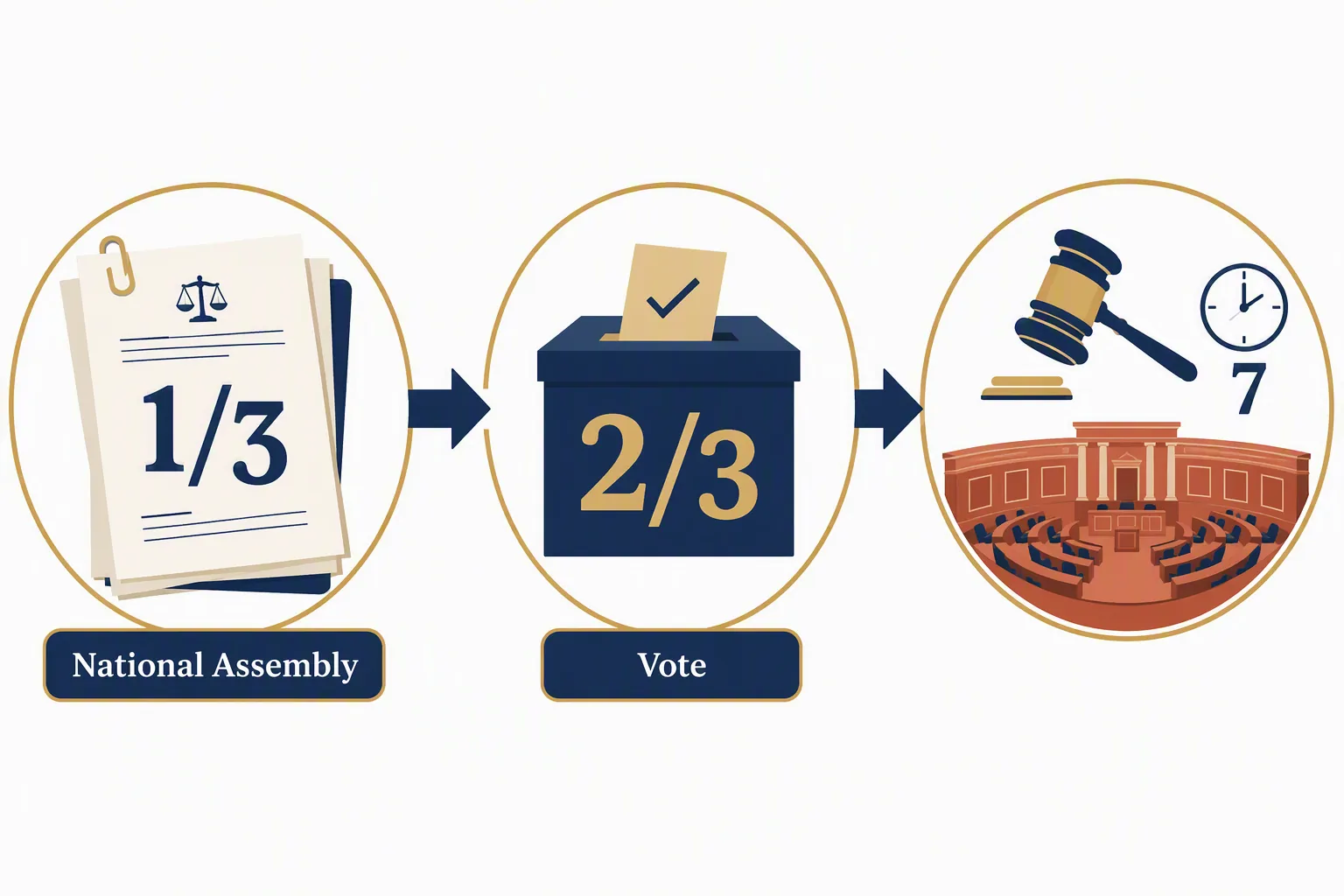
- A member of the National Assembly brings an impeachment motion, supported by at least one-third of all MPs. In the court record, that meant 117 of 349 members. [2]
- The National Assembly debates and votes. The motion must pass by at least two-thirds of all MPs; the court-recorded threshold was 233. [2]
- If the National Assembly passes the motion, the Senate stage begins. The Senate Speaker must convene the Senate within seven days. [2]
- The Senate may appoint an 11-member special committee. If it does, that committee has ten days to investigate and report whether the particulars of any allegation have been substantiated. [2]
- If the matter proceeds in plenary, the Deputy President is entitled to appear and be represented. Removal requires the Senate to uphold a charge by at least two-thirds of all Senators. [2]
That sequence is not merely descriptive. It is the difference between a political claim that a Deputy President “can be removed” and a legal path that a lawyer can reconstruct without guessing which institution had authority at which point.
How the Gachagua process moved through the machinery
The first real use of the machinery began on October 1, 2024, when MP Mwengi Mutuse introduced a motion to impeach Deputy President Rigathi Gachagua on 11 grounds. On October 8, 2024, the National Assembly passed the motion. The High Court recorded the vote as 282 to 44, while also noting that one petitioner’s submissions cited 281 to 44 with one abstention. For legal-risk purposes, the safer figure is the court-recorded 282 to 44, with the discrepancy left visible rather than silently harmonized. [2]
The Senate trial took place on October 16 and 17, 2024. On October 17, five of the eleven charges were upheld. [2] The cited record does not supply a reliable exact Senate division figure for each charge, so a precise count should not be invented. The constitutionally material point is that the Senate had to meet the two-thirds-of-all-Senators threshold for any charge it upheld.
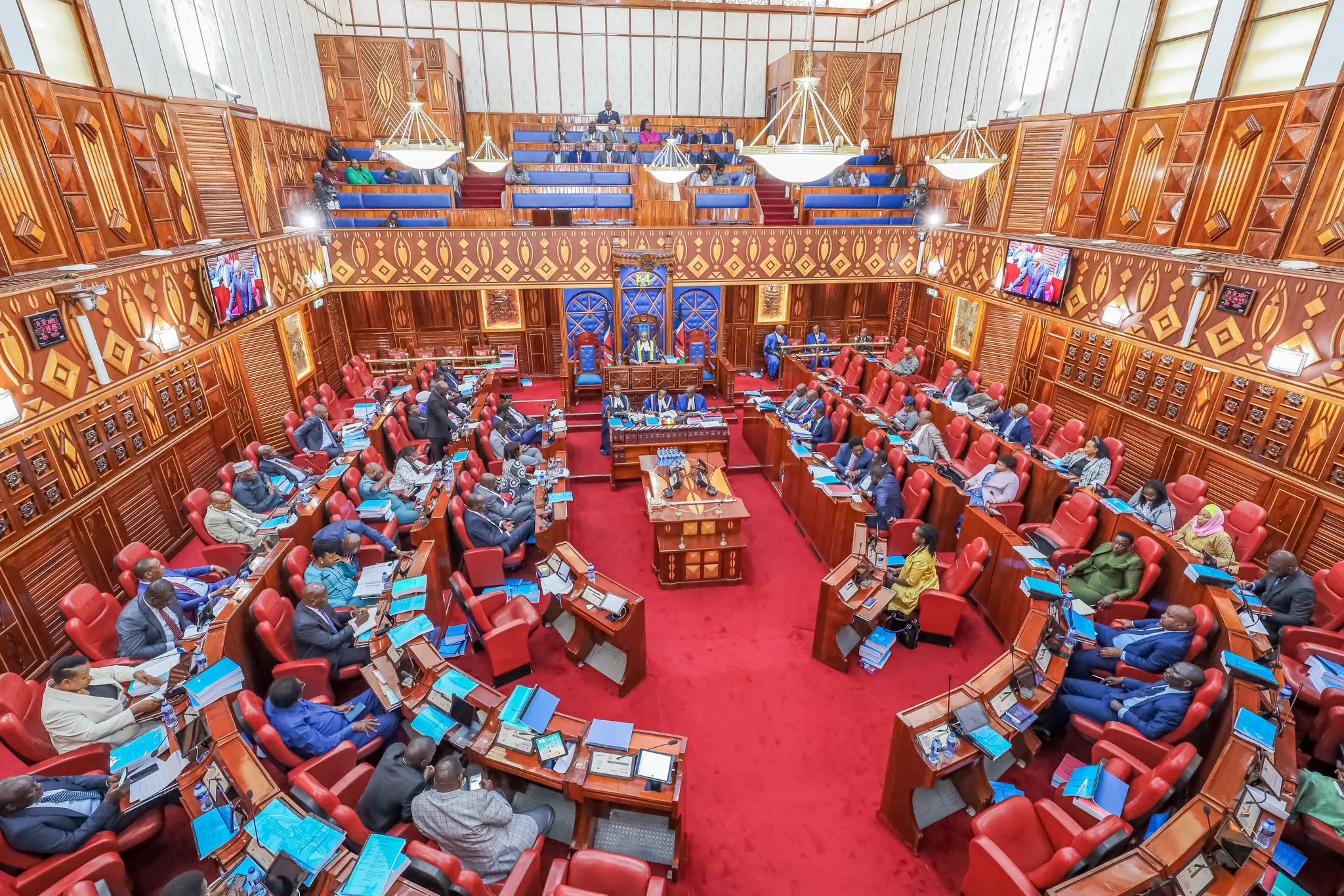
On June 8, 2026, a three-judge bench of Ogola, Mrima and Mugambi JJ delivered the controlling High Court judgment. The court upheld the removal and upheld Kithure Kindiki’s replacement, but it did not bless every step. Its central distinction was between a removal outcome that survived review and a Senate trial process that violated fair-trial rights at a critical moment. [2]
Public participation: adequate in the National Assembly, not separately required in the Senate
Public participation was one of the areas where a compressed summary can easily mislead. The High Court found the National Assembly’s public participation adequate. The judgment recorded just over 223,000 participants through 337 access points. [2] That finding did not mean every complaint about speed or design was politically unimportant; it meant the court was not prepared to invalidate the National Assembly process on the public participation record before it.
The Senate was treated differently. The court held that the Senate did not have a separate obligation to conduct its own public participation once the National Assembly had conducted an adequate process on the impeachment motion. [2] That matters because the Senate’s constitutional task at that stage was trial of the charges, not reopening the participation phase as a parallel public consultation exercise.
The same restraint appeared in the replacement findings. Under Article 149(1), once a vacancy occurs in the office of Deputy President, the President nominates a person within fourteen days, and the National Assembly votes on the nomination within sixty days. The High Court upheld Kindiki’s appointment and found that the replacement process required neither public participation nor an IEBC role. It also accepted that Kindiki had formally resigned and that his Cabinet exit had been gazetted before he took the oath as Deputy President. [2]
The fair-trial breach is not a footnote
The sharpest defect arose at the Senate trial stage. Gachagua was hospitalized during the proceedings, and the Senate refused an adjournment. The High Court held that this breached his Article 47 and Article 50 fair-trial rights, including a non-derogable fair-trial guarantee. [2]
The remedy was unusual and pointed. The court awarded KSh 50 million in constitutional damages payable by the Senate. BBC News reported that amount as about $386,000 or £290,000. [3] The award is not a cosmetic rebuke. It marks the Senate, not the electorate, not the courts, and not the former Deputy President, as the institutional actor responsible for the trial-stage rights violation.
Even so, the court declined to quash the removal. It relied on constitutional-finality concerns under Article 145(7) and on the practical problem of dual incumbency after Kindiki had already been installed. [2] That combination is the awkward but controlling holding: the impeachment survived, the replacement survived, and the Senate still violated a non-derogable fair-trial right.
The statutory gap the court could not ignore

The deeper problem is not that Article 150 is unknowable. The court read it, applied it and confirmed that the Deputy President’s removal process is justiciable. The problem is that Article 150 tells Parliament to adapt presidential removal machinery “with the necessary modifications,” and the High Court treated that phrase as a substantive constitutional directive that has not been properly implemented through a dedicated statute. [2]
The Impeachment Procedure Bill, 2018 exists as a bill, but the materials do not support treating it as governing law. [4] The June 2026 judgment confirmed the absence of a dedicated Article 150 statutory framework and declared the framework structurally inadequate, calling for urgent enactment of legislation. [2]
| Issue | High Court position | Risk left after judgment |
|---|---|---|
| Article 150 justiciability | The courts can review the process. | Future removals remain litigable; parliamentary labels will not end the inquiry. |
| National Assembly public participation | Adequate on the Gachagua record, including just over 223,000 participants through 337 access points. [2] | A future record could differ if participation is thinner or less traceable. |
| Senate public participation | No separate Senate public participation obligation for the trial stage. [2] | The Senate’s risk shifts to trial fairness, not consultation design. |
| Fair trial at Senate | Breach found after refusal to adjourn for hospitalization. [2] | The outcome survived, but damages and institutional exposure remain real. |
| Dedicated Article 150 statute | No adequate dedicated framework in force; urgent legislation required. [2] | The process can be repeated, but not on a fully well-built statutory platform. |
What this means for any attempt against Kithure Kindiki
Any attempt to remove Deputy President Kithure Kindiki would have to begin in the same place: Article 150. There is no third constitutional route for political displeasure, intra-executive tension or succession anxiety. The available doors remain incapacity or impeachment, with the presidential mechanisms imported and modified for the Deputy President. [1]
If impeachment is chosen, the same hard gates apply: one-third support to initiate in the National Assembly, two-thirds of all MPs to pass the motion, a Senate convened within seven days, any special committee reporting within ten days, and a final Senate threshold of two-thirds of all Senators to uphold a charge. [2] Those are legal thresholds, not opinion-poll proxies.
There were secondary reports in February 2026 of Kindiki-related court activity, including bids concerning the legality of his swearing-in and possible bench expansion, with one report pointing to a March 19 ruling date. [5][6][7] The cited sources do not verify the later posture of that specific docket as of August 3, 2026. The verified and more recent authority on the core eligibility and replacement questions is the June 8, 2026 consolidated High Court judgment, which upheld Kindiki’s appointment. [2]
Appeal posture also needs a date stamp. BBC News reported after the judgment that Gachagua’s side intended to appeal, and that Senate Speaker Amason Kingi intended to appeal the KSh 50 million damages award. [3] The cited sources do not establish a final appellate outcome by August 3, 2026.
The forward risk is therefore precise. The legal path to remove Kenya’s Deputy President is knowable from Article 150 and the Gachagua judgment, but it is not fully well-built. Parliament can repeat the sequence only by carrying the court’s warnings with it: fixed thresholds, fixed timeframes, a trial that can withstand fair-hearing review, and a still-missing dedicated Article 150 statute.
References
- Article 150 of The Constitution of Kenya: Removal of Deputy President — SheriaPlex
- Gachagua & 57 others v Speaker, National Assembly & 35 others [2026] KEHC 8198 (KLR) (8 June 2026) — Kenya Law, 8 June 2026
- Kenya court upholds impeachment of former deputy president Rigathi Gachagua — BBC News
- The Impeachment Procedure Bill, 2018 — Parliament of Kenya
- High Court to rule on expanded bench in Kindiki ouster case as DP — The Star, 26 February 2026
- Court to rule March 19 on bid to remove DP Kindiki — NTV Kenya, 27 February 2026
- Petitioner seeks five-judge bench in case over legality of DP Kithure Kindiki's swearing-in — Eastleigh Voice
Related records
Tool profile
How Meta's AI Spending Reshapes Law Firm ProfitabilityGoverning regulation
Browse the obligations tracker →Preventive workflow
Browse verification workflows →
Report a correction or tip
Spotted an outdated figure, a misstated fact, or a ruling this case record should reflect? Public comments are disabled for this content given the professional cost of a misreported case outcome, penalty amount, or rule text — use the structured correction channel instead.
Report a correction or tip for this record →