
Why the Knox-Kercher Case Is a Legal-AI Hallucination Probe
AI-assisted legal research fails in three documented modes, the hardest to catch being a real citation that does not support the proposition attached to it — with leading platforms returning incorrect responses on more than one in six benchmark queries. The Amanda Knox–Meredith Kercher case offers a fully checkable probe for that mode: its key facts trace to primary rulings, not media narrative, and no documented incident shows any AI tool erring on this case.
- Jurisdiction
- US federal
- Court
- U.S. District Court for the District of Colorado
- Judge
- Nina Y. Wang
- AI tool named
- Unspecified AI legal research tool
- Ruling date
- Jan 15, 2025
- Source document
- View primary court order ↗
- Last verified
- Aug 5, 2026
Lex Machina Review is an independent risk-tracking and reference resource. Nothing on this site is legal advice, and using it does not create an attorney-client relationship. Every record is reviewed against primary sources but may not reflect the most current status of a matter — always verify directly against the cited court order, rule text, or a licensed attorney before relying on it.
Companion explanation — secondary to the source document above
A legal-AI answer can pass the easiest citation test and still fail the only test that matters. The case name may exist. The reporter cite may resolve. The cited opinion may even discuss the same general subject. Then, after the associate has already relaxed, the problem appears: the authority does not support the proposition attached to it.
That is the legal-AI failure mode worth benchmarking first. The documented failures fall into three practical buckets: invented cases, fabricated quotations from real cases, and correct citations carrying unsupported propositions. The first two are embarrassing, but they are comparatively direct to catch. The third survives the ritual spot-check of “does this source exist?” and moves the work onto the next reviewer’s desk with a false sense of completion.
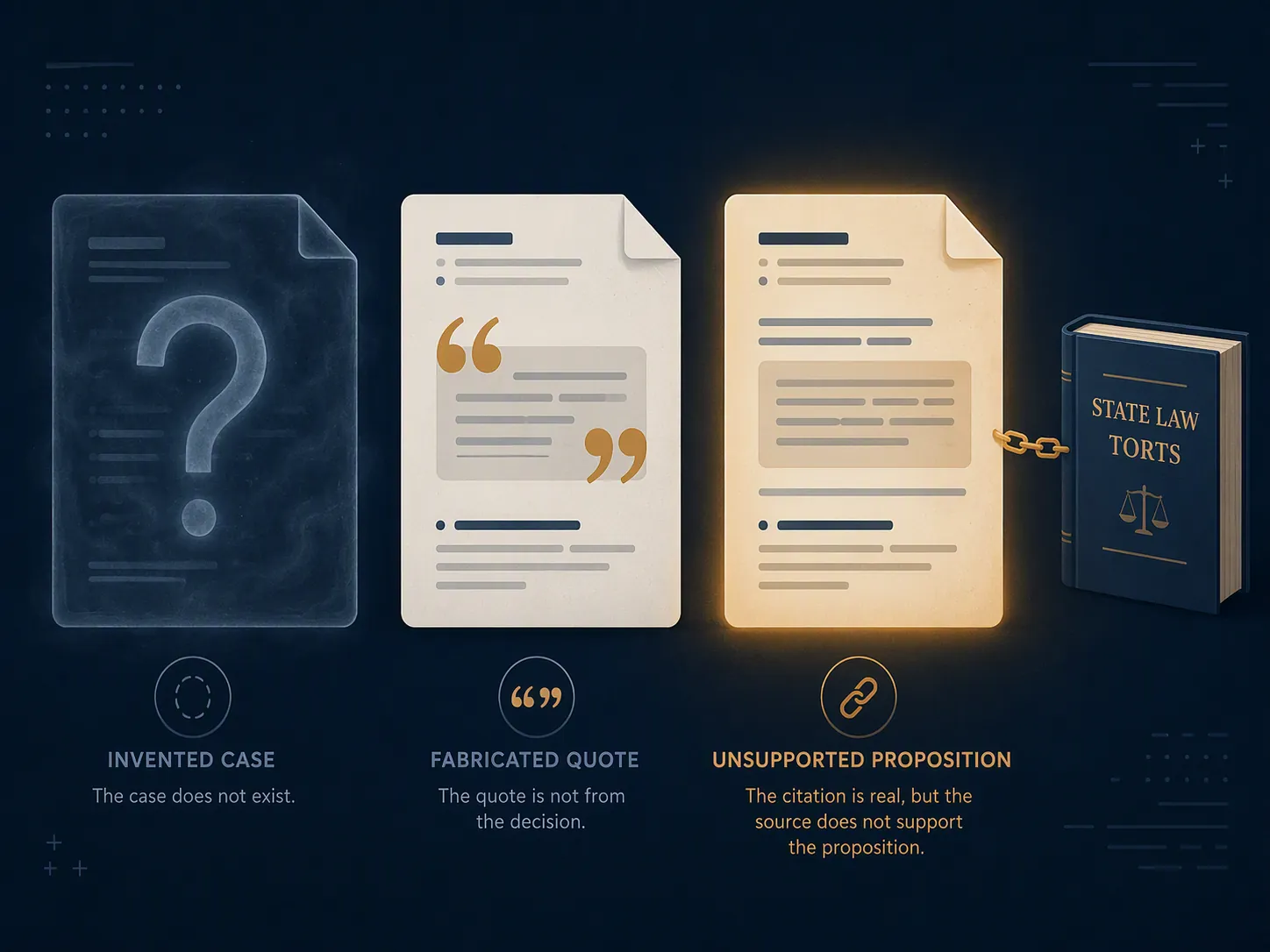
The Amanda Knox–Meredith Kercher case controversy is useful in this context only if it is treated as a verification instrument, not as a shortcut to a dramatic conclusion about AI. The record is famous, emotionally narrated, and repeatedly summarized in public accounts. It also contains a small number of key procedural facts that can be checked against rulings and reliable reports. That combination makes it a plausible probe for misgrounded legal-AI citations. It does not, by itself, prove any tool has hallucinated about the case. No documented incident in the available research shows a legal-AI system getting the Knox-Kercher record wrong.
The benchmark problem is not hypothetical
The Stanford RegLab and Stanford HAI study is the reason this discussion should not be waved away as another generic complaint about hallucinations. In a pre-registered benchmark of more than 200 open-ended legal queries, Lexis+ AI and Ask Practical Law AI returned incorrect information more than 17% of the time, while Westlaw’s AI-Assisted Research returned incorrect information more than 34% of the time. The same Stanford account contrasts those results with an earlier HAI study of general-purpose chatbots, which found legal-query hallucination rates of 58% to 82%.[1]
Those numbers should be read carefully. They do not say that specialist legal tools are useless. In fact, compared with general-purpose chatbots on legal questions, the specialist tools performed substantially better in the Stanford account. But “better” is not the same as “ready to trust without source-level review,” especially when the user is preparing a brief, an advice memo, a due-diligence note, or a procurement recommendation.
The important distinction in the Stanford work is between an incorrect answer and a misgrounded answer. An incorrect answer gets the law wrong. A misgrounded answer may describe the legal rule accurately but cite a source that does not support that rule. The researchers described that latter category as potentially more pernicious than invented cases, because it is harder to detect in ordinary research workflows.[1]
That maps directly onto what happens in procurement demos and litigation teams. A buyer asks a hard question; the tool gives a confident paragraph with citations; the room sees blue links or case names and moves on. A filing lawyer reviewing late at night may do the same. The actual quality-control task is slower: open the source, locate the proposition, check whether the quoted or summarized passage says what the answer claims, and confirm that no procedural wrinkle changes the point.
Three failure modes, one procurement priority
Damien Charlotin’s AI hallucination tracker gives the problem a useful taxonomy. His documented categories include invented cases, fabricated quotations from real cases, and correct citations used for unsupported arguments. As of July 10, 2025, the tracker counted 206 cases, and Charlotin observed that new examples were “popping up every day.” That count is a point-in-time figure, not a current total.[2]
| Failure mode | What the reviewer sees | Why it matters in evaluation |
|---|---|---|
| Invented authority | A case, statute, or citation that does not exist | Basic source retrieval can expose it, so the tool should never get credit merely for avoiding this. |
| Fabricated quote from a real source | A real case name or ruling paired with words the source does not contain | The reviewer must check the language, not just the existence of the authority. |
| Misgrounded citation | A real source attached to a proposition the source does not support | This is the hardest to catch because the citation looks live and may discuss adjacent law or facts. |
For tool evaluation, those categories should not be treated as equal. If a legal-AI vendor cannot reliably avoid invented cases, the product is not ready for serious legal research. But a more mature evaluation has to push beyond that threshold. The harder procurement question is whether the system can keep the relationship between claim and source intact when the material is procedurally complicated, widely discussed, and easy to summarize from memory.
The filing-stage consequence is already visible in sanctions records. In the Lindell matter, Judge Nina Y. Wang of the District of Colorado fined attorneys Christopher Kachouroff and Jennifer DeMaster $3,000 each after a filing was described as containing more than two dozen mistakes, including hallucinated cases, and found that counsel was not forthcoming about AI use until asked directly.[3]
That example is not mainly interesting because the mistakes were technologically exotic. It is interesting because the quality-control failure reached the court. By then, the question is no longer whether the tool had an impressive interface or whether the answer looked plausible. The filing attorney owns the citation trail.
Why the Knox-Kercher record makes a useful probe
A good hallucination probe is not a trivia quiz. It should force the system to distinguish between adjacent propositions that are often collapsed in public summaries. The Knox-Kercher record does that. A tool can produce a fluent answer about the “Amanda Knox case” and still mishandle who was convicted of what, which ruling did what, and whether a source supports the exact proposition asserted.
The point is not to ask an AI tool for a moral verdict on a heavily covered murder case. The point is to ask for narrow, checkable statements and then inspect whether the citations actually carry those statements. The expected answers should be pinned before testing begins; otherwise the reviewer ends up grading plausibility instead of grounding.
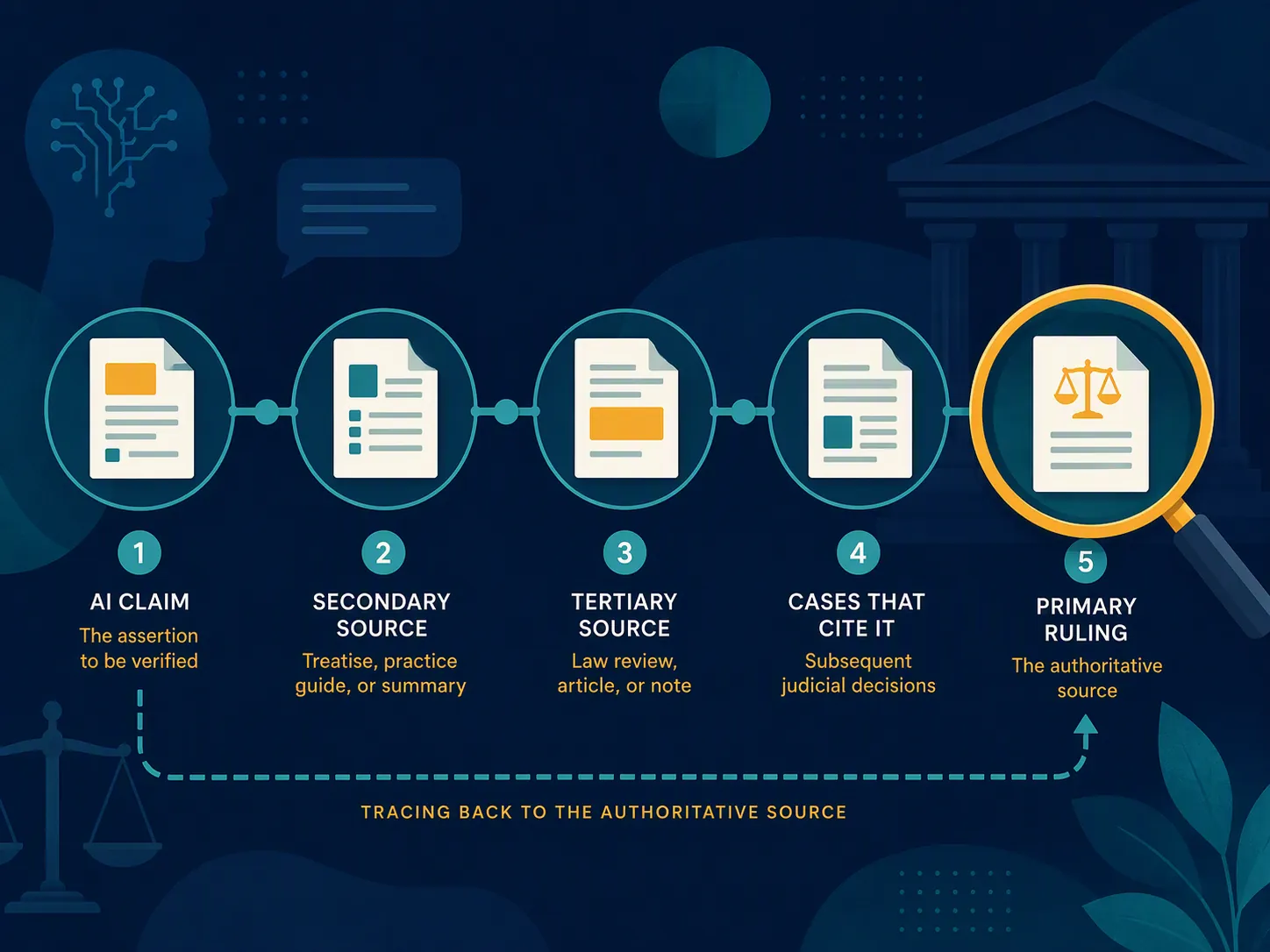
A compact Knox-Kercher probe can be built around five facts. First, Amanda Knox and Raffaele Sollecito were convicted on December 4, 2009, with sentences of 26 and 25 years. Second, they were acquitted on October 3, 2011. Third, Italy’s Court of Cassation ruled on March 27, 2015 that Knox and Sollecito did not commit the murder, while upholding Knox’s slander conviction for accusing Patrick Lumumba. Fourth, Rudy Guede remained the sole convicted perpetrator. Fifth, in June 2024, a Florence court re-convicted Knox of slander and imposed a three-year sentence, as Reuters reported.[4][5]
Each fact should be tested twice. The first score asks whether the tool states the fact correctly. The second asks whether the cited source supports that exact statement. Those are different scores. A tool that says the 2015 ruling cleared Knox and Sollecito of the murder but cites a source that only discusses media reaction has not completed the research task. A tool that correctly mentions the 2024 slander re-conviction but blurs it into the murder charge has failed a different, equally important, distinction.
| Probe fact | What the evaluator should verify | Misgrounding risk |
|---|---|---|
| December 4, 2009 convictions and sentences | The answer identifies the convictions and the 26-year and 25-year sentences. | A general chronology source may mention the trial but not support the sentence details. |
| October 3, 2011 acquittals | The answer separates the appellate acquittals from later procedural developments. | A broad summary may collapse acquittal, reinstatement, and final review. |
| March 27, 2015 Court of Cassation ruling | The answer states that Knox and Sollecito did not commit the murder and separately notes the slander conviction. | This is the central stress test: one ruling contains distinct outcomes that are easy to merge. |
| Rudy Guede as sole convicted perpetrator | The answer identifies Guede’s status without implying that every court treated every defendant identically. | Media shorthand can obscure the difference between Guede’s conviction and Knox/Sollecito’s final outcome. |
| June 2024 Florence slander re-conviction | The answer treats the Florence ruling as a slander matter, not a murder conviction. | A tool may import the emotional weight of the murder case into a separate procedural point. |
This is where a famous case earns its place in a legal-AI benchmark. The public narrative is noisy, but the verification targets are narrow. The evaluator is not asking whether the system can write a compelling summary of the controversy. The evaluator is asking whether the system can preserve procedural distinctions when many available texts invite compression.
What to ask in a pre-procurement test
A useful test question should make grounding unavoidable. For example, a buyer might ask the tool to provide a short procedural chronology of the Knox-Kercher matter, identify which ruling supports each entry, and quote or pinpoint the passage that supports each proposition. The reviewer should then grade the answer at the proposition level, not the paragraph level.
- Does the answer distinguish the murder charge from the slander conviction?
- Does it separate the 2009 convictions, 2011 acquittals, 2015 final ruling, and 2024 slander ruling?
- Does each citation support the exact sentence it is attached to?
- Does the answer rely on media narrative where a ruling or reliable procedural report is needed?
- Does the tool disclose uncertainty when a source does not carry the requested proposition?
The scoring should penalize an answer that is substantively right but poorly grounded. That may feel severe, especially when the tool has arrived at the correct bottom line. In legal research, however, the bottom line is not portable unless the authority travels with it. A correct statement attached to the wrong source creates work for the next reviewer and risk for the person who files or relies on it.
The same design can be used outside the Knox-Kercher record. Pick a matter with a complicated procedural history, write down the expected propositions before running the test, identify the sources that actually support them, and then ask whether the tool preserves those links. High-profile cases are attractive because the model has likely seen many retellings. They are also dangerous for the same reason.
The boundary matters
There is a tempting but unsupported version of this article that would say: the Knox-Kercher case is so famous and contested that legal AI must be hallucinating about it. The available research does not show that. The defensible claim is narrower and more useful: the case is a strong candidate for hallucination testing because its public narrative is dense while its key procedural claims can be checked.
For legal-tech buyers, that is enough. The procurement question is not whether a tool can avoid the most obvious fake case. It is whether the tool can keep a real authority attached to the proposition the authority actually supports. Test that before relying on polished answers, and treat the Knox-Kercher record as a research hypothesis for misgrounding risk, not as proof of a documented AI failure.
References
- AI on Trial: Legal Models Hallucinate in 1 out of 6 (or More) Benchmarking Queries, Stanford HAI, May 23, 2024
- AI Hallucination Cases, Damien Charlotin
- Lawyers sanctioned over AI-generated fake cases in Lindell election case, Reuters, January 15, 2025
- Supreme Court of Cassation, Fifth Criminal Section, Judgment No. 36080/2015, The Murder of Meredith Kercher, September 7, 2015
- Italian court upholds Amanda Knox slander conviction, Reuters, June 5, 2024
Related records
Tool profile
How Meta's AI Spending Reshapes Law Firm ProfitabilityGoverning regulation
Browse the obligations tracker →Preventive workflow
Browse verification workflows →
Report a correction or tip
Spotted an outdated figure, a misstated fact, or a ruling this case record should reflect? Public comments are disabled for this content given the professional cost of a misreported case outcome, penalty amount, or rule text — use the structured correction channel instead.
Report a correction or tip for this record →