
How the Kohberger DNA Ruling Signals Risk for IGG Cases
Judge Hippler's February 2025 order denying suppression of investigative genetic genealogy evidence in State v. Kohberger is analyzed as a Fourth Amendment risk signal for other DNA-forensic cases, explaining why the defense's warrant arguments failed and what the abandonment and privacy-of-identity holdings mean for future prosecutions.
- Jurisdiction
- US-ID
- Court
- Idaho District Court
- Judge
- Steven Hippler
- AI tool named
- GEDmatch, FamilyTreeDNA
- Ruling date
- Feb 19, 2025
- Source document
- View primary court order ↗
- Last verified
- Jul 31, 2026
Lex Machina Review is an independent risk-tracking and reference resource. Nothing on this site is legal advice, and using it does not create an attorney-client relationship. Every record is reviewed against primary sources but may not reflect the most current status of a matter — always verify directly against the cited court order, rule text, or a licensed attorney before relying on it.
Companion explanation — secondary to the source document above
The useful starting point is not the crime narrative. It is Judge Steven Hippler’s February 19, 2025 Idaho state trial-court order denying Bryan Kohberger’s motion to suppress genetic information in State of Idaho v. Bryan C. Kohberger. The primary order is available through Idaho Courts Cases of Interest, but the quoted language discussed here should be checked against the PDF before it is reused in a brief; the accessible quotations in this analysis are taken from CBS News’s reporting on the ruling. This is legal-risk analysis, not legal advice, not a motive explainer, not a documentary recap, and not an assessment of forensic-AI reliability. [1][2]
For readers arriving through the Kohberger trial or motive coverage, the motive question is beside the legal signal. The suppression ruling matters because it gives prosecutors a compact Fourth Amendment answer to investigative genetic genealogy, or IGG: DNA on the sheath was treated as abandoned, Kohberger disclaimed ownership or knowledge of the sheath, and the court rejected a reasonable expectation of privacy in identity in the genealogy-database setting. That sequence is not binding appellate law. It is still something other lawyers will copy.

The order’s importance is procedural, not biographical
A state trial-court suppression order does not settle the Fourth Amendment law of forensic genealogy. It does not bind other Idaho trial judges in the way an appellate decision would, and it certainly does not bind courts in other jurisdictions. Its significance is more practical: it is a dated risk record showing how a court accepted the state’s IGG pathway when conventional identification methods had not produced a suspect.
CBS characterized the ruling as removing “a major wrench in the prosecution’s case before trial starts in August,” which is a fair description of its litigation effect at that moment, not a judicial finding about plea leverage or guilt. [2]
That distinction matters. The ruling is useful because it reduces a complicated IGG investigation into a defensible chain of Fourth Amendment propositions. It is risky for the same reason. A busy prosecutor looking for a suppression-response paragraph can lift the abandonment language. A busy judge looking to deny a motion without holding a seminar on genetic privacy can follow the identity rationale. The next litigant then inherits the compressed version.
The evidence chain the Fourth Amendment analysis depends on
The IGG issue is hard to evaluate if the investigation is described only as “DNA evidence.” The relevant chain began with DNA recovered from a knife sheath at the crime scene. Investigators then used single nucleotide polymorphism, or SNP, analysis and uploaded a genetic profile to genealogy databases after conventional database searching had not identified the source. Reporting described databases such as GEDmatch or FamilyTreeDNA as part of the investigative route. That genealogy work helped identify Kohberger as a suspect, and investigators later compared the crime-scene DNA with DNA obtained from trash collected outside the Pennsylvania family home. [2]
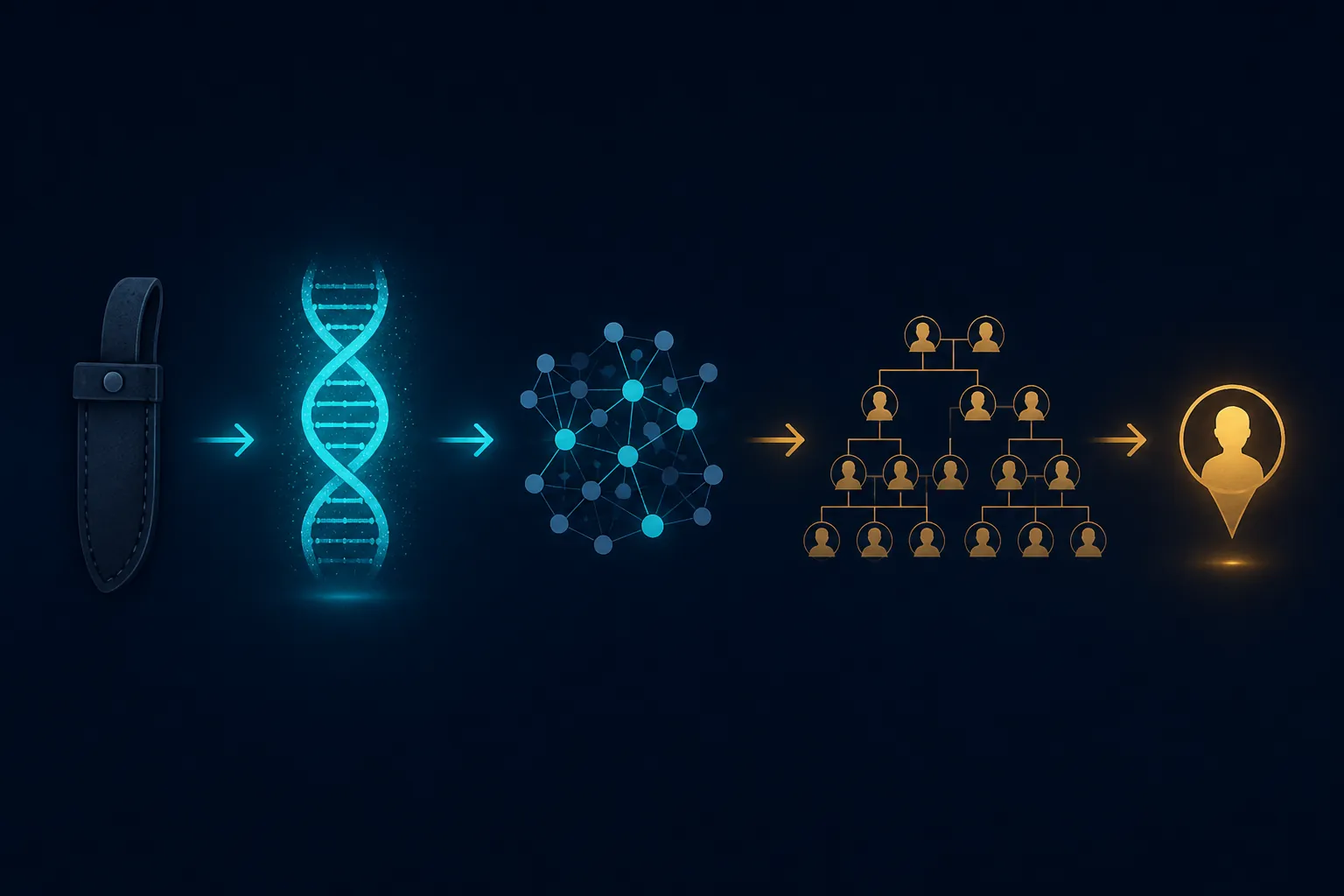
| Investigative step | Why it mattered to suppression |
|---|---|
| DNA recovered from the sheath | The court’s abandonment analysis attached to the physical item and the biological material left with it. |
| SNP analysis performed | The defense argued that additional genetic analysis itself required a warrant. |
| Genealogy-database upload used after conventional routes failed | The defense challenged the use of profiles associated with potential relatives in public genealogy databases. |
| Kohberger identified as a suspect | The state treated IGG as an investigative lead, not as the final courtroom match standing alone. |
| Trash DNA collected outside the Pennsylvania family home | The later comparison supplied a confirmation path separate from the genealogy search. |
That last point is often where trial narratives become too loose. IGG did not need to do every evidentiary job in the case. Its most important role was moving investigators from an unknown DNA source to a named suspect. Once the investigation had a name, later collection and comparison work could carry different burdens. That is why suppression of the IGG path would have been a serious threat: it targeted the bridge between biological trace evidence and suspect identification.
This article does not revisit the separate reliability-oriented questions addressed in the site’s analysis of the Idaho murders documentary and AI-forensics angle. The February 2025 suppression order is a Fourth Amendment record: search, seizure, abandonment, privacy expectation, and identity.
Why the warrant arguments failed
The defense argument, as reported, had two related warrant theories. First, the FBI needed a warrant to analyze the crime-scene DNA beyond ordinary comparison work. Second, the government needed a warrant before using the genetic profiles of potential relatives in genealogy databases. The court rejected both theories. [2]
The abandonment holding did the first job
The court’s most portable sentence is the one CBS quoted this way: any privacy interest in the DNA “was abandoned along with the sheath, to which he claims no ownership or knowledge.” [2]
That is a tight suppression answer. It links the DNA to the sheath, links the sheath to abandonment, and links abandonment to Kohberger’s own position that he did not own or know the item. Once framed that way, the state does not have to defend every downstream laboratory step as a new invasion of a continuing privacy interest. The court’s logic treats the privacy interest as already gone.
A defense lawyer in the next case will notice the load-bearing assumptions. Does abandoning an object always abandon every genetic inference that can later be extracted from biological material on it? Does disclaimer of ownership strengthen abandonment only as to the object, or also as to the DNA? Does crime-scene context matter differently from discarded consumer genetic data, medical genetic data, or voluntarily uploaded genealogy profiles? Hippler’s order gives the prosecution a clean answer, but the cleanliness is exactly what future suppression motions will test.
The identity holding did the second job
The genealogy-database argument required a different move. The defense was not only objecting to what police did with Kohberger’s alleged DNA. It was objecting to the investigative use of genetic information connected to possible relatives. The court answered by rejecting a reasonable expectation of privacy in identity in this setting. CBS reported that Hippler found no reasonable privacy interest in DNA left at a crime scene. [2]
For prosecutors, that is the sentence that travels beyond the physical sheath. It allows the government to characterize IGG as identification work rather than as a search through constitutionally protected intimate information. The distinction is operationally important. If the state is merely learning who left abandoned biological material at a crime scene, the Fourth Amendment objection looks weaker. If the state is mining inherited genetic information about a network of people who never became suspects, the privacy problem looks larger.

The ruling’s appeal to the prosecution side is that it keeps the focus on the defendant’s asserted privacy interest. That focus helps avoid a broader inquiry into whether people who upload profiles to genealogy platforms can expose partial genetic information about relatives who did not consent, whether database terms of service are meaningful Fourth Amendment facts, and whether law enforcement use of consumer genealogy tools should be treated differently from ordinary public-source investigation.
The ruling is a template because it is easy to quote
Suppression law often moves through reusable formulations before appellate courts bless or reject them. The February 2025 order has several features that make it reusable.
- It starts from a physical crime-scene item, not from a genealogy company’s routine possession of consumer data.
- It uses abandonment, a familiar Fourth Amendment doctrine, rather than announcing a new genetic-privacy framework.
- It relies on disclaimer of ownership or knowledge, which gives the court a defendant-specific reason to deny suppression.
- It describes identity as outside a reasonable privacy expectation, which helps the state frame IGG as suspect identification rather than genetic exploration.
- It came before trial, when loss of the evidence path could have affected the structure of the prosecution’s case.
Those features do not make the order correct in every future setting. They make it administratively attractive. A court facing a similar suppression motion can borrow the sequence without deciding the whole law of IGG. A prosecutor can cite it as an example of a court treating crime-scene DNA and genealogy-assisted identification as outside the defendant’s protected privacy interest. A defense lawyer can distinguish it by attacking any missing piece: no true abandonment, no disclaimer, different database terms, broader genetic exploration, weaker independent confirmation, or a jurisdiction with more protective search-and-seizure doctrine.
The limits are not cosmetic
The first limit is authority. This was a state trial-court order. It may persuade; it does not control. Treating it as if it settled IGG law would overstate what the materials support. The site’s separate record on Kohberger procedural unknowns notes the same practical problem from another angle: the genetic-genealogy ruling did not become an appellate test of the issue.
The second limit is verification. The primary order should be the citation source for lawyers and researchers, but the directly accessible quoted language used here comes through CBS News. Anyone preparing a motion, bench memo, CLE deck, or knowledge-management entry should compare the quoted passages against the PDF and preserve the exact page references before relying on them. [1][2]
The third limit is doctrinal contest. UNC NCJOLT’s “The Wild West of Investigatory Genetic Genealogy” frames IGG as an underregulated investigative space and treats the legal rules around forensic genealogy as unsettled rather than complete. That critique does not make Hippler’s ruling an outlier with no value. It does show why a simple abandonment-and-identity script should not be mistaken for a consensus Fourth Amendment settlement. [3]
The fourth limit is jurisdictional variation. Some courts may be more receptive to abandonment doctrine when DNA is recovered from a crime-scene object. Others may be more concerned with the amount of personal and familial information that SNP analysis and genealogy searching can reveal. State constitutional law may also do work that the federal Fourth Amendment does not. Kohberger’s value is therefore strongest as a briefing tool and weakest as a prediction that every IGG suppression motion will fail.
How to read the order in the next IGG case
For prosecution teams, the order suggests a disciplined way to defend IGG evidence: separate the original crime-scene DNA from the genealogy lead, emphasize abandonment of the physical item and associated biological material, characterize genealogy work as identification, and point to later confirmatory DNA collection when available. That approach is strongest when the state can show that IGG was used after conventional searches failed and that the case did not rest solely on an opaque database match.
For defense teams, the order identifies the points that need preservation. If the case permits it, challenge whether the DNA interest should follow the abandoned-property label, whether disclaimer of ownership should be used offensively to defeat privacy, whether the genealogy search exposed information beyond identity, and whether relatives’ data created a privacy problem the court has too quickly assigned to the defendant alone. The appellate issue will not improve if the trial record treats IGG as a black box.
For legal-risk tracking, the classification is narrower still: citeable template, persuasive only, quotation-dependent until checked against the primary PDF, and live enough to monitor in other jurisdictions. Kohberger is important for IGG cases because it gives prosecutors a concise abandonment-and-identity script. It does not close the Fourth Amendment debate.
References
- Order on Defendant's Motion to Suppress Genetic Information, State of Idaho v. Bryan C. Kohberger, Idaho Courts Cases of Interest, filed Feb. 19, 2025
- Judge in University of Idaho killings case makes ruling on key DNA evidence, CBS News
- The Wild West of Investigatory Genetic Genealogy, UNC NCJOLT
Related records
Tool profile
Browse tool evaluations →Governing regulation
Browse the obligations tracker →Preventive workflow
Browse verification workflows →
Report a correction or tip
Spotted an outdated figure, a misstated fact, or a ruling this case record should reflect? Public comments are disabled for this content given the professional cost of a misreported case outcome, penalty amount, or rule text — use the structured correction channel instead.
Report a correction or tip for this record →