
KOSPI Crash and the New AI Securities Litigation Risk for Korean Companies
The KOSPI bear market has shifted AI securities litigation from AI-washing claims to failure-to-disclose theories targeting Korean chipmakers. This article examines how the ZoomInfo AI-disruption nondisclosure case, the surge in foreign-issuer filings, and the Korea AI Basic Act create a layered cross-border litigation risk for Samsung, SK Hynix, and their suppliers.
- Jurisdiction
- United States
- Court
- U.S. District Court
- AI tool named
- ZoomInfo AI
- Ruling date
- Jun 25, 2026
- Source document
- View primary court order ↗
- Last verified
- Jul 29, 2026
Lex Machina Review is an independent risk-tracking and reference resource. Nothing on this site is legal advice, and using it does not create an attorney-client relationship. Every record is reviewed against primary sources but may not reflect the most current status of a matter — always verify directly against the cited court order, rule text, or a licensed attorney before relying on it.
Companion explanation — secondary to the source document above
The useful legal question after the KOSPI break is not whether Korean AI stocks were overvalued. It is whether the crash gives US plaintiffs a better way to plead that an issuer’s prior AI disclosures became incomplete. For a legal investment analysis of the KOSPI bear market’s impact on AI stocks, the litigation shift matters more than the market slogan: AI securities cases are moving from “you exaggerated your AI” toward “you failed to disclose how AI was damaging the business, the stock, or both.”
That is why the ZoomInfo complaint deserves more attention than another recap of falling chip shares. Filed on June 25, 2026, the case allegedly does not rest on the simple claim that ZoomInfo lied about having AI products. The allegation, as described by The D&O Diary, is sharper: the company accurately described its AI offerings but failed to disclose that AI was simultaneously disrupting the company’s legacy subscription business. The D&O Diary characterized it as the first case advancing that theory.[1]
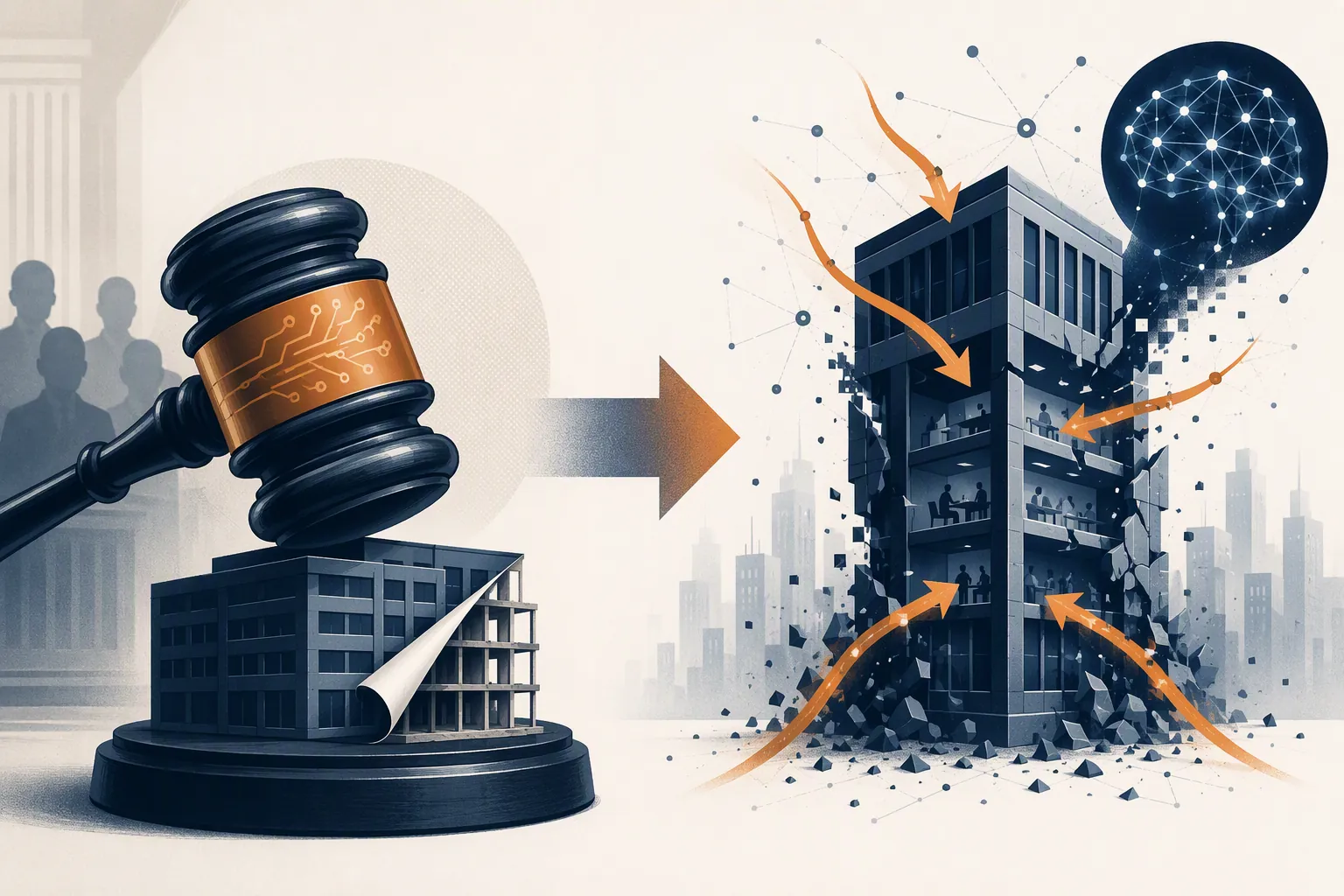
The distinction is not cosmetic. An AI-washing complaint asks whether the issuer overstated its capabilities, customer adoption, or monetization. An AI-disruption nondisclosure complaint asks whether the issuer talked about AI in one register while omitting that the same technology was eroding pricing power, renewal rates, demand, or the durability of an existing revenue model. The second theory can survive even where the product description is technically accurate, because the alleged omission concerns business impact rather than product existence.
That does not make ZoomInfo a new rule. As of July 29, 2026, the complaint was only weeks old, and no motion-to-dismiss ruling had tested whether the theory satisfies the PSLRA, Rule 9(b), loss causation, or the usual safe-harbor defenses. It is a pleading template, not a precedent. But pleading templates matter. They tell plaintiffs’ firms what to look for after a stock drop: a prior risk factor that described AI competition as hypothetical, internal documents showing the risk had already materialized, and an earnings event that can be framed as the corrective disclosure.
The New Complaint Grammar
For Korean technology issuers, the legal danger is not that ZoomInfo involved Korea. It did not, on the materials available here. The danger is that the case separates AI optimism from AI exposure. A company can be an AI beneficiary in one part of its business and an AI casualty in another. A chipmaker can benefit from accelerator demand while its equity becomes acutely exposed to a crowded AI trade. A supplier can report AI-driven orders while under-disclosing customer concentration, financing fragility, or inventory dependence.
| Pleading Theory | What Plaintiffs Try To Show | Why It Matters After KOSPI |
|---|---|---|
| AI-washing | The issuer overstated AI capabilities, adoption, or revenue contribution. | Useful where public AI claims outran internal product or sales records. |
| AI-disruption nondisclosure | The issuer discussed AI while omitting that AI was impairing an existing business model. | Useful where AI demand and AI harm coexist inside the same issuer story. |
| AI market-structure nondisclosure | The issuer failed to disclose that its stock had become unusually exposed to AI concentration, leverage, or forced selling. | Potentially useful after the leveraged AI-chip unwind, but still untested as a Korea-specific securities theory. |
The third category is the one Korean issuers should not dismiss too quickly. It is not a claim that a company must warn investors that its stock can go down. It is a narrower theory: if the issuer’s equity has become unusually tethered to an AI-stock concentration trade and retail leverage, plaintiffs may argue that existing risk disclosures were stale or incomplete when they described volatility, customer demand, or market conditions in generic terms.
A complaint built that way would still have hard work to do. It would need a class period, specific misstatements or omissions, a corrective event, price impact, and a non-speculative scienter theory. It would also need to avoid turning ordinary market beta into securities fraud. But the KOSPI facts give plaintiffs something more organized than a chart: concentration, leverage, forced liquidations, and regulatory reaction.
Foreign Issuers Are No Longer a Side Note
The foreign-issuer filing data is the bridge from a US complaint theory to Korean companies with US-market exposure. Alston & Bird, using NERA data, reported 23 foreign-issuer securities class action filings in H1 2026, equal to 20.5% of all filings, up from 13.8% in 2025 and reversing a five-year decline trend.[2]
That number does not mean Korean issuers are presumptively targeted, and it does not say anything about merits. It says that foreign-issuer cases are again occupying meaningful space in the US class action docket. For companies that issue ADRs, access US investors, speak through English-language investor materials, or buy D&O insurance priced against US exposure, that is enough to change the disclosure conversation.
The broader AI filing counts point in the same direction, although the exact number depends on methodology. AI-related securities cases increased from roughly 6–8 per year during 2021–2023 to 15 in 2024, 12 in H1 2025, and 18 in H1 2026, according to Bloomberg Law and Fried Frank commentary citing Alston & Bird/NERA data.[3][2] The D&O Diary used a narrower count of 14 AI-related securities suits by June 25, 2026.[1] That discrepancy is not a scandal; it is a reminder to check whether a tracker counts every filing with AI-related disclosures or only cases where AI is central to the alleged fraud.
For risk analysis, the exact count is less important than the pattern. Plaintiffs are not merely recycling AI-washing allegations against US software companies. They are testing event-driven theories, disruption theories, and foreign-issuer theories at the same time. Korean AI companies sit where those lines can intersect.
That intersection should be handled with some discipline. A Korean issuer is not exposed to a viable US securities claim simply because its shares fell, because AI appeared in investor presentations, or because the KOSPI entered a bear market. The more serious risk arises where the issuer made US-facing statements about AI demand, capacity, customer visibility, risk management, or market conditions while internal documents allegedly showed stress that was more specific, more current, or less contingent than the public disclosure suggested.
What the KOSPI Crash Adds
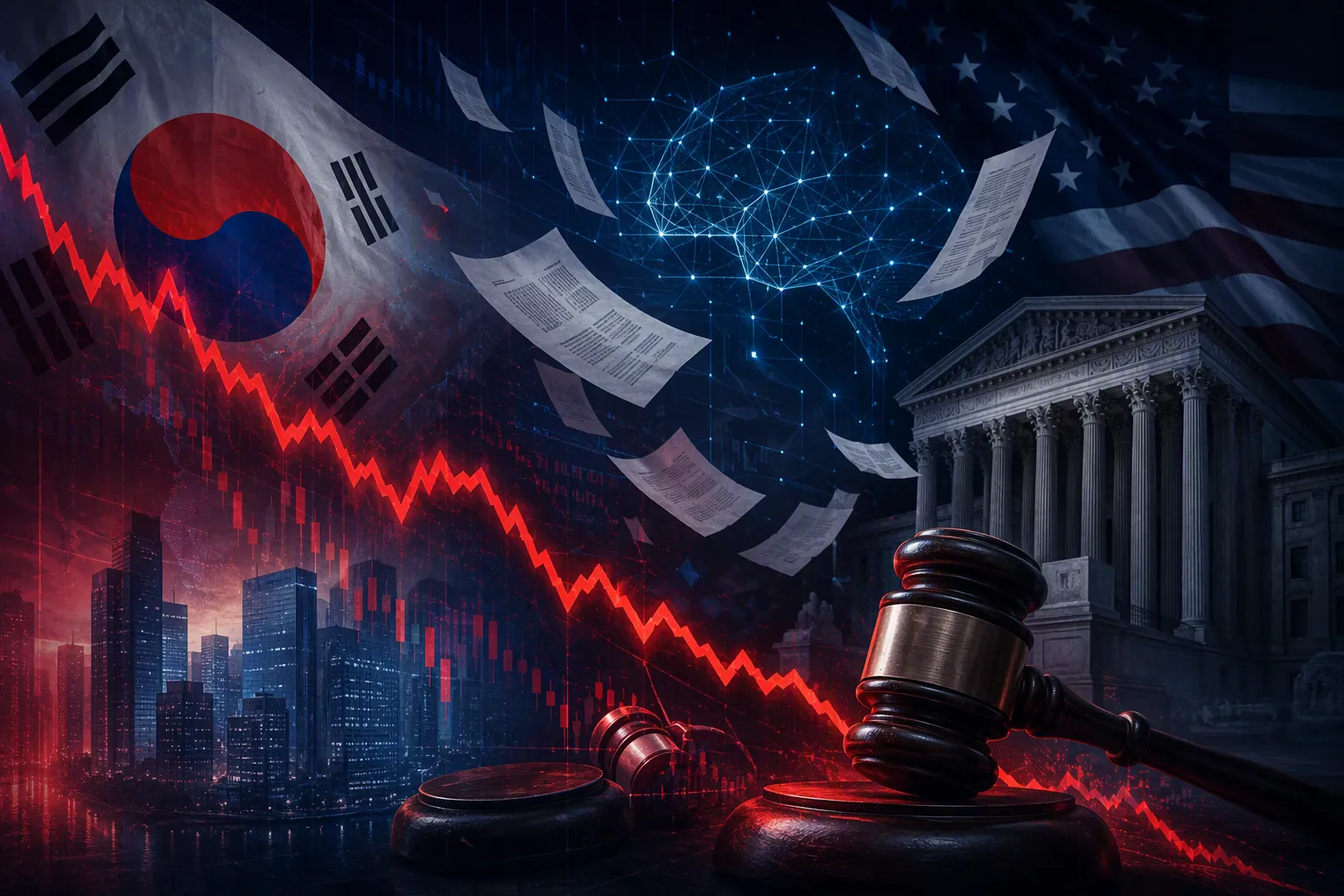
The Korea-specific record starts with concentration. CNBC reported that Samsung and SK Hynix together accounted for more than half of KOSPI weighting as of June 2026. On July 9, 2026, the KOSPI entered bear territory with a decline of more than 20% from its peak, driven by the unwind of leveraged AI-chip positions.[4]
That sequence matters more than the label “bear market.” If two AI-linked chip names carry more than half of an index, a decline in those names can be pleaded as more than issuer-specific disappointment. Plaintiffs can try to cast it as a foreseeable market-structure vulnerability: AI-chip enthusiasm increased concentration, leverage amplified the move, forced selling transmitted the shock, and public risk factors allegedly failed to describe the degree to which issuer equity had become dependent on that structure.
The leverage facts give that theory more texture. Investing.com, citing Goldman Sachs, reported that South Korean margin loan balances reached a record 38.63 trillion won on June 24, 2026.[5] Reuters later reported that 320,000–360,000 retail accounts were fully liquidated during the turmoil.[6] Those are not company fundamentals in the ordinary sense. They are market plumbing. But after a stock-drop event, market plumbing often becomes pleading material.
A plaintiff would still need to connect that plumbing to an issuer statement. A generic allegation that “retail leverage existed” should not be enough. The sharper complaint would identify a statement about investor demand, liquidity, volatility, AI-cycle durability, financing conditions, or risk controls, then allege that internal monitoring showed the issuer understood its stock or capital-market access was unusually exposed to leveraged AI-chip flows. That is where investor-relations materials, board presentations, D&O renewal submissions, exchange correspondence, and treasury memoranda start to matter.
The regulatory response supplies another pleading hook. On July 16, 2026, South Korea’s Financial Services Commission banned new single-stock leveraged ETF listings, and Reuters reported that the FSC head said the products had been “approved too hastily.”[7] A regulator’s after-the-fact statement does not prove issuer fraud. It does, however, give plaintiffs a public document around which to organize foreseeability: if the regulator later treated single-stock leverage as a product-design problem, plaintiffs may argue that issuers and underwriters should have recognized the risk earlier.
That argument will be easier to allege than to prove. Issuers do not control every leveraged product referencing their shares. They also do not have a general duty to warn that retail investors may use margin aggressively. The disclosure issue becomes more serious only if a company had specific knowledge that leverage, index concentration, or structured products were materially affecting trading, financing, capital raising, employee equity compensation, or investor demand, and then spoke as if the relevant risk were generic or merely hypothetical.
Samsung, SK Hynix, and Suppliers Are Not in the Same Position
It is tempting to group Samsung, SK Hynix, and their suppliers under one “Korean AI stocks” heading. That is usually where the legal analysis gets sloppy. The stronger disclosure questions differ by issuer role.
- For large chipmakers, plaintiffs would likely focus on AI demand visibility, capacity commitments, customer concentration, inventory risk, capital expenditure discipline, and whether public risk factors captured equity-market dependence created by index concentration and leverage.
- For suppliers, the cleaner theory may be customer or cycle dependence: whether AI-related orders were presented as durable while internal materials showed pull-forward demand, financing stress, or vulnerability to a small number of chipmaker customers.
- For US-listed or ADR-linked entities, plaintiffs can search for inconsistencies between Korean disclosures, English investor materials, ADR documentation, analyst calls, and D&O insurance submissions.
- For companies without meaningful US-market exposure, the immediate US securities class action path is narrower, though their documents may still appear in discovery if they are counterparties, suppliers, customers, or acquisition targets.
The practical defense question is therefore not “Did the company mention AI?” It is whether AI appeared in the disclosure record as upside while the downside sat in a different file: a Korean-language compliance register, a risk committee deck, a domestic regulatory submission, or a financing analysis that never crossed into US-facing materials. Cross-border cases are built in those gaps.
The site’s earlier discussion of AI bubble legal risks for investors covered the general filing surge. The Korean variant is narrower and less sentimental: when a concentrated index, leveraged retail accounts, and AI-chip narratives collapse together, plaintiffs do not need to prove that AI was fake. They need to plead that the issuer’s risk language failed to describe the way AI had already changed the company’s exposure.
The Korea AI Basic Act Adds a Records Problem
The Korea AI Basic Act should not be treated as a magic US discovery statute. It is a domestic AI regulatory framework, effective January 22, 2026. White & Case’s regulatory tracker states that foreign AI operators with more than 1 million daily Korean users or more than KRW 1 trillion in revenue must designate a domestic representative and comply with transparency and risk-management obligations.[8]
For securities litigators, the important point is not the headline obligation. It is the record it may create. Transparency and risk-management duties tend to produce inventories, classification decisions, committee minutes, model-risk assessments, incident logs, vendor reviews, user-impact analyses, and board reporting. If a Korean AI company later faces a US securities suit, plaintiffs will ask whether those domestic compliance records contradict the issuer’s public statements about AI risk, demand, reliability, or business impact.
That is especially uncomfortable for companies that assume Korean compliance documents will remain Korean. In a US securities case, plaintiffs do not need the Korea AI Basic Act to create a private right of action. They need the records to make falsity or scienter look less speculative. A risk committee document saying a particular AI deployment, dependency, or disruption had already materialized can be more valuable at the pleading and discovery stages than a regulatory violation theory.
The caveats are real. The White & Case tracker cites Korean Ministry of Science and ICT materials for implementing details, including decree thresholds, and US counsel should verify specific requirements against official Korean-language sources before relying on them in advice, pleadings, or underwriting models.[8] It is also unresolved whether a US court would compel production of Korea AI Basic Act compliance records over Korean data-protection, confidentiality, blocking-statute, or public-policy objections. The discovery path is plausible, not settled.
Even with those limits, the compliance layer changes the document map. A company defending an AI-disruption claim may no longer be fighting only over investor presentations and earnings-call scripts. It may also be fighting over domestic AI governance records prepared for a Korean regulator, a Korean representative, or a Korean internal control process. That is where disclosure controls and AI compliance controls need to meet before the complaint arrives.
What Counsel Should Be Reading Now
The immediate review is not a generic AI-risk refresh. It is a comparison exercise. Korean issuers with US exposure should read their English and Korean disclosure sets against the documents most likely to become exhibits.
- Risk factors: whether AI competition, leverage, volatility, customer concentration, and market-structure risks are described as hypothetical when internal materials treated them as current.
- Earnings scripts and investor decks: whether AI demand was presented as durable without matching disclosure on order quality, financing dependence, capacity risk, or retail-flow sensitivity.
- Korean regulatory and compliance files: whether AI Basic Act materials identify risks, dependencies, incidents, or governance gaps absent from US-facing materials.
- Board and committee records: whether directors received a sharper account of leveraged AI-chip exposure, ETF flows, margin stress, or demand fragility than investors received.
- ADR and D&O materials: whether cross-border offering, insurance, or renewal documents use a cleaner risk narrative than internal Korean documents support.
The point is not to make every disclosure longer. Over-disclosure can obscure the actual issue and create inconsistency across languages. The point is to avoid a record where AI upside is centralized in investor-facing documents while AI downside is scattered through domestic risk files. That asymmetry is exactly what a post-crash complaint will try to turn into motive, knowledge, and omission.
The most useful internal question is concrete: if a US complaint quoted this sentence after the KOSPI crash, which internal Korean document would plaintiffs put next to it? If the answer is an AI risk assessment, margin-exposure analysis, customer concentration deck, or regulatory file that makes the public statement look incomplete, counsel has found the problem before a plaintiffs’ firm does.
The Risk Judgment
No available material supports saying that Samsung, SK Hynix, or their suppliers already face viable US securities claims merely because their shares fell in the KOSPI bear market. That would be an overread. The stronger conclusion is that the crash has improved the raw material for a new kind of pleading: AI-disruption nondisclosure, reinforced by foreign-issuer filing momentum, Korea-specific market-structure facts, and domestic AI compliance records.
Each layer still has to survive its own test. ZoomInfo is untested at the motion-to-dismiss stage. AI case counts vary by methodology. KOSPI concentration and retail leverage do not automatically create issuer-level disclosure duties. Korea AI Basic Act discovery consequences remain unresolved. But those caveats do not make the exposure theoretical. They define where the next complaint will have to work.
For Korean AI companies with US-facing disclosures, the litigation risk is now layered rather than linear. A plaintiff can start with an AI-stock crash, borrow the ZoomInfo grammar, use foreign-issuer filing trends to normalize the forum, cite Korean market-structure facts for foreseeability, and seek domestic AI compliance records to sharpen falsity or scienter. That is not a prediction of filed claims. It is the disclosure map the crash has handed to plaintiffs.
References
- AI-Related Securities Litigation Continues to Evolve, The D&O Diary, July 2026
- Securities Class Action Filings Surge in First Half of 2026 as AI and Cryptocurrency Cases Rise, Alston & Bird, July 2026
- Event-Driven AI Cases Dominate 2026 Securities Litigation Field, Bloomberg Law
- KOSPI enters bear territory as AI favorites Samsung and SK Hynix tumble, CNBC, July 9, 2026
- Korea’s leveraged chip trade hits the margin call wall, Investing.com
- ‘I couldn’t breathe’: South Korea’s frenzied stock trading exposes margin loan risks, Reuters, July 20, 2026
- South Korea regulator to announce new measures on single-stock leveraged ETFs, Reuters, July 16, 2026
- AI Watch: Global regulatory tracker - South Korea, White & Case
Related records
Tool profile
How Meta's AI Spending Reshapes Law Firm ProfitabilityGoverning regulation
Browse the obligations tracker →Preventive workflow
Browse verification workflows →
Report a correction or tip
Spotted an outdated figure, a misstated fact, or a ruling this case record should reflect? Public comments are disabled for this content given the professional cost of a misreported case outcome, penalty amount, or rule text — use the structured correction channel instead.
Report a correction or tip for this record →