
The Lake Mead Crisis Is About to Test Water Rights Law
The Bureau of Reclamation's 20% cut to Lake Powell releases has brought the Colorado River Compact's ten-year delivery obligation within reach of default, creating a credible basis for the first compact-call lawsuit in U.S. history. The article traces the legal mechanism, the interpretive dispute over Article III(d), and the concrete indicators—Arizona's retained counsel, funded war chest, and the 2007 guideline expiration—that practitioners should monitor into late 2026.
- Jurisdiction
- United States
- Court
- U.S. Supreme Court
- AI tool named
- No AI tool
- Ruling date
- Apr 23, 2026
- Source document
- View primary court order ↗
- Last verified
- Jul 28, 2026
Lex Machina Review is an independent risk-tracking and reference resource. Nothing on this site is legal advice, and using it does not create an attorney-client relationship. Every record is reviewed against primary sources but may not reflect the most current status of a matter — always verify directly against the cited court order, rule text, or a licensed attorney before relying on it.
Companion explanation — secondary to the source document above
Risk signal: the 6 MAF release cut
For counsel tracking the Lake Mead water crisis, California water-rights law is now only one part of the exposure map. The sharper legal signal came in April 2026, when the Bureau of Reclamation cut Lake Powell releases from 7.48 million acre-feet to 6 million acre-feet, roughly a 20% reduction. KTS Law treated that operational move as the point at which the Colorado River dispute could ripen into a lawsuit over obligations under an interstate compact, with the U.S. Supreme Court as the likely forum.[1]
The relevant instrument is not a drought plan or a voluntary conservation pledge. It is Article III(d) of the 1922 Colorado River Compact, and the asserted Lower Basin theory is that the Upper Basin must deliver 82.5 million acre-feet over ten years at Lee Ferry: 75 million acre-feet under Article III(d), plus half of Mexico’s 1.5 million acre-foot annual share. The Upper Basin disputes that reading, including both the Mexico-share addition and whether the compact imposes an affirmative delivery obligation rather than a non-depletion standard.[2]
| Risk item | Current reading |
|---|---|
| Agency action | April 2026 Reclamation reduction of Lake Powell releases from 7.48 MAF to 6 MAF.[1] |
| Legal hook | Article III(d) ten-year Lee Ferry accounting under the 1922 Colorado River Compact.[2] |
| Lower Basin asserted threshold | 82.5 MAF over ten years: 75 MAF plus half of Mexico’s annual 1.5 MAF share.[2] |
| Likely forum if filed | U.S. Supreme Court original jurisdiction for an interstate compact dispute.[1] |
| Case status | No compact-call complaint has been filed; the risk remains contingent on late-2026 operations and flow accounting. |
This is a litigation-risk analysis, not legal advice. The point is not that the Lower Basin will necessarily file, or that it would prevail. The point is narrower: the April release decision gives lawyers something more concrete than political grievance to brief.

Why the reservoir numbers matter only after the compact math
Lake Mead and Lake Powell remain the visible pressure points. In late July 2026, Lake Mead was reported at 27% of capacity and Lake Powell at about 23% to 24%.[3] Those numbers explain the operational pressure on Reclamation and the political pressure on the basin states. They do not, by themselves, create the compact-call theory.
The legal problem runs through Lee Ferry accounting. If the ten-year flow total stays comfortably above the Lower Basin’s asserted threshold, a compact-call complaint becomes harder to justify as a ripe claim. If the accounting approaches or falls below that asserted threshold, the Lower Basin can argue that the Upper Basin has crossed from shortage politics into compact breach.
The current pressure point is the projected 2017–2026 Lee Ferry flow of about 82.74 MAF. That figure is close to the Lower Basin’s asserted 82.5 MAF line, but it should not be treated as final. Hydrology projections can shift before year-end accounting is complete, and any complaint would have to work with the record that exists when a state decides to sue, not with a midyear projection.
The Article III(d) dispute is the case
The Lower Basin’s theory begins with the compact language that the Upper Division states will not cause the flow of the Colorado River at Lee Ferry to be depleted below an aggregate of 75 MAF for any period of ten consecutive years. That 75 MAF figure is the baseline. The disputed step is the Lower Basin’s addition of 7.5 MAF over the same ten-year period, representing half of Mexico’s 1.5 MAF annual allocation. That produces the asserted 82.5 MAF ten-year obligation.[2]
For Lower Basin lawyers, the 6 MAF release matters because it can narrow the margin between actual Lee Ferry flows and that asserted 82.5 MAF obligation. A release number is an agency action; a ten-year accounting deficit is a litigation predicate. The former does not automatically prove the latter, but it may help assemble the record.
The Upper Basin’s answer is not merely that drought made performance difficult. Its legal position challenges the Lower Basin’s construction of the obligation. First, it disputes adding half of Mexico’s share to Article III(d)’s 75 MAF figure. Second, it disputes the premise that Article III(d) creates an affirmative duty to deliver a fixed amount, rather than a prohibition on causing depletions below the compact floor.[2]
That difference matters in pleading terms. A fixed delivery theory asks whether the ten-year total hit the required number. A non-depletion theory asks a more complicated causation question: what did the Upper Basin states cause, and how should hydrologic conditions, federal operations, and compact accounting be separated? The first theory is cleaner for a plaintiff. The second gives defendants more room to contest both law and fact.
Nothing in the public record described here makes the Lower Basin interpretation settled law. That is why KTS Law’s framing is significant. Its point is not that the Lower Basin has already won the legal argument; it is that the dispute has developed into the kind of interstate-compact obligation question that could be placed before the Supreme Court.[1]
Arizona is building a litigation record, and California has reason to watch it closely
Arizona has done the most visible pre-filing work. In March 2026, Arizona retained Sullivan & Cromwell for the Colorado River fight.[4] The state also had a $3 million litigation fund, with an additional $1 million in spring 2026 legislative appropriations described in the public record. For risk teams, retained Supreme Court-capable counsel plus appropriated litigation money changes the file from policy monitoring to active dispute preparation.
California’s role is different but not peripheral. The Lower Basin theory would protect the supply architecture on which California users depend, even if Arizona is the more visible public actor. For California water-rights practitioners, the immediate issue is not a general reordering of state-law priorities. It is whether an interstate compact claim alters the operating assumptions behind deliveries, shortages, contracts, and settlement posture.
That distinction is easy to lose in shorthand references to California water-rights law. A compact-call case would not be a normal California priority dispute. It would be a state-versus-state original action asking the Supreme Court to interpret an interstate compact against a record of federal reservoir operations and ten-year Lee Ferry accounting.
The late-2026 window is not speculative background
Several dates now sit close together. The final environmental impact statement for post-2026 operations is due in summer 2026, and the 2007 Interim Guidelines expire in October 2026.[1] Colorado River District General Manager Andy Mueller said he expected Supreme Court litigation within 12 months.[2] None of those facts proves a complaint will be filed. Together, they explain why late 2026 is the period to monitor.
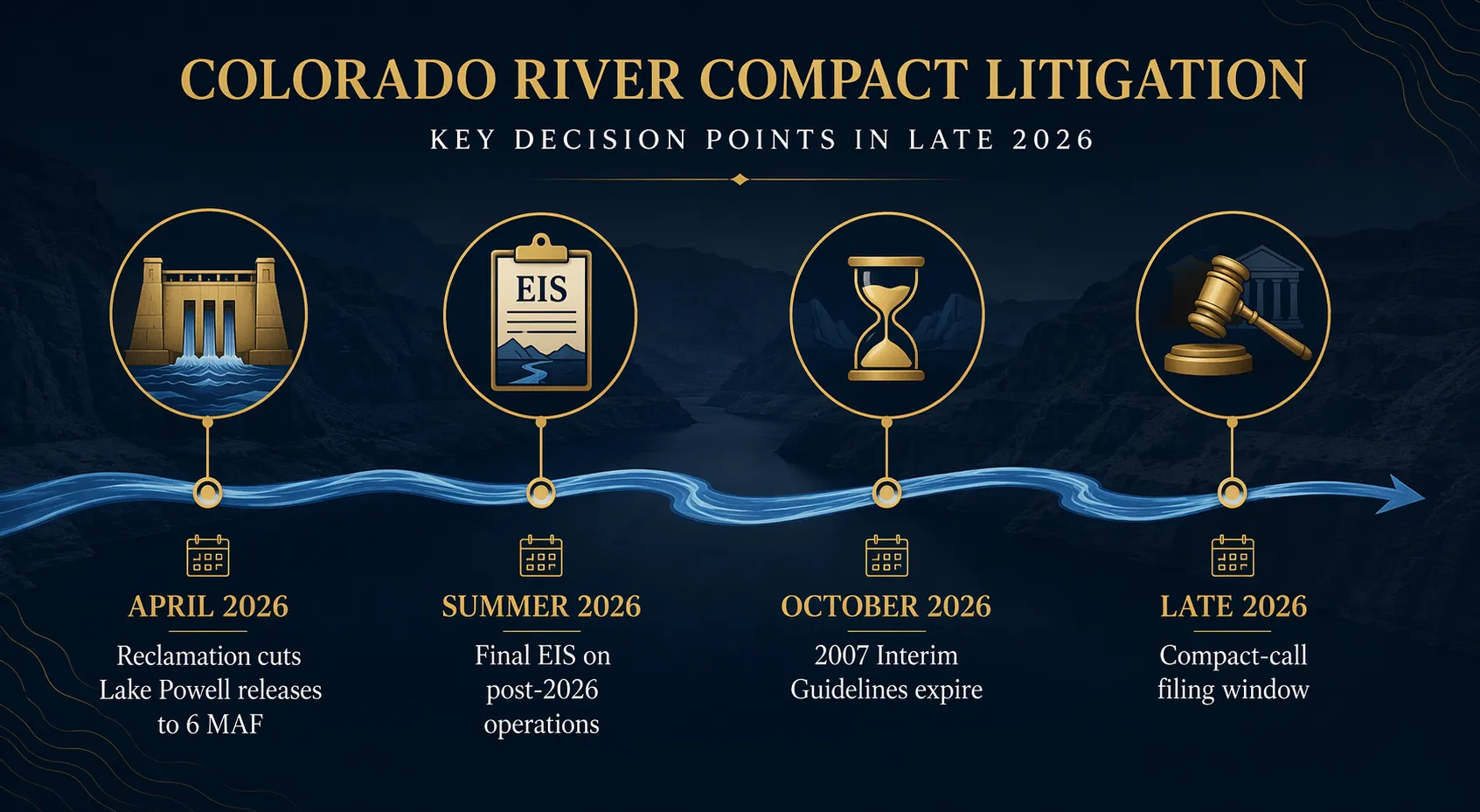
| Timing | Why it matters to litigation risk |
|---|---|
| April 2026 | Reclamation’s 6 MAF Lake Powell release decision supplies the concrete operational trigger.[1] |
| Summer 2026 | The final EIS for post-2026 operations is due, giving states a clearer federal operating record to evaluate.[1] |
| October 2026 | The 2007 Interim Guidelines expire, increasing pressure to define the next operating regime.[1] |
| Late 2026 | Lee Ferry accounting, federal operating decisions, and Lower Basin litigation posture may align closely enough to move from threat to filing risk. |
The expiring operating regime matters because compact litigation is unlikely to be filed in a vacuum. A plaintiff state would want a record showing not only low reservoirs, but also an operating decision and accounting consequence that make the alleged breach concrete. The final EIS and any Record of Decision could either sharpen that record or complicate it.
The same is true for the Lee Ferry number. A projected 82.74 MAF total against an asserted 82.5 MAF obligation is close enough to make counsel pay attention, but close cases are sensitive to updated hydrology, accounting conventions, and the precise period used. A few tenths of a million acre-feet can matter when the theory depends on a ten-year aggregate.
What would change the risk level
The watch items are practical. Counsel do not need another broad basin narrative; they need to know which facts would make a complaint more or less likely.
- Final EIS and Record of Decision: whether post-2026 operations preserve, offset, or deepen the effects of the 6 MAF release decision.
- Lee Ferry accounting: whether the 2017–2026 ten-year total remains above the asserted 82.5 MAF line, falls below it, or stays close enough to invite a dispute over accounting methodology.
- Lower Basin posture: whether Arizona, California, or other Lower Basin actors move from funded preparation to formal notices, authorizations, or public litigation positions.
- Upper Basin response: whether the defense remains focused on the Mexico-share addition and non-depletion interpretation, or adds factual challenges to causation and federal operations.
- Supreme Court framing: whether public statements begin to describe the dispute less as negotiation leverage and more as an original-jurisdiction compact action.
A filing would be unprecedented in the specific compact-call sense described here, but the preparatory facts are no longer abstract. Reclamation has made the release cut. Arizona has retained major outside counsel and funded litigation capacity. The operating guidelines are expiring. The Lower Basin’s asserted ten-year number is close enough to the projected Lee Ferry accounting to support serious briefing, while the Upper Basin’s legal defenses remain substantial.
Late 2026 is therefore the point at which the record should be rechecked, not the point at which victory should be predicted. If the final operating documents, Lee Ferry accounting, and Lower Basin litigation posture continue to align, the compact-call claim moves from threat language to filing risk in the U.S. Supreme Court.
References
- Colorado River Developments and Potential Compact Litigation, KTS Law, April 23, 2026
- Colorado River states potential water cuts legal battles, Colorado Sun, March 27, 2026
- Colorado River cuts, Los Angeles Times, July 23, 2026
- Arizona Colorado River water battle: what to know, Phoenix New Times, March 24, 2026
Related records
Tool profile
How Meta's AI Spending Reshapes Law Firm ProfitabilityGoverning regulation
Browse the obligations tracker →Preventive workflow
Browse verification workflows →
Report a correction or tip
Spotted an outdated figure, a misstated fact, or a ruling this case record should reflect? Public comments are disabled for this content given the professional cost of a misreported case outcome, penalty amount, or rule text — use the structured correction channel instead.
Report a correction or tip for this record →