
Why the Linda Blair Warrant Wasn't a Search Warrant
Headlines and AI summaries called it a raid, but the July 2026 search of Linda Blair's California property was authorized by an administrative inspection warrant, not a criminal search warrant. The distinction changes what the event means legally, and a classification checklist helps litigators and journalists vet warrant-type claims in AI-generated legal summaries.
- Jurisdiction
- US - California
- Court
- Los Angeles County Superior Court
- AI tool named
- AI summarization tool
- Ruling date
- Jul 31, 2026
- Source document
- View primary court order ↗
- Last verified
- Aug 2, 2026
Lex Machina Review is an independent risk-tracking and reference resource. Nothing on this site is legal advice, and using it does not create an attorney-client relationship. Every record is reviewed against primary sources but may not reflect the most current status of a matter — always verify directly against the cited court order, rule text, or a licensed attorney before relying on it.
Companion explanation — secondary to the source document above
Last verified: August 2, 2026, UTC. This article is legal information, not legal advice, and was reviewed by a legal-background reviewer. The warrant document itself was not public in the verification set: no docket number, issuing judge, affidavit, return, or full warrant scope was available. That matters because the strongest current conclusion is a classification conclusion, not a full warrant-validity analysis.
If you arrived through “Linda Blair home raid warrant” coverage, start with the procedural label: the best available public record describes an administrative inspection or investigative warrant tied to county animal-code compliance, not a criminal search warrant. That difference changes what the event signals. A criminal search warrant normally points toward suspected criminal evidence. An administrative inspection warrant is a Fourth Amendment tool for lawful regulatory access, including code inspections, with a different probable-cause standard and a scope tied to the inspection purpose.
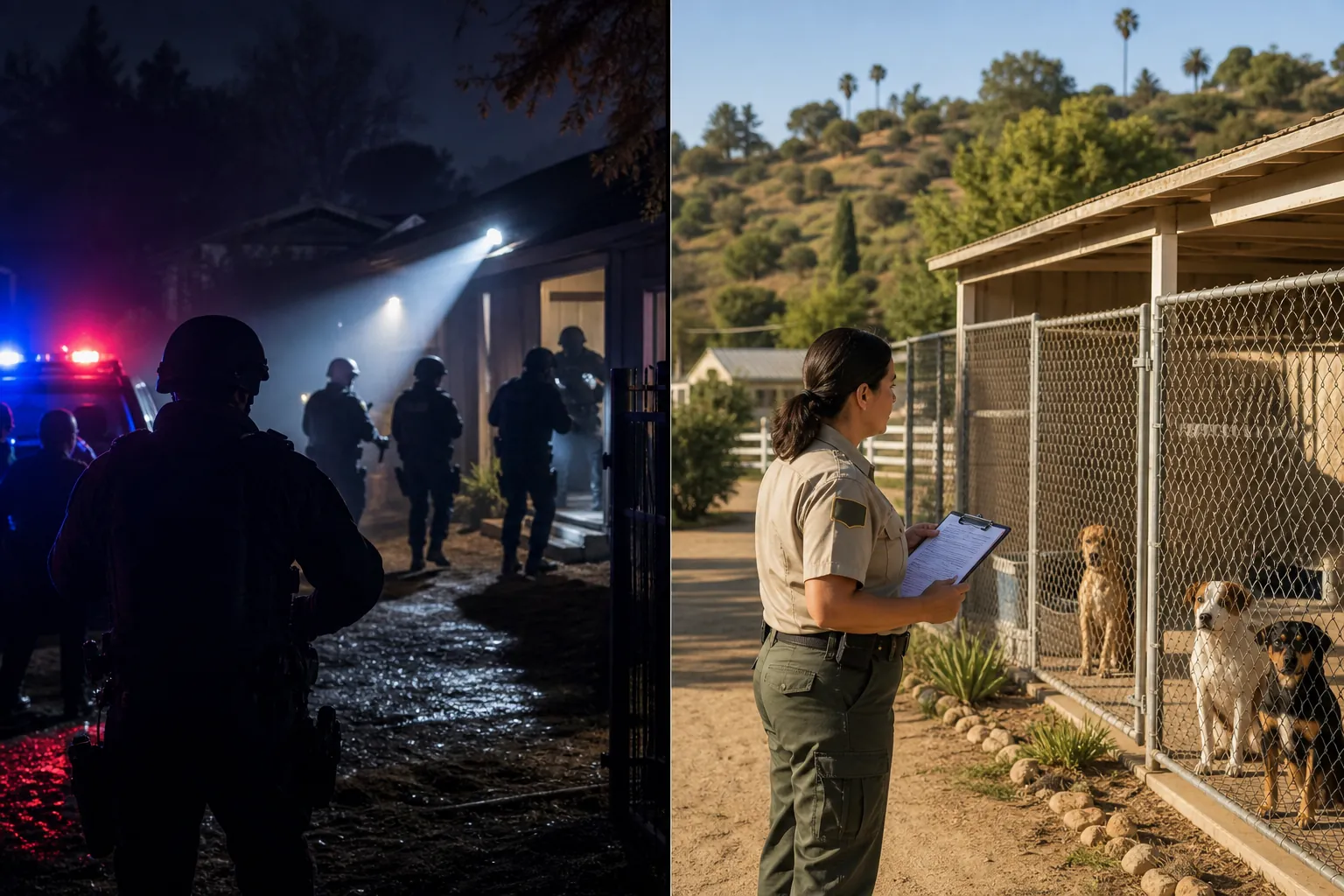
What the county statement actually supports
The Los Angeles County Department of Animal Care and Control statement is the load-bearing source. As reported by People, DACC said the warrant allowed lawful access to verify compliance with county codes and to evaluate animal care, safety conditions, and the welfare of dogs at the property. The same account reported DACC’s position that Blair’s kennel permit expired in 2023 and that the department had made unsuccessful attempts to contact her about renewal and compliance before the warrant was executed. DACC described the property as housing more than 100 dogs.[1]
That statement does not say the county had a criminal search warrant. It does not announce charges. It does not say animals were seized. It does not disclose the affidavit, the issuing court, or the warrant’s exact premises-and-items language. For anyone briefing the matter, those absences are not cosmetic. They are the difference between a confirmed administrative compliance event and a criminal exposure narrative that the public record does not yet support.
TMZ supplied much of the scene-setting that drove the “raid” framing: an early morning execution at about 6 a.m., roughly 70 personnel, district attorney investigators reportedly present, Blair described as “extremely cooperative,” and no animals removed. TMZ also reported that the instrument was an investigative warrant and “NOT a search warrant for any criminal conduct.”[2] Those details are relevant to how the event looked and how it was amplified. They are not a substitute for the warrant document, and several TMZ-only details remain reported rather than agency-confirmed.
| Point | Current status |
|---|---|
| Warrant type | Confirmed public framing: administrative inspection/investigative warrant for county-code and animal-welfare compliance; not confirmed as a criminal search warrant. |
| Dogs at issue | DACC statement reported more than 100 dogs. TMZ’s roughly 200-dog figure is reported by TMZ, not independently confirmed in the public agency statement. |
| Permit issue | DACC position, as reported: kennel permit expired in 2023, with unsuccessful contact attempts before the warrant. |
| Execution details | TMZ reported about 6 a.m., roughly 70 personnel, DA investigators present, Blair cooperative, and no animals removed. |
| Charges or citations | No known charges or citations were identified in the August 1–2 verification window. |
| Unavailable materials | Actual warrant, affidavit, docket, issuing judge, return, and precise scope. |
Why an administrative inspection warrant is not a criminal search warrant
Both instruments use the word “warrant,” and both implicate the Fourth Amendment. The similarity largely ends there. A criminal search warrant authorizes a search for evidence, contraband, fruits, or instrumentalities of crime, based on probable cause to believe that evidence of criminal conduct will be found in a particular place. An administrative inspection warrant authorizes access for a regulatory purpose, such as code enforcement, health-and-safety inspection, or licensed-activity compliance.
The Supreme Court’s administrative-inspection doctrine, associated with Camara v. Municipal Court, recognizes that routine regulatory inspections can require a warrant while also allowing that warrant to issue on a showing different from probable cause of crime. The Constitution Annotated summary describes administrative inspection warrants as capable of issuing on standards connected to reasonable legislative or administrative inspection schemes rather than the traditional criminal probable-cause model.[3]
That distinction is not a lawyer’s technicality. It is the legal category that tells a reader what the government was authorized to do. In the administrative setting, the point may be to inspect conditions, verify licensing status, count or evaluate animals, document safety hazards, and decide whether civil enforcement or corrective action is needed. The inspection does not become a criminal search merely because uniformed personnel are present, because entry occurs early in the morning, or because prosecutors’ investigators are reported to have observed or assisted.
The Institute for Justice’s administrative-warrant explainer makes the same basic category distinction in more practical terms: administrative warrants are government inspection tools used outside the ordinary criminal-investigation model, and their standards and safeguards differ from criminal warrants.[4] Whether a particular administrative warrant is valid still depends on the actual application, the authorizing law, the scope of entry, and how it was executed. In the Blair matter, those are precisely the documents the public does not yet have.
Applying that distinction to Blair’s property
The confirmed public classification is administrative because DACC’s statement described access to verify county-code compliance and evaluate animal care, safety, and welfare, while the reported predicate was an expired kennel permit and unanswered compliance contacts.[1] That is the vocabulary of inspection and permitting. It is not the vocabulary of a narcotics warrant, financial-crimes warrant, digital-device search warrant, or animal-cruelty charging announcement.
TMZ’s own account points in the same legal direction despite its “raided” headline language. It reported that the warrant was not for criminal conduct, that Blair cooperated, and that no animals were removed.[2] The personnel count and early-hour execution may explain why the scene felt like a raid to observers. They do not, without the warrant and affidavit, change the instrument into a criminal search warrant.
Deadline and other entertainment outlets repeated the agency’s compliance framing and Blair’s own description of the matter as a paperwork issue.[5] That does not prove Blair’s characterization is legally complete. It does, however, fit the current public record better than a criminal-suspicion narrative. Her rescue background is context, not a legal defense to inspection authority.
The Linda Blair WorldHeart Foundation describes itself as an animal-rescue organization associated with Blair’s long-running animal-welfare work.[6] That background helps explain why many readers understood the property as a rescue setting rather than a conventional commercial kennel. It does not answer the county’s permitting question, and it does not establish whether the conditions on the property complied with code.
The DA-investigator detail should be handled carefully
TMZ reported district attorney investigators were present and that the search was conducted at the behest of the Los Angeles County District Attorney.[2] That is a meaningful detail, but it is not enough to reclassify the warrant on the present record. DACC’s public description, as reported elsewhere, does not turn the matter into a criminal search warrant; it describes lawful access for code compliance and animal-welfare evaluation.[1]
Prosecutors’ offices can have investigators involved in matters that later remain civil or regulatory, and they can also become involved when facts raise possible criminal concerns. The point is not to minimize the possibility of escalation. The point is to keep the present-tense label attached to the present-tense record. As of the verification window, the record supports administrative inspection and active investigation, not announced criminal charges.
Where LA County animal rules fit
Los Angeles County’s Title 10 is the county animal-law frame. It covers animal-related regulation, including licensing, keeping, control, and enforcement mechanisms for animals and animal facilities.[7] In a kennel-permit dispute, that frame matters because the legal question may begin with whether a person has the required permit, whether the number or keeping of animals fits the permit, and whether conditions satisfy animal-care and safety requirements.
Regulatory enforcement can move in stages. Inspectors may seek access, document conditions, require compliance, issue citations, pursue abatement, or refer facts for other enforcement if the evidence supports it. Those are possible pathways, not findings in the Blair matter. The available public reports did not identify animals removed from the property or charges filed during the August 1–2 verification window.

This is where “raid” coverage does the most damage. It compresses the enforcement ladder into a single criminal-looking image. If the county later files citations, abatement papers, or charges, those documents will change the analysis. Until then, the cleaner legal description is administrative code-compliance inspection under an active investigation.
What cannot be concluded without the warrant
The unavailable warrant is not a footnote. Without it, no one outside the matter can responsibly state the issuing judge, the full legal basis, the exact areas authorized for inspection, the time-of-day authorization, the limits on photography or records review, or whether the warrant contained special execution conditions. The affidavit would matter even more for any challenge because it would show what facts the county presented to obtain access.
That limits the legal analysis in both directions. The public record does not support calling the event a criminal search warrant. It also does not support declaring the administrative warrant valid or invalid. A serious challenge would need the warrant application, the governing code provisions, the execution record, and any return or inventory.
For lawyers comparing this to other Fourth Amendment contexts, the same verification discipline applies. The warrant category comes before the merits argument. That is true in phone-search review, suppression-risk tracking, and AI-generated case summaries. The site’s cellphone search verification workflow uses the same basic habit: identify the legal instrument before drawing exposure conclusions.
A warrant-type checklist for lawyers, journalists, and AI-summary review
When a headline, intake memo, or AI-generated summary says “raid” or “search warrant,” classify the instrument before repeating the label. The following checklist is designed for fast review, not litigation briefing.
- What does the issuing or executing authority call the instrument? Use the agency statement, warrant face page, court docket, or return before using a headline label.
- What purpose does the warrant authorize? Code compliance, licensing inspection, welfare check, evidence seizure, arrest support, or another purpose?
- Does the source allege criminal conduct, or only regulatory noncompliance? Keep “probable cause of crime” separate from administrative probable cause.
- Are charges, citations, seizure orders, abatement proceedings, or removals documented? If not, say so plainly.
- Which facts are agency-confirmed and which come from unnamed press sources? Do not let reported execution details become the legal basis.
- Is the actual warrant available? If not, avoid claims about the issuing judge, affidavit contents, authorized areas, items to be seized, or time-of-day scope.
- Does the summary use “raid” as atmosphere or as legal characterization? If it is only atmosphere, replace it with the actual procedural label.
This is also the point at which AI review should slow down. Aggregators often compress “administrative warrant,” “investigative warrant,” “search,” and “raid” into a single event label. For a repeatable review method, compare the source hierarchy against an AI-claim workflow like Verify AI claims on personality and impulse-control sentencing: identify the claim, locate the primary source, separate quoted facts from inference, and downgrade any conclusion the source does not actually support.
On the current record, the accurate legal description is narrow: county animal-care authorities executed an administrative inspection or investigative warrant connected to expired kennel-permit and code-compliance issues at a property with more than 100 dogs; the investigation remained active; Blair was reported cooperative; no animals were reported removed; and no charges or citations were known in the August 1–2 verification window. There is no present public basis for calling it a criminal search warrant.
References
- Linda Blair Home Searched as Authorities Investigate Reported Kennel Operation, People.
- Linda Blair's Home Raided by Police, TMZ, July 31, 2026.
- Inspections, Constitution Annotated.
- Administrative Warrants, Institute for Justice.
- Linda Blair Kennel Search, Deadline.
- About Linda Blair, Linda Blair WorldHeart Foundation.
- Title 10 - Animals, Los Angeles County Code.
Related records
Tool profile
How Meta's AI Spending Reshapes Law Firm ProfitabilityGoverning regulation
Browse the obligations tracker →Preventive workflow
Browse verification workflows →
Report a correction or tip
Spotted an outdated figure, a misstated fact, or a ruling this case record should reflect? Public comments are disabled for this content given the professional cost of a misreported case outcome, penalty amount, or rule text — use the structured correction channel instead.
Report a correction or tip for this record →