
What the Lindsey Graham Guardianship Tells Us About AI Citation Risk
Examines how the Lindsey Graham–Darline guardianship story creates a hallucination trap for AI legal research tools, and what South Carolina Code provisions a lawyer should verify before relying on AI-generated answers about sibling guardianship.
- Jurisdiction
- South Carolina, United States
- Court
- South Carolina Family Court
- AI tool named
- AI legal research tool
- Ruling date
- Jul 29, 2026
- Source document
- View primary court order ↗
- Last verified
- Jul 29, 2026
Lex Machina Review is an independent risk-tracking and reference resource. Nothing on this site is legal advice, and using it does not create an attorney-client relationship. Every record is reviewed against primary sources but may not reflect the most current status of a matter — always verify directly against the cited court order, rule text, or a licensed attorney before relying on it.
Companion explanation — secondary to the source document above
The search query sounds simple enough: lindsey graham sister legal guardian law. The factual lure is compact and memorable. After Lindsey Graham’s parents died, he was reported to have become the guardian of his younger sister, Darline, while he was about 22 and she was about 13; later, after joining the Air Force, he adopted her so she could receive military benefits.[1][2]
That is exactly the kind of story that makes a legal-research answer look more reliable than it is. It has a famous name, a family tragedy, a sibling caretaker, a guardianship label, an adult adoption, and a benefits motive. A model can assemble those pieces into a fluent paragraph long before it has found the right statute.
The point is not that a documented AI system has been caught inventing a Lindsey Graham guardianship case. No such incident was identified in the materials reviewed for this article. The point is narrower and more useful: this story is a clean stress test for the kind of South Carolina guardianship question that invites citation drift.

The Statutory Split an AI Answer Has to Keep Straight
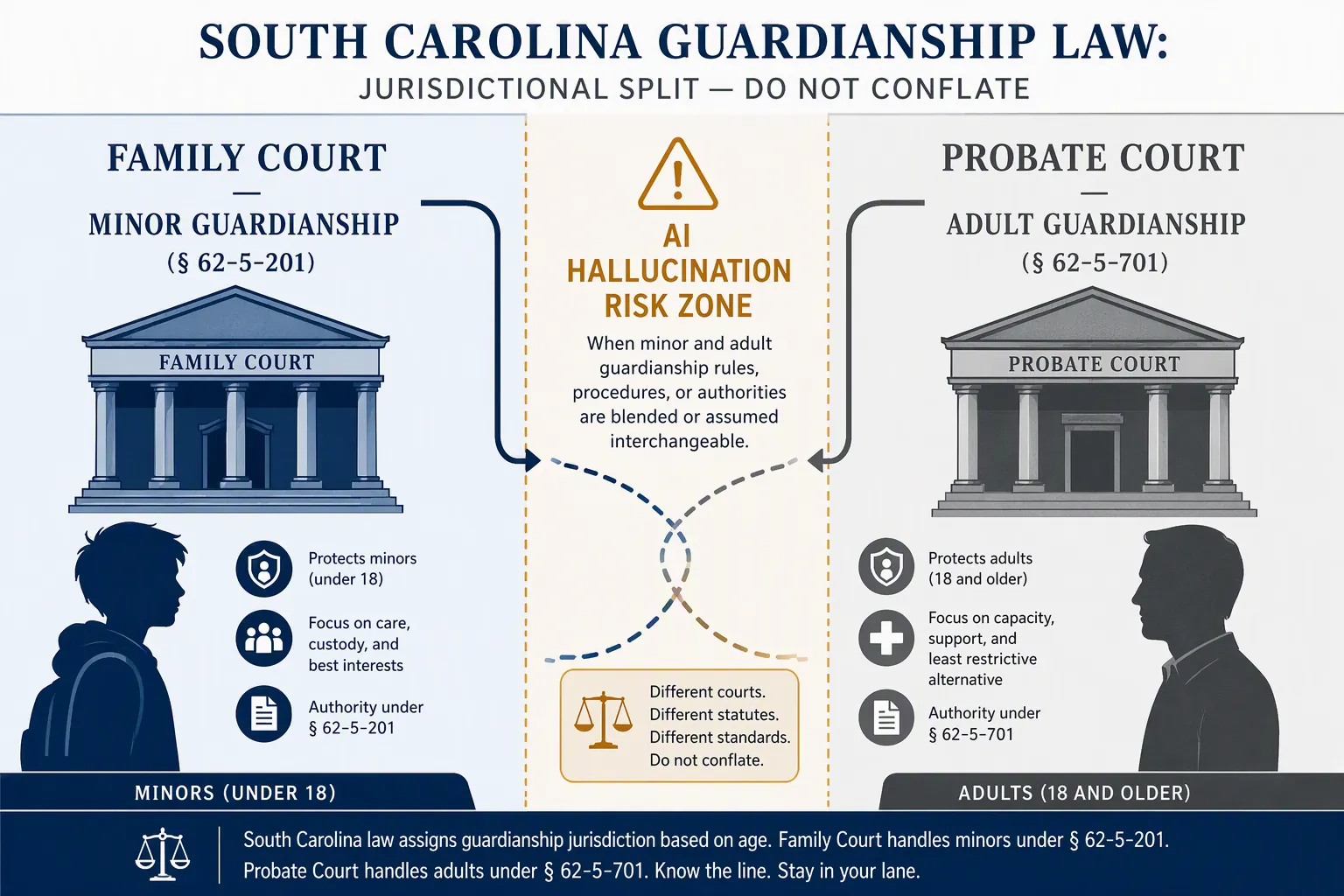
For a lawyer checking an AI-generated answer today, the first stop is not the biography. It is the current South Carolina Code. The relevant Article 5 provisions separate minor guardianship from adult guardianship in a way that a smooth narrative can easily conceal.
Current South Carolina Code § 62-5-201 gives the family court exclusive jurisdiction over guardianship of minors. Current § 62-5-701 separately addresses jurisdiction for guardianship and protective proceedings for adults in probate court.[3] Those two provisions are not interchangeable, even when the same family story contains both a child-care episode and an adult legal step.
| Question the AI answer may blur | Current South Carolina provision to check | Why it matters |
|---|---|---|
| Who has jurisdiction over a minor guardianship? | § 62-5-201 | Minor guardianship sits in family court under the current Code. |
| Who handles adult guardianship proceedings? | § 62-5-701 | Adult guardianship is a probate-court track, not the minor-guardianship track. |
| Where does a sibling fall in the adult priority list? | § 62-5-308(A)(7) | A sibling is seventh in the listed priority categories, not automatically first. |
| What must a petition include? | § 62-5-303 | The petition procedure matters before priority can do much work. |
| What examiner process applies? | § 62-5-303B | The adult-guardianship process includes examiner requirements that do not come from the family story. |
The Graham-Darline facts began with a minor. The reported later adoption was a separate adult adoption step tied in public accounts to Air Force benefits.[1][2] Treating those two events as one guardianship mechanism would be a legal error, not a harmless simplification.
The Sibling Detail Is Not a Sentimental Shortcut
Sibling care feels legally intuitive. If an older brother raises a younger sister after both parents die, a reader expects the law to recognize that relationship. The current South Carolina adult-guardianship priority list does recognize siblings, but not in the way an AI answer may casually imply.
Under current § 62-5-308(A), a sibling appears as the seventh of ten priority categories for appointment as guardian for an allegedly incapacitated adult.[3] That placement is an unglamorous statutory detail, but it is the kind that decides whether an answer is usable. “Sibling” is not the same as “automatic guardian,” and priority is not the same as appointment.
The current adult-guardianship procedure also does not begin and end with family rank. Section 62-5-303 governs petition procedure, and § 62-5-303B addresses examiner requirements.[3] A generated answer that says, in effect, “a sibling may become guardian under South Carolina law,” has not yet answered the legal question. It has only named a possible relationship.
That distinction matters because the Graham story is usually encountered as biography. Biography compresses sequence and procedure. Law does the opposite: it asks which court, which person, which date, which petition, which statutory version, and which remedy.
The 1977 Problem
There is another trap here. The current Code is a verification map for a lawyer working in 2026. It is not proof of what governed a South Carolina proceeding in the late 1970s.
The reviewed materials do not provide the exact court file, docket, petition, order, or statutory text used in the original Lindsey Graham guardianship matter. The current Article 5 framework also reflects later changes, including substantial revisions by 2017 Act No. 87 and further amendments in the 2023–2024 period.[3] A careful answer should therefore avoid saying that Graham became guardian “under § 62-5-201” or that any current priority category controlled the original event.
The safe formulation is more modest: public accounts report that Graham became responsible as guardian for his younger sister after their parents died; a lawyer researching a current South Carolina sibling-guardianship question should verify the current family-court and probate-court provisions separately; and historical claims about the 1970s proceeding require historical law and docket-level confirmation.
Where the Hallucination Usually Enters
Legal AI errors rarely announce themselves with nonsense. The more dangerous answer is the one that correctly remembers a public story, correctly knows that South Carolina has guardianship statutes, and then binds the two with an authority that has not been verified.
The Stanford RegLab and Stanford HAI evaluation of leading legal research tools found that retrieval-augmented generation systems still produced hallucinations, including incorrect or unsupported legal propositions, even though they performed better than general-purpose chatbots on many legal-research tasks.[4] That finding does not mean every generated guardianship answer is wrong. It means a lawyer should expect the failure mode and build the check before relying on the output.
- It may merge minor guardianship with adult guardianship, even though current South Carolina law sends minor guardianship and adult guardianship through different jurisdictional paths under § 62-5-201 and § 62-5-701.[3]
- It may treat the later adult adoption as if it were part of the guardianship code, even though the reported Air Force-benefits adoption is a separate adoption-law step.[1][2]
- It may overstate sibling status by implying automatic entitlement, even though a sibling appears seventh in the current adult-guardianship priority list under § 62-5-308(A)(7).[3]
- It may invent a case-style citation from the biography, because a public figure’s name, a family-law fact pattern, and a jurisdiction are enough raw material for a plausible-looking but unsupported authority.
- It may cite the current Code as if it governed the 1970s proceeding, despite later statutory revisions and the absence of the original docket materials in the reviewed sources.[3]
Damien Charlotin’s AI Hallucination Cases Database collects court episodes involving fabricated or erroneous AI-generated legal citations, and it is useful here as a cross-reference for the pattern rather than as proof of a Graham-specific incident.[5] The repeated lesson in those cases is not that lawyers failed to use a particular brand correctly. It is that a citation can look formal enough to survive casual review.
How to Check an AI Answer About This Story
A useful verification pass does not require a full treatise. It requires refusing to let the narrative choose the law for you.
- Identify the person whose status matters: a minor child, an allegedly incapacitated adult, an adoptive parent, or a benefits recipient.
- Identify the court path before accepting any citation: current § 62-5-201 for minor guardianship, current § 62-5-701 for adult guardianship and protective proceedings.[3]
- If the answer discusses adult guardianship priority, check § 62-5-308(A)(7) directly and confirm that sibling status is being used as a priority category, not as an automatic appointment rule.[3]
- If the answer describes procedure, check § 62-5-303 and § 62-5-303B rather than accepting a generic statement that a family member may petition.[3]
- If the answer makes a historical claim about Graham’s original guardianship, require historical statutory authority or docket-level material. Current law alone cannot carry that claim.
- If the answer connects the later adoption to military benefits, keep that fact separate from the guardianship analysis and verify the relevant adoption-law authority before using it.
This is also where a supervising lawyer should be precise when assigning review. “Verify the Lindsey Graham guardianship law” is too loose. A better instruction is: verify the current South Carolina Code sections the memo cites, identify whether the answer concerns minor guardianship, adult guardianship, or adoption, and do not let any AI-generated case name into a filing until the reporter, docket, or court record exists outside the tool.
The Practical Risk
The Lindsey Graham-Darline story is not legally difficult because the human facts are obscure. It is difficult because the human facts are vivid. Vivid facts encourage the answer to become one clean story, while the law separates the problem into jurisdiction, status, priority, petition procedure, examiner process, historical date, and adoption authority.
That is the citation-risk lesson. When an AI tool answers a question about sibling guardianship in South Carolina, the smoothest paragraph may be the one that has silently merged the most categories. Before relying on it, check the named Code sections, check the date of the governing law, and keep the reported adult adoption out of the guardianship analysis unless the adoption statute is actually being researched.
References
- Who is Darline Graham Nordone, the late Sen. Lindsey Graham’s sister, PBS NewsHour
- Darline Graham, Wikipedia
- South Carolina Code of Laws, Title 62, Article 5, South Carolina Legislature
- Hallucination-Free? Assessing the Reliability of Leading AI Legal Research Tools, Stanford Law School
- AI Hallucination Cases Database, Damien Charlotin
Related records
Tool profile
How Meta's AI Spending Reshapes Law Firm ProfitabilityGoverning regulation
Browse the obligations tracker →Preventive workflow
Browse verification workflows →
Report a correction or tip
Spotted an outdated figure, a misstated fact, or a ruling this case record should reflect? Public comments are disabled for this content given the professional cost of a misreported case outcome, penalty amount, or rule text — use the structured correction channel instead.
Report a correction or tip for this record →