
Legal analysis of the Mark Walter $16B disclosure gap
The SDNY/SEC investigation of Mark Walter centers on a $15.6 billion gap between reported and actual related-party investments at Delaware Life Insurance. This analysis outlines the four legal theories the dual-track probe supports and what the disclosure failure signals about fraud risk for insurer-affiliated credit structures.
- Jurisdiction
- US-Federal (SDNY)
- Court
- U.S. District Court for the Southern District of New York
- AI tool named
- No AI tool implicated
- Ruling date
- Jul 28, 2026
- Source document
- View primary court order ↗
- Last verified
- Jul 30, 2026
Lex Machina Review is an independent risk-tracking and reference resource. Nothing on this site is legal advice, and using it does not create an attorney-client relationship. Every record is reviewed against primary sources but may not reflect the most current status of a matter — always verify directly against the cited court order, rule text, or a licensed attorney before relying on it.
Companion explanation — secondary to the source document above
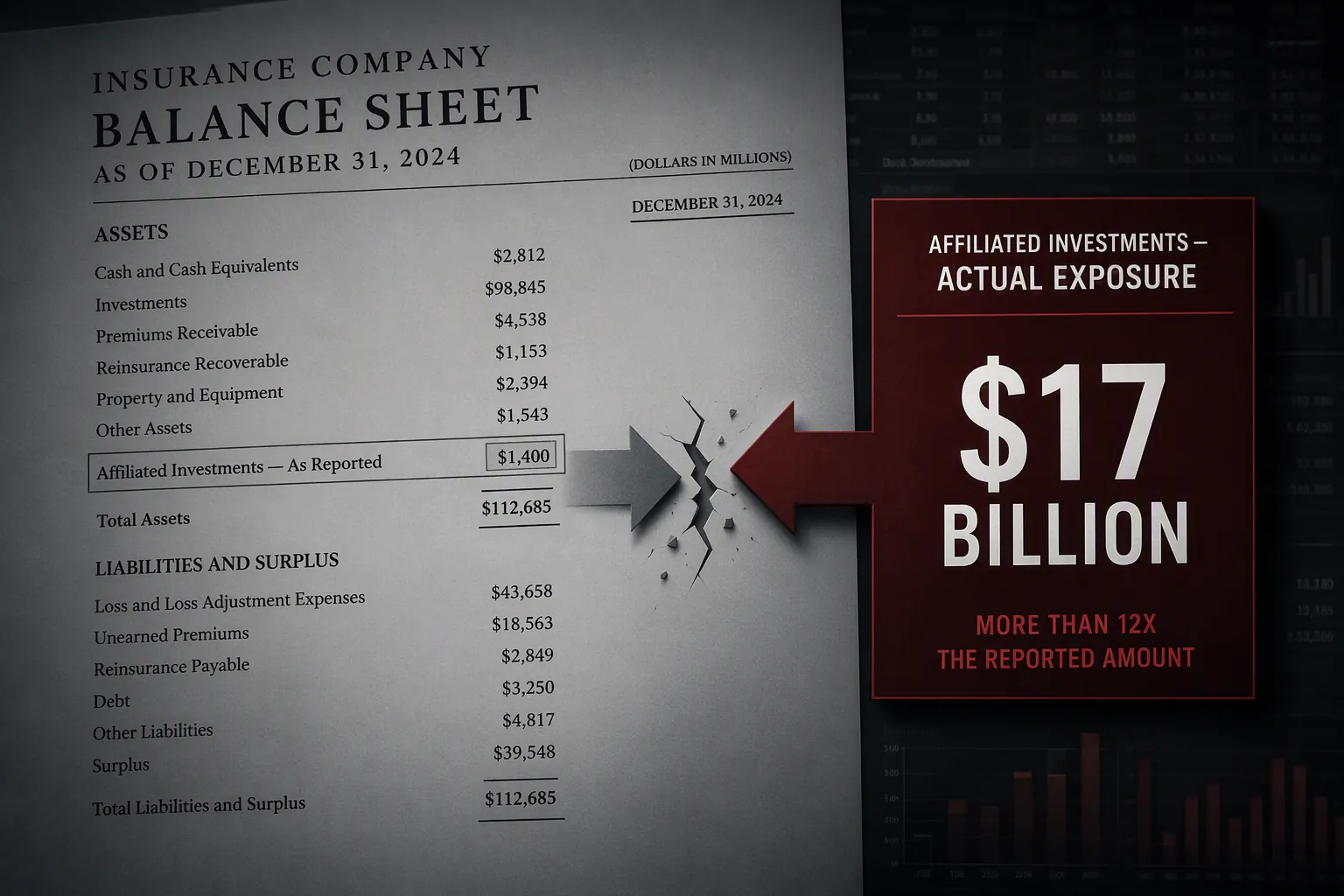
The legal analysis begins with a balance-sheet movement too large to treat as clerical background. Delaware Life Insurance reported $1.4 billion in affiliated investments, roughly 3% of total invested assets; after an internal review, the figure was identified as more than $17 billion, about 39% of total invested assets, as reported on July 28, 2026.[1][2]
That is not a footnote changing color. It is a disclosure category moving from low-concentration exposure to a balance-sheet-defining concentration. The gap is at least $15.6 billion. In legal terms, the important point is not that the affiliated structure was complicated; it is that the reporting regime exists precisely so affiliated investments do not disappear into ordinary invested-asset totals.
Why the affiliated-investment label matters
The legal significance of the Delaware Life gap depends on the rules that make affiliate exposure visible. SSAP No. 25 addresses accounting and disclosure for affiliates and other related parties in statutory financial statements; the NAIC insurance holding company framework separately requires attention to transactions and relationships within an insurance holding company system.[3][4]
Those requirements do not turn every affiliated investment into misconduct. An insurer can hold affiliated investments. An asset manager can operate near an insurance balance sheet. The question is whether the exposure was properly identified, measured, approved where necessary, and disclosed in the place where regulators, rating agencies, counterparties, and policyholder-protection officials expect to see it.
That is why the percentage movement matters. A reader seeing 3% affiliated-investment exposure would understand Delaware Life as having limited related-party concentration. A reader seeing about 39% would understand something materially different: a large portion of invested assets sat inside affiliate-linked channels. The rules are not decorative at that point. They are the architecture that lets outsiders distinguish ordinary portfolio credit risk from related-party concentration risk.
The harder question for investigators is not whether a revised figure looks bad. It is whether the original reporting was misleading under a defined duty, whether the omission was material, and whether the evidence supports a culpable state of mind. The size of the gap supplies a serious factual predicate. It does not, by itself, answer who knew what, when they knew it, or whether the filings and communications at issue crossed the threshold from deficient reporting into fraud.
The known procedural record
The investigation did not begin as a generalized complaint about private credit or insurance ownership structures. Bloomberg Law reported that a Guggenheim Investments employee internally questioned revenue booking in late 2023 or early 2024, and that the inquiry later cascaded into the insurers’ related-party exposure.[2]
| Event | Legal significance |
|---|---|
| Late 2023 or early 2024: employee internally questions revenue booking at Guggenheim Investments.[2] | Provides a reported internal trigger rather than an abstract policy concern. |
| September 2024: FBI executes a search warrant on Walter’s private plane at Chicago Midway, according to Bloomberg Law reporting.[5] | Shows criminal-investigative escalation, while not establishing charges or liability. |
| February 2026: SDNY grand jury subpoenas are issued to Delaware Life, affiliate insurers, and Guggenheim Partners, according to Bloomberg Law.[2] | Places the insurer disclosures and affiliated entities inside a grand jury evidence-gathering track. |
| June 2026: S&P Global Ratings revises Delaware Life Insurance Co.’s outlook to negative while affirming its A- rating.[6] | Shows rating-agency concern without implying a finding of fraud. |
| July 28, 2026: reports identify the affiliated-investment revision from $1.4 billion to more than $17 billion.[1][2] | Frames the disclosure gap that gives the legal theories their factual weight. |
The FBI search warrant and the grand jury subpoenas are serious signals, but they should not be made to carry more than the sourced record supports. A search warrant reflects a judicially authorized investigative step. A subpoena seeks evidence. Neither is a conviction, a charge, or a final agency conclusion.
Four legal theories the record can support
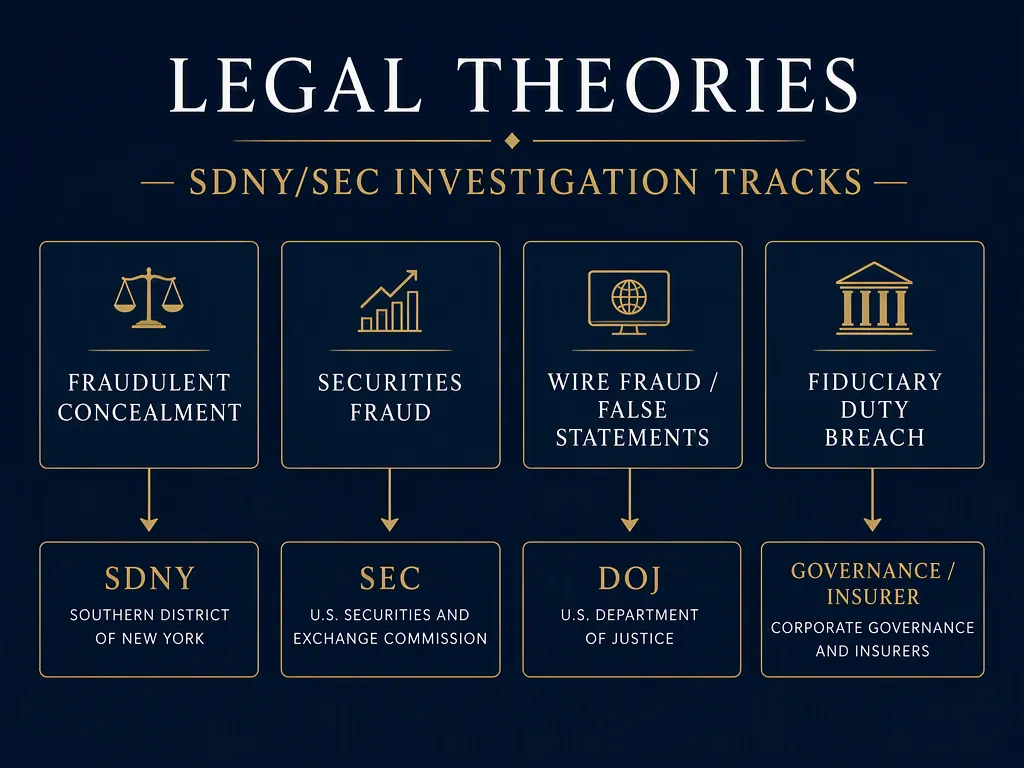
The dual-track posture matters because the government does not need every theory to survive in the same form. The SDNY criminal inquiry and the SEC civil interest can proceed along distinct evidentiary paths. The same disclosure gap may be relevant to several theories, but each theory requires a different fit between duty, statement, omission, materiality, state of mind, and harm.
Fraudulent concealment
A fraudulent-concealment theory is the most direct way to understand the disclosure gap. The question is whether Delaware Life or responsible actors had a duty to disclose affiliated investments under the applicable statutory-accounting and holding-company framework, whether the $1.4 billion figure left a materially false impression, and whether the omission was knowing or reckless rather than the product of an explainable classification failure.
The magnitude gives prosecutors a rational starting point. A movement from approximately 3% to about 39% is difficult to characterize as a marginal judgment call. Still, fraudulent concealment would require more than arithmetic. Investigators would need evidence about internal knowledge, classification decisions, review procedures, communications with auditors or regulators, and the path by which the revised figure emerged.
Securities fraud
The SEC’s parallel interest would not simply duplicate the SDNY criminal track. A securities-fraud theory would ask whether investor-facing statements, offering materials, valuation communications, or other securities-related disclosures were materially misleading because they failed to reveal the true scale of insurer-affiliate exposure. The research record supports the existence of SEC civil interest, not a resolved finding that securities fraud occurred.
That distinction matters. A statutory insurance filing can be misleading for insurance-regulatory purposes without automatically becoming securities fraud. The securities case would need its own connection to securities transactions, investors, or market-facing statements. The disclosure gap may be the factual center, but the SEC still needs a securities-law pathway.
Wire fraud or false statements
Wire-fraud or false-statement exposure would turn on the transmission and use of misleading information. If regulator submissions, electronic communications, certification materials, or responses to examiners carried the understated affiliated-investment figure, prosecutors could examine whether those communications were part of a scheme to mislead or contained knowingly false statements.
The conditional matters. The public record, as summarized here, identifies the gap, the whistleblower sequence, the search warrant, and the subpoenas. It does not establish the contents of every communication or filing under review. That evidence is exactly what subpoenas and warrants are designed to obtain.
Fiduciary-duty breach
The fiduciary-duty theory belongs to insurer governance. Directors, officers, and responsible control personnel do not merely receive investment numbers; they oversee the systems that classify affiliate exposure, route transactions for review, and protect the insurer from conflicts embedded in a holding-company structure.
Here, the alleged governance problem is not that affiliated investments existed. It is that the apparent affiliated-investment concentration presented to outsiders was dramatically lower than the figure later identified after internal review. For a fiduciary-duty claim, the important evidence would include board materials, committee minutes, control certifications, escalation records, and the handling of the whistleblower-raised issues.
What the whistleblower sequence adds
The whistleblower sequence gives the investigation a practical origin. An internal question about revenue booking reportedly came first; the insurer-affiliate disclosure problem followed from that internal review path.[2] That sequence does not prove concealment. It does make the case harder to describe as a purely external misunderstanding of a complicated business model.
For counsel, the sequence also marks where document review will likely become decisive. The relevant record is not limited to final statutory statements. It includes the first internal complaint, management’s response, the decision to expand review into insurer exposures, drafts of revised schedules, communications with ratings analysts or regulators, and any effort to reconcile investment systems against affiliate definitions.
If those materials show rapid escalation, careful legal review, and good-faith classification disputes, the legal posture changes. If they show warnings ignored while public or regulatory reporting continued to carry the lower figure, the same disclosure gap becomes more dangerous. The number is the predicate; the documents supply the state-of-mind evidence.
The rating action is corroborating context, not a verdict
S&P Global Ratings’ June 2026 action deserves careful placement. The agency revised Delaware Life Insurance Co.’s outlook to negative while affirming the A- rating.[6] That is meaningful risk context, particularly for readers concerned with insurer strength, counterparty confidence, and market discipline. It is not a fraud finding.
The negative outlook helps explain why disclosure quality matters beyond courtroom theory. An insurer balance sheet depends on confidence in asset quality, governance, liquidity management, and regulatory transparency. When affiliated exposure is revised by an order of magnitude, rating analysts do not have to decide criminal intent to treat the event as relevant to credit risk.
What similar insurance-and-asset-management structures should take from this
The practical lesson is narrower than the scandal framing. Firms using insurer-affiliated credit structures should treat affiliate-investment reporting as a fraud-risk control point. That means the legal department cannot leave SSAP No. 25 and holding-company reporting entirely to accounting workflow, and accounting cannot treat affiliate status as a static field in a portfolio system.
- Build the affiliate map from control relationships, investment vehicles, side agreements, and management arrangements before the reporting period closes.
- Reconcile statutory investment schedules against the affiliate map, rather than relying only on issuer names or legacy system tags.
- Require legal review when an investment is classified as non-affiliated despite economic ties to the asset manager, sponsor, or holding-company system.
- Create an escalation path for whistleblower or employee concerns that can reach insurance-regulatory counsel, not only revenue-accounting personnel.
- Keep board and committee records specific enough to show what affiliated-exposure information was reviewed and what questions were asked.
The Delaware Life revision gives investigators a sustainable factual predicate because the gap is both large and located inside a defined disclosure regime. The open issues are evidentiary: knowledge, intent, communication paths, governance response, and the use of the understated figure in regulatory or securities-related contexts. Until those issues are resolved, the sound legal conclusion is not that charges are inevitable. It is that an order-of-magnitude related-party disclosure failure is exactly the kind of fact pattern that turns statutory-accounting classification into fraud-risk evidence.
References
- Los Angeles Times report on Delaware Life affiliated investments — Los Angeles Times, July 28, 2026. Source link not provided in research brief.
- Bloomberg Law report on Delaware Life affiliated investments, whistleblower trigger, and SDNY subpoenas — Bloomberg Law, July 28, 2026. Source link not provided in research brief.
- SSAP No. 25—Affiliates and Other Related Parties — NAIC. Source link not provided in research brief.
- Insurance Holding Company System Regulatory Act / NAIC Holding Company Act framework — NAIC. Source link not provided in research brief.
- Bloomberg Law report on FBI search warrant at Chicago Midway involving Mark Walter’s private plane — Bloomberg Law, September 2024, updated July 2026. Source link not provided in research brief.
- S&P rating action on Delaware Life Insurance Co. outlook and A- rating — S&P Global Ratings, June 2026. Source link not provided in research brief.
Related records
Tool profile
How Meta's AI Spending Reshapes Law Firm ProfitabilityGoverning regulation
Browse the obligations tracker →Preventive workflow
Browse verification workflows →
Report a correction or tip
Spotted an outdated figure, a misstated fact, or a ruling this case record should reflect? Public comments are disabled for this content given the professional cost of a misreported case outcome, penalty amount, or rule text — use the structured correction channel instead.
Report a correction or tip for this record →