
What the Mark Walter probe means for the Dodgers, Lakers
As of Aug. 3, 2026, the federal probe of Mark Walter's insurance empire has produced no team-level action — no Walter-owned club is named and no league penalty is pending — even though the insurer-linked capital behind the Dodgers and Lakers purchases is at the center of the investigation. This franchise-risk assessment separates what changes today from the two triggers that history shows would be needed to force divestiture.
- Jurisdiction
- US federal
- Court
- Federal grand jury
- AI tool named
- No AI tool named
- Ruling date
- Aug 3, 2026
- Source document
- View primary court order ↗
- Last verified
- Aug 3, 2026
Lex Machina Review is an independent risk-tracking and reference resource. Nothing on this site is legal advice, and using it does not create an attorney-client relationship. Every record is reviewed against primary sources but may not reflect the most current status of a matter — always verify directly against the cited court order, rule text, or a licensed attorney before relying on it.
Companion explanation — secondary to the source document above
As of Aug. 3, 2026, the Mark Walter federal investigation has produced no team-level action against the Dodgers, Lakers, Sparks, or PWHL. No Walter-owned club is named in the reported investigation, no league enforcement proceeding is pending, and neither MLB nor the NBA has publicly announced a disciplinary process tied to the teams. For the confirmed-vs.-reported baseline on the investigation itself, see what is verified in the Mark Walter federal investigation; the narrower question here is what, if anything, changes for the franchises. The answer today is operationally simple even if the financing story is not: the clubs keep operating, while Walter’s insurer-linked capital structure moves deeper into counterparty risk memos.[1]
That distinction matters. A federal probe touching an owner’s insurance and investment empire is not the same thing as a league finding that a franchise has violated league rules, lost financial control, or become unfit to operate under a best-interests standard. It may eventually become evidence in a league file. It may affect lenders, sponsors, minority investors, or transaction approvals. But as of this date, there is no public team sanction to price into Dodgers baseball operations, Lakers basketball operations, Sparks business planning, or PWHL governance.

The live risk sits above the teams
The Dodgers and Lakers are exposed to the story because their owner’s acquisition capital is part of the story. They are not, on the present public record, enforcement targets. That is why the more useful franchise-risk question is not “Will a scandal force a sale?” but “What would have to happen before a league, lender, sponsor, or board committee treats the owner-level probe as a team-level problem?”
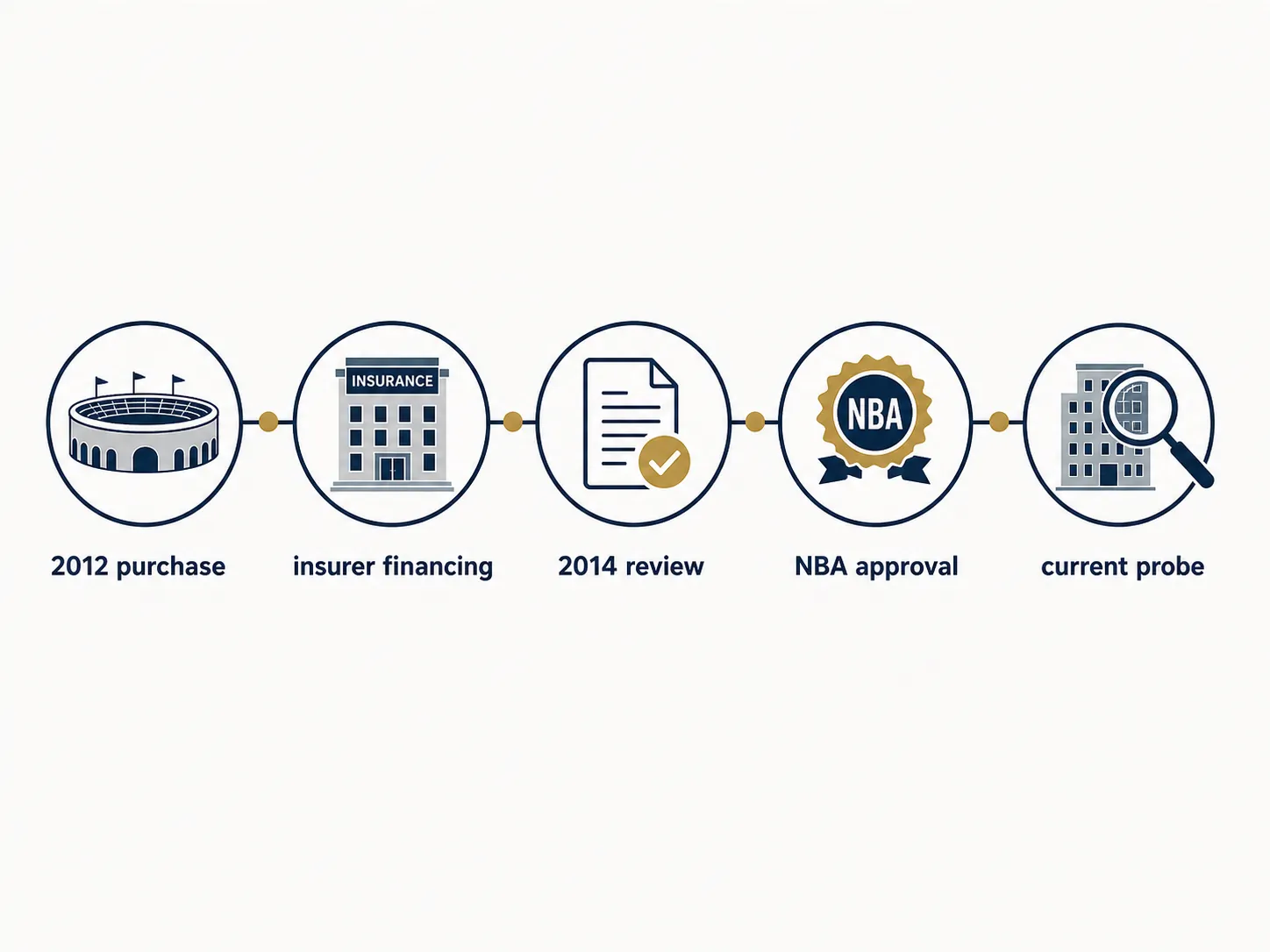
The Dodgers’ 2012 purchase is the starting point because more than $1 billion of that transaction reportedly came from Walter-controlled, Guggenheim-managed insurance companies. State insurance regulators reviewed the purchase in 2014 and found no irregularities, a fact that should not be erased merely because the same architecture is now under fresh scrutiny.[2][3]
The Lakers are the second major franchise node. The NBA Board of Governors unanimously approved Walter’s controlling-stake purchase at a valuation of roughly $10 billion, making the approval itself a relevant league-action fact rather than background color.[4] The timing is messier than some summaries suggest: USA Today described the approval as occurring last fall before the subpoenas became public, while FindLaw described approval as coming months after subpoenas had issued but before the probe became public.[1][2] That discrepancy should be kept as an attribution issue, not resolved by assumption.
Four large numbers that should not be merged
The worst way to brief this matter is to collapse every large dollar figure into a single “scandal number.” The current record contains different measures from different contexts: loans under examination, related-party exposure, previous disclosure levels, a Lakers valuation, and a Mubadala-linked investment line. They may intersect in the same risk narrative, but they do not measure the same thing.
| Figure | What it measures | Why it matters for franchise risk |
|---|---|---|
| $16 billion | Loans under examination as framed in coverage of the reported insurance-company investigation.[5][6] | A headline-scale investigation figure; not a team debt figure and not a league penalty. |
| At least $17 billion / 39% | Restated related-party exposure in June 26, 2026 regulatory filings, measured as of Dec. 31, 2025.[5] | The strongest document-driven risk signal because it changes the reported exposure profile of the insurer entities. |
| About $1.4 billion / 3% | The previously reported related-party exposure before the June 26 restatement.[5] | The comparison point that makes the restatement material; it is not a separate loss number. |
| Roughly $10 billion | The Lakers controlling-stake valuation and, separately, the reported scale of the April 2025 TWG-Mubadala investment context.[4][7] | A transaction-valuation and investment-context number; it should not be treated as the same measure as insurance exposure. |
The June 26 restatement deserves more attention than the airport scene. Bloomberg-reported facts include the FBI seizure of Walter’s phone on a plane at Chicago Midway on Sept. 18, 2025, grand jury subpoenas to Delaware Life and Clear Spring in February 2026, and the later regulatory filings that restated related-party exposure from roughly $1.4 billion, or 3%, to at least $17 billion, or 39%.[5] The device seizure is the detail that travels fastest. The restatement is the detail that changes a credit memo.
Ratings actions are the institutional signal
S&P affirmed Delaware Life’s A- rating but placed the outlook negative, citing uncertainty around management and compliance risks.[8] Fitch then placed Delaware Life on Rating Watch Negative on July 22, 2026.[9] Those actions do not say the Dodgers are distressed, that the Lakers must be sold, or that a league has found wrongdoing. They do say professional credit analysts see enough uncertainty around the insurer entities to mark the risk differently.
That is the right level of concern. A sponsor renewing a multiyear deal, a lender looking at a facility, a league finance committee reviewing future owner liquidity, or counsel negotiating change-of-control language does not need a criminal charge to update diligence questions. It does need to avoid pretending that a ratings outlook is the same as a league order.
The Mubadala-related line should be handled with the same discipline. Bloomberg Law sources described an early investigative focus on whether the Abu Dhabi fund was misled about valuations in the April 2025 TWG investment; the public materials summarized here do not establish the current status of that line of inquiry.[5] Mubadala Capital announced a multi-billion-dollar investment alliance with TWG Global in April 2025, but that announcement is not itself an accusation and should not be read as one.[7]
What would have to happen before MLB or the NBA intervened
There are two plausible triggers that would move this from owner-level scrutiny toward franchise-level intervention. The first is personal charges against Walter or a filed accusation that directly affects his suitability, control, or representations to a league. The second is a formal league best-interests process, whether grounded in misconduct, financial-control concerns, or a finding that the owner’s conduct threatens the league or club.
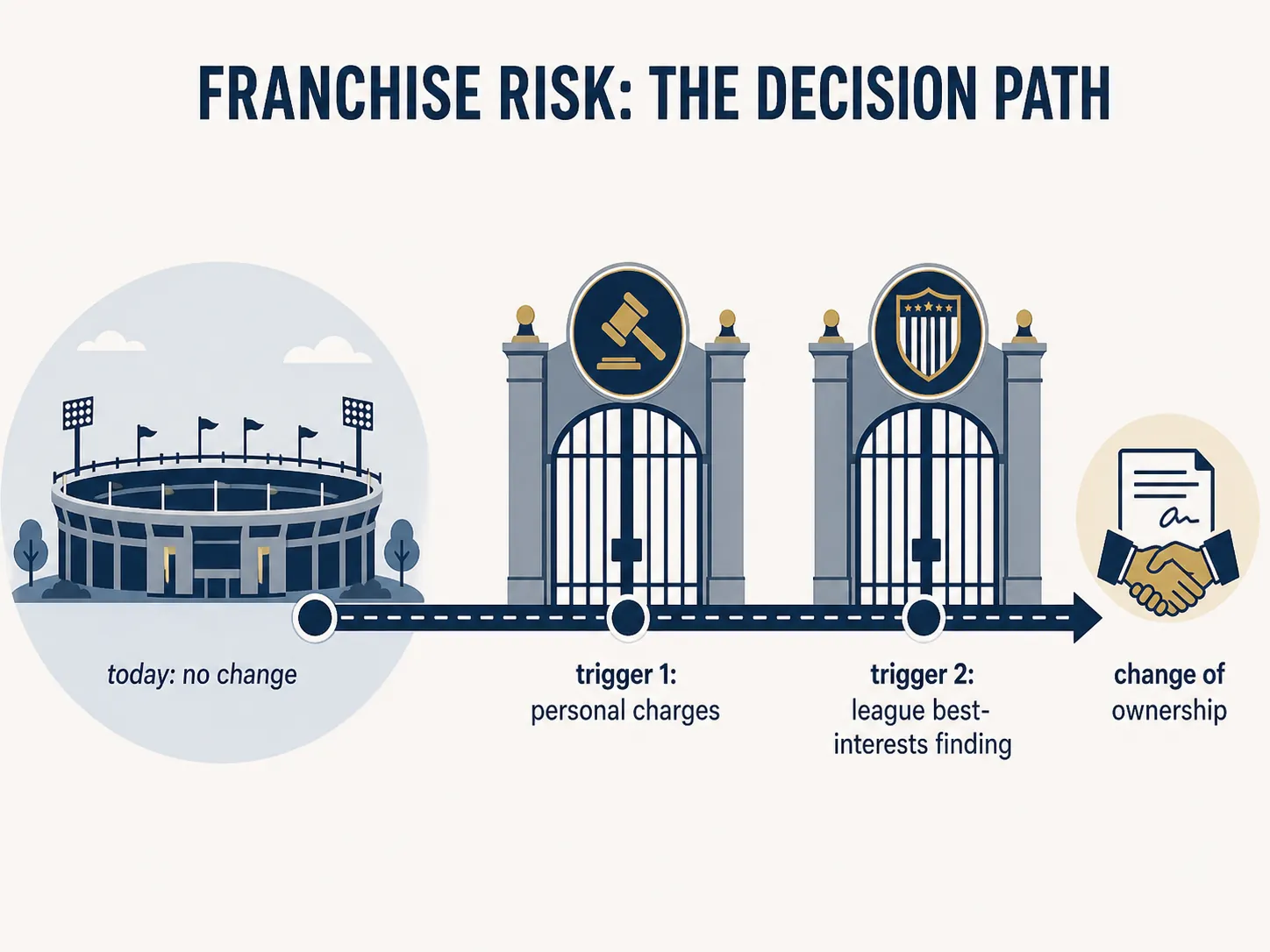
Those triggers are not formal magic words; leagues retain broad discretion. But in franchise practice, silence usually breaks when the matter becomes either a personal-conduct problem the league cannot ignore or a financial-control problem that interferes with the club. A collateral investigation into owner-affiliated capital, without charges and without a named team, sits short of that line.
Trigger one: personal charges
No charges have been filed against Walter in the materials summarized here, and there is no formal accusation in a court record as of Aug. 3, 2026. That caveat carries real weight. A subpoena, a device seizure, a reported investigative focus, and a ratings action can all matter without becoming proof of criminal liability.
If personal charges were filed, the league analysis would change quickly because suitability, candor, control, and reputational harm would become active issues rather than contingency planning. That would not automatically dictate a sale, but it would give MLB or the NBA a concrete event around which to open or escalate a process.
Trigger two: a league best-interests process
The second path does not require a criminal conviction. Leagues have their own governance standards and can act when an owner’s conduct, finances, or control problems are judged harmful to the league or franchise. But a league process still needs something firmer than public discomfort: a rule issue, a control issue, a misconduct finding, a material misrepresentation, or a best-interests determination.
That is why the absence of a named team matters. If prosecutors, regulators, or league investigators eventually connect franchise acquisition representations, team debt, league approvals, or control rights to the alleged insurance-company issues, the analysis tightens. Without that bridge, the story remains serious but one step removed from the clubs.
The precedents do not support a shortcut to forced sale
McCourt, McNall, Sterling, and Sarver are useful only if kept in their proper lanes. They show that leagues can force, pressure, or effectively engineer ownership change. They do not show that every investigation involving an owner’s business empire turns into divestiture.
| Precedent | Risk lane | Why it is not a clean analogue |
|---|---|---|
| Frank McCourt / Dodgers, 2011 | Bankruptcy and league control concerns.[1] | A club-control and solvency fight, not a collateral insurance-company investigation without a named team. |
| Bruce McNall / Kings, 1994 | Personal criminal exposure.[1] | A personal-criminal lane, closer to the first trigger than to the present no-charge posture. |
| Donald Sterling / Clippers, 2014 | Personal misconduct and league action.[1] | A misconduct finding with direct reputational and governance consequences, not a financing-structure inquiry. |
| Robert Sarver / Suns, 2022 | Misconduct findings and reputational pressure.[1] | A league-investigated conduct case, not an insurer-exposure restatement tied to acquisition capital. |
The precedent lesson is narrower than the usual forced-sale headline. A league can act when the facts become direct enough: team insolvency, control breakdown, personal criminal liability, or misconduct findings that trigger best-interests authority. The Walter record, as publicly described today, has not reached that point. It is still possible for later filings, charges, or league fact-finding to close the gap.
The trade deadline is a weak proxy for the real exposure
For Dodgers fans, the most immediate version of the question is whether the investigation changes trade-deadline behavior. The public record does not support that conclusion. Coverage of the deadline context points instead to continued competitive spending, the Dodgers’ long-term local television revenue, and the Ohtani contract as baseball-revenue facts rather than evidence that Walter’s insurer-linked capital is needed for every roster move.[10]
That does not make the probe irrelevant to baseball economics. It means the deadline is too small a window to measure the durable risk. The more important questions are whether future financing, sponsor diligence, league approvals, or ownership-liquidity reviews begin to treat the insurer exposure as impaired.
What would change the assessment
The first watch item is a filed charge or formal accusation against Walter personally. That would move the matter from reported investigative activity to a legal event that leagues and counterparties would have to process directly.
The second is any public league step: a best-interests inquiry, finance-committee review with stated concerns, ownership-condition demand, suspension, forced governance change, or explicit finding that the conduct at issue affects a club. League silence is not proof of comfort, but it is still materially different from a pending proceeding.
A secondary watch item is impairment in the insurer-linked financing structure severe enough to affect owner liquidity, pledged interests, acquisition representations, or future approvals. Even then, financial stress alone would not automatically force a Dodgers or Lakers sale. It would matter because it could supply the bridge from owner-level risk to franchise-control risk.
That leaves the current posture in two parts: no operational impact on the teams as of Aug. 3, 2026, and real structural scrutiny around the capital that helped put Walter in position to own them. The gap between those statements is where the responsible franchise-risk analysis belongs.
References
- What Mark Walter's federal probe means for the Dodgers and Lakers, USA Today, July 20, 2026
- How Mark Walter’s Insurance Investments Landed Him in a Federal Probe, FindLaw
- Dodgers, Lakers owner Mark Walter companies probed, Los Angeles Times, July 28, 2026
- Report: Mark Walter’s insurance companies, Guggenheim face federal probe, Sports Business Journal, July 20, 2026
- LA Dodgers Owner Mark Walter’s Phone Was Seized Last Year by FBI, Claims Journal, July 22, 2026
- Dodgers and Lakers owner dragged into shocking $16B scandal, New York Post, July 28, 2026
- TWG Global and Mubadala Capital to Enter Multi-Billion Dollar Investment Alliance, Mubadala Capital, April 2025
- Delaware Life Insurance Co. Ratings Affirmed At 'A-' On Uncertain Management And Compliance Risks; Outlook Negative, S&P Global Ratings
- Fitch Places Delaware Life on Rating Watch Negative, Fitch Ratings, July 22, 2026
- Dodgers' Mark Walter investigation, trade deadline, USA Today, July 30, 2026
Related records
Tool profile
How Meta's AI Spending Reshapes Law Firm ProfitabilityGoverning regulation
Browse the obligations tracker →Preventive workflow
Browse verification workflows →
Report a correction or tip
Spotted an outdated figure, a misstated fact, or a ruling this case record should reflect? Public comments are disabled for this content given the professional cost of a misreported case outcome, penalty amount, or rule text — use the structured correction channel instead.
Report a correction or tip for this record →