
What courts actually decided on Medicaid work requirements
A docket-by-docket record of Medicaid work-requirement litigation from Stewart v. Azar (2018) through the pending Massachusetts v. Oz challenge, with court, judge, ruling date, status, and the coverage-loss figure at stake in each case. The piece closes with a merits outlook for the January 1, 2027 implementation date.
- Jurisdiction
- US-Federal
- Court
- Multiple federal courts (D.D.C., D.C. Circuit, Supreme Court, D. Mass.)
- Judge
- Judge Boasberg; Judge Sentelle
- AI tool named
- No AI tool implicated
- Ruling date
- Apr 18, 2022
- Source document
- View primary court order ↗
- Last verified
- Aug 4, 2026
Lex Machina Review is an independent risk-tracking and reference resource. Nothing on this site is legal advice, and using it does not create an attorney-client relationship. Every record is reviewed against primary sources but may not reflect the most current status of a matter — always verify directly against the cited court order, rule text, or a licensed attorney before relying on it.
Companion explanation — secondary to the source document above
This is a legal record, not legal advice. The useful question for Medicaid work requirements legal challenges and impact is narrower than the political shorthand usually allows: which court reviewed which government action, under what posture, and what happened to coverage while that review was pending.
One limit should be stated at the start. The record supplied here identifies the rulings, dates, courts, status, and the coverage-loss issue each decision turned on, but it does not supply case-specific numeric coverage-loss estimates for Kentucky, Arkansas, or the pending Massachusetts case. Those figures should not be invented to make a tracker look complete.
| Case or legal event | Docket / court / judge | Ruling date or posture | What was decided | Status flag | Coverage-loss figure at stake |
|---|---|---|---|---|---|
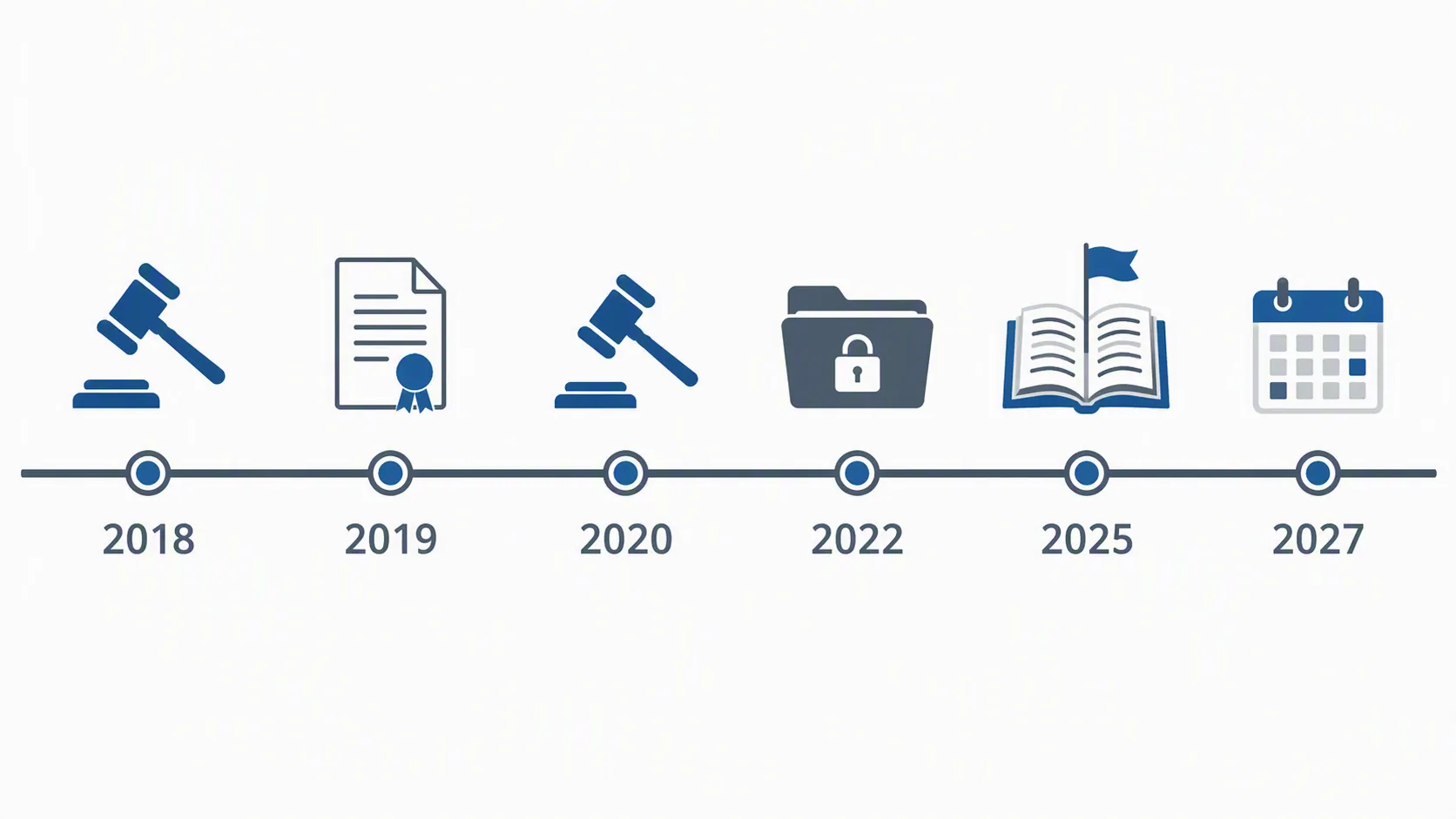
| Stewart v. Azar | No. 18-152; U.S. District Court for the District of Columbia; Judge Boasberg | June 29, 2018 | Kentucky waiver approval vacated; the approval failed because the Secretary had not adequately weighed coverage loss. | Vacated | Coverage loss was central to the ruling, but no precise numeric figure is supplied in the provided record. [1] |
| Gresham v. Azar | No. 18-1900; U.S. District Court for the District of Columbia; Judge Boasberg | March 27, 2019 | Arkansas waiver approval vacated; the ruling halted Arkansas disenrollments midstream. | Vacated; disenrollments halted | Disenrollments were already occurring, but no precise numeric figure is supplied in the provided record. [2] |
| Gresham v. Azar | No. 19-5094; U.S. Court of Appeals for the D.C. Circuit; Judge Sentelle | February 14, 2020 | Unanimous affirmance; the Secretary’s approval was arbitrary and capricious because coverage impact had been ignored. | Affirmed | The appellate holding turned on ignored coverage impact, not on a new numerical finding. [3] |
| Azar v. Gresham | Supreme Court of the United States | Certiorari granted in December 2020; dismissed April 18, 2022 | The Court dismissed the case as moot after Biden HHS withdrew the approvals; it issued no merits ruling on the waiver framework. | Moot | No coverage-loss merits determination by the Supreme Court. [4] |
| One Big Beautiful Bill Act | P.L. 119-21; federal statute | Signed July 4, 2025; implementation date January 1, 2027 | Mandates 80 hours per month of qualifying activity for expansion-group eligibility in 44 jurisdictions, including DC. | Enacted; not yet effective as of August 4, 2026 | The provided record identifies the affected expansion-group eligibility rule, but no adjudicated coverage-loss number. [5] |
| Commonwealth of Massachusetts et al. v. Oz et al. | U.S. District Court for the District of Massachusetts; docket and judge not supplied in the provided record | Pending as of August 4, 2026 | Challenge to the statutory mandate; no ruling supplied in the provided record. | Pending | Coverage-loss showing remains to be litigated; no precise figure supplied in the provided record. [6] |

The first cases were waiver cases, not a general referendum
The early litigation did not begin with Congress ordering a nationwide eligibility condition. It began with federal agency approvals of state Medicaid work-requirement waivers. That difference does most of the legal work.
In Stewart v. Azar, Judge Boasberg vacated the Kentucky approval on June 29, 2018. The court’s objection was not that “work” could never appear in Medicaid policy. The defect was administrative: the Secretary approved Kentucky’s waiver without adequately considering the coverage loss that would follow from the approval. The vacatur sent the approval back because the agency had not done the required analysis. [1]
That posture matters. A vacated waiver approval is not the same thing as a holding that every Medicaid work requirement is unlawful. It means the agency action before the court could not stand on the record the Secretary had built.
Nine months later, the same judge confronted Arkansas. On March 27, 2019, in Gresham v. Azar, Judge Boasberg vacated the Arkansas approval. This was not a purely prospective ruling. The Arkansas program was already in motion, and the decision halted disenrollments midstream. [2]
That is the point at which the coverage issue stops being an abstraction. The court was reviewing a record in which the consequences of conditioning Medicaid eligibility were not merely predicted at a whiteboard level. People were losing coverage while the legal theory was being tested.
What the D.C. Circuit actually affirmed
The D.C. Circuit did not write on a blank slate. It reviewed the district court’s work in Gresham and, on February 14, 2020, unanimously affirmed. Judge Sentelle’s opinion held that the Secretary’s approval was arbitrary and capricious because the agency had ignored coverage impact. [3]
That is a strong administrative-law holding. It tells an agency defending a Medicaid waiver approval that coverage loss is not a side issue it may glide past. If the approval changes who remains insured, the Secretary must grapple with that consequence in the approval record.
It is also a bounded holding. The D.C. Circuit affirmed an arbitrary-and-capricious ruling about waiver approvals. It did not hold that all Medicaid work requirements are categorically unlawful. It did not decide what Congress itself may require by statute. And it did not create a Supreme Court rule, because the Supreme Court had not yet spoken on the merits.
That distinction is not pedantry. It changes which party must defend what. In Stewart and Gresham, the Secretary had to defend an agency approval record. The court asked whether the Secretary considered the consequences that mattered under that record. If the answer was no, the approval could be vacated without the court having to decide every constitutional or statutory question that might be imagined around work requirements.
The Supreme Court did not decide the merits
The Supreme Court granted certiorari in Azar v. Gresham in December 2020. That grant is sometimes treated as if it put the whole waiver framework on the edge of a national answer. It did not produce one.
After Biden HHS withdrew the approvals, the Court dismissed the case as moot on April 18, 2022. The result was procedural finality without a merits rule. The D.C. Circuit’s judgment remained the operative appellate record for those waiver approvals, but the Supreme Court did not decide whether Medicaid work requirements may be approved under the waiver framework. [4]
That is the common shorthand error: turning “dismissed as moot after withdrawal” into “the Supreme Court rejected work requirements,” or turning the certiorari grant into evidence that the Justices were prepared to approve them. Neither statement is a holding.

The statutory turn changes the defendant’s problem
The One Big Beautiful Bill Act changes the posture. Signed on July 4, 2025, P.L. 119-21 requires 80 hours per month of qualifying activity for expansion-group Medicaid eligibility in 44 jurisdictions, including DC, starting January 1, 2027. [5]
That is not another state-by-state waiver approval sitting in an administrative record. It is a federal statutory command with an implementation date. The earlier cases therefore cannot simply be copied onto the 2027 mandate. They remain important because they identify coverage loss as a legally serious consequence. But they arose from agency discretion and agency explanation, not from a statute that Congress placed directly into federal law.
The coverage-loss question also shifts. In the waiver cases, the court asked whether the Secretary adequately considered coverage loss before approving state demonstrations. Under the statutory mandate, the court may have to separate at least two questions: what the statute itself requires, and whether the agencies implementing it have taken legally sufficient account of coverage consequences where they still have discretion.
That is why the January 1, 2027 date matters. It is not merely a calendar marker for policy rollout. It is the point at which expansion-group eligibility is scheduled to be conditioned on the federal 80-hours-per-month requirement, unless litigation, agency action, or later legislation changes the path.
Massachusetts v. Oz is pending in the gap the earlier cases left open
Commonwealth of Massachusetts et al. v. Oz et al. is pending in the U.S. District Court for the District of Massachusetts as of August 4, 2026. The provided record does not identify a docket number, judge, ruling date, or case-specific coverage-loss figure. It should therefore be treated as a pending challenge, not as an extension of a decided merits rule. [6]
The plaintiffs can point to Stewart and Gresham for a concrete proposition: courts have already required serious attention to coverage loss when Medicaid work requirements are approved through agency action. The government can answer that the 2027 requirement is different because Congress has written it into federal law. That answer does not erase coverage impact, but it changes the source of authority being reviewed.
The hardest merits question is therefore not whether the D.C. Circuit cared about coverage loss. It did. The question is whether a coverage-loss standard developed against discretionary waiver approvals can constrain, inform, or fail to reach a statutory eligibility condition that takes effect by command of P.L. 119-21.
A court could treat the prior cases as highly relevant to any agency choices made in implementation. It could also find that the earlier arbitrary-and-capricious analysis does not invalidate the statute itself. The supplied record does not justify a prediction between those paths. It does justify rejecting the loose claim that the Supreme Court has already decided the legality of Medicaid work requirements.
Where the record stands before 2027
The early litigation produced a clear rule for agency waiver approvals: the Secretary may not ignore coverage impact and still survive arbitrary-and-capricious review. Judge Boasberg applied that principle in vacating Kentucky’s approval and then Arkansas’s approval; the D.C. Circuit unanimously affirmed the Arkansas ruling. [1][2][3]
The Supreme Court did not convert that appellate record into a merits decision. Its April 18, 2022 dismissal ended the case as moot after the approvals were withdrawn, leaving the waiver framework’s ultimate legality unresolved at the Supreme Court level. [4]
The pending Massachusetts challenge now faces a different legal object: a federal statutory mandate scheduled for January 1, 2027. The strongest lesson from Stewart and Gresham is that coverage loss cannot be treated as legally invisible. The unresolved question is what that lesson can do when the requirement is no longer only an agency-approved waiver, but a condition Congress has written into law.
References
- Stewart v. Azar, No. 18-152 — U.S. District Court for the District of Columbia — June 29, 2018.
- Gresham v. Azar, No. 18-1900 — U.S. District Court for the District of Columbia — March 27, 2019.
- Gresham v. Azar, No. 19-5094 — U.S. Court of Appeals for the D.C. Circuit — February 14, 2020.
- Azar v. Gresham — Supreme Court of the United States — certiorari granted December 2020; dismissed April 18, 2022.
- One Big Beautiful Bill Act, P.L. 119-21 — signed July 4, 2025.
- Commonwealth of Massachusetts et al. v. Oz et al. — U.S. District Court for the District of Massachusetts — pending as of August 4, 2026.
Related records
Tool profile
How Meta's AI Spending Reshapes Law Firm ProfitabilityGoverning regulation
Browse the obligations tracker →Preventive workflow
Browse verification workflows →
Report a correction or tip
Spotted an outdated figure, a misstated fact, or a ruling this case record should reflect? Public comments are disabled for this content given the professional cost of a misreported case outcome, penalty amount, or rule text — use the structured correction channel instead.
Report a correction or tip for this record →