
Miami Police Lieutenant DUI Arrest: Defense Counsel Workflow
When a police officer is charged with DUI, defense counsel must navigate both criminal penalties and professional certification revocation. This workflow for the Miami PD lieutenant case covers challenging AI-enhanced bodycam footage, preserving officer credibility, and protecting state law enforcement credentials.
- Jurisdiction
- Miami-Dade County, Florida
- AI tool named
- Topaz Video AI
- Ruling date
- Jul 19, 2026
- Source document
- View primary court order ↗
Lex Machina Review is an independent risk-tracking and reference resource. Nothing on this site is legal advice, and using it does not create an attorney-client relationship. Every record is reviewed against primary sources but may not reflect the most current status of a matter — always verify directly against the cited court order, rule text, or a licensed attorney before relying on it.
Companion explanation — secondary to the source document above
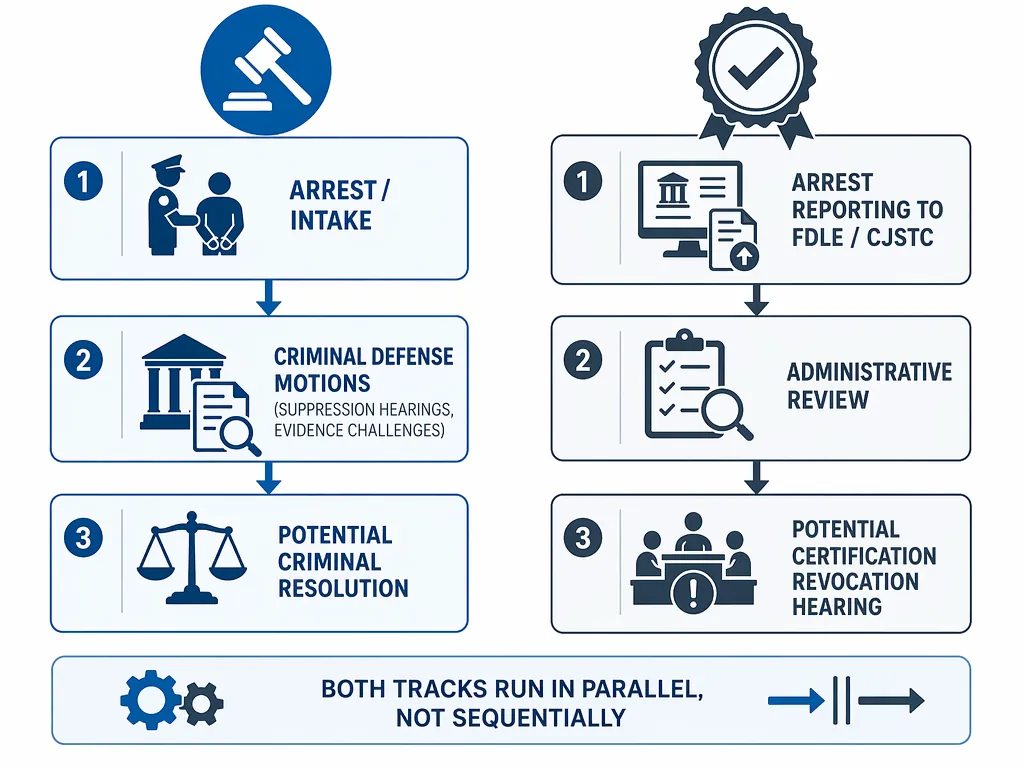
After intake in a Miami police lieutenant DUI matter, the defense file should not open with a theory of guilt or innocence. It should open with a map. One track is the criminal DUI case. The other is the officer’s Florida certification exposure. In the public reporting on Miami Police Lt. Thomas Carroll, the concrete sequence is already enough to make both clocks visible: a US-1 crash during the night of July 18-19, 2026, Carroll found unconscious, refusals of field sobriety testing and a breathalyzer, relief from duty, and an internal investigation moving alongside the arrest posture.[1]
That is the boundary. The matter is pretrial. The public facts do not establish guilt, innocence, charging outcome, discipline, or certification action. They do establish a workflow problem that is easy to mishandle: a criminal defense decision that looks tolerable in county court may become career-ending in the administrative file.
The First Conflict Is Not the Plea Offer
For a civilian DUI defendant, counsel may first triage license suspension, breath evidence, probable cause, video, and mitigation. For a sworn law enforcement defendant in Florida, counsel has to add the certification question immediately. Florida’s Criminal Justice Standards and Training Commission process can move from agency reporting into professional compliance review, and Fla. Stat. § 943.1395 gives the commission authority over certification discipline, including revocation for certain misconduct.[2]
For Florida certification purposes, DUI may be treated as a reportable misdemeanor involving moral turpitude, while a reduction to reckless driving may preserve certification.[2] That distinction changes the value of every criminal negotiation. A sentence that seems light on paper can still end the officer’s ability to work in law enforcement if the conviction fits the certification rule.
| Criminal track | Certification track |
|---|---|
| Arrest report, probable cause, chemical-test refusal, bodycam or dashcam review | Agency reporting, internal investigation, FDLE/CJSTC professional compliance review |
| Motions to suppress, evidentiary objections, plea negotiation, trial preparation | Moral-turpitude classification, discipline exposure, possible revocation hearing |
| Resolution affects fines, probation, driving consequences, record, and collateral terms | Resolution may determine whether the officer can remain certified |
The practical point is not that the administrative issue is more important than the criminal case. It is that neither file can be safely negotiated in isolation. Before a lawyer discusses a plea to DUI, the lawyer should know whether that plea creates a certification consequence that no criminal sentence can soften.
Build the Evidence File Before Accepting the Video File
DUI video can be persuasive because it feels familiar: the stop, the officer’s voice, the bodycam angle, the roadside lighting, the defendant’s balance, the missing or present slur. That familiarity is exactly why enhanced footage deserves a colder review. “Clearer” is not an evidentiary category. Counsel has to separate what the camera recorded from what software later supplied.
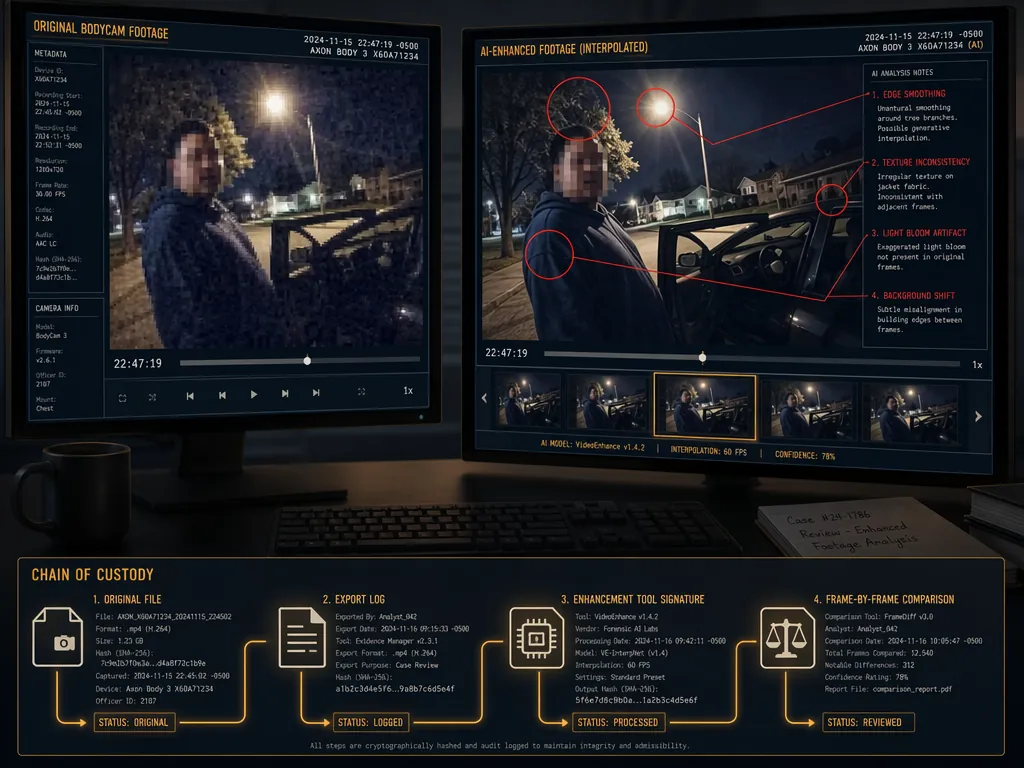
The first request should be for the originals: native bodycam or dashcam files, associated metadata, audit logs, export history, file hashes if available, evidence-management records, and every derivative version delivered to prosecutors, internal affairs, or the defense. If the file played in court is an export, counsel should know who exported it, when, from which system, with which compression settings, and whether any frame-rate, brightness, stabilization, sharpening, denoising, zoom, or upscaling process was applied.
That request is not a technical flourish. In a refusal case, the visual record may carry more weight than a test number. Carroll reportedly refused field sobriety testing and a breathalyzer.[1] Those refusals may be litigated under ordinary evidentiary rules, but they also change the practical center of the case: more attention moves to officer observations, crash evidence, demeanor, speech, balance, consciousness, and video.
Original Pixels, Processed Pixels, Generated Pixels
A useful defense review divides the footage into three buckets. The first is original recorded information. The second is transparent processing, such as ordinary resizing or interpolation whose method can be described and repeated. The third is generative enhancement, where the software may create a sharper-looking image by predicting or inventing visual information that was not captured in the original file.
SWGDE guidance identifies transparent interpolation methods such as nearest-neighbor, bi-linear, and bi-cubic interpolation as established image-processing techniques.[3] Those methods are not automatically admissible for every purpose, but they are different in kind from generative upscaling that produces new apparent detail. A defense motion should not collapse those categories. If the prosecution used conventional brightness adjustment, the challenge may focus on foundation and repeatability. If it used generative AI enhancement, the challenge should focus on whether the resulting detail is forensic evidence or a software-produced guess.
State v. Puloka is useful because it treats that distinction as admissibility work rather than courtroom theater. In that Washington trial-court ruling, the court excluded Topaz Video AI generative enhancement under Frye after finding that the method was not peer-reviewed by the forensic video analysis community, was not reproducible, and was not generally accepted.[4] Puloka does not decide Florida law. It is not an appellate rule, and it does not bind a Florida DUI judge. It does, however, give defense counsel a disciplined template: identify the tool, demand reproducibility, test general acceptance, and make the court decide whether generated visual detail can be shown to the factfinder.
The Criminal Legal News analysis of Puloka is particularly useful for motion drafting because it names the danger plainly: AI can “invent” pixels, and the courtroom may mistake those invented pixels for recovered detail.[4] DUI-specific defense commentary makes the same operational point from another angle: video evidence can be challenged not only for what it shows, but for how it was captured, processed, interpreted, and presented.[5]
A Focused Disclosure Demand
A broad demand for “all video” is too loose when enhanced footage may exist. Counsel should ask for enough information to recreate the chain from scene to courtroom, or to show that the chain cannot be recreated.
- Native bodycam, dashcam, surveillance, and evidence-system files, not only prosecutor exports.
- Metadata, audit logs, upload records, download records, and file-hash information where available.
- Every edited, clipped, compressed, stabilized, brightened, sharpened, denoised, zoomed, or upscaled version.
- The name, version, settings, presets, model information, and operator notes for any enhancement tool.
- A frame-by-frame comparison identifying which courtroom image comes from the original file and which comes from later processing.
The point is not to make every DUI case into a software trial. The point is to prevent the enhanced file from becoming the unexamined “real” event. Once the judge, prosecutor, internal affairs reviewer, or certification decision-maker sees the polished version first, the original record may have to fight its way back into the case.
Refusal Evidence Carries Two Different Meanings
A reported refusal of field sobriety testing is not the same thing as a reported refusal of a breathalyzer, and neither is the same thing as proof of impairment. They are evidence events. They affect admissibility, argument, negotiation, and credibility. In a police-officer DUI case, they also affect perception because the defendant knows how roadside evidence is built.
That cuts both ways. The prosecution may argue that a trained officer refused because he understood the evidentiary value of testing. The defense may argue that a trained officer understood the limitations of field exercises, the risk of subjective scoring, the effect of injury or shock after a crash, and the importance of not creating unreliable evidence. The record has to support the argument chosen. Counsel should not turn a documented strategic pattern into a universal claim that officers always refuse testing.
In the Carroll posture, the unconscious-after-crash fact also matters.[1] A person emerging from a collision may present cues that overlap with impairment: confusion, slow response, imbalance, disorientation, or poor recall. That does not erase a DUI investigation. It does require counsel to separate impairment observations from crash, injury, fatigue, lighting, officer positioning, camera angle, and the timing of each observation.
Officer Credibility Is Not a One-Way Weapon
When the accused person is a police lieutenant, ordinary credibility assumptions shift. The defendant understands report writing, camera activation, roadside cues, test administration, and the professional consequences of a criminal record. That knowledge may make a refusal look calculated. It may also make the defendant more alert to bad evidence-handling, shortcut testing, or overconfident narrative-building by the investigating officers.
NACDL’s Breaking Blue framework is often used to challenge police-officer credibility in suppression litigation. Its value here is not as a script for attacking police as a class. It is a structure for organizing contradiction: visual inconsistency charts, standard-operating-procedure noncompliance, demeanor documentation, prior statements, report gaps, and hearing preparation that forces each witness to stay inside the evidence.[6]
For a law-enforcement defendant, that structure should run in both directions. Counsel should chart inconsistencies by investigating officers, but also prepare for the prosecution to argue that the defendant’s own conduct shows insider knowledge. If the defendant declined field sobriety exercises, knew the breath process, or understood camera placement, counsel should decide before the hearing whether those facts support caution, consciousness of guilt, medical vulnerability, distrust of the testing conditions, or some narrower explanation.
| Credibility issue | What counsel should build |
|---|---|
| Video does not match report language | A visual inconsistency chart with timestamps, still frames, and exact report quotations |
| Testing was requested after a crash or possible injury | A timeline separating crash effects, medical observations, impairment observations, and refusal events |
| Officer-witness skipped or compressed procedure | An SOP-noncompliance narrative tied to the agency’s actual written policy |
| Enhanced footage appears clearer than the original | A side-by-side frame comparison identifying original, processed, and generated visual information |
| The defendant’s police experience becomes a prosecution theme | A direct explanation of what the defendant knew, what he did not know, and why the conduct remains consistent with lawful caution |
This is where demeanor evidence should be handled carefully. Slurred speech, delayed answers, confusion, or frustration can look different in a clipped enhanced segment than in the full roadside sequence. The defense needs the minutes before and after the clip, not only the dramatic exchange. If the client was unconscious after a crash, counsel should also know who first assessed him, whether medical personnel were involved, what questions were asked, and what the camera captured before refusal language appears.
Suppression Preparation Should Include the Administrative File
A suppression hearing can create a transcript that later matters outside the criminal courtroom. If counsel treats the hearing only as a probable-cause fight, damaging concessions may land in the certification record. If the investigating officer testifies that the defendant refused in a particular way, that the video showed a particular cue, or that agency procedure was followed, those statements may shape internal and professional review even if the criminal case later resolves quietly.
The defense team should therefore prepare suppression exhibits with dual use in mind. A timestamp chart can test probable cause and preserve the argument that the evidence record is unstable. An enhancement disclosure motion can support exclusion and preserve the argument that administrative reviewers should not rely on generated visual detail. A plea memorandum can address sentencing and certification consequences in the same document, even if the tribunal considering each issue is different.
- Before the first motion: confirm all original video sources and preservation status.
- Before any enhancement is shown: demand tool, settings, operator, version, and reproducibility information.
- Before cross-examination: chart report language against video timestamps and SOP requirements.
- Before plea discussion: calculate whether the contemplated disposition creates certification exposure.
- Before administrative response: preserve the criminal record in a form that can be understood by FDLE/CJSTC reviewers.
Puloka Helps, but It Does Not Carry the Florida Case
Puloka is a serious warning against treating AI-enhanced video as ordinary clarification. It is not a national exclusion rule. A Florida court could distinguish the tool, the purpose of the enhancement, the expert foundation, the governing standard, or the way the footage is offered. A judge might allow enhanced footage for demonstrative use while limiting it as substantive proof, or might admit conventional processing while excluding generative upscaling.
That is why the motion should be built from the file, not from a headline. The defense needs the original footage, the enhancement path, the expert foundation, and the proposed use. If the prosecution cannot reproduce the output or explain which visual details came from the camera rather than the model, Puloka supplies language for the objection. If the footage was only subject to transparent processing, a Puloka-style generative-AI objection may overreach.
The Integrated Case Map
A police-officer DUI defense should leave the first week with four connected records: the criminal record, the video record, the credibility record, and the certification record. The criminal record asks what the state can prove and what can be suppressed. The video record asks what was captured, what was processed, and what may have been generated. The credibility record asks whether the reports, testimony, SOPs, demeanor evidence, and refusal narrative hold together. The certification record asks whether any criminal resolution preserves or destroys the officer’s ability to remain certified.
The dangerous mistake is sequencing these questions as if they can wait their turn. By the time a plea is attractive, the certification consequence may already define the real risk. By the time enhanced footage is accepted as merely “clearer,” the defense may have lost the best chance to separate recorded evidence from generated detail. And by the time the internal file is active, the criminal transcript may already contain the admissions, omissions, and credibility framing that decide the professional case.
References
- Local10.com articles on the July 18-19, 2026 Miami Police Lt. Thomas Carroll DUI arrest, Local10.com, July 19 and July 20, 2026
- Fla. Stat. § 943.1395 (2025); FDLE Professional Compliance Process, Florida Department of Law Enforcement
- SWGDE Doc. No. 22-V-001-1.1, Scientific Working Group on Digital Evidence, September 2022
- When AI Invents the Pixels: Challenging AI-Enhanced Video Evidence in Criminal Cases, Criminal Legal News, December 15, 2025
- Using AI to Challenge DUI Video Evidence, Davis-Hoss
- Breaking Blue: Challenging Police Officer Credibility, National Association of Criminal Defense Lawyers
Related records
Tool profile
How Meta's AI Spending Reshapes Law Firm ProfitabilityGoverning regulation
Browse the obligations tracker →Preventive workflow
Browse verification workflows →
Report a correction or tip
Spotted an outdated figure, a misstated fact, or a ruling this case record should reflect? Public comments are disabled for this content given the professional cost of a misreported case outcome, penalty amount, or rule text — use the structured correction channel instead.
Report a correction or tip for this record →