
Millennials' Shrinking Inheritance Meets AI Estate Planning
Millennials' inheritance expectations outpace the transfers that will actually arrive, yet 58% hold no estate-planning documents and 30% of U.S. adults now trust AI more than a human attorney. This analysis connects that gap to documented AI-drafting failure modes—invalid execution, missing testamentary intent, and hallucinations reaching probate courts—and identifies the verification steps that keep an AI-assisted plan from becoming litigation.
- Jurisdiction
- US-New York
- Court
- Kings County Surrogate's Court
- AI tool named
- Unspecified AI
- Ruling date
- Jan 1, 2024
- Source document
- View primary court order ↗
- Last verified
- Aug 1, 2026
Lex Machina Review is an independent risk-tracking and reference resource. Nothing on this site is legal advice, and using it does not create an attorney-client relationship. Every record is reviewed against primary sources but may not reflect the most current status of a matter — always verify directly against the cited court order, rule text, or a licensed attorney before relying on it.
Companion explanation — secondary to the source document above
The inheritance is shrinking before it reaches the heir
Millennials’ inheritance problem looks contradictory only if the transfer is treated as a headline number. The money is real. The reliance on it is real, too. In Northwestern Mutual’s 2025 Planning & Progress Study, 26% of millennials said they expect an inheritance, and 69% of those expecting millennials called that inheritance critical or highly critical to their long-term financial security. Across U.S. adults, 20% expected an inheritance, down from 25% the prior year. The millennial figure was also down, from 32% to 26%. That is not a small emotional adjustment when the expected money has already been assigned a role in the household balance sheet. [1]
Visa’s July 2026 Business and Economic Insights analysis is useful because it does the work that transfer headlines often skip. Boomers hold about $93 trillion. Visa then subtracts about $5 trillion in liabilities, excludes about $28 trillion held by the top 1%, accounts for roughly $16 trillion in retirement spending, and subtracts about $8 trillion for charity, taxes, and fees. The result is about $36 trillion expected to reach Gen X and millennial heirs over 20 years. Visa estimates about $515,000 per inheriting household, with only about $8 trillion expected to be spent, and notes that nearly three-quarters of recipients already have above-median net worth. [2]

Cerulli’s broader wealth-transfer estimate keeps the scale in view: $124 trillion is projected to transfer through 2048, including $105 trillion to heirs and $18 trillion to charity, with 81% coming from boomers and older generations. Millennials are projected to inherit the most over 25 years, about $46 trillion, while Gen X receives more in the next decade, $14 trillion compared with $8 trillion for millennials. The concentration is severe: more than half of transfers are expected to come from high-net-worth and ultra-high-net-worth households, which Cerulli identifies as only 2% of households. [3]
That concentration matters for probate risk. The household most likely to be courted by a private bank, a family office, or a long-standing estate lawyer is not the same household that is postponing planning because the estate feels too small to justify a legal bill. Trust & Will’s 2026 Estate Planning Report found that 56% of adults had no estate-planning documents, and 58% of millennials had none. The same report found that 30% of adults trusted AI more than a human attorney for estate planning, up from 20% in 2025, while only 5% said they would use AI with no attorney review. The top reported barrier was “not enough assets,” cited by 27%. [4]
Put those numbers beside each other and the risk becomes more specific. A smaller, uneven inheritance does not make planning less important. It makes the margin for repair thinner. A family that expected a life-changing transfer and receives a contested instrument, a defective signing ceremony, or a document no one can explain has not merely bought an imperfect form. It has bought a probate problem at the point when the person who could best explain the document is gone.
The downloaded document is only the first exhibit
Estate planning does not fail only when a clause is clumsy. It fails when the file cannot prove that the testator meant to make this instrument, had capacity to make it, signed it in the required manner, and was not being pushed by someone with an interest in the result. A generated will or trust may look complete on the day it is downloaded. Probate asks different questions later.
That is why broad AI-confidence numbers should be read as procurement signals, not proof of legal adequacy. Trust in a tool may explain why a client arrives with a document already in hand. It does not say whether the tool selected the correct jurisdictional rules, created a usable execution record, preserved capacity evidence, or verified the legal authorities behind its advice.
The useful question is narrower: if an AI-assisted estate plan later becomes a probate exhibit, what will the court, the objecting beneficiary, and the lawyer defending the instrument be able to see?
Three failure modes courts can actually see
Hallucinated legal material has already reached probate litigation
Matter of Samuel is the probate-specific warning sign. In a 2024 contested probate proceeding in Kings County Surrogate’s Court, careless lawyer use of AI produced hallucinated output in which an incapacitated person supposedly made a will. The case is not evidence that every AI estate-planning tool produces defective wills. It is evidence that AI-generated legal material can enter a probate record in a way that forces a court to deal with fiction dressed as authority or fact. [5]
The adjacent appellate warning is not limited to probate, but it belongs in the same risk file. ElderLawAnswers reported an Alabama appellate trust dispute dismissed with Rule 38 sanctions after fake AI citations appeared in the litigation. A trust dispute does not need an AI-drafted will to suffer from AI contamination. If legal research, authorities, or procedural claims are generated and not verified, the litigation record can become unreliable before anyone reaches the merits. [6]
Execution defects are local, formal, and often fatal
A will can be beautifully written and still fail because it was not executed under the governing state’s rules. The risk is not exotic. It is clerk-level: the wrong witnesses, the wrong sequence, no self-proving affidavit where one was expected, a notarization treated as a substitute for witnesses when state law does not allow that, or a remote-signing workflow used without confirming whether it works for that instrument in that jurisdiction.
AI and DIY workflows are weakest when they treat execution as the last screen in a transaction rather than the legal act that turns a draft into an instrument. The verification question is not whether the PDF has signature lines. It is who confirmed the signing requirements before the ceremony, who supervised or documented the ceremony, and what proof will exist if a disappointed heir later says the document was never validly made.
Testamentary intent needs a record, not just a recital
BarTalk’s February 2026 discussion of AI-generated wills identified the more difficult evidentiary problem: no court had yet decided an AI-generated will, but the usual proof of testamentary intent may be missing from an AI workflow. A lawyer’s file can contain drafting-solicitor notes, correspondence, intake questionnaires, redlines, and explanations of why a client excluded one person, favored another, or changed a prior plan. AI workflows may generate the final document without generating that surrounding evidence. [7]
That gap matters most in the cases that were never simple. A beneficiary who was also a caregiver. A late-life change after diagnosis. A child disinherited after a family break. A blended family where the surviving spouse and adult children read the same clause differently. The document’s wording matters, but the file around the wording often explains whether the testator knew what was being done and intended this result.
The absence of a lawyer’s file does not automatically invalidate an instrument. It does, however, change the evidentiary posture. The person defending the will may be left with a final PDF, a payment receipt, and no contemporaneous record of instructions, capacity observations, revisions, or warnings given. That is a poor record on which to ask a court to reject a capacity or undue-influence challenge.
Form-looking text can still fail in ordinary ways
The supporting drafting cases are not probate centerpieces, but they show why a polished format should not be confused with enforceability. In Urban Roots Salon Spa Ltd., an AI-generated contract was found unenforceable after unfilled “[State]” placeholders remained in the document. That is a mundane drafting failure, not a science-fiction failure. The document looked like a contract until someone had to enforce it. [8]
Mansour v. Girgis supplies the estate-planning analogue without needing AI to be the villain. An ambiguous life-estate will required rectification by the Ontario court. The lesson is limited but important: ambiguity in testamentary drafting can consume court time and family money even when the problem is not technological. AI merely gives more people a faster way to create language whose consequences they may not understand. [9]
Verification is the part that turns a draft into a defensible plan
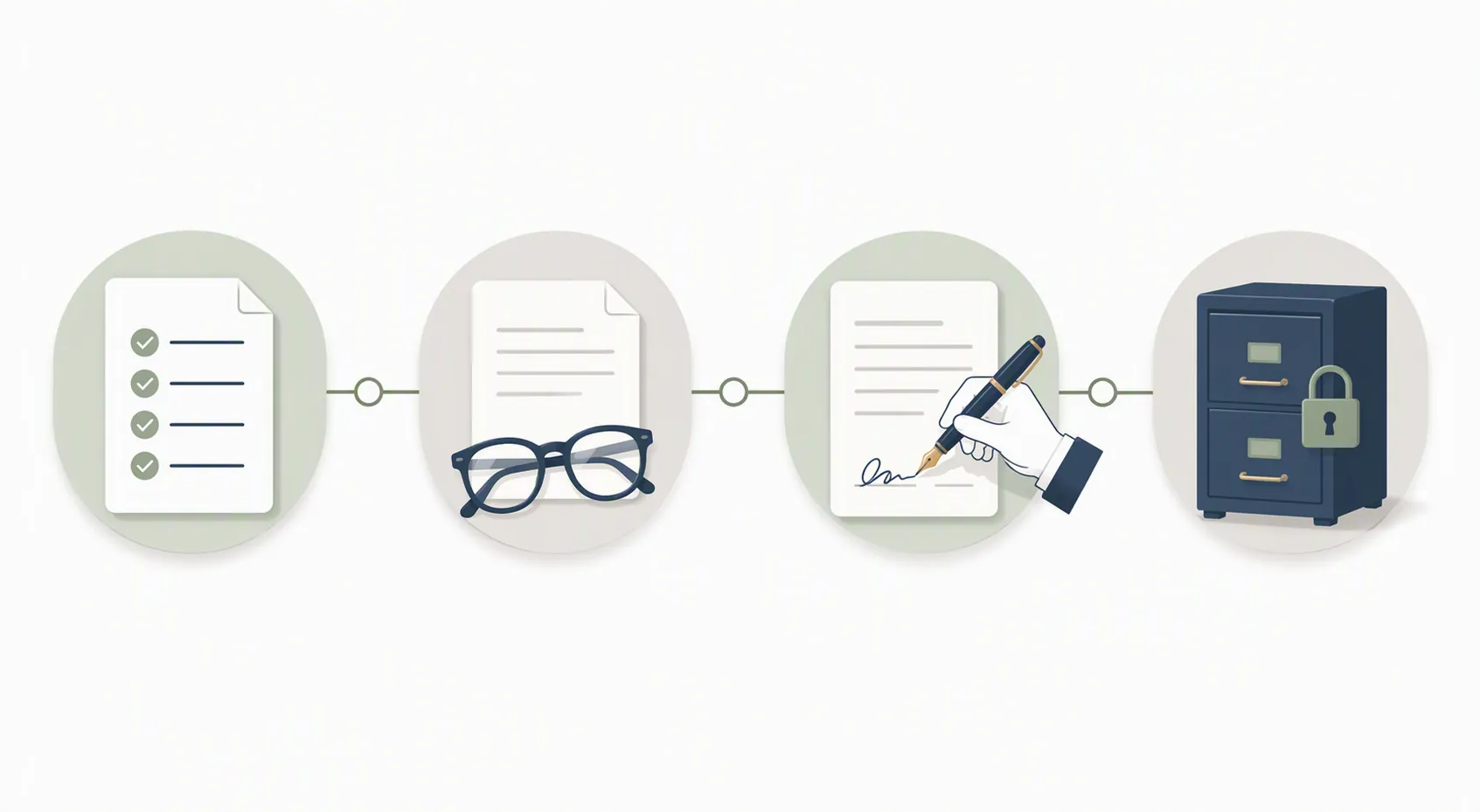
The practical answer is not to pretend that AI drafting will disappear. The Trust & Will data points the other way: many consumers are open to AI, but the same data also shows that only a small minority would use it without attorney review. That distinction should shape the workflow. AI can help produce a first draft. Verification determines whether the instrument can survive the ordinary probate questions that follow death.
| Risk visible later | Verification step before signing | Record to keep |
|---|---|---|
| Wrong jurisdiction or wrong instrument type | Confirm governing state law, client domicile, property location, and whether the document is a will, trust, power of attorney, health directive, or beneficiary-related instruction. | Intake notes, jurisdiction check, existing-document review, and version history. |
| Invalid execution | Confirm the required signing ceremony for the state and instrument, including witnesses, notarization, self-proving affidavit, and any remote-execution limits. | Execution checklist, witness information, notary details where applicable, and signed final copies. |
| Capacity or undue-influence challenge | Document instructions, client meetings, who was present, capacity observations, major changes from prior plans, and reasons for unequal or unexpected dispositions. | Attorney notes, questionnaires, correspondence, redlines, and conflict or independence screening notes. |
| Unverified AI legal claims | Trace every legal proposition, citation, and jurisdictional statement to authoritative sources before relying on it. | Research log, cited authorities, reviewer identity, and correction history. |
| Ambiguous or unexplained language | Review dispositive clauses, fiduciary appointments, survivorship language, trust funding language, and tax-sensitive provisions for internal consistency. | Annotated draft, client approval record, explanation of material choices, and final execution copy. |
| No one can reconstruct the plan later | Retain a complete file that explains what was drafted, why it was drafted that way, and how it was signed. | Centralized matter file with drafts, final documents, communications, execution proof, and storage instructions. |
Attorney review is most valuable before the client signs, not after the family has discovered a defect. A lawyer reviewing an AI-assisted estate plan should not merely scan for typos. The review has to answer whether the client’s instructions are complete, whether the chosen document type fits the assets and family structure, whether beneficiary designations or jointly held property make the will less important than the client thinks, and whether any clause invites a predictable contest.
The execution confirmation should be treated as its own legal task. A platform can display a generic signing instruction; that does not prove the ceremony matched the law of the state whose probate court will later be asked to admit the document. If the plan uses multiple instruments, each instrument needs its own execution analysis. A will, revocable trust, financial power of attorney, and health-care directive may not share the same formalities.
The capacity and intent record is the part families miss until they need it. Notes showing that the client gave instructions privately, understood the nature of the property and family relationships, and approved the material terms can be more important than another round of stylistic editing. If a child is omitted, a spouse receives less than expected, or a caregiver benefits, the file should not be silent about whether the client understood that consequence.
Source verification belongs in the estate-planning workflow even when no litigation has started. Matter of Samuel and the Alabama sanctions episode show the cost of letting AI-generated legal content travel unverified into court. A firm or platform that permits AI-assisted drafting should be able to identify who verifies legal claims, what sources are acceptable, how corrections are recorded, and whether citations or legal summaries are ever passed to clients without review.
What the smaller inheritance changes
For the highest-net-worth families, the shrinking from headline wealth to received wealth may still leave a large, lawyered transfer. The harder planning problem sits elsewhere: households expecting enough inheritance to matter, but not enough to feel sure that traditional estate planning is worth the cost; adult children who may be depending on money that arrives late, arrives smaller, or arrives with strings; parents who think “not enough assets” means no plan is needed; and survivors who discover that a cheap document did not create a cheap administration.
AI can lower the friction of starting. That is useful. A blank file is not safer than a reviewed draft, and many families need an easier first step. But the legal risk is created when the workflow stops at generation. Probate does not ask whether the client experienced convenience. It asks whether the instrument was validly made, whether the testator intended it, whether the text can be applied, and whether the record is trustworthy.
A millennial heir may never see the headline transfer. A surviving spouse or sibling may see only the document left behind. If that document came from an AI-assisted process, the decisive question is not whether AI wrote a decent first draft. It is whether someone preserved the verification record that a probate court and the family’s lawyers will later need.
References
- 2025 Planning & Progress Study, Northwestern Mutual, 2025.
- Visa Business and Economic Insights analysis of the great wealth transfer, Visa, July 2026.
- Cerulli Associates wealth transfer research, Cerulli Associates, December 2024.
- 2026 Estate Planning Report, Trust & Will, 2026.
- Matter of Samuel, Kings County Surrogate’s Court, New York, 2024.
- Alabama appellate trust dispute with Rule 38 sanctions for fake AI citations, ElderLawAnswers.
- AI-generated wills discussion, BarTalk, February 3, 2026.
- Urban Roots Salon Spa Ltd., 2025 BCEST 103.
- Mansour v. Girgis, 2024 ONSC 1611.
Related records
Tool profile
How Meta's AI Spending Reshapes Law Firm ProfitabilityGoverning regulation
Browse the obligations tracker →Preventive workflow
Browse verification workflows →
Report a correction or tip
Spotted an outdated figure, a misstated fact, or a ruling this case record should reflect? Public comments are disabled for this content given the professional cost of a misreported case outcome, penalty amount, or rule text — use the structured correction channel instead.
Report a correction or tip for this record →