
Murkowski's Undecided Vote: Legal Implications for Blanche's DOJ
Even if Lisa Murkowski votes against Todd Blanche's confirmation, he can serve as acting Attorney General indefinitely under 28 U.S.C. § 508. This article examines why the vote outcome doesn't change DOJ leadership but signals a deeper erosion of institutional credibility that practitioners should watch.
- Jurisdiction
- US Federal
- Court
- U.S. Department of Justice
- AI tool named
- General AI
- Ruling date
- Jul 25, 2026
- Source document
- View primary court order ↗
- Last verified
- Jul 25, 2026
Lex Machina Review is an independent risk-tracking and reference resource. Nothing on this site is legal advice, and using it does not create an attorney-client relationship. Every record is reviewed against primary sources but may not reflect the most current status of a matter — always verify directly against the cited court order, rule text, or a licensed attorney before relying on it.
Companion explanation — secondary to the source document above
As of July 25, 2026, no final confirmation outcome is known for Todd Blanche. But the operational answer is narrower than the Senate drama suggests: even if Lisa Murkowski votes no and Blanche’s nomination fails, that result would not by itself remove him from DOJ leadership.
The reason is not a political loophole hidden in the vote count. It is the succession statute for the Department of Justice. Under 28 U.S.C. § 508, the Deputy Attorney General may serve as acting Attorney General when the Attorney General’s office is vacant. Lawfare’s analysis of the Blanche fight emphasizes the point practitioners need first: § 508 contains no time limit, and the Federal Vacancies Reform Act’s familiar 210-day limit does not control where another statute expressly designates an acting officer.[1]
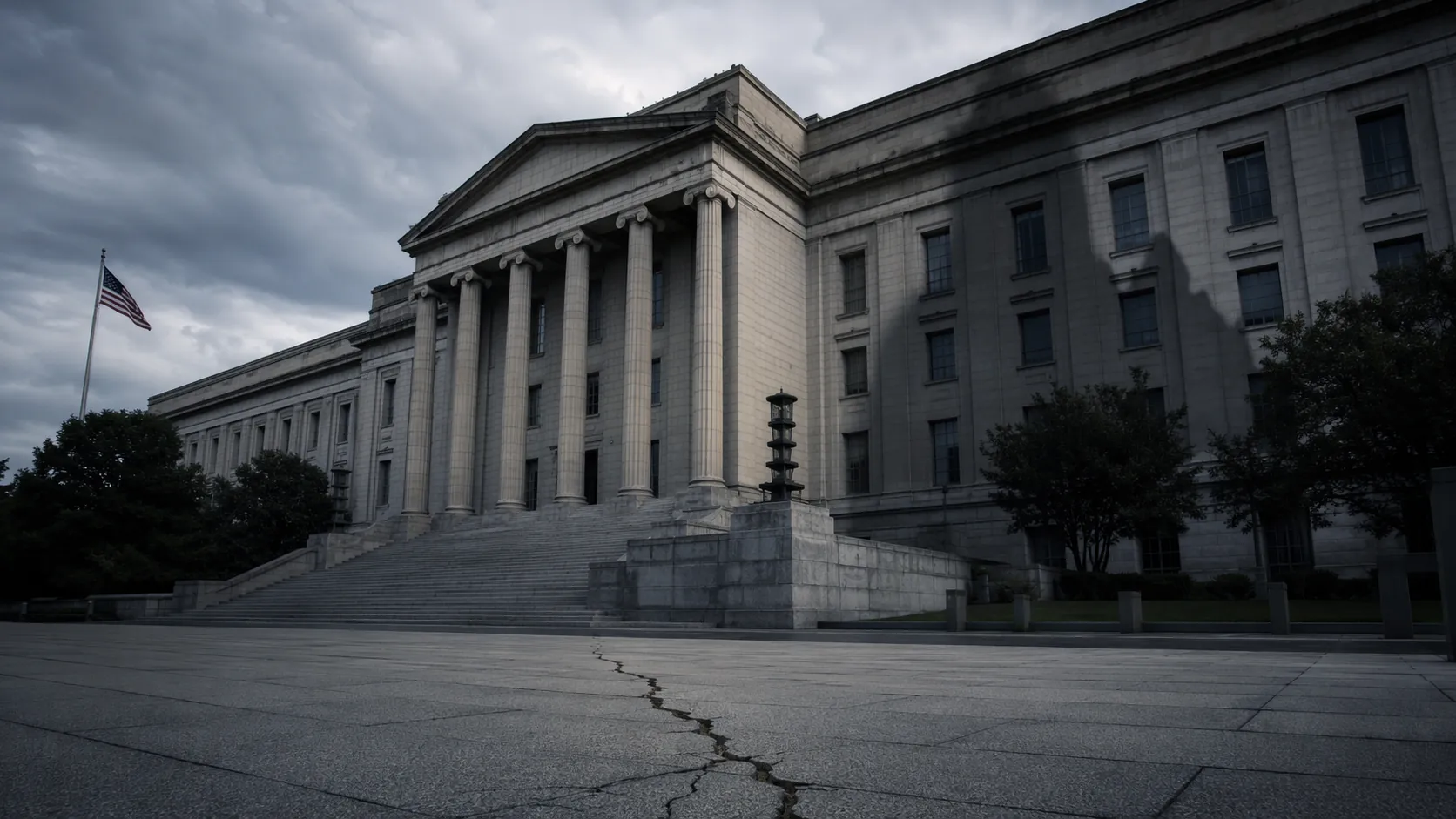
That answer matters because it separates two questions that confirmation coverage often collapses. One question is whether Blanche has the votes to become confirmed Attorney General. The other is whether DOJ suddenly lacks a lawful head if the nomination fails. The first question remains live. The second, on the current materials, has a stable statutory answer.
Why a failed vote does not remove Blanche
The controlling sequence starts with Blanche’s existing office. He has already been Senate-confirmed as Deputy Attorney General, by a 52-46 vote in March 2025.[1] That prior confirmation is not window dressing. It is what places him inside the Department’s statutory succession path.
Section 508 is unusually important here because it is not merely a default instruction for a few days of transition. It specifically provides a DOJ succession mechanism. Where the Attorney General’s office is vacant, the Deputy Attorney General may act as Attorney General. The statute does not say that acting service ends after a failed nomination vote, nor does it impose a calendar limit comparable to the FVRA’s 210-day framework.[1]
The FVRA point is where some quick legal takes go wrong. The Federal Vacancies Reform Act is often the right place to start when an acting officer is serving without Senate confirmation to the higher office. But the FVRA also recognizes express statutory exceptions. Lawfare identifies § 508 as one of those exceptions through 5 U.S.C. § 3347, which means the FVRA’s 210-day cap does not do the work some readers may expect it to do for Blanche.[1]
| Issue | Practical effect as of July 25, 2026 |
|---|---|
| Failed confirmation vote | Does not automatically remove Blanche from acting DOJ leadership |
| FVRA 210-day limit | Does not control where § 508 supplies the DOJ-specific acting-service mechanism |
| Prior Senate confirmation as Deputy AG | Strengthens Blanche’s position against an Appointments Clause challenge |
| Presidential replacement decision | Could change who leads DOJ if the President designates someone else under an available authority |
The recent comparison is Julie Su, not as a political analogy but as an operating precedent. Su served as acting Labor Secretary for 577 days, from March 2023 to October 2024, under 29 U.S.C. § 552, a Labor Department succession statute parallel to DOJ’s § 508.[1] That example shows how an agency-specific succession statute can sustain acting service long after the confirmation process stalls or fails to produce a confirmed secretary.
The same analysis also narrows the constitutional objection. Lawfare contrasts Blanche with Edward DeMarco, whose multi-year service at the Federal Housing Finance Agency was later held unconstitutional by the Sixth Circuit. Blanche is in a different posture because he has already received Senate confirmation to the Deputy Attorney General office that places him in DOJ’s succession line.[1] That does not make every future DOJ action litigation-proof. It does make a broad Appointments Clause attack on his acting service materially harder.
The only clear route to an immediate leadership change would be a presidential decision to replace Blanche with another acting Attorney General under an available designation authority. A failed vote alone does not supply that replacement.[1]
What Murkowski’s undecided status changes, and what it does not
Murkowski matters because the vote count is tight enough that one Republican defection can become operationally relevant for nomination timing. Bloomberg Law reported a 52-47 Senate environment and noted that Darline Graham was sworn in on July 14, restoring a 12-10 Republican majority on the Senate Judiciary Committee.[2] The committee vote was delayed on July 23 and was expected around July 30, leaving the outcome unknown as of July 25.[2]
That timing affects calendars, not the statutory succession answer. It may affect when DOJ leaders file nomination-related disclosures, when the White House chooses whether to spend floor time, and when litigants update a court about leadership status. It does not convert an undecided senator into the legal switch that turns Blanche’s acting authority on or off.
Darline Graham’s arrival should be treated with the same discipline. Her committee presence changes the Republican committee majority on paper. It does not establish a guaranteed vote on Blanche, and her nomination voting record was untested in the materials available by July 25.[2] For litigation planning, that is a reason to monitor the committee docket, not a reason to assume the confirmation fight is already over.
The real litigation risk is credibility, not automatic invalidity
If Blanche loses and stays in place, practitioners should resist two bad shortcuts. The first is saying the Department suddenly lacks authority. The second is saying nothing changes. The better view is more practical: formal authority remains stable, but institutional credibility may become more expensive to defend.
The former-employee opposition is one reason. Slate reported that more than 1,200 former DOJ employees opposed Blanche’s confirmation and that a July 2026 letter to Senators Chuck Grassley and Dick Durbin claimed approximately 16,000 employees had left the Department under his leadership.[3] The 16,000 figure should be described carefully: it is a claim by the letter’s authors, not an independently verified attrition count in the cited materials.[3]
Even with that caveat, the opposition is not irrelevant noise. Former-employee letters do not decide statutory authority, and they do not create a defense to a subpoena or indictment. But they can affect how institutional representations are received, especially where DOJ is asking a court to trust its account of internal process, prosecutorial regularity, classification judgments, discovery compliance, or remedial commitments.
Blanche’s own public positioning adds to that risk signal. The materials identify a February 2025 assurance that “politics plays no role” at DOJ and a May 2026 position emphasizing that Article II vests executive power in the President.[3] Those propositions are not impossible to reconcile in constitutional theory. In litigation practice, though, the shift gives opposing counsel a ready frame: DOJ asks for institutional deference while its leadership speaks in a more presidential-control register.
That frame matters most before judges already sensitive to DOJ reliability. A court does not need to hold Blanche unlawfully appointed to scrutinize a Department declaration more closely, require a more specific factual proffer, press harder on privilege assertions, or refuse to let government counsel rely on generalized assurances. Those are not dramatic remedies. They are ordinary litigation consequences, and they can change cost, timing, and settlement posture.
The same trust problem appears in other DOJ-facing disputes, including warnings over AI hallucination in an ICE detention filing. That kind of episode does not prove anything about Blanche’s confirmation fight. It does show the channel through which credibility erosion becomes concrete: a judge who has reason to doubt one DOJ representation may demand more support the next time the Department asks for procedural latitude or factual deference.
How practitioners should price the risk
For a client-facing assessment, the first sentence should stay plain: a failed confirmation vote does not, on current materials, remove Blanche from acting DOJ leadership. The second sentence should be equally plain: the vote may still matter because it can intensify challenges to DOJ credibility in matters where trust is already contested.
- Track leadership status as a factual update, not as an assumed defect in DOJ authority.
- Preserve the record when relying on DOJ representations, especially in settlement, discovery, declination, cooperation, or compliance discussions.
- Expect more targeted challenges where a party can connect DOJ leadership controversy to a specific representation or procedural posture.
- Watch judges who have already expressed concern about DOJ reliability, because confirmation-fight facts may have more traction in those courtrooms.
- Treat large attrition claims as risk signals, not established headcounts, unless independently verified evidence becomes available.
The most likely near-term effect is not a successful motion declaring DOJ action void. It is friction. More declarations may need to be more specific. More agency explanations may be tested against the record. More opposing briefs may include a credibility section that would have looked gratuitous in a calmer institutional environment.
Practitioners should not plan around Blanche’s automatic removal after a failed vote. They should track whether courts, opposing parties, and career DOJ departures convert the confirmation fight into litigation friction. Statutory authority remains stable; institutional trust does not.
References
Related records
Tool profile
How Meta's AI Spending Reshapes Law Firm ProfitabilityGoverning regulation
Browse the obligations tracker →Preventive workflow
Browse verification workflows →
Report a correction or tip
Spotted an outdated figure, a misstated fact, or a ruling this case record should reflect? Public comments are disabled for this content given the professional cost of a misreported case outcome, penalty amount, or rule text — use the structured correction channel instead.
Report a correction or tip for this record →