
Authenticating the Nancy Guthrie ransom notes under FRE 901
This analysis examines how the Nancy Guthrie ransom notes present a novel authentication challenge under FRE 901(b)(4) and (b)(9), given the digital submission method, non-public details, and potential AI authorship, and highlights the risks of relying on pre-trial law enforcement statements before judicial determination.
- Jurisdiction
- US Federal
- Court
- U.S. District Court
- AI tool named
- AI
- Ruling date
- Jul 2, 2026
- Source document
- View primary court order ↗
- Last verified
- Jul 25, 2026
Lex Machina Review is an independent risk-tracking and reference resource. Nothing on this site is legal advice, and using it does not create an attorney-client relationship. Every record is reviewed against primary sources but may not reflect the most current status of a matter — always verify directly against the cited court order, rule text, or a licensed attorney before relying on it.
Companion explanation — secondary to the source document above
The Nancy Guthrie ransom-note evidence now has a problem that is easy to state and harder to litigate: on July 1, 2026, Reuters reported that FBI analysis had concluded the notes were fake and did not come from the real kidnapper; on July 2, the FBI Phoenix field office said some notes were still being investigated and “may potentially be legitimate.”[1] That is not a minor public-relations inconsistency. It is the difference between an investigative position reported before trial and a judicial finding that a particular item is what the proponent says it is.
For counsel, the useful question is not whether the notes feel sinister, theatrical, implausible, or convincing. The useful question is what a court would need to see before treating anonymous digital submissions to news organizations as ransom communications connected to the kidnapping. Federal Rule of Evidence 901 supplies the gatekeeping frame: the proponent must produce evidence sufficient to support a finding that the item is what the proponent claims it is.[2]
The Notes Matter Because Of Their Details, Not Their Demands
The reported chronology is compact. NewsNation reported that a first set of ransom messages was submitted on February 2, 2026 through tip lines to KOLD and KGUN, and that another message was submitted on February 6 through TMZ’s tip system.[3] The Los Angeles Times reported that the notes demanded a $10 million wire transfer within 72 hours, included a Bitcoin fallback, gave a second deadline of February 9, and that the second note claimed Nancy Guthrie had died.[4]
The dollar figure is not the strongest authentication fact. Ransom demands can be copied, inflated, or invented. The reported non-public details are different. The Los Angeles Times reported that the messages contained details about the placement of Nancy’s Apple Watch and a broken floodlight, information not disclosed publicly.[4] If those facts are established, they do real work under Rule 901(b)(4), which allows authentication through distinctive characteristics and the surrounding circumstances.[2]
That does not make the notes self-authenticating. It means the proponent has a serious route into the evidence. A court would still need a foundation for why those details were genuinely non-public, who knew them, when they became known to investigators, whether any leaks occurred, and whether the submitted messages accurately contained those details as received. The phrase “only the kidnapper would know” is a conclusion. Rule 901 asks for the evidentiary steps that make the conclusion permissible.
The 901(b)(4) Path: Distinctive Content Plus Circumstances
Rule 901(b)(4) is the natural first stop because the reported notes do not merely say “pay money.” They allegedly reference crime-scene or investigation-adjacent details that had not been released. In a physical-letter case, that sort of content might be paired with handwriting, mailing location, fingerprints, paper, envelope handling, or possession. Here, the content has to carry more weight because the submissions arrived through digital tip channels rather than through a conventional chain of custody.
The Apple Watch placement and broken floodlight therefore matter in a narrow, disciplined way. They may support an inference that the author had access to information connected to the kidnapping. They do not, by themselves, identify the author. They do not prove the sender personally committed the crime. They do not resolve whether the same person drafted, transmitted, edited, or forwarded the messages. Authentication is not guilt, and distinctive content is not authorship in the full forensic sense.
The foundation would likely need to move through several points: when investigators first documented the Apple Watch and floodlight facts; which agencies, witnesses, family members, media personnel, or outside contractors had access to them; whether any search materials, affidavits, internal briefings, or informal communications disclosed them; and whether the language in the notes matches the underlying facts precisely or only roughly. The more restricted and precise the knowledge, the stronger the 901(b)(4) argument becomes.
That is why premature public labels are dangerous. If the notes are called fake because investigators doubt the sender, that is one proposition. If they are fake because the distinctive details were leaked or guessed, that is another. If they are potentially legitimate because they contain non-public facts, that still leaves process and attribution unresolved. These are different evidentiary problems, and collapsing them into a single adjective makes later litigation messier.
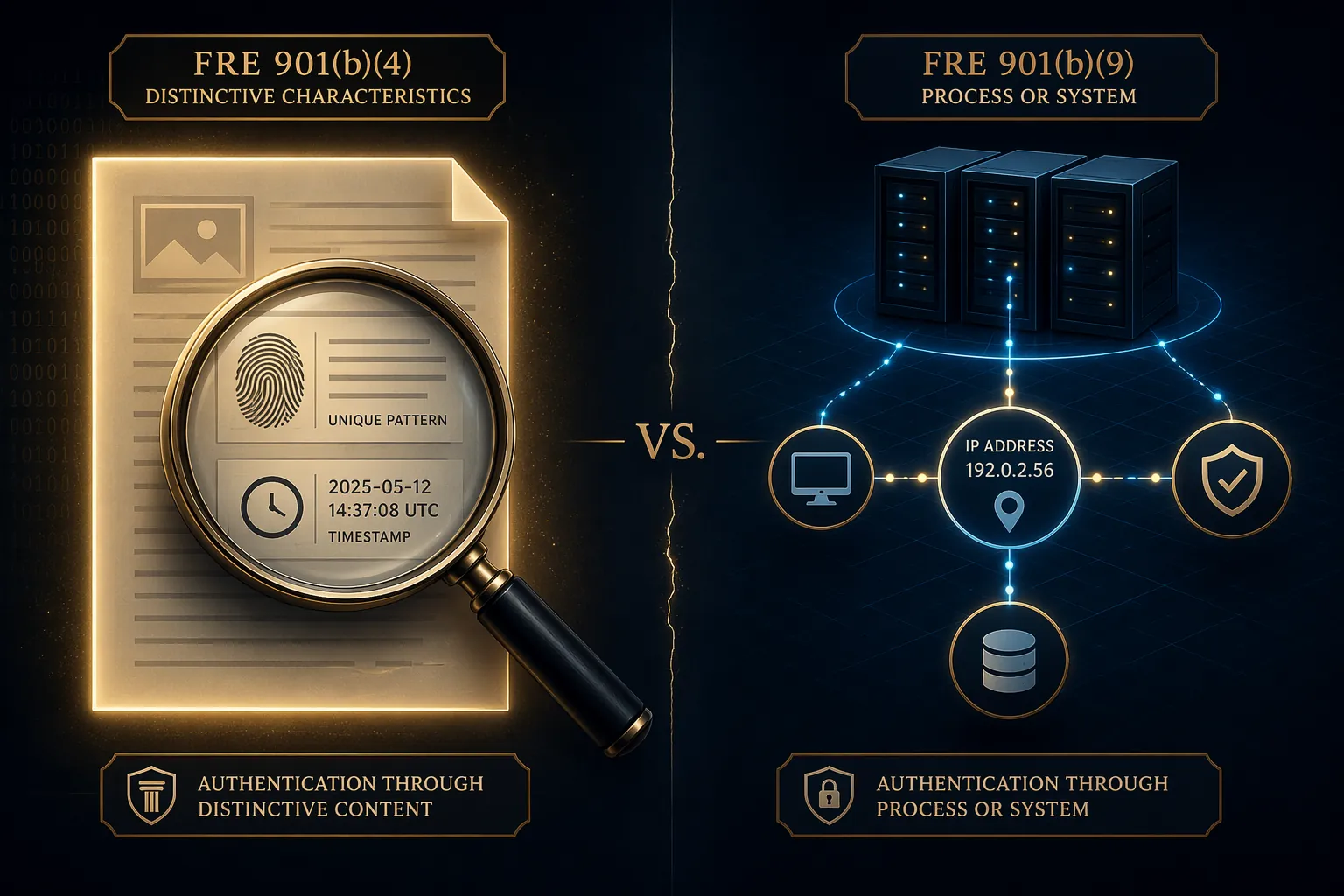
The Separate 901(b)(9) Problem: How The Messages Got There
The digital route creates a second authentication layer. CBS News reported that the ransom notes originated from the same IP address and were sent using VPN or cloaking software.[5] NewsNation reported that the messages reached media outlets through tip systems, and the materials also refer to a Gmail contact address.[3] Those facts may help connect the submissions to each other, but they also show why this is not a simple “letter found in a mailbox” problem.
Rule 901(b)(9) permits authentication with evidence describing a process or system and showing that it produces an accurate result.[2] In this setting, that means the proponent cannot rely only on the message text. The court may need to understand the news outlets’ tip systems, what metadata they captured, how submissions were stored, who accessed them, whether timestamps were generated automatically, how IP information was preserved, and whether any export or screenshot altered what investigators later reviewed.
A same-IP fact is useful only after the system evidence is laid. Counsel would want to know whether “same IP” means the same public-facing address recorded by each platform, whether the platforms used comparable logging practices, whether the address belonged to a VPN exit node, and whether the records reliably tie the February 2 and February 6 submissions to the same technical source. VPN or cloaking software does not make evidence inadmissible. It does make casual attribution more vulnerable.
| Authentication Route | What It Can Help Show | What It Does Not Resolve |
|---|---|---|
| Rule 901(b)(4): distinctive characteristics and circumstances | The notes may be connected to the crime if the Apple Watch and broken floodlight details were genuinely non-public. | Who authored, transmitted, edited, or controlled the messages. |
| Rule 901(b)(9): process or system | The digital tip systems, logs, timestamps, IP records, and preservation steps accurately captured the submissions. | Whether the person behind the digital trail was the kidnapper. |
This is where the case becomes more useful than a standard ransom-note story. The same evidence can look strong under one rule path and fragile under another. Distinctive content may point toward insider knowledge. The submission route may obscure authorship. A careful proponent has to build both foundations rather than assuming that strength in one cures weakness in the other.
AI Authorship Is An Added Uncertainty, Not The Whole Case
NewsNation reported that investigators were asking whether the ransom notes were “assisted by AI.”[3] That is a live investigative question, not a finding. It should not be converted into a claim that the notes were AI-generated, or into the opposite claim that AI has been excluded.
AI assistance would complicate authentication in two ways. First, it may weaken stylistic inferences about authorship because wording, tone, grammar, and structure could reflect a tool rather than a person. Second, it may require closer scrutiny of forensic methodology if investigators use text-classification tools or linguistic analysis to support an authorship theory. The public materials do not establish that such a methodology has been used, validated, or tested in court in this investigation.
For Rule 901 purposes, AI does not erase the importance of the non-public details. A person using a model still has to supply, select, or approve the information that appears in the message. But it may make the surrounding process harder to describe cleanly: prompt history, copied text, shared accounts, browser artifacts, generated drafts, and human edits could all matter if the government later tries to tie a specific person to the final submitted note.
The Fake-Note Conviction Does Not Authenticate The Original Notes
The Callella guilty plea belongs in the analysis, but only as a contrast. The Guardian reported that a California man pleaded guilty on July 2, 2026 to faking a Nancy Guthrie ransom note under 47 U.S.C. § 223.[6] That shows that false ransom communications can be criminally prosecutable in their own right. It does not decide whether the February 2 and February 6 notes are authentic evidence in the kidnapping investigation.
That distinction matters because public discussion can treat every fake-note development as if it resolves the evidentiary status of every note. It does not. A proved hoax communication may help investigators separate noise from signal. It may also demonstrate why caution is necessary. But unless the charged fake communication is the same item being offered, or unless it bears on a specific foundation issue, it is not a substitute for authenticating the original disputed messages.
What Counsel Should Treat As Unresolved
On the available public record, no court has ruled that the ransom notes are admissible under Rule 901. No suspect has been charged in the kidnapping itself. The FBI’s reported internal analysis has not been tested through an evidentiary hearing, and the July 1-July 2 contradiction has not been formally reconciled in a judicial forum.
The notes may ultimately present strong 901(b)(4) material if the Apple Watch and broken floodlight details are established as genuinely non-public and accurately reflected in the submissions. The digital tip-line route, same-IP evidence, VPN or cloaking software, and Gmail contact point still demand a separate 901(b)(9)-type showing about systems, records, preservation, and attribution. Those are related foundations, not interchangeable ones.
That is the practical lesson in the Reuters/FBI Phoenix conflict. A law-enforcement statement can be important, and it can be made in good faith. It still remains a reported position until a court tests the evidence. In a case built partly on anonymous digital messages, counsel should resist both temptations: treating the notes as fake because one account says so, or treating them as authenticated because another account keeps them alive.
References
- FBI Says Some Ransom Notes Are Still Being Investigated — People
- Rule 901 — Authenticating or Identifying Evidence — Cornell LII
- Nancy Guthrie ransom notes: Everything we know so far about the messages — NewsNation
- The Nancy Guthrie ransom note was carefully crafted, listed two deadlines, contained key details — LA Times, February 6, 2026
- FBI investigating legitimacy of Nancy Guthrie ransom notes — CBS News
- California man pleads guilty to faking Nancy Guthrie ransom note — The Guardian, July 2, 2026
Related records
Tool profile
How Meta's AI Spending Reshapes Law Firm ProfitabilityGoverning regulation
Browse the obligations tracker →Preventive workflow
Browse verification workflows →
Report a correction or tip
Spotted an outdated figure, a misstated fact, or a ruling this case record should reflect? Public comments are disabled for this content given the professional cost of a misreported case outcome, penalty amount, or rule text — use the structured correction channel instead.
Report a correction or tip for this record →