
Who filed the Netflix $105 million lawsuit?
The named plaintiffs in the $105 million suit against Netflix over the missing 'Fortitude' master are Simon Afram and Op-Fortitude Ltd., per the July 29, 2026 docket in the Central District of California. This record keeps docket-confirmed facts separate from unadjudicated complaint allegations and covers the three claims, the damages demand, and Netflix's response.
- Jurisdiction
- US Federal
- Court
- U.S. District Court for the Central District of California
- AI tool named
- None
- Ruling date
- Jul 29, 2026
- Source document
- View primary court order ↗
- Last verified
- Jul 31, 2026
Lex Machina Review is an independent risk-tracking and reference resource. Nothing on this site is legal advice, and using it does not create an attorney-client relationship. Every record is reviewed against primary sources but may not reflect the most current status of a matter — always verify directly against the cited court order, rule text, or a licensed attorney before relying on it.
Companion explanation — secondary to the source document above
The Netflix $105 million lawsuit was filed by Simon Afram and Op-Fortitude Ltd. against Netflix, Inc. in the U.S. District Court for the Central District of California. The controlling case record is No. 2:26-cv-08384, filed July 29, 2026; the public docket entry also records a $405 filing fee and Receipt No. CCACDC-42919203.[1] Bloomberg Law and Reuters both identify the dispute as the lawsuit over the missing unreleased Nicolas Cage film “Fortitude,” but the answer to who filed it starts with the docket caption and complaint parties, not the celebrity shorthand.[2][3]
- Risk Digest note: this is a litigation-record summary, not legal advice.
- Last verified: July 31, 2026, UTC.
- Current posture: complaint-only based on the public materials identified here; no adjudication, answer, or later public docket event is reflected in the cited public sources as of this verification date.
- Source hierarchy used here: docket and complaint first, reported context second. This record belongs in the Risk Digest.
| Field | Verified record |
|---|---|
| Court | U.S. District Court for the Central District of California[1] |
| Case number | No. 2:26-cv-08384[1] |
| Filing date | July 29, 2026[1] |
| Fee / receipt | $405 filing fee; Receipt No. CCACDC-42919203[1] |
| Plaintiffs | Simon Afram and Op-Fortitude Ltd.[2][3] |
| Defendant | Netflix, Inc., identified in the docket caption as a Delaware corporation[1] |
| Claims pleaded | Conversion, breach of bailment contract, and breach of implied contract[3][4] |
| Demand | At least $105,000,000 plus punitive damages and a jury trial, as demanded by plaintiffs[3][4] |
| Posture as verified | Complaint filed; no merits ruling identified in the provided public record as of July 31, 2026[1] |
What the docket fixes
The filing date to use is July 29, 2026. If a secondary write-up describes the lawsuit by a weekday or compresses the filer into “a producer,” that phrasing should not displace the docket record. The docket metadata gives the federal court, the case number, the date, the fee, the receipt number, and the defendant’s corporate description.[1]
The caption also matters because the public shorthand can make the plaintiff identity look looser than it is. Reuters’ headline refers to a producer suing Netflix, while the reported party record identifies Simon Afram together with Op-Fortitude Ltd.; Bloomberg Law likewise frames the dispute around the missing Nicolas Cage film, but the legal lookup question is answered by the named plaintiffs and docket number.[2][3]
That distinction is not pedantry. It changes how the case is cited in a memo, how conflicts are checked, and how a lawyer answers the threshold question of whether Netflix is being sued by an individual, a company, or both.
What the complaint alleges about the missing “Fortitude” master
The entertainment context is narrow but necessary: the dispute concerns “Fortitude,” described in the reporting as an unreleased World War II spy thriller starring Nicolas Cage.[3] The complaint’s theory is not that Netflix owned the film. It is that plaintiffs allegedly delivered an unencrypted master copy or DCP to Netflix for screening, Netflix allegedly had custody of it, and the copy was allegedly stolen from Netflix’s Los Angeles office.[4][5]
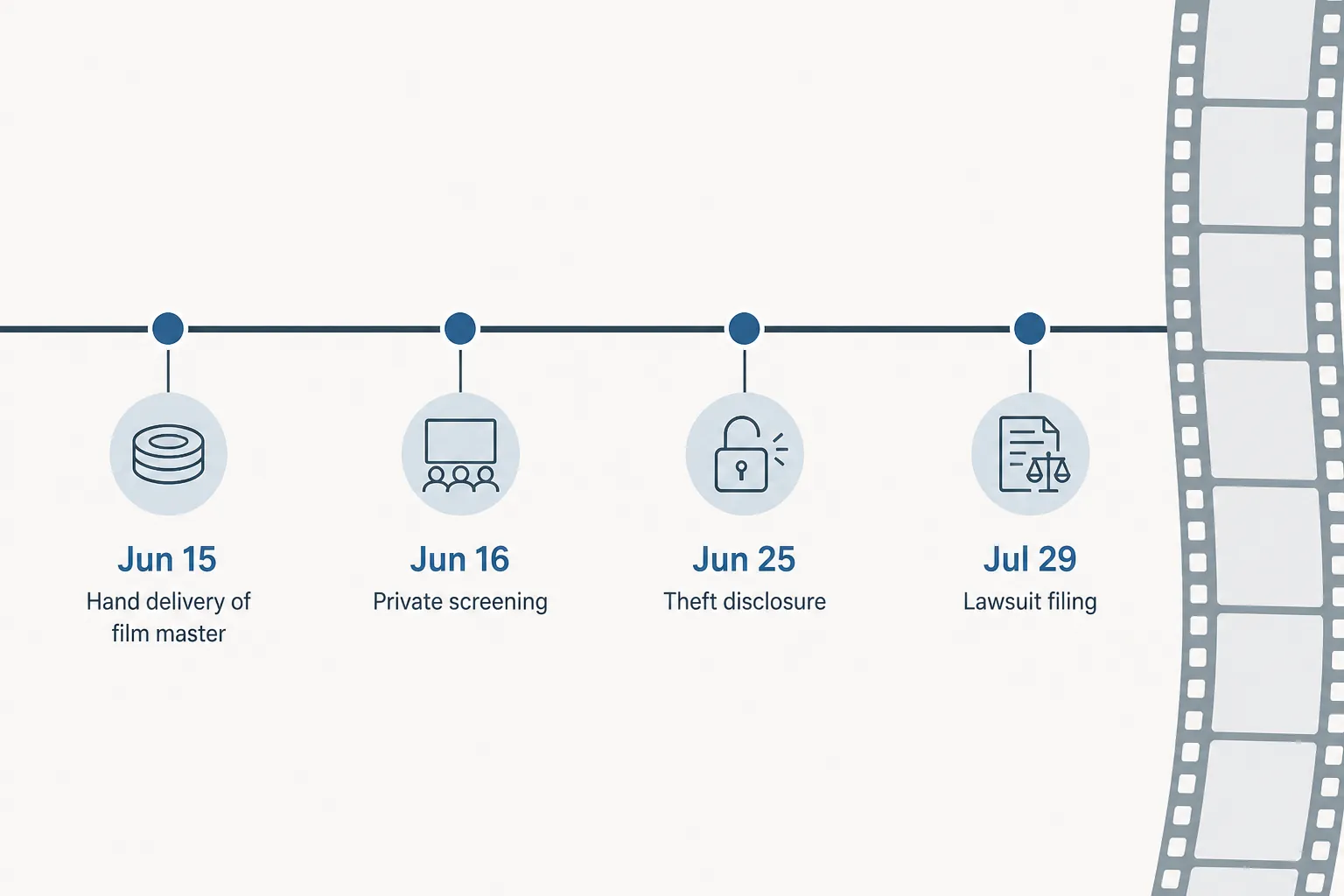
| Date | Status of the fact |
|---|---|
| June 15, 2026 | Plaintiffs allege the DCP was hand-delivered to Netflix at Netflix’s request, with an instruction to delete it after screening.[5] |
| Around June 16, 2026 | Plaintiffs allege Netflix screened the film around this date.[5] |
| June 25, 2026 | Plaintiffs allege they were informed by email from Netflix Director of Original Film Sean Berney that drives had been stolen from Netflix office desks.[5] |
| Up to one week before notice | Plaintiffs allege Netflix knew of the theft for up to a week before notifying them; that timing remains an allegation, not a finding.[5] |
| July 29, 2026 | The federal lawsuit was filed in the Central District of California.[1] |
Those entries should not be blended into a single “Netflix lost the movie” fact. The court record, at this stage, proves that a complaint was filed. It does not prove that the DCP was delivered under the conditions alleged, that the copy was deleted or not deleted after a screening, that Netflix had notice on any particular day, or that the theft occurred in the precise way plaintiffs describe.
The pleaded claims and the money demand
The complaint pleads three civil claims: conversion, breach of bailment contract, and breach of implied contract.[3][4] In practical terms, the claims depend on plaintiffs’ custody theory: that Netflix allegedly accepted possession of valuable film material for a limited purpose and then allegedly failed to safeguard or return control over it.
The damages figure should be carried with the same caution. Plaintiffs demand at least $105,000,000, plus punitive damages, and request a jury trial.[3][4] Reports also describe plaintiffs as asserting more than $45 million in investment over seven years, but that investment figure is a plaintiff-side assertion, not a judicial valuation of the missing master or the film’s market value.[5]
Any larger “$165 million” or “extortion” framing belongs in the category of litigation characterization, not established loss. It may matter later if the parties brief damages, settlement conduct, or risk allocation, but it is not something the complaint-only docket has adjudicated.
Netflix’s response is also a position, not a court finding
Netflix’s reported response is that it does not own the rights to “Fortitude” and disputes bearing the risk of loss for a film allegedly delivered without proper industry-standard safeguards.[2][3] That position matters because it points to the likely defense terrain: rights ownership, custody terms, delivery protocols, encryption or security measures, and who contractually or practically assumed loss risk.
It still remains Netflix’s position. The current record described here does not contain a ruling accepting Netflix’s risk-of-loss argument, rejecting plaintiffs’ bailment theory, or valuing the alleged loss. The same discipline applied in other official-record-versus-reported-context reviews applies here: separate the event narrative from the record posture.
Status as of July 31, 2026
| Category | What can be said now |
|---|---|
| Confirmed by docket | Case No. 2:26-cv-08384 was filed in the Central District of California on July 29, 2026, with a $405 fee and Receipt No. CCACDC-42919203.[1] |
| Confirmed party answer | The plaintiffs identified in the public reporting and complaint record are Simon Afram and Op-Fortitude Ltd.; the defendant is Netflix, Inc.[1][2][3] |
| Alleged in complaint | The DCP was allegedly hand-delivered, allegedly subject to a delete-after-screening instruction, allegedly stolen from Netflix’s Los Angeles office, and allegedly disclosed to plaintiffs after a delay.[4][5] |
| Pleaded claims | Conversion, breach of bailment contract, and breach of implied contract.[3][4] |
| Plaintiff demand | At least $105,000,000, plus punitive damages and a jury trial.[3][4] |
| Disputed by Netflix | Netflix says it does not own the rights and disputes risk of loss for a film allegedly delivered without proper industry-standard safeguards.[2][3] |
| Not yet adjudicated | Theft details, custody duties, delivery safeguards, notice timing, liability, punitive exposure, and damages valuation. |
So the durable answer to “who filed the Netflix $105 million lawsuit” is Simon Afram and Op-Fortitude Ltd. The rest of the headline—the alleged theft, the custody failure, and the value assigned to the missing “Fortitude” master—remains litigation allegation until the court record develops.
References
- Op-Fortitude Ltd., a United Kingdom company v. Netflix, Inc., a Delaware corporation, No. 2:26-cv-08384, public docket, PACER Monitor, July 29, 2026
- Missing Nicolas Cage Film Spurs $105 Million Netflix Lawsuit, Bloomberg Law
- Producer sues Netflix for $105 million over missing Nicolas Cage movie, Reuters, July 30, 2026
- Op-Fortitude Complaint_Redacted.pdf, Deadline
- Netflix Sued Over Missing Hard Drive Of World War II Movie, Deadline, July 2026
Related records
Tool profile
Browse tool evaluations →Governing regulation
Browse the obligations tracker →Preventive workflow
Browse verification workflows →
Report a correction or tip
Spotted an outdated figure, a misstated fact, or a ruling this case record should reflect? Public comments are disabled for this content given the professional cost of a misreported case outcome, penalty amount, or rule text — use the structured correction channel instead.
Report a correction or tip for this record →