
Legal Actions a Nissan Dealer Faces for Retaliatory Reviews
This article analyzes the legal claims arising from the July 2026 Nissan of Cape Coral incident, where a general manager retaliated against a customer's negative review by posting fake reviews about the customer's business. Readers will understand the viability of defamation, tortious interference, and potential FTC penalty exposure.
- Jurisdiction
- Florida, United States
- Court
- No court (unfiled incident)
- AI tool named
- No AI tool implicated
- Ruling date
- Jul 22, 2026
- Source document
- View primary court order ↗
- Last verified
- Jul 24, 2026
Lex Machina Review is an independent risk-tracking and reference resource. Nothing on this site is legal advice, and using it does not create an attorney-client relationship. Every record is reviewed against primary sources but may not reflect the most current status of a matter — always verify directly against the cited court order, rule text, or a licensed attorney before relying on it.
Companion explanation — secondary to the source document above
As of July 24, 2026, there is no filed lawsuit in the reported Nissan of Cape Coral episode. There is, however, a fact pattern that would make most litigation counsel stop scrolling: a Fort Myers customer reportedly left a 1-star Google review after a poor service experience; the dealership's general manager, Blake Varnadoe, allegedly responded by posting fake negative reviews about the customer's separate small business, RT Upholstery, on Google and Facebook; the customer documented the exchange on TikTok; and Krause Auto Group apologized and placed the general manager on leave.[1][2]
That sequence matters more than the noise around it. Motor1 reported that the TikTok video drew more than 1.2 million views within 24 hours, which explains the speed of reputational pressure on the dealer group.[1] The view count does not prove defamation, interference, agency, or regulatory liability. The alleged posts, the platforms used, the relationship between the dealership and the manager, and the effect on RT Upholstery would do that work, if a case is ever filed.

The claims map starts with the customer's separate business
The important legal move is not that a dealership employee disliked a review. Businesses can dispute customer accounts. They can ask platforms to remove reviews that violate platform rules. They can respond publicly, correct facts, and sometimes sue over false statements. The risk changes when someone with managerial authority allegedly turns away from the dealership review and targets the customer's unrelated livelihood.
On the reported facts, the prospective plaintiff is not just a dissatisfied service customer. She is also the owner of RT Upholstery, the business allegedly hit with fake negative reviews after she criticized Nissan of Cape Coral.[1] That gives the dispute a commercial-retaliation shape: the original review concerned the dealership, while the alleged response concerned another business whose customers, search results, and reputation were not part of the service visit.
| Reported fact | Why it matters legally |
|---|---|
| Customer leaves a 1-star review of Nissan of Cape Coral | Sets up protected consumer speech and the dealership's motive to respond |
| General manager allegedly posts fake negative reviews of RT Upholstery | Creates potential falsity, publication, business-reputation injury, and retaliatory motive |
| Posts reportedly appear on Google and Facebook | Confirms third-party publication while raising platform-immunity issues |
| Customer's TikTok account amplifies the dispute | Explains public pressure, but does not by itself establish liability |
| Krause Auto Group apologizes and places the manager on leave | Shows employer response, while leaving agency and scope-of-employment questions unresolved |
Defamation would be the first civil claim to test
A fake negative review of a small business is not automatically defamation. The first question is whether the review contains a factual assertion capable of being proven true or false. A vague insult, a star rating standing alone, or a loose opinion may be hard to plead as defamatory. A claimed experience with RT Upholstery that never happened, a fabricated accusation about workmanship, dishonesty, missed work, or customer treatment would be different.
The reported word "fake" is doing heavy work here. If the alleged reviews were posted by someone who had no customer relationship with RT Upholstery, falsity becomes more concrete. The plaintiff would still need the actual posts, account information where available, timestamps, screenshots, platform notices, and evidence tying the reviews to the alleged author. Viral retellings are useful for locating witnesses and preserving chronology; they are not a substitute for the review text itself.
In a business-defamation pleading, injury also needs care. RT Upholstery would not want to rely only on embarrassment or online outrage. The stronger damages record would show loss of inquiries, canceled jobs, reduced conversion, customer questions about the reviews, search-result changes, time spent on remediation, and any platform correspondence about removing the posts. For a small service business, the burden can fall immediately on the owner: explaining the episode to customers, documenting the falsehood, and deciding whether litigation costs are rational.
The general manager's role would matter at both liability and damages stages. A random stranger's fake review can be actionable. A dealership general manager allegedly using review platforms to punish a customer after a dealership complaint adds motive, context, and potential punitive-damages arguments. It also creates the harder employer-liability question: whether the conduct can be treated as purely personal spite or as an extension of dealership review management.
Tortious interference fits the same facts, but requires more than reputational upset
A tortious-interference theory would focus less on the words in the reviews and more on customer relationships. The core allegation would be that the manager knowingly used false reviews to disrupt RT Upholstery's prospective or existing business relationships. That is plausible as a theory, but it is not self-proving.
The cleanest interference proof would connect the reviews to identifiable business consequences. A customer who says they hesitated because of the Google listing, a prospect who canceled after seeing the reviews, or records showing a measurable drop in calls after the posts would be more useful than a general claim that bad reviews are bad for business. The pleading can start with reasonable inferences, but discovery and damages will need a narrower record.
There is also a privilege and competition problem to watch. The dealership was not competing with RT Upholstery in the reported facts, which may make the conduct look less like rough commercial competition and more like retaliation. But the plaintiff still has to identify the business expectancy or relationship that was allegedly impaired. Courts are usually more comfortable with interference claims when the plaintiff can point to actual customers, not just an abstract pool of future internet users.
The dealership's exposure depends on agency, not apology language
Krause Auto Group's apology and leave decision are important facts, but they do not answer the vicarious-liability question.[1][2] Employer responsibility would turn on what the manager was doing, whose interests he was serving, what authority he had over customer relations and review response, and whether the dealership benefited from or ratified the conduct.
The defense version is straightforward: the alleged posts were personal-account conduct, outside policy, outside the scope of employment, and directed at a third-party business the dealership did not sell against. On that view, the manager may have created personal tort exposure without converting the dealership into the publisher of the reviews.
The plaintiff's version would emphasize authority and motive. A general manager is not a low-level employee with no public-facing role. If the alleged retaliation was triggered by a dealership service review, and if the manager acted to punish or deter criticism of the dealership, the conduct becomes easier to characterize as connected to dealership business even if the posts came from a personal account. Internal policies, prior review-response practices, access to customer information, and any messages about the customer's original review would become discovery targets.
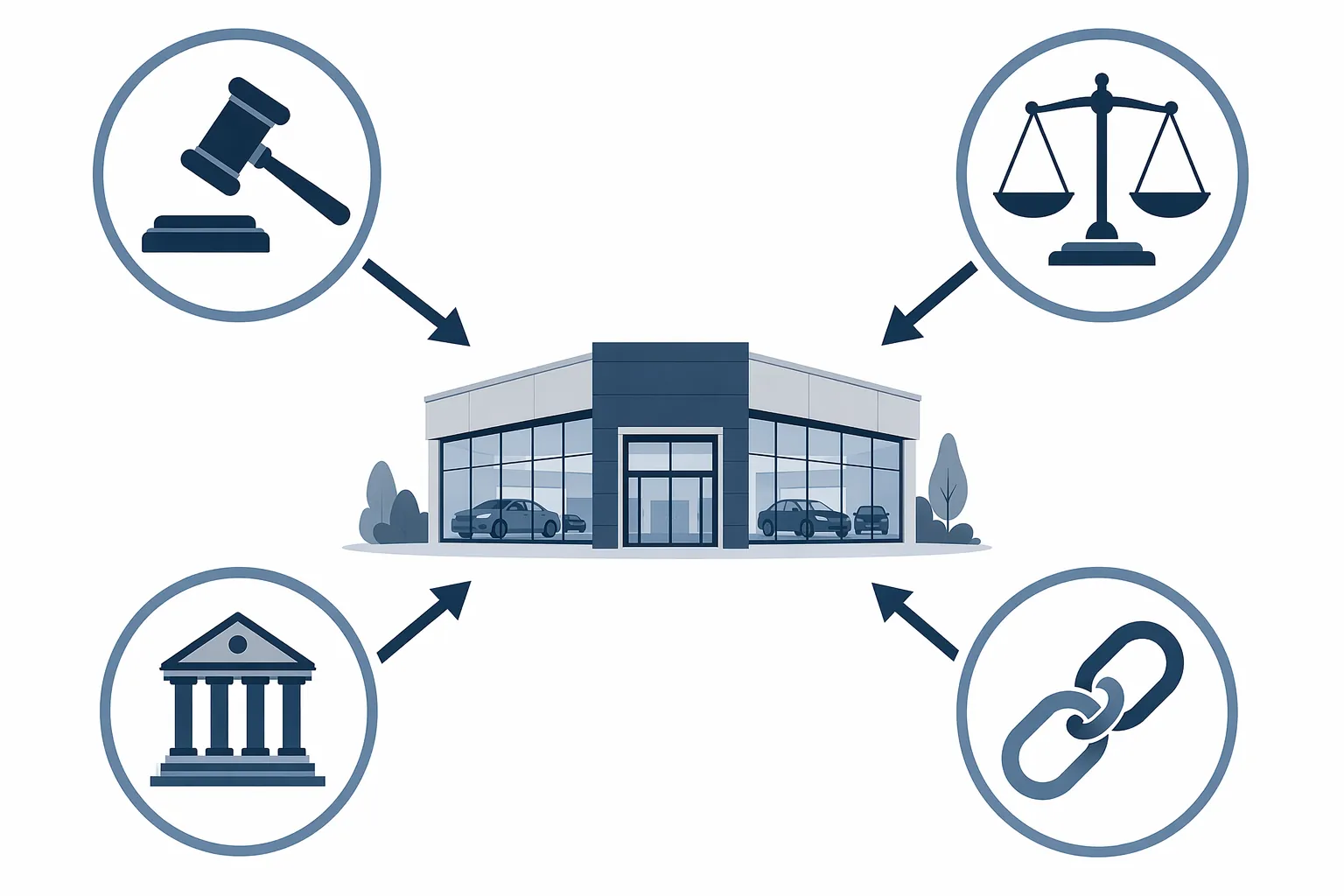
Ratification is a separate path, but it needs evidence. A quick apology and leave decision may help the dealer group argue that it did not approve the conduct. A slow response, selective deletion, inconsistent explanations, or internal messages celebrating the retaliation would point the other way. Counsel on both sides would want the same materials preserved before platform content disappears or accounts are locked down.
Anti-SLAPP risk should shape the pleading
A defamation complaint over online reviews also invites an anti-SLAPP response, especially in Florida. That does not make the claim weak. It means the plaintiff should plead falsity, publication, author identity, damages, and commercial-retaliation context with discipline. If the defendant can frame the case as punishment for speech on a matter of public concern, a motion to strike can change the leverage and, if successful, create fee-shifting risk.
The plaintiff's best answer would be narrowness. The case should not be pleaded as "the manager said something mean online." It should be pleaded, if the evidence supports it, as fabricated statements about a business by someone who was not a customer, made in retaliation for a separate dealership review, and causing identifiable commercial harm. That framing does not eliminate anti-SLAPP risk, but it avoids handing the defense an overbroad complaint.
Section 230 protects platforms, not the alleged author
Google and Facebook would be unattractive defendants for this kind of claim. Section 230 generally shields platforms from liability for third-party user content, and the reported facts point to alleged posts by a manager, not content created by the platforms. A plaintiff may still use platform processes to remove reviews or seek information through proper legal channels, but the tort case would ordinarily aim at the person who allegedly authored the reviews and any entity legally responsible for that person.
That distinction matters because "the reviews were on Google" is not the same as "Google is liable." Platform immunity does not launder the author's conduct. If the author made false factual statements, Section 230 is unlikely to be the author's shield.
The FTC angle is real, but not automatic
The Federal Trade Commission's consumer-review rule became effective on October 21, 2024. The final rule bans fake reviews and testimonials, certain insider reviews, and review suppression; it also prohibits using threats, whether legal or otherwise, explicit or implicit, to suppress negative reviews. The FTC announced that civil penalties can reach $53,088 per knowing violation, with no statutory cap stated in the announcement.[3]
That is why dealer groups should not treat review retaliation as a private customer-service spat. The FTC followed the rule with December 2025 warning letters to 10 companies, including auto dealers, specifically calling out the Review Rule's review-suppression prohibition.[4] The agency had already shown interest in auto-dealer review misconduct in the Leader Automotive Group matter, a December 2024 settlement described as the largest FTC auto-dealer settlement and involving allegations that employees were required to post fake 5-star reviews and received bonuses tied to review generation.[5]
The hard boundary is fit. The rule plainly targets fake reviews and review suppression by threats. The reported Cape Coral facts involve alleged fake negative reviews of a customer's unrelated business after the customer criticized a dealership.[1] That looks retaliatory, and retaliation can deter negative reviews. But whether a manager's retaliatory review of a customer's separate business falls within the FTC's review-suppression framework is an enforcement question, not a settled holding.
The FTC would likely care about facts that show deterrence or policy failure: Did the manager threaten the customer before or after posting? Did anyone at the dealership know? Were other customers treated similarly? Did the dealership have review-response policies? Were employees trained after the Review Rule took effect? Was the retaliation meant to pressure deletion of the 1-star review? Those questions decide whether the episode looks like one employee's misconduct or a compliance failure in the dealer group's review ecosystem.
State enforcers are already watching auto dealers
State attorney general activity is relevant context, not a prediction. New York Attorney General Letitia James announced recoveries from Nissan dealers in 2025 and 2026 for lease-overcharge schemes, including more than $3.2 million from one group of Nissan dealers and refunds for additional New Yorkers in a later action.[6][7] Those matters do not involve the Cape Coral facts and do not prove that an attorney general will pursue review retaliation. They do show that auto-dealer conduct, including Nissan-branded dealer conduct, is not confined to private disputes when regulators see consumer harm.
What this is not
Search interest around this incident will naturally pull in the phrase "nissan dealer review bombing legal action lawsuit." The phrase is only partly accurate. On the present record, this is not confirmed review-bombing litigation and not a filed lawsuit. It is a reported review-retaliation incident involving an alleged single managerial actor, followed by viral amplification and an employer response.[1][2]
That distinction is not pedantic. Review bombing usually suggests coordinated mass posting. The leading comparators are different kinds of disputes. In Clay Nissan, a dealership filed a $1.5 million defamation countersuit against customers who organized a social-media boycott, and the case settled before trial.[8] In Burress v. Western Avenue Nissan, online reviews were cited as evidence in a RICO class action alleging a broader pattern, but the case was filed in May 2025 and terminated in October 2025, with the disposition unclear from the docket materials identified in the research.[9] In Houseman v. Harrison, a Saskatchewan court treated coordinated fake reviews as actionable and awarded CA$240,000, but that Canadian decision is persuasive at most for U.S. courts.[10]
Those examples help mark the boundaries. A dealership can sue over organized false attacks. Reviews can become evidence in broader consumer-fraud litigation. Coordinated fake-review campaigns can produce serious judgments in some courts. None of that converts the Cape Coral episode into a filed review-bombing lawsuit. The reported facts point to a narrower and still serious problem: alleged retaliatory false reviews against a customer's separate business.
The litigation posture if a complaint is filed
A careful complaint would likely name the alleged author and then decide whether to name the dealership, the dealer group, or both based on agency evidence available before filing. It would attach or quote the challenged reviews, identify why they are false, describe the original dealership review, plead the retaliatory chronology, and allege concrete harm to RT Upholstery. If the plaintiff cannot yet identify all account data, the complaint can preserve the core claim while discovery seeks platform and device evidence.
The defense would likely separate the actors. Expect arguments that the dealership did not publish the reviews, did not authorize them, placed the manager on leave, and cannot be liable for personal-account conduct directed at an unrelated business. Expect anti-SLAPP arguments if the complaint is loose. Expect challenges to damages if RT Upholstery cannot connect the reviews to lost business or measurable remediation costs.
Regulatory exposure would move on a different track. A private plaintiff does not need to prove an FTC violation to bring defamation or interference claims. The FTC does not need a private judgment to investigate review practices. Dealer counsel should therefore separate the questions: tort liability to the customer and RT Upholstery, employment and agency exposure for the dealership, platform-removal strategy, and Review Rule compliance.
If the reported posts are preserved and provable, the conduct sits at the intersection of defamation, tortious interference, FTC review-suppression exposure, and employer-liability risk. The operational lesson is not complicated: preserve the posts, preserve the original 1-star review, preserve internal messages, separate platform immunity from author liability, and treat managerial review retaliation as a multi-front legal exposure rather than a public-relations inconvenience.
References
- Nissan Dealership Attacks Small Business After Customer Leaves Bad Review, Motor1.com, July 22, 2026.
- A Nissan dealership's TikTok review apology, Automotive News, July 23, 2026.
- Federal Trade Commission Announces Final Rule Banning Fake Reviews and Testimonials, Federal Trade Commission, August 2024.
- Warning letter or ten: Businesses, comply with the FTC's Consumer Review Rule, Federal Trade Commission, December 2025.
- FTC and IL Take Action Against Automotive Group for Allegedly Overcharging and Deceiving Consumers Through Fake Reviews and Junk Fees, FTC Attorney, December 2024.
- Attorney General James Secures Over $3.2 Million from Nissan Dealers for Cheating Consumers, New York State Attorney General, 2025.
- Attorney General James Secures Refunds for All New Yorkers Cheated by Nissan, New York State Attorney General, 2026.
- Clay Nissan Settles $1.5M Defamation Suit, Auto Dealer Today.
- Reviews Cited in RICO Suit Against Chicago Nissan Dealer, DealerAgent News.
- Review Bombing: Canadian Court Attaches Liability to Campaign of Defamatory Internet Reviews, Commercial Litigation Blog.
Related records
Tool profile
How Meta's AI Spending Reshapes Law Firm ProfitabilityGoverning regulation
Browse the obligations tracker →Preventive workflow
Browse verification workflows →
Report a correction or tip
Spotted an outdated figure, a misstated fact, or a ruling this case record should reflect? Public comments are disabled for this content given the professional cost of a misreported case outcome, penalty amount, or rule text — use the structured correction channel instead.
Report a correction or tip for this record →