
How AI Evidence Contamination Complicates the Nolan Wells FBI Case
Deepfake videos, disputed enhanced audio, and metadata redaction converged in the Nolan Wells FBI investigation, creating three distinct AI-evidence contamination vectors. This case highlights evidentiary admissibility risks that current authentication rules do not resolve and points to a verification workflow for counsel.
- Jurisdiction
- US-Mississippi
- Court
- Jackson County Circuit Court
- AI tool named
- Unspecified AI deepfake generator
- Ruling date
- Jul 27, 2026
- Source document
- View primary court order ↗
- Last verified
- Jul 31, 2026
Lex Machina Review is an independent risk-tracking and reference resource. Nothing on this site is legal advice, and using it does not create an attorney-client relationship. Every record is reviewed against primary sources but may not reflect the most current status of a matter — always verify directly against the cited court order, rule text, or a licensed attorney before relying on it.
Companion explanation — secondary to the source document above
Risk Digest posture, last verified July 31, 2026: the Nolan Wells disappearance and death investigation remains an active Mississippi matter in Jackson County, with a grand jury path approaching and federal assistance publicly described only at a general level. Nothing in this article treats any disputed file as court-authenticated, any forensic finding as adjudicated, or any AI-related claim as a substitute for admissibility analysis.
That is the practical point for counsel following the Wells investigation: counsel may have to make preservation, filing, and witness-protection decisions before the public record is technically clean. In the Wells matter, three different evidence-contamination problems arrived close together: AI-generated videos circulating online, a disputed enhanced-audio file, and redacted metadata in the source recording. They do not create the same legal problem, and treating them as one generalized “deepfake” issue obscures the work a lawyer actually has to do.
The case record is already split across three evidentiary tracks
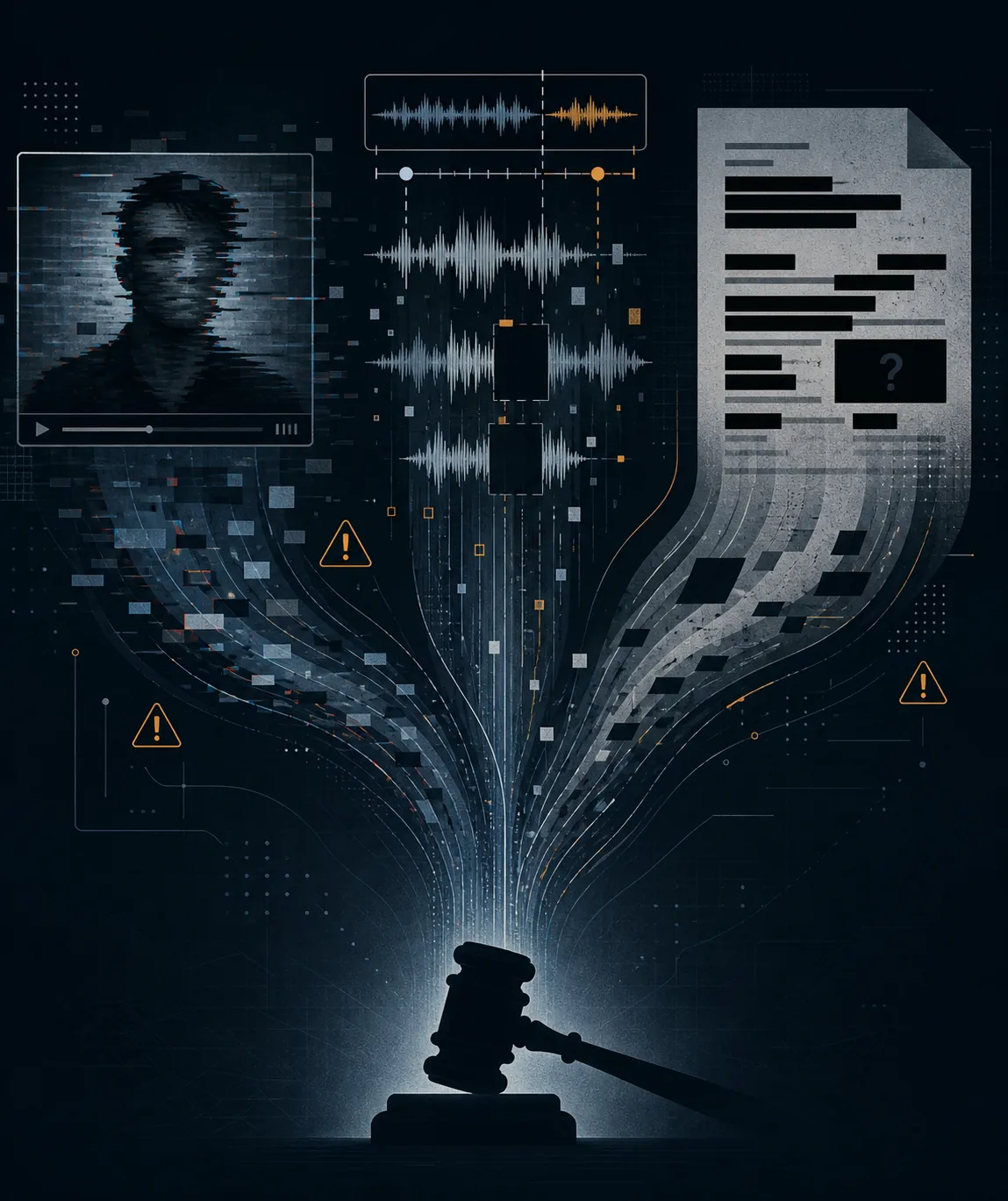
The public reporting around Nolan Wells now has to be read in layers. One layer is the underlying death investigation. A second is the online environment that formed around it. A third is the forensic dispute over media files that may or may not have evidentiary value. The danger is not merely that false content exists. The danger is that false, altered, enhanced, redacted, and source-record material can be discussed in the same public stream until a later reviewer has to untangle which file came from where.
The most emotionally direct contamination came first. The Clarion Ledger reported that fake videos and deepfakes spread amid the investigation, including AI-generated videos impersonating Wells’s mother and fabricating drowning scenes; the videos appeared within three days of the body recovery, and his mother publicly pleaded for their removal. [1]
That detail matters for reasons that are more concrete than reputational harm. When a victim’s family member is impersonated, family communications become harder to evaluate. When fabricated scenes circulate, witnesses may be pressured to respond to images that were never investigative records. When junior lawyers or investigators are later asked to “check the media file,” they may inherit screenshots, reposts, downloads, and platform-compressed copies with no reliable path back to an original. Sympathy for the family does not authenticate the file; it does explain why contamination can move faster than preservation.
The second track is more technical and more dangerous for admissibility because it concerns audio tied to the July 4 Sea Tow emergency call. NewsNation reported that TMZ released an “enhanced audio” version on July 27, 2026, and that the enhanced version was 20 seconds longer than the original Mississippi Department of Marine Resources recording, with different digital fingerprints. [2]
The third track narrows the question from suspected alteration to incomplete authentication. Digital forensics expert Robert Fried of Page One, Inc. found that the MDMR original contained redacted metadata, including omitted account numbers and phone numbers, which prevented full authentication under current standards. [2]
Those three tracks should stay separate in any litigation file. The deepfake videos create public-environment contamination. The enhanced audio creates a forensic-comparison dispute. The redacted metadata creates a chain-of-custody and source-authentication gap. A single “AI evidence” label is too blunt to protect the record.
Deepfake circulation creates witness pressure before it creates a courtroom exhibit
The fake videos are not important because they prove that a synthetic clip will be offered in court. There is no public basis for that conclusion. They are important because they show how quickly non-evidence can begin behaving like case material: shared, captioned, reacted to, saved, and discussed by people who may later be witnesses, family members, tipsters, or targets of harassment.
For a lawyer, the first question is not whether the clip is realistic. The first question is where it entered the record. Was it ever submitted to law enforcement? Was it attached to a message from a witness? Was it sent to a family member? Was it viewed by someone whose later recollection becomes relevant? Was it preserved only as a platform download stripped of useful metadata? Those are not glamorous questions, but they decide whether the item belongs in a litigation hold, a witness file, a threat packet, or a discard pile labeled public synthetic content.
The Nolan Wells videos also illustrate a protective concern that gets lost in abstract deepfake commentary. A mother pleading for fake videos to be removed is not an evidentiary doctrine, but it is a warning about secondary harm. Synthetic content can force family members to deny scenes that never occurred and can invite strangers to treat fabricated material as investigative fact. That matters when counsel later evaluates witness stress, inconsistent public statements, or threats attached to online speculation.
For a fuller discussion of the public-contamination side of the case, see the pre-litigation deepfake risk from the Nolan Wells case. The narrower point here is that deepfake circulation can become legally relevant even when the deepfake itself never becomes evidence.
The enhanced audio dispute is the harder admissibility problem
The July 4 Sea Tow call presents a different problem because it sits closer to a potential evidentiary record. According to NewsNation’s reporting, TMZ’s enhanced audio was 20 seconds longer than the MDMR original and had different digital fingerprints. [2] That does not prove fabrication. It does mean a lawyer cannot responsibly cite the enhanced version as though it were merely a clearer copy of the source file.
A length discrepancy changes the authentication inquiry. If the file is longer, counsel needs to know whether silence was added, whether a lead-in or outro was appended, whether a processing tool changed duration, whether an export setting altered the container, or whether the compared files are not the same recording at all. Different digital fingerprints raise a related question: are the files different because one is a derivative produced through documented enhancement, or because the chain between original and derivative cannot be shown?
| Audio issue | Question counsel has to preserve |
|---|---|
| 20-second length difference | What accounts for the additional time, and is the difference documented in the enhancement process? |
| Different digital fingerprints | Can the proponent show a source-to-derivative path rather than relying on visual or auditory similarity? |
| Claimed audible phrases | Can an independent examiner reproduce the claimed interpretation from the same source material? |
| Unclear enhancement method | Can the method be explained, replicated, and tested under Rule 702/Daubert scrutiny? |
The claimed phrases are where the dispute becomes particularly sensitive. TMZ reportedly claimed the enhanced audio included phrases such as “Is he dead?” and “check his chest,” but those phrases could not be corroborated by independent forensic audio analysis. [2] If a phrase is not reproducible, it should not be laundered into a filing as a quotation simply because a media outlet placed it in circulation.
This is the point at which “enhancement” becomes an evidentiary word, not a media word. Enhancement may improve intelligibility, but it may also introduce artifacts, suppress context, or make an ambiguous sound seem more definite than the source supports. A court will not be helped by an argument that begins with what the internet heard. It will need the original, the derivative, the tool or process used, the settings or workflow if available, the examiner’s qualifications, and a way to test whether another competent examiner can reach the same result.
That distinction is not hostile to forensic audio work. It is how useful audio survives challenge. A separate counterpoint is discussed in How Forensic Audio Authentication Can Defeat the Deepfake Defense, where the value lies in authentication discipline rather than confidence language. In the Wells record, the public materials support skepticism about the disputed enhancement, not a final conclusion about what the original call proves.
Redacted metadata turns the question from fake to incomplete
Metadata redaction is less visually dramatic than a deepfake and less quotable than a disputed audio phrase, but it may be the most familiar problem to anyone who has had to authenticate a record under deadline. Fried’s reported finding was not that the MDMR original was fake. It was that redactions to metadata, including account numbers and phone numbers, prevented full authentication. [2]
That is a narrower conclusion, and it should stay narrow. Redaction can be legitimate. Agencies may have privacy, security, or investigative reasons to omit fields from a public production. But a redacted public file is not the same thing as a fully authenticated source record. If counsel is comparing a media-enhanced version to an agency-released original, and the agency file itself lacks metadata needed for full authentication, the clean comparison counsel wants may not yet exist in the public record.
The practical consequence is that the authentication burden shifts from “can we hear the phrase?” to “can we prove what file this is?” That means identifying the earliest available original, the custodian, the export path, the redaction process, any hash or digital fingerprint created before redaction, and any later processing that changed the file container or duration. Without those answers, a court may be asked to evaluate interpretation before provenance has been stabilized.
FBI assistance does not publicly authenticate the disputed files
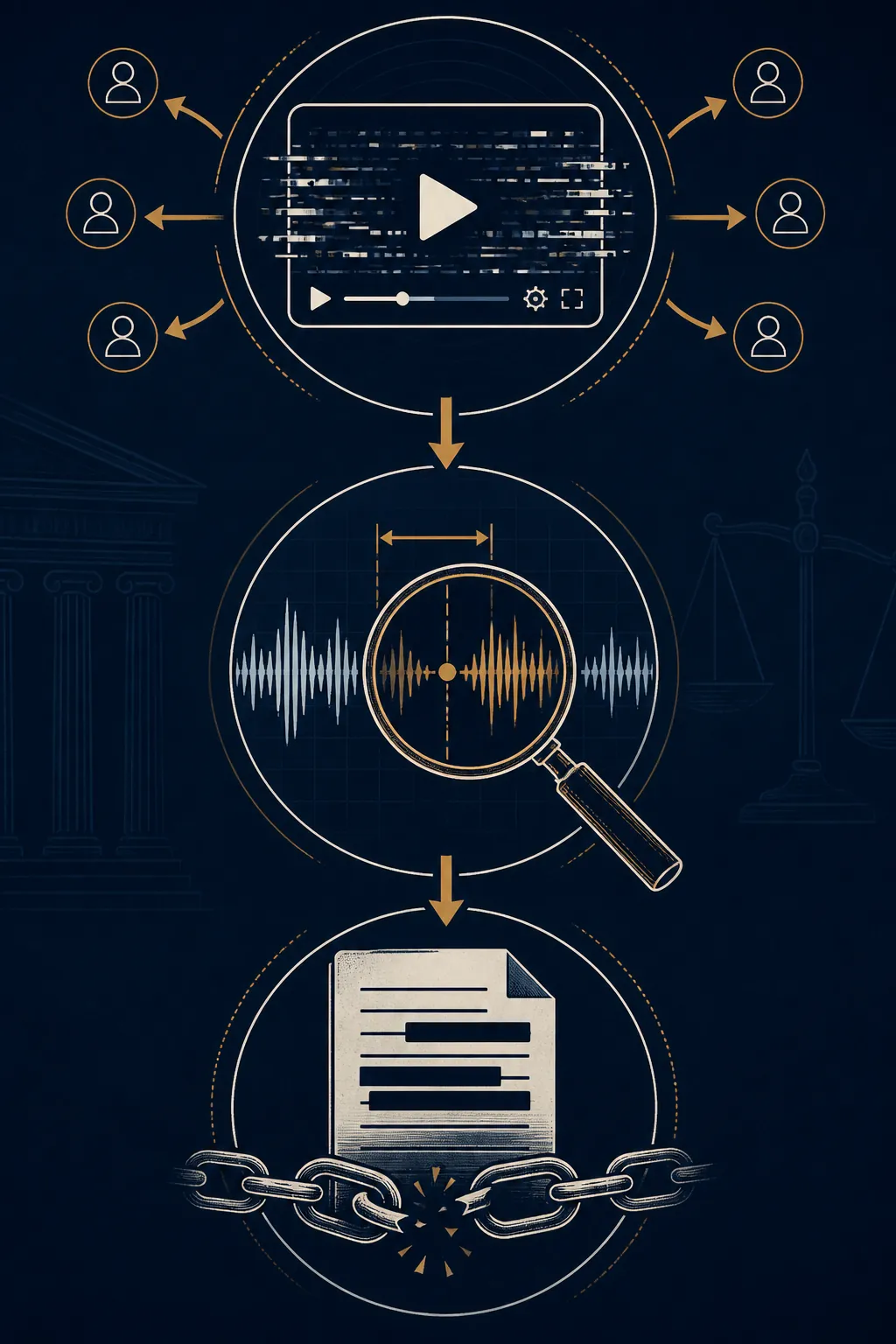
The FBI’s role has to be stated carefully. Public reporting says the FBI’s Jackson office is assisting the Jackson County Sheriff’s Office with digital evidence examination using “federal tools and partnerships,” and that the FBI is also investigating threats made in connection with Wells’s death. [3][4] That is not the same as a public FBI validation of TMZ’s enhanced audio, a court-tested endorsement of any forensic conclusion, or a disclosure of the Bureau’s specific analytical methods.
The witness-threat investigation is still relevant because it shows the contaminated information environment had consequences beyond comment threads. Fox News reported that the FBI was investigating threats against approximately 60 witnesses. [4] If synthetic videos, disputed audio claims, and online speculation are circulating while witnesses are being threatened, counsel has to preserve not only potential evidence but also the path by which non-evidence may have affected people connected to the investigation.
That does not make every online artifact relevant. It does mean the separation has to be documented. A synthetic TikTok clip belongs in a different folder from an agency source recording. A media-enhanced file belongs in a different folder from the MDMR recording. Threat communications belong in their own record set. Collapsing those categories may be convenient for a timeline memo, but it is dangerous for later motion practice.
Detection scores will not cure a broken chain
AI-detection tools are tempting in this kind of record because they appear to offer a fast answer: likely synthetic, likely real, likely altered. The National Center for State Courts has warned that AI-generated evidence threatens public trust in courts and that detection tools may output probability scores without contextualizing alternative explanations, creating a black-box problem for admissibility under Daubert and Rule 702. [5]
A probability score can be an investigative lead. It is not a chain of custody. It does not identify the original recorder, explain a 20-second discrepancy, restore redacted metadata, or prove that a claimed phrase is audible to a competent examiner applying a reproducible method. If the tool cannot explain plausible alternative reasons for its score, the score may create a new expert-evidence fight rather than solve the old one.
That is why the Wells matter is better understood as a record-management problem before it is treated as an AI-detection problem. The lawyer’s first obligation is to keep categories clean enough that an expert can later do useful work. A detection result attached to a corrupted intake process is still attached to a corrupted intake process.
The rule gap leaves ordinary authentication rules carrying the load
The federal evidence rules do not currently supply a clean AI-specific authentication pathway for this fact pattern. Kennedys Law reported in 2026 that Proposed Federal Rule of Evidence 707 was not adopted, leaving courts without a dedicated AI-evidence authentication rule. [6] The consequence is not that AI-adjacent evidence is automatically excluded. The consequence is that existing authentication, expert, relevance, prejudice, hearsay, and chain-of-custody principles have to absorb disputes they were not drafted to name.
That gap is manageable when the proponent has a clean source record, a documented process, and an expert who can explain and replicate the method. It becomes much harder when the available public materials include a social-media synthetic environment, a longer enhanced file with different digital fingerprints, and a source recording whose metadata is redacted. None of those facts alone decides admissibility. Together, they make casual use of the disputed materials indefensible.
The structural problem is not unique to Wells. Other AI-evidence disputes, including those discussed in The James Duckett case shows why AI evidence needs stronger gatekeeping, raise the same practical concern: courts may be asked to make evidentiary decisions before the technical record has been separated into source, derivative, synthetic, and unknown categories.
A counsel-facing verification workflow
The workflow for a matter like Nolan Wells should begin before anyone drafts a paragraph that treats a media file as evidence. It is not enough to say that the FBI is involved, that a file sounds clearer, or that a detection tool produced a score. The record has to be made sortable.
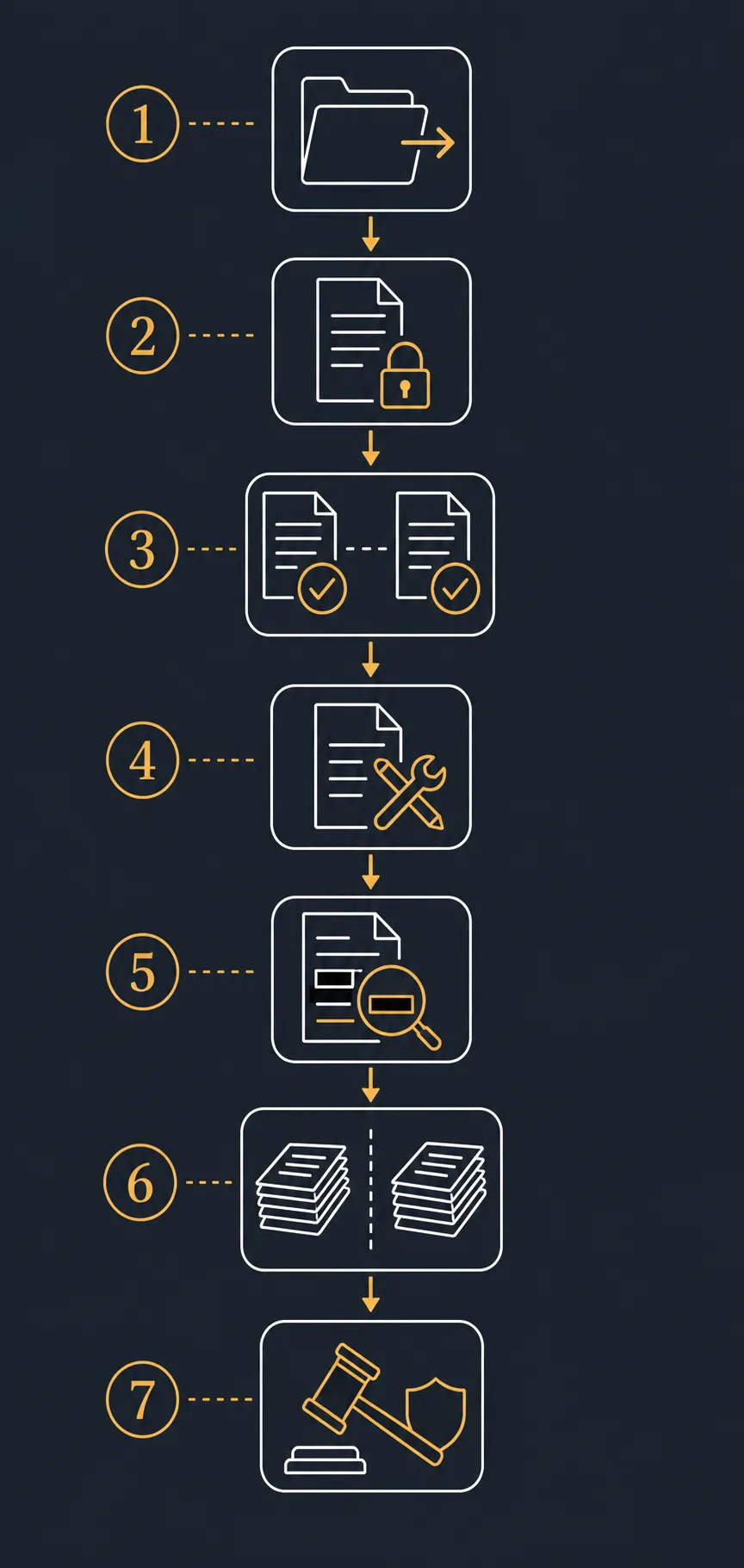
- Isolate the earliest available original. Identify the first source record held by the agency, platform, device owner, or custodian before reviewing derivatives.
- Preserve provenance. Record who obtained the file, from whom, when, by what method, and whether any export, download, compression, or redaction occurred.
- Compare hashes or digital fingerprints where available. Treat mismatches as questions requiring explanation, not as automatic proof of fabrication.
- Document enhancement methods. For audio and video derivatives, preserve the tool, operator, settings, workflow, output file, and any interpretive claims attached to the output.
- Identify metadata redactions. Separate legitimate public-record omissions from the authentication question they create for litigation use.
- Separate public synthetic content from investigative evidence. Keep deepfakes, reposts, threat communications, source agency files, and media-enhanced files in distinct record sets.
- Prepare Rule 702 and Daubert objections where the expert method cannot be replicated, explained, or placed in context with alternative explanations.
This sequence does not predict whether any disputed material in the Wells investigation will be offered, challenged, admitted, or excluded. It is a way to keep counsel from making the avoidable mistake: allowing public synthetic content, media enhancement, and incomplete source authentication to merge into one undifferentiated case file.
Nolan Wells matters less because it proves a new doctrine than because it shows, in one active investigation, how three AI-evidence contamination vectors can arrive before existing authentication rules have a clean way to sort them. The safer legal work is not to marvel at the technology. It is to preserve the original, mark the derivative, identify the missing fields, and refuse to quote what the record cannot yet support.
References
- Fake videos, deepfakes spread amid Nolan Wells investigation, Clarion Ledger, July 9, 2026
- Nolan Wells case: forensic expert disputes TMZ enhanced audio claims, NewsNation, July 2026
- FBI Investigating 'Threats' Made in Connection to Nolan Wells' Death, People
- FBI investigates threats against Nolan Wells witnesses, Fox News
- AI-generated evidence is a threat to public trust in the courts, National Center for State Courts
- 86% fake — 100% admissible? Rethinking evidence in the AI era, Kennedys Law, 2026
Related records
Tool profile
How Meta's AI Spending Reshapes Law Firm ProfitabilityGoverning regulation
Browse the obligations tracker →Preventive workflow
Browse verification workflows →
Report a correction or tip
Spotted an outdated figure, a misstated fact, or a ruling this case record should reflect? Public comments are disabled for this content given the professional cost of a misreported case outcome, penalty amount, or rule text — use the structured correction channel instead.
Report a correction or tip for this record →