
Analyzing Nolan Wells Enhanced Audio for Daubert Challenges
This article examines the AI-enhanced 911 call audio in the Nolan Wells case and provides a Daubert admissibility risk framework for litigators. It explains why the absence of methodological transparency and challenging acoustic conditions make this evidence presumptively unreliable under Mississippi’s Daubert-based Rule 702.
- Jurisdiction
- Mississippi
- Court
- Mississippi state court
- AI tool named
- Unspecified AI tool
- Ruling date
- Jul 27, 2026
- Source document
- View primary court order ↗
- Last verified
- Jul 28, 2026
Lex Machina Review is an independent risk-tracking and reference resource. Nothing on this site is legal advice, and using it does not create an attorney-client relationship. Every record is reviewed against primary sources but may not reflect the most current status of a matter — always verify directly against the cited court order, rule text, or a licensed attorney before relying on it.
Companion explanation — secondary to the source document above
Before the Nolan Wells enhanced 911 call audio analysis can be treated as evidence, the label needs tightening. The underlying recording was not a 911 dispatch call; it was a Sea Tow distress call released by the Mississippi Department of Marine Resources, with WLOX reporting the raw audio on July 26, 2026.[1] TMZ then published what it described as an AI-enhanced version on July 27, attributing background phrases such as “Is he dead?”, “Check his chest,” and “Wake up” to its enhanced audio.[2]
That is the record posture as of July 28, 2026: a raw MDMR-released Sea Tow call, a media-created enhancement, no public court ruling on the enhancement, and an investigation expected to proceed through grand jury review rather than a trial record already tested by motions practice.[3] The phrases circulating online are therefore TMZ’s interpretive claims, not authenticated forensic findings.
For admissibility purposes, the most important fact is not whether the enhanced file sounds persuasive to a listener wearing headphones. It is that TMZ’s public report did not disclose the enhancement software, algorithm version, settings, chain of custody, validation process, or examiner qualifications.[2] Under Mississippi’s Rule 702 framework, that absence is not a footnote. It is the challenge.
The raw call is the baseline; the enhanced file is the opinion
A raw recording gives the court something to measure against. It can be authenticated, compared, played for context, and examined for continuity, artifacts, interruptions, and competing sounds. An enhanced version does something different: it asks the court to trust a transformation.
That transformation may be useful. Audio enhancement is not automatically suspect merely because software was used. But once a party offers the enhanced version for the proposition that previously unclear background speech contains particular words, the exhibit begins to resemble technical expert testimony. Someone, or some tool selected and configured by someone, has separated sound, amplified certain frequencies, suppressed others, and presented the result as more intelligible than the original.
That is why the raw Sea Tow call matters more than the viral excerpt. If a litigant later tries to offer TMZ’s enhanced audio, or an equivalent enhancement derived from the same source, the first question is not whether the jury should “listen closely.” The first question is what changed between the MDMR file and the enhanced file, who changed it, and whether the process can be reproduced.
Mississippi Rule 702 turns missing methodology into an admissibility problem
Mississippi Rule of Evidence 702 requires expert testimony to help the trier of fact, rest on sufficient facts or data, use reliable principles and methods, and apply those principles and methods reliably to the facts of the case.[4] Mississippi’s expert-admissibility standard is Daubert-based, following the state’s 2003 amendment to Rule 702.[5] Kumho Tire’s extension of Daubert-style gatekeeping to technical and specialized expertise matters here because audio enhancement is not a lay act simply because the output is a sound file.[6]
On the public record, the enhanced Wells audio arrives with almost none of the foundation a trial judge would need. TMZ’s story identifies the alleged audible phrases, but not the tool used to extract them, the model or algorithm version, the settings, the qualifications of the person who performed the enhancement, or any blind-listening or validation protocol.[2]
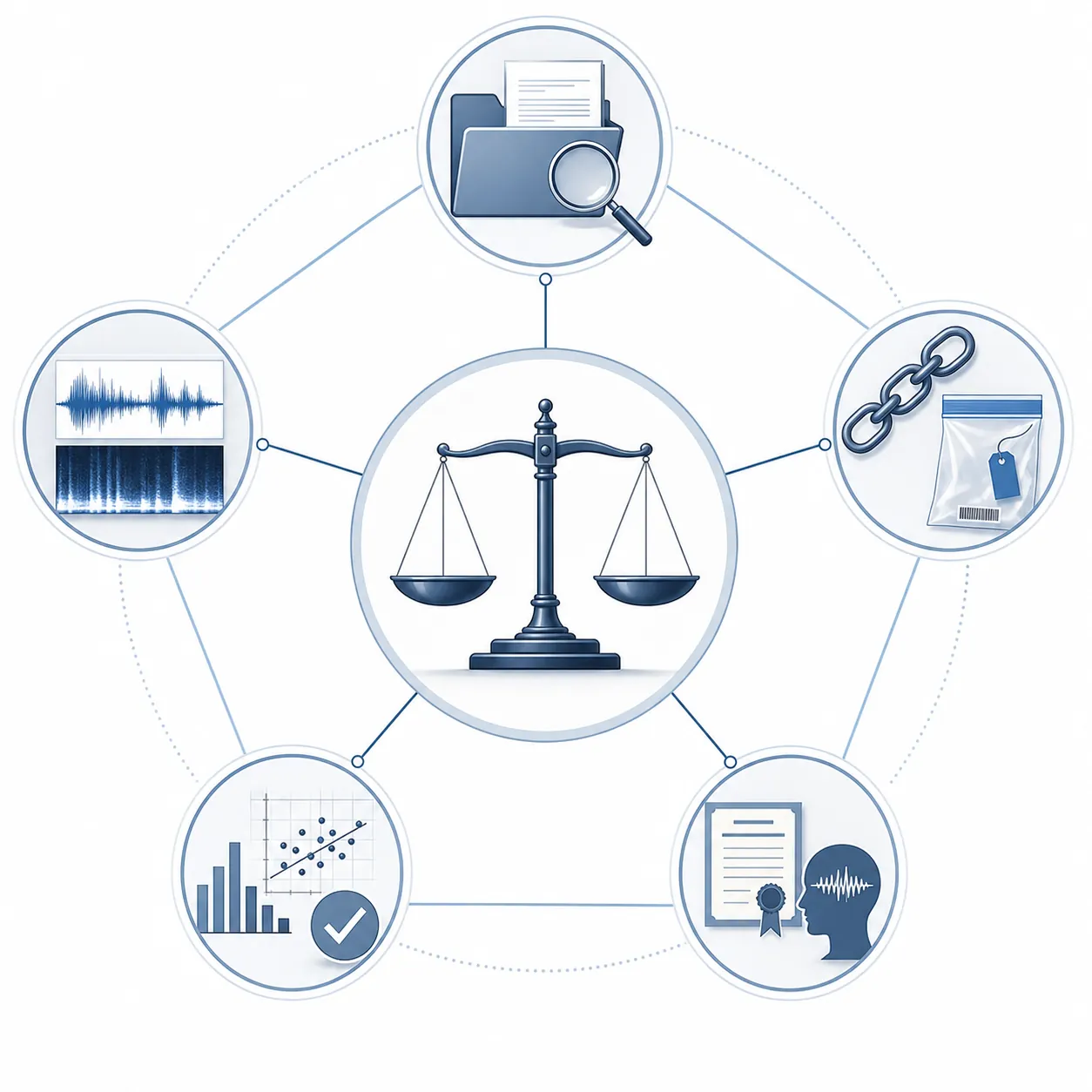
| Missing foundation in the public enhancement | Why it matters under Rule 702 / Daubert | What counsel should force into the record |
|---|---|---|
| Original-file lineage from MDMR release to enhancement | The court cannot know whether the enhanced file was generated from the same recording, a compressed copy, an edited excerpt, or a derivative file. | Produce the original file, metadata, hash values if available, transfer logs, and every intermediate file. |
| Enhancement software, model, version, and settings | Without the actual method, reliability cannot be tested, replicated, or meaningfully cross-examined. | Identify the tool, algorithm version, filters, separation settings, denoising settings, export format, and any manual edits. |
| Examiner qualifications | A technical process offered as clarifying speech requires a witness who can explain both the method and its limits. | Disclose training, forensic audio experience, prior testimony, error-rate familiarity, and whether the examiner followed any professional protocol. |
| Validation data for similar acoustic conditions | A method that performs well on clean speech may fail in noisy, overlapping, distance-miked speech. | Require test results on comparable noise, speaker overlap, microphone distance, compression, and engine or cabin background conditions. |
| Bias-control procedures | If the enhancer knew the desired phrases before processing or listening, confirmation bias becomes a reliability issue. | Use blind or sequential listening, independent examiners, and transcript-free comparison before exposing listeners to suggested phrases. |
| Side-by-side comparison to the raw call | A jury may treat enhancement as revelation unless the court can see whether the software clarified speech or created artifacts. | Offer the raw audio, enhanced audio, processing notes, and a demonstration of each transformation step. |
The table is not a generic digital-evidence checklist. Each demand follows from a specific defect in the public TMZ release. If a party cannot say what software was used, the judge cannot assess methodology. If the party cannot identify settings, the opposing expert cannot replicate the process. If the examiner is unknown, the court has no basis to decide whether the witness is applying specialized knowledge or merely presenting an edited exhibit.
The acoustic conditions are not a harmless detail
AI-enhanced audio often sounds more authoritative than it is because the end product has cleaner edges. That does not mean the words are more reliable. In speech separation, the underlying acoustic environment controls much of the risk: signal-to-noise ratio, overlapping speakers, microphone distance, reverberation, compression, and mechanical background sound all affect whether a model separates speech or invents confidence.
A 2025 ScienceDirect study of AI voice-separation models in noisy environments found that word-recognition accuracy reliably exceeded 80% only when the signal-to-noise ratio was at least 0 dB, and that performance degraded non-linearly below that threshold.[7] The Wells recording has been publicly described through the raw Sea Tow call and the TMZ enhancement as a noisy, multi-speaker boat setting rather than a controlled interview room.[1][2]
That benchmark does not prove the TMZ phrases are wrong. It proves a narrower and more useful point: a court should not assume that AI enhancement is neutral when the recording conditions are exactly the kind that make speech separation fragile. If no one has measured the signal-to-noise ratio, documented the overlap, or tested the method on comparable audio, the proponent is asking the judge to accept the output without the reliability showing Rule 702 is designed to require.
This is where viral audio clips mislead non-lawyers. The listener hears a phrase after being told what to hear. A court has to ask whether the process made speech intelligible, whether it enhanced noise into speech-like artifacts, and whether independent listeners would identify the same words without suggestion.
What the broader evidence record does, and does not, solve
The audio is only one stream in the Nolan Wells investigation. Public reports have also addressed phone custody and forensic inspection issues, including a joint forensic inspection agreement reported for July 15, 2026, and GPS records placing the boat departure at 4:31 PM.[8][9] Reuters reported on July 24 that the matter would go before a Mississippi grand jury, with evidence remaining outside ordinary public review while that process unfolds.[3]
Those facts do not authenticate the enhanced audio. They show why the enhancement cannot be evaluated in isolation. If phone data, GPS timing, witness accounts, autopsy findings, and audio interpretation eventually intersect, the court will need to know whether the enhanced words were independently reliable or whether they merely appeared to fit a developing theory.
A sealed or incomplete investigative record also cuts against overconfident public interpretation. The absence of a ruling is not proof the enhancement will be excluded. It is proof that the admissibility work has not yet been done in public.
How a motion in limine should frame the challenge
A motion to exclude AI-enhanced audio should not begin by arguing that the clip is emotionally prejudicial, even if it is. The stronger first move is foundation. The moving party should separate the raw call from the enhanced version and ask the court to treat the enhancement as technical opinion evidence subject to Rule 702.
- Demand the raw MDMR file and every derivative file used in the enhancement. The proponent should not be allowed to authenticate only the final audio excerpt.
- Require a complete custody path. Counsel should identify who obtained the raw call, who transmitted it, who processed it, and whether any file was compressed, clipped, normalized, or otherwise changed before enhancement.
- Force disclosure of the tool and settings. “AI-enhanced” is not a method; it is a label. The record needs the software, model or algorithm version, denoising and separation parameters, manual edits, and export settings.
- Depose the examiner. The questions should cover forensic audio training, experience with noisy multi-speaker recordings, knowledge of error rates, prior validation, and whether the examiner knew the alleged phrases before processing.
- Test against the raw call. The court should hear or review whether the alleged words are present in the original, whether enhancement merely increases audibility, and whether artifacts appear only after processing.
- Use blind listening where possible. Independent listeners should attempt transcription without being given TMZ’s claimed phrases first.
- Request a Rule 702 hearing before any jury exposure. Once jurors hear an emotionally loaded phrase, limiting instructions may not cure the practical effect.
If the enhancement is being offered only as an investigative lead, the court may not need to decide admissibility immediately. If it is being offered to prove what someone said on the boat, the proponent should carry the full reliability burden before the jury hears it.
What a proponent would need to supply
The same framework can be used defensively by a party trying to admit enhanced audio. The proponent would need to rebuild the missing record rather than rely on the media file.
- Authenticate the raw Sea Tow recording through a competent custodian and document that the enhancement was generated from that file or a verified copy.
- Preserve and disclose the full processing chain, including software identity, version, settings, intermediate outputs, and any manual intervention.
- Offer a qualified forensic audio examiner who can explain the method, not merely sponsor the finished clip.
- Provide validation evidence tied to similar acoustic conditions: noise, overlapping voices, boat-engine or cabin background, microphone distance, and compression.
- Address bias controls, including whether listeners or examiners were exposed to suggested phrases before transcription.
- Let the court compare raw and enhanced versions before deciding whether the enhanced file helps the jury or risks substituting software confidence for proof.
A proponent who can supply those materials may have an admissibility argument. A proponent who cannot is left with a polished audio file and an invitation to believe it.
The admissibility risk on the present public record
The enhanced Wells audio is not proven false. That matters. Exclusion analysis should not be converted into a public verdict on what happened or what was said.
But on the public record available now, the enhanced version is presumptively vulnerable under a Daubert-style Rule 702 analysis. The raw call exists. The enhancement methodology has not been publicly disclosed. The examiner is unidentified. The settings and model version are unknown. The relevant acoustic environment appears to involve noise and overlapping speech, conditions under which published speech-separation benchmarks warn against easy confidence.
That is the evidentiary posture: not a solved recording, not an authenticated forensic transcript, and not yet reliable evidence for a jury. It is an enhanced media exhibit awaiting the foundation that courtroom evidence requires.
References
- MDMR releases call audio in boat Nolan Wells case — WLOX, July 26, 2026.
- Nolan Wells Enhanced Emergency Call — TMZ, July 27, 2026.
- Death of Black teen Nolan Wells to go before Mississippi grand jury — Reuters, July 24, 2026.
- Mississippi Rules of Evidence 2025 — Mississippi Judiciary, April 7, 2025.
- Mississippi Expert Witness Admissibility Rules — Expert Institute.
- Daubert vs. Frye: Navigating the Standards of Admissibility for Expert Testimony — Expert Institute.
- AI-Powered Voice Separation Algorithms: Testing Accuracy in Noisy Environments — ScienceDirect, 2025.
- Sun Herald FBI digital evidence — Sun Herald.
- Nolan Wells phone forensic investigation — NewsNation.
Related records
Tool profile
How Meta's AI Spending Reshapes Law Firm ProfitabilityGoverning regulation
Browse the obligations tracker →Preventive workflow
Browse verification workflows →
Report a correction or tip
Spotted an outdated figure, a misstated fact, or a ruling this case record should reflect? Public comments are disabled for this content given the professional cost of a misreported case outcome, penalty amount, or rule text — use the structured correction channel instead.
Report a correction or tip for this record →