
Legal Steps When a North Carolina Mother Disappears in Grenada
When a US citizen vanishes abroad, most families and their attorneys overestimate what American authorities can do. This roadmap uses the Elizabeth Waddell disappearance in Grenada to outline the limited but layered protocol: local police reporting, State Department consular notification, Interpol alerts, evidence preservation, and the practical costs of engaging foreign counsel.
- Jurisdiction
- Grenada
- Court
- Royal Grenada Police Force
- AI tool named
- No AI tool
- Ruling date
- Jul 22, 2026
- Source document
- View primary court order ↗
- Last verified
- Jul 27, 2026
Lex Machina Review is an independent risk-tracking and reference resource. Nothing on this site is legal advice, and using it does not create an attorney-client relationship. Every record is reviewed against primary sources but may not reflect the most current status of a matter — always verify directly against the cited court order, rule text, or a licensed attorney before relying on it.
Companion explanation — secondary to the source document above
This Risk Digest entry is current as of July 27, 2026, in Q3 2026. It is a standalone cross-border risk protocol, outside the site’s usual AI-in-legal-practice lane, because the same professional discipline applies: separate verified facts from reports, identify the decision-maker with legal authority, and do not confuse a familiar U.S. institution with an enforceable remedy abroad.
The useful legal update on the North Carolina mother missing after a Grenada swim is procedural, not predictive. Elizabeth Waddell, a 44-year-old physical therapist from Cary, North Carolina, was last seen on July 22, 2026, in the Grand Anse Beach area after leaving an Airbnb to swim; she did not return, and a towel was later reported found on a pier. The Royal Grenada Police Force search has included divers, patrol boats, and St. George’s University students assisting in search activity. As of this writing, the matter remains an active five-day-old disappearance with no confirmed outcome, no charges, and no litigation posture to analyze. [1][2][3][4]
That is enough to begin a legal protocol. It is not enough to write a criminal theory. It is also not enough to import the frame of the 2024 Kathy Brandel and Ralph Hendry yacht-hijacking homicide in Grenada. The Waddell matter may sit in the same country in public memory, but the reported facts do not establish a confirmed criminal element.

Start with the authority that can make the first record
For a U.S. family in shock, “call the FBI” feels like action. Sometimes U.S. federal contact may become relevant. It is not the first legal substitute for the foreign police report. In Grenada, the first official missing-person record, the search coordination, witness contact, scene handling, and any later evidence pathway run through the Royal Grenada Police Force, not through a U.S. lawyer’s letterhead.
The first hours are where avoidable damage occurs. Someone thinks a spouse already “told the authorities,” but no report number has been collected. A hotel employee speaks to a patrol officer, but the family does not know which station took the report. A relative posts the last-known location online before counsel has asked who has the device, who has the passcode, and whether location-sharing data is still accessible. None of this is exotic international law. It is evidence management under bad conditions.
Counsel’s first practical task is to identify the local report and make it usable. That means obtaining the case or occurrence number if one exists, the station or unit handling the matter, the name and rank of the point of contact, the date and time the report was made, and the exact description entered into the record. If the family has a local representative, that person should not improvise new facts; they should supply a written, time-stamped statement of what is known and what is only believed.
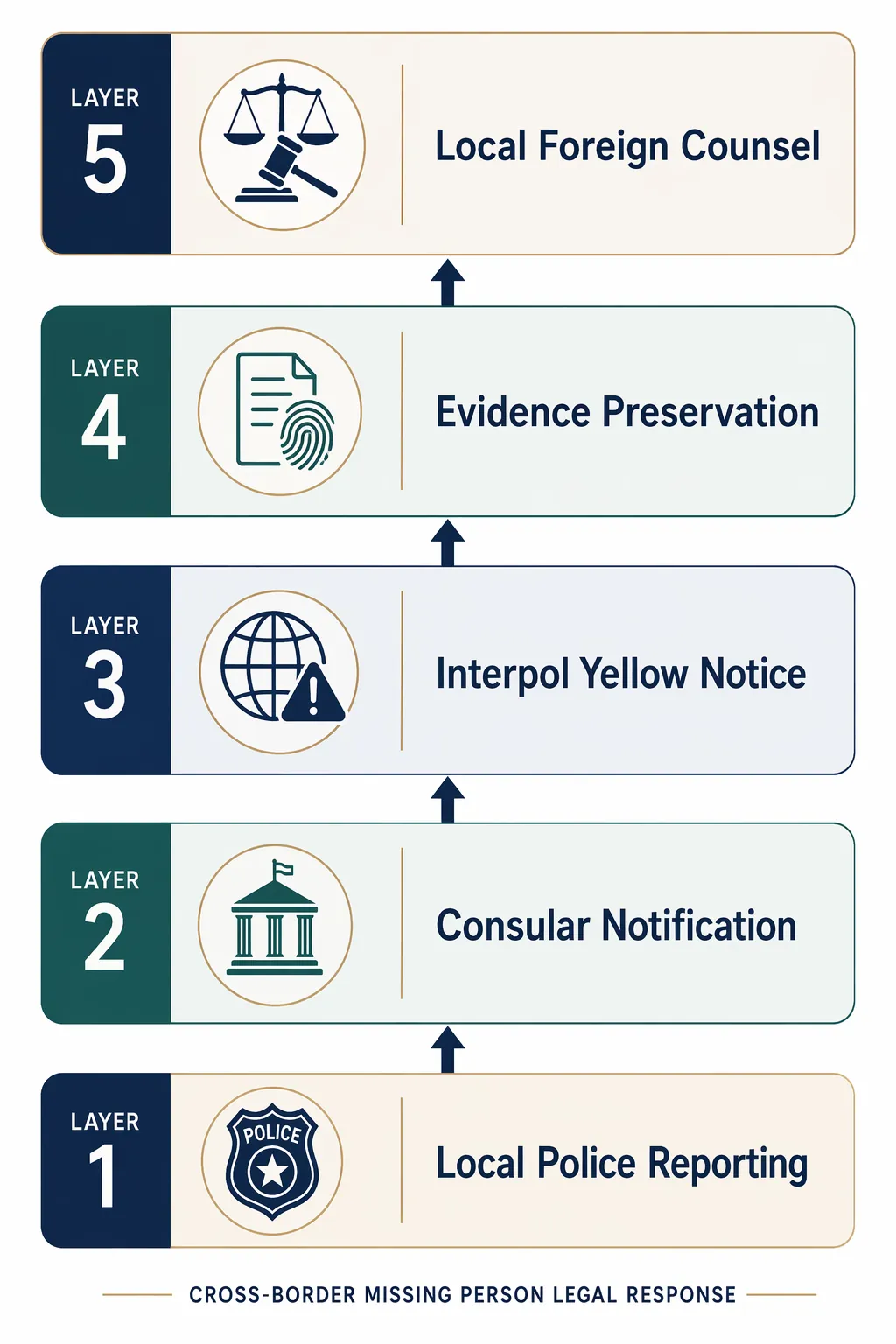
| Layer | What it can do | What it cannot do |
|---|---|---|
| Royal Grenada Police Force report | Creates the first local record, supports search coordination, receives scene and witness information | Does not answer U.S. family-law, estate, employment, or insurance questions |
| U.S. consular notification | Opens a U.S. government welfare-and-assistance channel for a citizen abroad | Does not turn the State Department into a rescue agency or investigator |
| Interpol Yellow Notice | May circulate a missing-person alert through police channels when criteria and routing are met | Is not a family-filed public lawsuit or a guarantee of search action |
| Evidence preservation | Protects records counsel may later need for identification, timeline, insurance, employment, or litigation | Does not authorize private parties to disturb a scene or seize evidence |
| Local foreign counsel | Explains Grenadian procedure, access, filings, and enforceability | Does not make U.S. court orders automatically effective in Grenada |
The physical-description discrepancy belongs in the file, not in a theory
One reported detail requires careful handling: the Royal Grenada Police Force description listed Waddell at 5 feet 5 inches, while her husband reportedly described her as 5 feet tall. That difference matters for search bulletins, witness verification, and later record reconciliation. It should be corrected or cross-referenced through the proper channel. It should not be inflated into a clue.
Context is useful only if it stays in its lane
Travel advisories can help counsel avoid asking the wrong question. The U.S. State Department’s January 5, 2026 Level 2 advisory for Grenada cited violent crime concerns; by contrast, the U.K. Foreign Office travel advice for Grenada warns travelers about strong currents and the absence of lifeguards or warning flags on some beaches. [5][6]
Those materials do not resolve what happened at Grand Anse Beach. They do explain why a legal file should not be built around only one hazard category. If the U.S. advisory discusses crime and the U.K. advice discusses water conditions, both may be relevant to risk counseling, insurance notice, employer travel policies, and family expectations. Neither turns an open disappearance into a solved event.
Consular notification is necessary, and narrower than families expect
The U.S. State Department’s Overseas Citizens Services contact point for emergencies involving U.S. citizens abroad is 1-888-407-4747 from the United States or Canada. That number should be in the first response plan, along with the local police report number and the family’s designated point of contact. [7]
The statutory frame matters. Under 22 U.S.C. § 2671, Congress authorizes appropriations connected to the protection and welfare of U.S. citizens abroad, including emergency assistance functions. That is not the same thing as a roving U.S. investigative power inside another sovereign country. [8]
In practical terms, consular officials may help notify family, communicate with local authorities, provide information about local resources, and maintain a U.S. government channel. They do not command the Royal Grenada Police Force. They do not direct divers, seize phones, compel Airbnb records, litigate in Grenadian court, or enforce a U.S. lawyer’s demand letter.
This is where lawyers need to be plain with clients. Consular contact is not ceremonial; it can be extremely important. But its value is coordination and channel preservation, not control. If the client hears only “the State Department is involved,” they may assume Washington has taken over the case. That assumption is usually wrong and can cost time.
The family file should be built before anyone knows which legal track will matter
A disappearance abroad creates several possible future tracks at once: identification, search, insurance, employment leave, banking access, estate planning, family-law authority, criminal inquiry, civil claims, and media response. Counsel will not know on day one which track becomes decisive. The file should be built so it can travel.
- Preserve phone and account access information without changing passwords unless security requires it and the change is logged.
- Record who has physical possession of the missing person’s devices, passport copies, travel documents, and luggage.
- Export or screenshot itinerary data, Airbnb communications, ride records, flight records, payment activity, and location-sharing settings where lawfully accessible.
- Collect recent photographs and a corrected physical description for police and consular use.
- Identify possible DNA reference sources, but coordinate with local authorities before shipping, sampling, or altering anything that may later require chain-of-custody documentation.
- Keep a single chronology with separate columns for confirmed facts, reported facts, family belief, and pending verification.
The distinction between “reported” and “verified” is not clerical fussiness. A towel found on a pier, an Airbnb departure, a swim plan, a height discrepancy, and the identity of the last person to see the traveler can all become operational details. If they are repeated loosely in family texts, press interviews, and lawyer emails, the record gets harder to clean.
Interpol is a police channel, not a family escalation button
An Interpol Yellow Notice may be relevant in a missing-person matter because Yellow Notices are used to help locate missing persons, often minors, or to help identify persons unable to identify themselves. The request does not operate like a complaint filed by a family in court; it moves through authorized police channels and depends on the relevant national authorities. [9]
For counsel, the practical question is not “Why hasn’t Interpol solved this?” It is whether local police have the corrected identifiers, photographs, passport information, and family contacts needed to consider an international notice if the facts justify one. A Yellow Notice can widen circulation. It cannot make a foreign agency act outside its law or resources.
Local Grenadian counsel is not optional if the matter moves past notification
U.S. counsel can organize the family, preserve records, manage U.S.-side institutions, and communicate with consular officials. Once the work requires Grenadian procedure — access to local records, interaction with police beyond family updates, court filings, retention of investigators, or advice on local enforceability — the U.S. lawyer needs Grenadian counsel with a defined scope.
The cost discussion should happen early. Initial local investigation or missing-person legal support can exceed $5,000 to $15,000, and that figure is a planning shock point for families who have been told, implicitly or explicitly, that a U.S. lawyer can control the matter cheaply from home. [11]
The engagement letter should say what the U.S. firm is doing and what it is not doing. It should identify who communicates with Grenadian counsel, who approves expenses, who speaks to media, who holds privileged material, and who is authorized to receive sensitive updates if the missing person’s spouse, adult children, parents, employer, or insurer all want information.
The absence of a U.S.-Grenada mutual legal assistance treaty should not be treated as a prediction that an investigation will fail. It should be treated as an enforceability warning. Without a treaty channel, U.S. counsel must be careful about promising compelled evidence collection, cross-border production, or the practical effect of any later U.S. court order in Grenada. [10]
What the client needs to hear in the first 48 hours
The first client conference should not be a lecture on sovereignty. It should be a triage call. Families reach for U.S. authorities first because those are the institutions they know, and because the alternative is admitting that the person they love is missing in a system they cannot see. The lawyer still has to correct the expectation.
- Confirm the local police report and obtain the identifying details of the report.
- Notify Overseas Citizens Services and log the date, time, reference information, and person who made contact.
- Designate one family spokesperson for police, one for consular communications, and one for counsel.
- Preserve devices, account access, travel records, photographs, and identification materials.
- Ask local police or Grenadian counsel what information should be supplied for any international notice consideration.
- Retain Grenadian counsel if the matter requires local procedure, filings, evidence access, or advice on enforceability.
- Keep the public narrative narrower than the file; do not publish speculation that the evidence record may later have to correct.
For an employer, insurer, university, or travel program, the same protocol should be translated into an incident plan before travel begins. The plan should say which executive calls counsel, who contacts the family, who preserves company-issued devices, who handles press, and how the organization will avoid implying that it can direct foreign police.
The legal work is layered, and every layer has a ceiling
The Waddell disappearance is still an open matter. A responsible legal update should stop before assigning fault, predicting an outcome, or converting a search file into a mystery narrative. The concrete facts are already serious enough: a Cary woman last seen after leaving to swim at Grand Anse Beach, a towel found on a pier, a local search involving police resources and community assistance, and a family forced to make decisions through several authorities that do not share one vocabulary.
In a foreign disappearance, useful legal work is not dramatic command from Washington. It is disciplined layering: local police action, consular notification, possible international alerts, evidence preservation, and carefully scoped foreign counsel. Each layer is necessary. Each is limited. None guarantees enforceability across borders.
References
- WRAL coverage of Elizabeth Waddell disappearance — WRAL, July 2026
- ABC11 coverage of Elizabeth Waddell disappearance — ABC11, July 2026
- People coverage of Elizabeth Waddell disappearance — People, July 2026
- Royal Grenada Police Force public updates on Elizabeth Waddell search — Royal Grenada Police Force, July 2026
- Grenada Travel Advisory — U.S. Department of State, January 5, 2026
- Grenada travel advice — GOV.UK
- Emergency Help for Americans Abroad — U.S. Department of State
- 22 U.S.C. § 2671 — U.S. House Office of the Law Revision Counsel
- Yellow Notices — Interpol
- Treaties in Force — U.S. Department of State
- Missing Persons Legal Guide — Lauth Missing Persons
Related records
Tool profile
How Meta's AI Spending Reshapes Law Firm ProfitabilityGoverning regulation
Browse the obligations tracker →Preventive workflow
Browse verification workflows →
Report a correction or tip
Spotted an outdated figure, a misstated fact, or a ruling this case record should reflect? Public comments are disabled for this content given the professional cost of a misreported case outcome, penalty amount, or rule text — use the structured correction channel instead.
Report a correction or tip for this record →