
How DOJ's North Korean Crypto Crackdown Creates Corporate Liability
The DOJ's DPRK RevGen initiative has shifted from indicting North Korean hackers to prosecuting US-based facilitators, creating strict liability for companies that inadvertently employ North Korean IT workers or process linked crypto. This Risk Digest entry documents the enforcement timeline, criminal charging theories, and $15M+ in civil forfeitures, and distills what companies—including law firms—must do to avoid becoming targets.
- Jurisdiction
- US Federal
- Court
- Multiple U.S. District Courts
- AI tool named
- Deepfake AI
- Ruling date
- May 1, 2026
- Source document
- View primary court order ↗
- Last verified
- Jul 28, 2026
Lex Machina Review is an independent risk-tracking and reference resource. Nothing on this site is legal advice, and using it does not create an attorney-client relationship. Every record is reviewed against primary sources but may not reflect the most current status of a matter — always verify directly against the cited court order, rule text, or a licensed attorney before relying on it.
Companion explanation — secondary to the source document above
Risk Digest record. Jurisdiction: U.S. federal criminal enforcement, civil forfeiture, and sanctions compliance, with cross-border crypto-laundering context. Last verified: July 28, 2026 UTC. This is legal information, not legal advice. Primary DOJ materials include the RevGen coordinated-actions release, the May 2026 nationwide-actions release, and the June 2025 civil-forfeiture release.
The legal implications of the North Korean crypto-hacker laundering cases no longer stop at foreign indictments. DOJ says its DPRK RevGen enforcement work has produced charges against more than 40 individuals since 2024, including guilty pleas by U.S.-based facilitators tied to more than $2.2 million in regime-bound revenue and more than 136 victim companies.[1] In May 2026, DOJ announced 18-month sentences for two U.S. nationals connected to laptop-farm facilitation and coordinated searches across 16 states.[2] The forfeiture side has also matured: a June 2025 complaint sought more than $7.74 million allegedly laundered for the North Korean government, and later filings sought more than $15 million in USDT tied to APT38-linked laundering.[3][4][5]
The current exposure is not the same for every company that gets fooled. OFAC civil sanctions liability can attach without proof that a U.S. person knew it was violating sanctions; criminal prosecution still requires the relevant knowledge, intent, or willfulness. That distinction matters. It is the line between a weak-control file that creates civil sanctions or forfeiture risk and a fact pattern that starts to look like wire fraud, IEEPA, identity theft, or money-laundering conspiracy.
The enforcement turn is domestic
The important shift in the RevGen record is not that North Korea steals cryptocurrency. It is that DOJ is now building cases around the people, devices, accounts, payroll paths, and companies that made the revenue stream usable from inside the United States. The laptop farm is the operational hinge. A foreign worker does not need to sit inside a U.S. office if a domestic facilitator can maintain the hardware, receive equipment, route connections, and help a sanctioned actor appear to be a lawful remote employee.
That changes the evidentiary chain. A company’s remote-hiring records, interview notes, identity-verification artifacts, payroll approvals, device-shipping logs, vendor tickets, endpoint telemetry, and sanctions-screening records become the documents someone later asks for. In many matters, the employer may still be a victim. But “victim” is not a control finding. It is a posture that has to survive the file.
The guilty-plea facts are the practical warning. DOJ’s coordinated-action release ties U.S. facilitators to illicit revenue generation, more than 136 victim companies, and more than $2.2 million allegedly intended for North Korea.[1] The May 2026 release then shows the same theory moving into sentencing and search activity: two U.S. nationals received 18-month sentences for their roles in facilitating laptop farms, while law enforcement executed coordinated searches across 16 states.[2] This is not an advisory-only environment anymore.
Where an ordinary employer enters the record
The employer’s first appearance is often mundane: a contractor profile, a resume, a video interview, a background-check report, a payment account, a laptop shipment. The later legal significance is that each artifact either corroborates a reasonable verification process or exposes a gap. If a company cannot show who reviewed the identity proof, what mismatches were escalated, why a remote worker’s location was accepted, and how sanctions screening was refreshed after onboarding, the government does not need to accuse the company of being part of the scheme to make the company relevant to the case.
This is also where corporate sympathy has limits. A hiring manager may have been deceived. A compliance officer may have inherited thin records from a fast-moving business unit. But the public enforcement record now gives companies a difficult notice problem: fully remote IT hiring has been identified as a high-risk channel, and laptop-farm facilitation has been charged, pleaded, searched, and sentenced.
Forfeiture made the crypto trail corporate
The June 2025 forfeiture complaint is useful because it shows what DOJ expects to prove with crypto tracing. DOJ sought more than $7.74 million allegedly laundered on behalf of the North Korean government, tracing revenue from North Korean IT workers through Sim Hyon Sop, an OFAC-designated Foreign Trade Bank representative, and Kim Sang Man, identified in the release as the CEO of Chinyong Information Technology Cooperation Company and as linked to a Ministry of Defense subordinate entity. The complaint used wallet clustering across 84 exchange accounts.[3]
The later USDT forfeiture filings widened the lens from IT-worker revenue to APT38-linked theft and laundering. TRM Labs described DOJ complaints seeking forfeiture of more than $15 million in USDT tied to four 2023 exchange heists involving alleged losses of $37 million, $100 million, $138 million, and $107 million at exchanges in Estonia, Panama, and Seychelles.[4] Secondary legal analysis of those filings notes reliance on Chainalysis tracing through cross-chain bridges, Tornado Cash, and over-the-counter desks.[5]
The mechanics of bridges and mixers can consume an article without improving the control judgment. The legal point is narrower: DOJ is asking courts to treat analytics-supported tracing, wallet clustering, and exchange-account attribution as enough to identify property for seizure. A crypto exchange, OTC desk, payment processor, fund, or law firm handling digital-asset proceeds should assume that blockchain analytics will be tested against its own screening and escalation records.
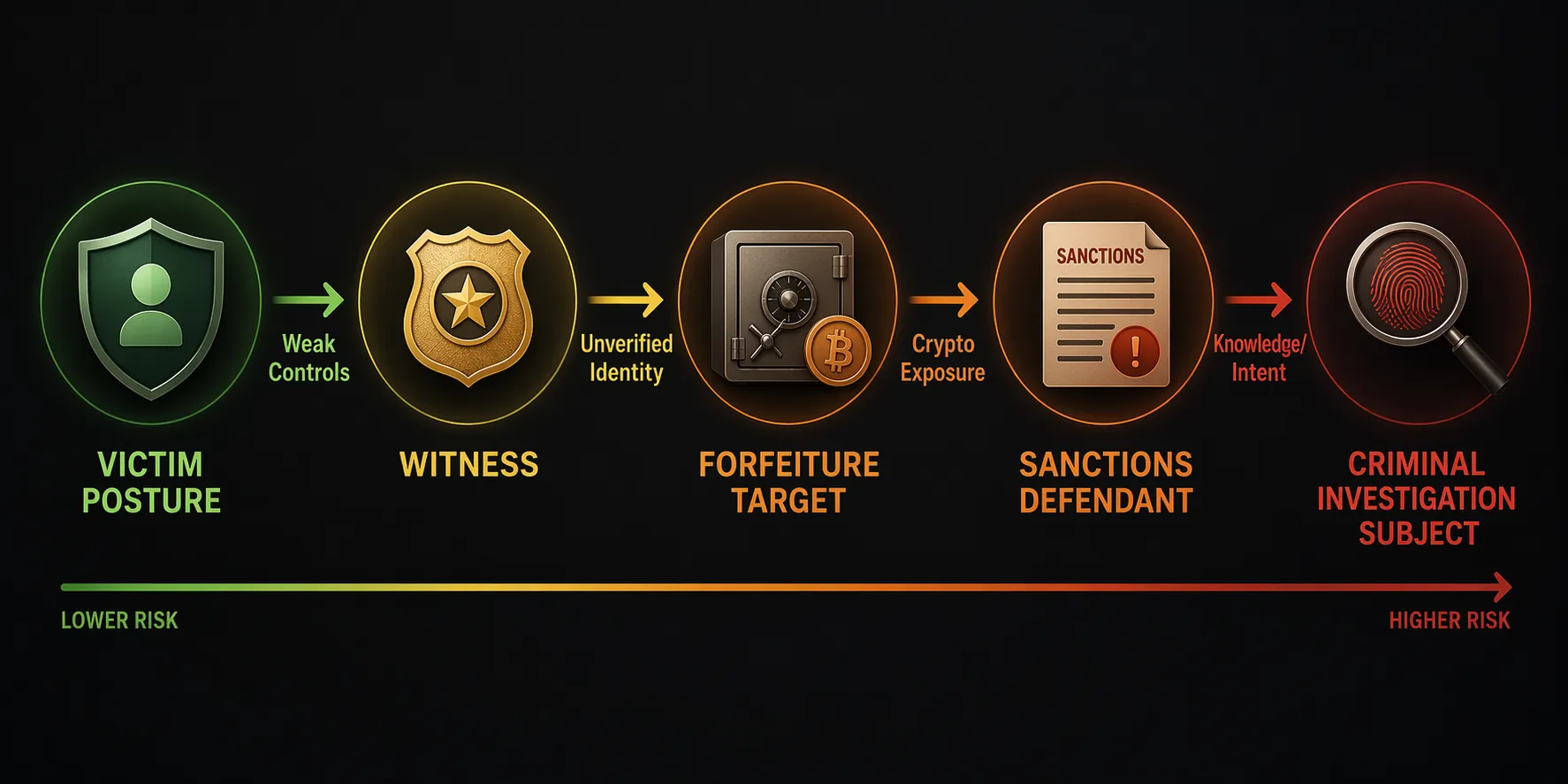
The liability theories should not be collapsed into one warning
A sloppy formulation would say that any company that hired a North Korean IT worker is criminally liable. That is not the law. The more accurate formulation is more useful to counsel: the same fact pattern can place a company in different legal positions depending on knowledge, funds flow, control failures, and post-alert conduct.
| Posture | How the company gets there | What counsel should look for |
|---|---|---|
| Victim or witness | A sanctioned or deceptive actor used the company’s hiring, payroll, vendor, exchange, or device systems without evidence the company knew. | Preserved records showing identity checks, screening, escalation, device custody, and prompt response after discovery. |
| Forfeiture claimant or stakeholder | Funds, wallets, exchange accounts, or other property are alleged to be traceable to DPRK-linked proceeds. | Source-of-funds diligence, blockchain-analytics alerts, account-control records, and any basis for innocent-owner or remission arguments. |
| OFAC civil sanctions respondent | A U.S. person processed a prohibited transaction or provided services to a sanctioned person or blocked jurisdiction, even without actual knowledge. | Whether screening was risk-based, documented, refreshed, and escalated when anomalies appeared. |
| Criminal investigation subject | Evidence suggests knowing participation, willful blindness, false documentation, identity misuse, laundering conduct, or continued activity after warnings. | Internal communications, rejected alerts, payment routing, false KYC artifacts, and decisions made after red flags were known. |
OFAC’s civil-sanctions framework is the hardest part for ordinary companies because it can operate on a strict-liability basis. Law-firm analysis of the current DPRK remote-IT risk notes that a U.S. person may face civil liability even without knowledge of the violation, with exposure that can include civil penalties up to $1 million per violation; criminal sanctions exposure, by contrast, depends on willful conduct and can include prison terms of up to 20 years.[5]
Criminal charges require more. DOJ’s North Korea-related cases have used wire-fraud, identity-theft, sanctions, and money-laundering theories, including in a Northern District of Georgia case charging four North Korean nationals in an alleged nearly $1 million cryptocurrency theft scheme.[6] Those theories are not interchangeable. Wire fraud turns on a scheme to defraud and use of interstate wires. Identity-theft charges turn on misuse of identifying information. IEEPA sanctions charges require the government to prove the relevant prohibited conduct and criminal state of mind. Money-laundering conspiracy focuses on agreement and transactions involving criminal proceeds.
For corporate counsel, the practical distinction is whether the file shows deception that the company reasonably tried to prevent, or whether the file shows ignored anomalies that made the deception convenient.
The FBI warning turns remote hiring into a board-level control issue
The most uncomfortable government statement is not about a nine-figure theft. It is the FBI’s December 2024 warning, quoted in later legal analysis: “If your company has hired fully remote IT workers, more likely than not you have hired or at least interviewed a North Korean national working on behalf of the North Korean government.”[5]
That sentence takes the issue out of the exotic-threat category. It belongs in HR controls, vendor management, access provisioning, payment review, and legal hold planning. After that warning, a company that relies on informal video interviews, reusable background checks, unverified location claims, and unreviewed payroll exceptions is not merely unlucky. It has chosen a control environment that the government has already described as vulnerable.
The AI layer makes the verification problem sharper, not more theatrical. A January 2025 FBI public service announcement, summarized by Alston & Bird, warned that North Korean IT workers were using deepfake AI in video interviews.[7] For law firms and legal departments, that fact should land in the same place as notarization, client intake, conflicts, and authority-to-act checks. An unstructured video call is no longer strong identity evidence just because everyone on the call felt satisfied at the time.
What should be in the file before the subpoena arrives
The control goal is not to guarantee that no deceptive applicant or tainted wallet ever reaches the company. The goal is to make the company’s decision process provable: who checked, what they checked, what failed, who escalated, and what changed after the alert.
Remote-worker identity verification
- Use documented identity-proofing for remote employees and contractors, including government-ID validation, liveness checks, location consistency review, and re-verification when device, address, bank-account, or access patterns change.
- Require interview controls that are deepfake-aware: multiple interview stages, interviewer training on synthetic-media indicators, independent contact-channel verification, and preservation of interview artifacts where legally permitted.
- Treat laptop shipping and endpoint custody as compliance events. Record who requested the device, where it was shipped, who acknowledged receipt, which network it connected from, and whether remote-access behavior matched the worker’s stated profile.
- Do not let staffing vendors be the control. Vendor certifications should be backed by audit rights, sample testing, sanctions-screening obligations, incident notice duties, and termination rights tied to identity or location misrepresentation.
Sanctions and payment controls
- Screen employees, contractors, beneficial owners, payment recipients, wallets, and relevant counterparties at onboarding and at risk-based intervals after onboarding.
- Preserve escalation records. A sanctions hit that is cleared orally, a wallet alert that is dismissed without notes, or a payroll mismatch that is “fixed” without explanation will be difficult to defend later.
- For crypto-exposed businesses, use blockchain analytics capable of wallet clustering, cross-chain tracing, mixer exposure detection, and exchange-account attribution review. The vendor output should feed a documented legal and compliance escalation path, not sit in a dashboard nobody owns.
- For law firms, apply source-of-funds and sanctions review to crypto retainers, client-controlled wallets, settlement proceeds, and transactions where the firm is asked to move quickly because assets are volatile.
Insider-threat and access monitoring
- Correlate remote-login geography, working hours, VPN use, device fingerprints, source-code access, privileged-account requests, and payroll information. The pattern matters more than any single anomaly.
- Set escalation thresholds for remote IT workers who request unusual access, avoid live interaction, change payment details, use inconsistent IP locations, or ask to route equipment through third parties.
- Create a response playbook that identifies who freezes access, who preserves records, who contacts outside counsel, who handles sanctions analysis, and who decides whether voluntary disclosure is appropriate.
- Test the file. If the company cannot reconstruct a remote worker’s identity-verification path within a short internal review, it probably cannot do so cleanly after a subpoena.
International cooperation is background, not the immediate control standard
The UN Convention Against Cybercrime belongs in the background file because cross-border criminalization and asset-recovery cooperation matter in crypto-laundering cases. But the U.S. and South Korea signature gap means it should not become the center of a U.S. company’s risk analysis. The near problem is already domestic: DOJ search warrants, forfeiture complaints, OFAC exposure, payroll records, exchange accounts, remote-worker devices, and the company’s ability to prove that obvious controls were in place before DPRK-linked labor or funds entered the system.
The enforcement record points to a practical posture. Companies, including law firms, need documented remote-worker identity verification, deepfake-aware interview procedures, sanctions-screening escalation records, blockchain-analytics review for crypto exposure, and insider-threat monitoring tied to access and payment anomalies. DOJ is no longer only chasing hackers abroad. It is testing whether U.S. companies can prove they took the foreseeable controls seriously.
References
- Justice Department Announces Coordinated, Nationwide Actions to Combat North Korean Remote Information Technology Workers' Illicit Revenue Generation Schemes — U.S. Department of Justice
- Justice Department Announces Nationwide Actions to Combat Illicit North Korean Government Revenue Generation — U.S. Department of Justice, May 2026
- Department Files Civil Forfeiture Complaint Against Over $7.74M Laundered on Behalf of the North Korean Government — U.S. Department of Justice, June 2025
- DOJ Seeks Forfeiture of $7.7 Million in Cryptocurrency Tied to North Korean IT Worker Laundering Network — TRM Labs
- North Korean Remote IT — Skadden, June 2026
- Four North Koreans Charged in Nearly $1 Million Cryptocurrency Theft Scheme — U.S. Attorney's Office for the Northern District of Georgia
- North Korea IT Fraud Scheme: Data Security Law — Alston & Bird, January 2025
Related records
Tool profile
How Meta's AI Spending Reshapes Law Firm ProfitabilityGoverning regulation
Browse the obligations tracker →Preventive workflow
Browse verification workflows →
Report a correction or tip
Spotted an outdated figure, a misstated fact, or a ruling this case record should reflect? Public comments are disabled for this content given the professional cost of a misreported case outcome, penalty amount, or rule text — use the structured correction channel instead.
Report a correction or tip for this record →