
Ole Miss Lawsuit Seeks $950,000 From Two LSU Transfers
Ole Miss's July 27, 2026 breach-of-contract suits against Princewill Umanmielen and Devin Harper after their transfers to LSU: $950,000 in combined claims, the 90-day early-termination clause, and what is reported versus primary-verified.
- Jurisdiction
- US-MS
- Court
- Lafayette County Circuit Court, Mississippi
- Judge
- John Kelly Luther; Kent E. Smith
- AI tool named
- No AI tool named
- Ruling date
- Jul 27, 2026
- Source document
- View primary court order ↗
- Last verified
- Aug 3, 2026
Lex Machina Review is an independent risk-tracking and reference resource. Nothing on this site is legal advice, and using it does not create an attorney-client relationship. Every record is reviewed against primary sources but may not reflect the most current status of a matter — always verify directly against the cited court order, rule text, or a licensed attorney before relying on it.
Companion explanation — secondary to the source document above
Risk Digest record status, last checked Aug. 3, 2026: reported, not primary-verified. The operative filings in the Ole Miss lawsuit over LSU transfer players have been described by named media outlets, but this article did not locate a freely available complaint, public contract exhibit, or court order resolving any issue in either case. That matters because the central documents are reported to be confidential revenue-sharing agreements, and the reported clause language is being litigated before any public merits ruling exists.
The compact version is this: the University of Mississippi reportedly filed two breach-of-contract complaints on July 27, 2026, in Lafayette County Circuit Court against former Ole Miss football players Princewill Umanmielen and Devin Harper after both transferred to LSU. The requested early-termination amounts are reported as $550,000 from Umanmielen and $400,000 from Harper, for a combined $950,000 before reported interest, attorneys’ fees, and costs—not a rounded “$1 million” claim unless the additional amounts are being described loosely. WAFB reported the complaint details and the early-termination theory; the Clarion Ledger reported the judges and counsel information for the two filings. [1][2]
| Reported item | Umanmielen case | Harper case |
|---|---|---|
| Plaintiff | University of Mississippi | University of Mississippi |
| Defendant | Princewill Umanmielen | Devin Harper |
| Court | Lafayette County Circuit Court, Mississippi | Lafayette County Circuit Court, Mississippi |
| Filing date | July 27, 2026 | July 27, 2026 |
| Reported judge | John Kelly Luther | Kent E. Smith |
| Reported Ole Miss counsel | Mayo Mallette PLLC | Mayo Mallette PLLC |
| Reported amount sought | $550,000, plus reported interest, fees, and costs | $400,000, plus reported interest, fees, and costs |
| Primary-verification status as of Aug. 3, 2026 | Complaint and contract not located in a freely available public record | Complaint and contract not located in a freely available public record |

What Ole Miss is reported to be enforcing
The legal hook is not the transfer itself. The reported theory is that Ole Miss entered into 2026 Revenue Sharing Agreements with the players in January 2026, and that those agreements included an early-termination payment tied to a 90-day period. WAFB reported that Umanmielen signed on or about Jan. 3, 2026, and Harper signed on or about Jan. 6, 2026. The same reporting describes a 30-day payment window after notice of termination, with Ole Miss claiming the players did not pay by the asserted deadlines. [1]
That description should be kept in its procedural lane. A phrase such as “reasonable estimate of the harm” is reported as Ole Miss’s position in the complaints, not as a judge’s finding that the fee is valid, enforceable, or properly calculated. The distinction is not academic: in a contract dispute, especially one involving confidential athlete agreements and large early-termination economics, the difference between an allegation and a ruling is the difference between a live claim and a precedent.
The confidentiality gap is the main reason the record should remain qualified. Reporters have described the agreements and the complaints, but the contracts themselves were reportedly withheld as confidential and were not available here for clause-level verification. Without the operative language, readers cannot independently test how the 90-day period is defined, what exactly triggers the payment obligation, whether any exceptions exist, how damages are characterized, or what dispute-resolution language may apply.
The January-to-July sequence, side by side
The two complaints appear to move in parallel, but the dates and dollar amounts are not identical. Ole Miss reportedly uses each player’s January revenue-sharing agreement, transfer-portal activity, LSU scholarship signing, demand letter, missed payment deadline, and later filing to frame breach and nonpayment.
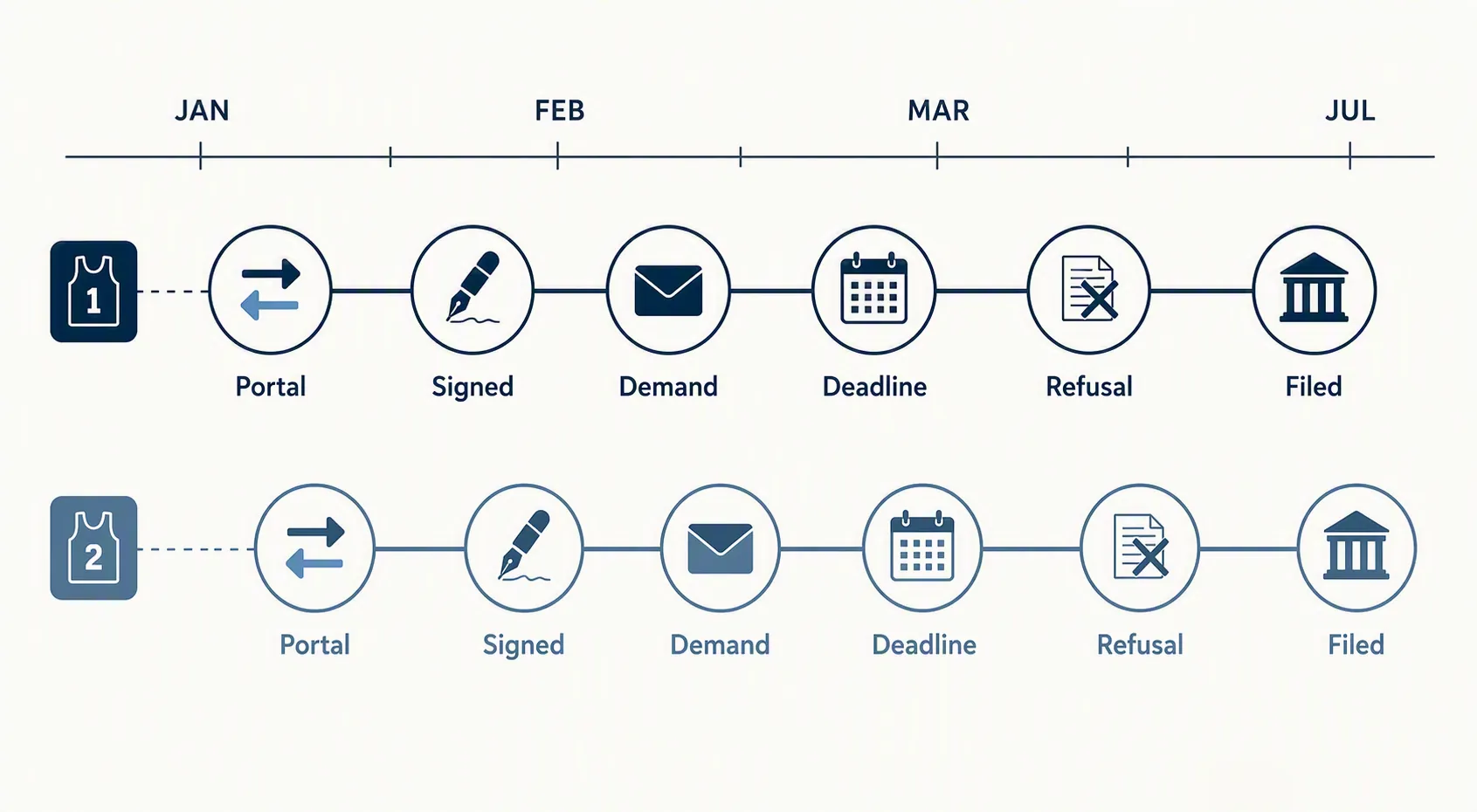
| Reported event | Princewill Umanmielen | Devin Harper |
|---|---|---|
| Revenue Sharing Agreement | Signed on or about Jan. 3, 2026 | Signed on or about Jan. 6, 2026 |
| Transfer portal entry | Jan. 14, 2026 | Jan. 20, 2026 |
| LSU scholarship signing | Jan. 16, 2026 | Jan. 21, 2026 |
| Ole Miss demand letter | Jan. 16, 2026 | Jan. 22, 2026 |
| Reported 30-day payment deadline | Feb. 13, 2026 | Feb. 19, 2026 |
| Ole Miss request to LSU | March 12, 2026 | March 12, 2026 |
| Reported LSU refusal | March 18, 2026 | March 18, 2026 |
| Complaint filed | July 27, 2026 | July 27, 2026 |
| Amount sought | $550,000 | $400,000 |
For Umanmielen, the reported sequence begins with a Jan. 3 revenue-sharing agreement, followed by a Jan. 14 portal entry, a Jan. 16 LSU scholarship signing, and a Jan. 16 demand letter from Ole Miss. The complaint reportedly says the 30-day payment window expired Feb. 13 and seeks $550,000 under the early-termination provision. [1]
For Harper, the reported sequence begins with a Jan. 6 revenue-sharing agreement, followed by a Jan. 20 portal entry, a Jan. 21 LSU scholarship signing, and a Jan. 22 demand letter. The complaint reportedly says the 30-day payment window expired Feb. 19 and seeks $400,000. [1]
The filings also reportedly describe a March 12 request by Ole Miss to LSU and a March 18 refusal by LSU to pay, with LSU taking the position that it was not a party to the player contracts. LSU is not reported as a defendant in either Lafayette County case. [1]
Escalation before the complaints
The July 27 filings did not arrive without warning. The Athletic reported in mid-July that Ole Miss was seeking unpaid buyouts from LSU transfers, placing the dispute in the pre-suit posture before the complaints were filed. [3]
Ole Miss athletics director Keith Carter also publicly signaled before the filings that litigation was an option. The Clarion Ledger reported that Carter said on July 13, 2026, that Ole Miss could sue to recover money it believed was owed under the agreements. [2]
CBS Sports and FOX Sports, citing Associated Press reporting, also described the university’s post-filing position: Ole Miss said it had tried to resolve the matter before filing suit and characterized the litigation as enforcement of contractual obligations. Those statements supply institutional context, but they do not fill the gap left by the absent public contracts. [4][5]
Why this is being watched beyond Oxford and Baton Rouge
The reason this Ole Miss lawsuit over LSU transfer players is more than a rivalry item is that the claim is directed at individual athletes under post-House revenue-sharing agreements. Yahoo/On3 framed the player contract as the school’s only available remedy in the current environment, a point that helps explain why Ole Miss would look to the athletes’ agreements rather than to LSU as the litigation target. [6]
That framing is useful, but it should not be overread. A school choosing the only remedy it believes is available does not establish that the remedy is enforceable. It also does not answer whether the 90-day early-termination economics operate as a valid liquidated-damages provision, an unenforceable penalty, a negotiated repayment obligation, or something else under the governing contract language. Those are merits questions, and the public record available as of Aug. 3, 2026, does not contain a ruling on them.
The reported amounts make the suits unusually visible. Ole Miss is not described as seeking a nominal declaration or a small reimbursement; it is reportedly seeking $950,000 combined from two former players, plus additional amounts. The size of the claim is what makes the cases a high-value test of the early-termination model. It is not, at this stage, proof that other schools will sue, that athletes will be liable, or that similar contract language will survive judicial scrutiny.
What has not happened yet
As of Aug. 3, 2026, the reported record does not include answers from Umanmielen or Harper, a publicly available order on the merits, or a court-posted version of the contracts. No judge is reported to have accepted Ole Miss’s damages theory, interpreted the 90-day clause, or ruled on whether the early-termination amount is enforceable.
LSU’s role is also narrower than many headlines imply. LSU is central to the factual narrative because both players transferred there and because Ole Miss reportedly asked LSU to pay before LSU refused. But LSU is not reported as a named defendant in the two Lafayette County complaints. [1]
The Sept. 19, 2026 LSU-at-Ole Miss football game is an obvious news hook. It is not a legal deadline in the reported pleadings. Unless the court sets a hearing, enters an order, or the parties file responsive papers around that time, the game belongs to the coverage calendar rather than the case chronology.
Present posture
The current procedural posture is simple and unresolved: Ole Miss reportedly filed two breach-of-contract complaints in Lafayette County Circuit Court on July 27, 2026; the reported claims seek $550,000 from Umanmielen and $400,000 from Harper; the contracts are described as confidential; LSU is not named as a defendant; and no answers, merits rulings, or public contract exhibits were located as of Aug. 3, 2026.
That makes the matter worth tracking, but not yet worth treating as precedent. The next verification step is the Lafayette County Circuit Court docket and, if obtainable, the actual complaints and contract language. Until then, the material facts should remain labeled as reported rather than primary-verified.
References
- Ole Miss sues LSU transfers for nearly $1 million after following Lane Kiffin, WAFB, July 29, 2026.
- Ole Miss LSU lawsuit: Princewill Umanmielen, Devin Harper, Clarion Ledger, July 28, 2026.
- Ole Miss, LSU transfers, unpaid buyouts, The Athletic, July 14, 2026.
- Ole Miss sues Princewill Umanmielen, Devin Harper after transfer to LSU, CBS Sports.
- Ole Miss, LSU NCAA lawsuit, FOX Sports/AP.
- In suing players who transferred to LSU, Ole Miss used school’s only available remedy in current environment, Yahoo Sports/On3.
Related records
Tool profile
How Meta's AI Spending Reshapes Law Firm ProfitabilityGoverning regulation
Browse the obligations tracker →Preventive workflow
Browse verification workflows →
Report a correction or tip
Spotted an outdated figure, a misstated fact, or a ruling this case record should reflect? Public comments are disabled for this content given the professional cost of a misreported case outcome, penalty amount, or rule text — use the structured correction channel instead.
Report a correction or tip for this record →