
Why Claude Opus 5 API pricing understates legal task costs
This article breaks down the true per-task cost of using Claude Opus 5 API in legal workflows, including the verification overhead imposed by cross-model citation hallucination rates that can multiply total cost by 3–5×.
- Jurisdiction
- us-federal
- Court
- Federal Court
- AI tool named
- Claude Opus 5
- Ruling date
- Jan 1, 2026
- Source document
- View primary court order ↗
- Last verified
- Jul 25, 2026
Lex Machina Review is an independent risk-tracking and reference resource. Nothing on this site is legal advice, and using it does not create an attorney-client relationship. Every record is reviewed against primary sources but may not reflect the most current status of a matter — always verify directly against the cited court order, rule text, or a licensed attorney before relying on it.
Companion explanation — secondary to the source document above
Claude Opus 5 API pricing for legal AI tools starts with a clean number: $5 per million input tokens and $25 per million output tokens. Batch pricing cuts that to $2.50 and $12.50, and cache reads are priced at 0.1x the standard input rate. The notable part is not that Opus 5 is cheap. It is that Anthropic kept the same Opus price tier while the model’s reported Intelligence Index moved to 61, above Opus 4.8’s maximum of 56.[1][2][3]
That is a useful procurement anchor. It is not a legal task price. In a production legal workflow, the invoice that matters usually arrives after the model has produced the answer: citation checking, jurisdiction review, privilege-sensitive routing, knowledge-management cleanup, and lawyer signoff. If a vendor’s deck stops at token math, it has stopped before the expensive part begins.
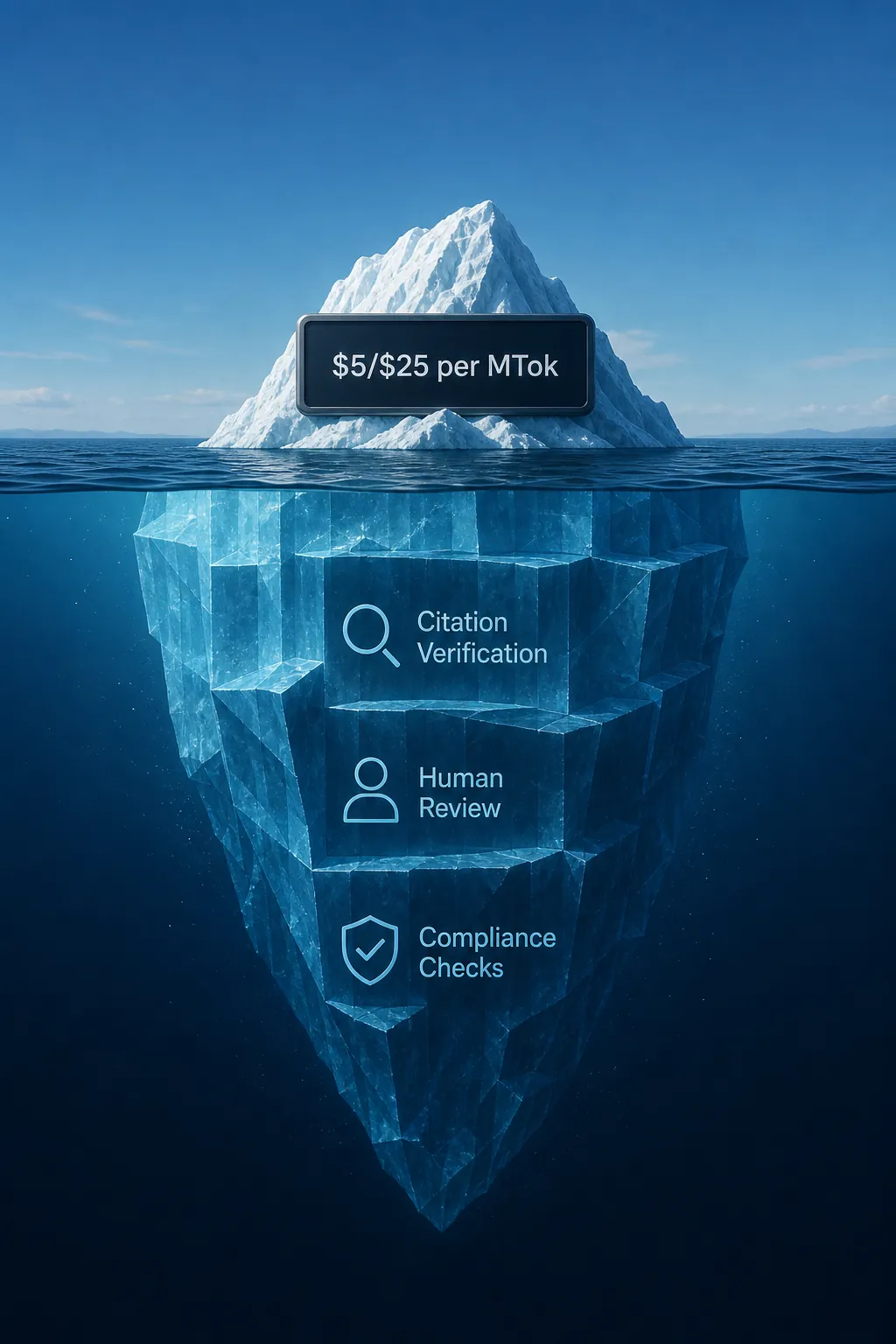
The Posted Opus 5 Price Is Stable, But The Unit Of Work Is Not
For general API planning, Opus 5’s price card is unusually easy to model. Standard usage is $5 input and $25 output per million tokens. Batch API usage is half that. Prompt caching can make repeated context much cheaper because cache reads are 0.1x the standard input price.[1] BenchLM describes the $5/$25 tier as identical to Opus 4.8 and the prior Opus generations, which makes it Anthropic’s longest-held Opus pricing band.[2]
That stability matters. Legal buyers can tolerate premium pricing when the model is being used for high-value reasoning rather than bulk summarization. A five-dollar input tier is easier to defend if the model reduces the number of senior-lawyer minutes spent untangling a difficult issue. It is much harder to defend if the organization has to send every answer through a second workflow because the model’s legal citations cannot be trusted.
| Model | Published API Price | Procurement Relevance |
|---|---|---|
| Claude Opus 5 | $5 input / $25 output per million tokens; $2.50 / $12.50 Batch API | Premium reasoning tier with unchanged Opus pricing |
| Claude Sonnet 5 | $2 input / $10 output introductory; $3 / $15 standard | Lower token price, but legal verification still determines total task cost |
| Claude Fable 5 | $10 input / $50 output | Higher posted price; relevant only if accuracy or workflow value offsets it |
| GPT-5.6 Sol | $5 input / $30 output | Similar input price to Opus 5 with higher output price |
The easy mistake is to turn that table into a buying decision. Sonnet 5 looks cheaper than Opus 5 on tokens. Fable 5 looks more expensive. GPT-5.6 Sol sits close to Opus 5 on input and above it on output. But for legal research, contract interpretation, and memo drafting, the model bill is often the smaller line item. A cheaper model that creates the same review burden may not be cheaper in any operational sense.
A Better Starting Proxy: The HAQQ Legal Benchmark
The closest available task-level proxy is not an Opus 5 legal benchmark. It is HAQQ’s 300-task legal benchmark for earlier frontier models. In that test, Opus 4.8 placed first overall with a score of 30.02 out of 35 and won 130 of 300 tasks. HAQQ estimated Opus 4.8’s raw cost at about $0.069 per legal analysis task.[4]
That $0.069 figure is useful precisely because it is modest. If the model layer costs seven cents to generate a legal analysis answer, then even a small amount of human checking can dominate the economics. Five minutes of attorney or trained legal-ops review will overwhelm the token charge. A knowledge-management analyst validating authorities, checking jurisdiction, and repairing citations can turn a sub-ten-cent model call into a multi-dollar internal task before anyone has evaluated the legal judgment.
There are two caveats a buying memo should keep in the main text, not in a footnote. First, HAQQ tested Opus 4.8, not Opus 5. Second, the newer tokenizer may produce roughly 30% more tokens for the same text, so Opus 5 task costs may not map cleanly from the Opus 4.8 estimate.[4] The right conclusion is not “Opus 5 costs $0.069 per legal task.” The narrower and safer conclusion is that the best public proxy puts the raw model charge in a range small enough that verification can easily become the controlling cost.
The Verification Multiplier Starts With Citation Error Rates
HAQQ found that, across frontier models in its legal benchmark, models cited law that did not back their claims 24% of the time.[4] That number is the procurement hinge. It does not say every answer is unusable. It says a material share of outputs require serious checking before they can be trusted in a legal workflow.
Purpose-built legal platforms do not remove the issue. Stanford RegLab data reported through Suprmind shows Lexis+ AI hallucinating more than 17% of citations and Westlaw AI hallucinating more than 34%.[5] Those are legal products with retrieval and domain-specific controls, not casual chatbot experiments. The implication is not that Lexis or Westlaw are unusable. It is that a bundled legal-AI platform can still require verification, and an unbundled Opus 5 stack certainly cannot assume it gets a free pass.
For cost modeling, the 24% cross-model citation-error rate is best treated as a queueing problem. If one in four cited outputs may contain a citation that does not support the proposition, the organization has to decide who catches that error, when they catch it, and what happens if they miss it. The answer changes the price more than the token tier does.
- If an associate checks every citation manually, the review layer is lawyer-time priced.
- If a research team checks only cited propositions above a risk threshold, the workflow needs triage rules.
- If a second model or retrieval system performs the first pass, the stack adds another API, logging, and exception-review layer.
- If the firm relies on user self-review, the cost may leave the procurement spreadsheet and reappear as filing risk.
This is where a 3-5x total-cost multiplier becomes plausible for production legal use. The multiplier is not a claim that Anthropic charges three to five times more than the posted API rate. It is the practical effect of adding citation verification, jurisdiction governance, escalation, and human signoff to a raw model call when material citation-error rates remain present across model and platform categories.[4][5]
What The Real Per-Task Cost Model Should Include
A credible Opus 5 legal AI cost model starts with token consumption, then immediately moves past it. The raw API line needs separate estimates for input context, generated answer length, repeated matter materials, and batchable work. From there, the model should attach costs to verification events rather than pretending review is a generic overhead percentage.
| Cost Component | What It Measures | Why It Changes The Buying Decision |
|---|---|---|
| Input tokens | Matter facts, contract text, excerpts, policies, prior examples, and instructions sent to Opus 5 | Large context is expensive unless repeated material can use caching |
| Output tokens | The model’s analysis, draft clause, research memo, or issue list | Verbose legal outputs can cost more than prompts because output tokens are priced higher |
| Prompt caching | Repeated use of the same context at 0.1x cache-read pricing | High-volume playbooks, template libraries, and stable policy packs can lower effective input cost |
| Batch API | Deferred processing at 50% of standard token pricing | Useful for non-urgent review sets, clause classification, and large backlogs |
| Citation verification | Checking whether cited law exists and supports the proposition | The dominant cost driver when citation-error rates remain material |
| Jurisdiction governance | Ensuring the answer applies in the right court, state, forum, or contract-law setting | Prevents correct-looking authorities from being used in the wrong context |
| Human signoff | Attorney or trained reviewer approval before delivery or filing | Moves the cost from API spend to legal labor and risk management |
Prompt caching is the part of the Opus 5 price card that legal teams should not ignore. A firm that repeatedly sends the same compliance policy, clause playbook, litigation hold instructions, or review protocol can reduce effective input costs because cache reads are priced at 0.1x.[1] That does not make the workflow safe, but it can make a premium model financially reasonable for repeated high-value tasks.
Batch API pricing has a different role. It helps when the work does not need an immediate response: classifying a backlog of agreements, extracting obligations from a document set, or pre-screening legal research candidates for later attorney review. With Batch API pricing at half the standard input and output rate, a high-volume legal-ops team can reduce the model line before verification begins.[1]
The important procurement question is whether those discounts lower the total verified task cost or merely make the model charge less visible. If a cached, batched Opus 5 workflow generates hundreds of outputs that still need proposition-by-proposition citation review, the bottleneck moves to the reviewers. If the workflow uses Opus 5 for closed-text contract analysis with no external legal citations, the verification burden may be much lighter. The same API price can support very different business cases.
A Hypothetical Task Model
Consider a hypothetical legal research workflow. The model receives a short fact pattern, a jurisdiction instruction, and a request for authorities. It returns a concise answer with cited cases. The token charge may be modest, especially if standard instructions and research policy are cached. The real work begins when a reviewer checks whether each case exists, whether the quoted proposition is supported, whether the jurisdiction is correct, and whether later authority affects the answer.
Now compare that with a hypothetical contract-review workflow limited to the four corners of uploaded documents and an internal playbook. There may be no external citations to validate. Review still matters, but the reviewer is checking extraction accuracy, clause interpretation, and escalation tags rather than chasing authorities. Opus 5’s token price may matter more in the second workflow than in the first because the verification burden is structurally different.
This distinction is why a single “cost per legal task” quote is usually false precision. The defensible number is task-family specific: research memo, deposition outline, contract redline, policy comparison, privilege log, demand letter, or litigation summary. Each has a different output length, citation density, risk threshold, and signoff rule.
The Cost Of Not Verifying Is Not The API Bill
The sanctions data belongs in the model only as a boundary marker, not as scareware. The issue is not that every hallucinated citation becomes a sanctions order. Most do not. The issue is that the downside of one missed citation can dwarf an annual API savings argument. Our AI hallucination sanctions tracker reported Q1 2026 sanctions exceeding $145,000 and 1,769 documented hallucination cases globally.
That does not prove Opus 5 will cause sanctions, and it does not prove a legal platform will prevent them. It proves that verification is not an optional quality layer for cited legal work. The buyer who saves a few thousand dollars in API spend and then pays for emergency outside-counsel review has not bought a cheaper system.
Unbundled Opus 5 Stack Versus Bundled Legal-AI Platform
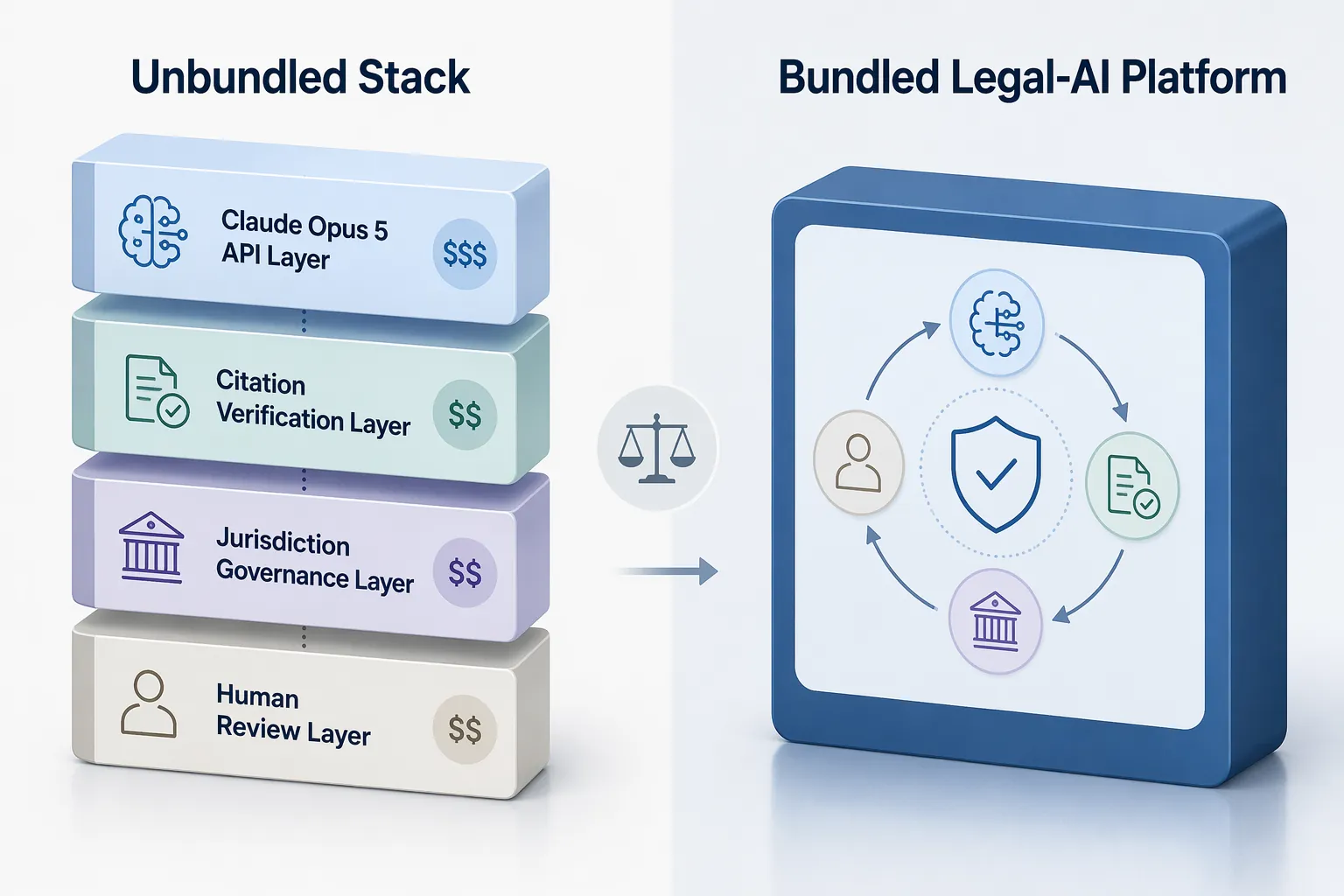
A raw Opus 5 build gives the buyer control. The team can choose its retrieval layer, logging policy, jurisdiction filters, review queues, escalation criteria, and matter-security design. That control is valuable for firms with mature engineering and risk functions. It also means the organization owns every missing workflow seam.
A bundled legal-AI platform may include research databases, citation display, source linking, administrative controls, user permissions, and review workflows. Those features can reduce operational burden if they fit the team’s practice area and risk policy. But the Stanford RegLab figures make one point hard to avoid: legal-platform bundling does not eliminate hallucination risk.[5]
| Procurement Question | Opus 5 Plus Controls | Bundled Legal-AI Platform |
|---|---|---|
| Who owns citation validation? | The buyer must design or procure the validation layer | Some validation workflow may be embedded, but citations still require review |
| How transparent is model spend? | Token pricing is public and directly measurable | Platform pricing is often not publicly disclosed |
| How flexible is the workflow? | Highly configurable if the team has technical capacity | Constrained by platform design and available integrations |
| How fast is procurement approval? | May require more security, privacy, and engineering review | May be easier if the platform already satisfies legal-industry controls |
| Where does risk governance sit? | In the buyer’s architecture, policies, logs, and review process | Partly in the vendor bundle and partly in the buyer’s use policy |
The pricing comparison is also asymmetric. Anthropic’s API rates are public. Many legal-vertical platform prices are not publicly disclosed, and reported figures are usually industry estimates rather than auditable rate cards. That makes the bundled-platform comparison harder, not less important. A buyer needs to ask what the subscription actually replaces: model usage, retrieval, citation checking, matter controls, audit logs, training, support, or reviewer labor.
For teams comparing general-purpose and purpose-built tools, the practical framework is similar to the one used in general-purpose AI versus purpose-built legal AI contract review: do not compare feature labels; compare the controls that change who must review what before the work leaves the system.
Where Opus 5 Can Still Be Worth The Premium
Opus 5’s unchanged price tier makes it easier to justify in workflows where better reasoning has measurable value. High-stakes contract interpretation, complex issue spotting, multi-document synthesis, and internal legal knowledge work can support a premium model if the output reduces senior-review time or improves first-pass quality. The Artificial Analysis intelligence improvement strengthens that argument, though it is not a legal hallucination benchmark.[3]
The missing number is still important: as of July 2026, no independent AA-Omniscience hallucination rate has been published for Opus 5. The closest proxy is Opus 4.8, and it may not reflect Opus 5’s calibration profile if Anthropic changed the model’s accuracy strategy. Buyers should not let a general intelligence score stand in for legal reliability testing.
There are also legal workflows where Opus 5 is probably the wrong economic starting point. Bulk clause tagging, low-risk document classification, and routine extraction may be better served by a cheaper model if quality remains acceptable after sampling. But that conclusion has to be proven with the same verification accounting. A lower token price does not help if it increases reviewer exceptions or sends more work to outside counsel.
The Buying Memo Should Price The Verified Task
A serious evaluation of Opus 5 for legal AI should produce at least two numbers for each workflow: raw model cost and verified task cost. The first is calculated from input tokens, output tokens, caching, and batch eligibility. The second includes the expected rate of citation review, exception handling, jurisdiction checks, lawyer signoff, and any platform or tooling needed to manage those steps.
- For cited legal research, assume verification is mandatory unless internal testing proves otherwise.
- For closed-document analysis, separate citation risk from extraction and interpretation risk.
- For repeated workflows, model cacheable context before rejecting Opus 5 on headline price.
- For large non-urgent backlogs, test whether Batch API pricing changes the cost floor.
- For bundled platforms, ask which verification tasks the platform actually removes and which it merely documents.
Professional-responsibility review should sit beside procurement review, not after it. The pricing model is incomplete if it assumes lawyers can delegate the risk layer to a model or a vendor. For teams mapping these duties, the ABA Formal Opinion 512 guide for AI contract analysis is the better companion document than another generic model-price comparison.
Opus 5’s $5/$25 per million-token API price may be defensible for high-value legal reasoning, especially when prompt caching and Batch API discounts apply. It is not, by itself, a defensible legal AI budget. The decisive comparison is the total verified task cost of Opus 5 plus controls against a bundled legal-AI platform whose subscription may reduce some operational burden but does not make citation risk disappear.
References
- Claude pricing, Claude Platform Docs
- Anthropic API Pricing, benchlm.ai
- Anthropic, Artificial Analysis
- Best AI for Legal Work Benchmark, HAQQ
- AI Hallucination Rates and Benchmarks, Suprmind.ai
Related records
Tool profile
For Law Firms, Claude Opus 5 Offers Better Compliance Than Fable 5Governing regulation
Browse the obligations tracker →Preventive workflow
Browse verification workflows →
Report a correction or tip
Spotted an outdated figure, a misstated fact, or a ruling this case record should reflect? Public comments are disabled for this content given the professional cost of a misreported case outcome, penalty amount, or rule text — use the structured correction channel instead.
Report a correction or tip for this record →