
Understanding Legal Risks in Oracle's DoW AI Software Deal
Oracle's classified AI agreement and $7B enterprise consolidation with the renamed Department of War impose 'any lawful use' terms that may override contractor safety controls. This analysis examines the resulting FCA, IP, and decommissioning liabilities for defense contractors and the regulatory split with the GSA's revised AI clause.
- Jurisdiction
- us-federal
- Court
- U.S. Department of Defense
- AI tool named
- GenAI.mil
- Ruling date
- Jul 23, 2026
- Source document
- View primary court order ↗
- Last verified
- Jul 26, 2026
Lex Machina Review is an independent risk-tracking and reference resource. Nothing on this site is legal advice, and using it does not create an attorney-client relationship. Every record is reviewed against primary sources but may not reflect the most current status of a matter — always verify directly against the cited court order, rule text, or a licensed attorney before relying on it.
Companion explanation — secondary to the source document above
The legal problem in the Oracle Department of War AI software deal starts with a sentence, not a server count. On Jan. 9, 2026, the Department of War AI Strategy Memo directed the Chief Digital and Artificial Intelligence Office to incorporate “any lawful use” language into all AI service contracts within 180 days.[1] In ordinary commercial AI contracting, acceptable-use policies, refusal behavior, and deployment restrictions are part of the vendor’s risk architecture. Under the DoW formulation, those controls may become subordinate to government discretion once the use is lawful.
The name also needs clearing up at the door. “Department of War” is the Trump administration’s 2026 renaming of the Department of Defense, so source materials still use both DoW and DoD. The contracting issue is the same procurement track: military AI acquisition under federal authority, now using DoW terminology in current materials.
Oracle became the useful test case because two announcements landed in sequence. On May 1, 2026, Oracle entered a classified AI agreement that made it the eighth company, after OpenAI, Google, NVIDIA, Microsoft, AWS, SpaceX, and Reflection, to deploy AI on IL6/IL7 classified networks.[2][3] On July 23, 2026, Oracle followed with a 10-year, $7 billion Pentagon enterprise software consolidation covering 10 dedicated U.S. government cloud regions at IL2 through SAP levels.[4][5] The deal value matters less than the combination: classified deployment, enterprise consolidation, and a procurement policy that tells contractors to accept government use as broadly as law permits.
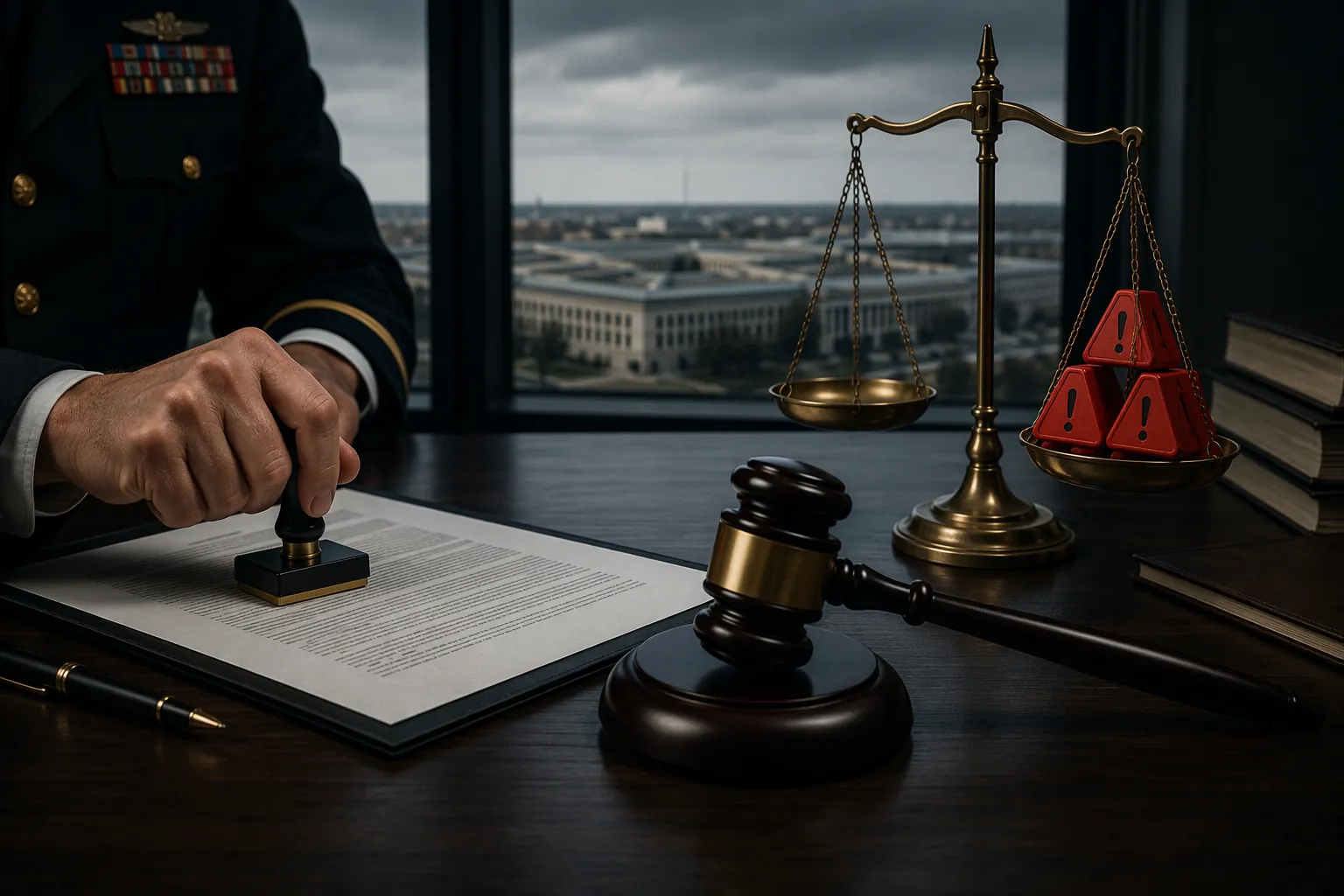
What “any lawful use” changes
A narrow AI service contract usually gives the contractor several ways to contain risk. The statement of work identifies approved uses. The service terms reserve the right to suspend abusive activity. The acceptable-use policy bars categories of deployment. Model refusals provide a technical backstop. If a customer pushes the system outside those boundaries, the vendor has at least some contractual record that the use was unauthorized.
The DoW approach changes that record. If the contract gives the government a right to use the system for any lawful purpose, then the contractor’s commercial guardrails no longer perform the same legal function. They may still exist as engineering controls, documentation, or policy statements, but they are weaker as limits on the buyer. The government has negotiated discretion upstream; downstream contractors and subcontractors then inherit the documentation, certification, and remediation burden after that discretion is exercised.
That is the legal implication the Oracle deal makes concrete. Oracle’s classified agreement is not public in full, and no public record supports a claim about hidden terms. But the governing DoW memo, the classified-network announcement, and the later enterprise consolidation are enough to identify the risk allocation problem. The contractor is supplying systems into an environment where the government is reserving broad use rights, while the contractor may still be expected to stand behind accuracy, security, bias controls, intellectual-property boundaries, and exit work.
| Contract pressure point | Why it matters after deployment |
|---|---|
| Any lawful use | Moves control over use cases toward the government and away from ordinary commercial acceptable-use limits. |
| Classified-network deployment | Limits outside visibility into how models are adapted, evaluated, and used. |
| Enterprise consolidation | Expands the number of programs and personnel that may rely on shared AI-enabled infrastructure. |
| Post-award compliance | Leaves contractors documenting outputs, certifications, fixes, and decommissioning after use has already scaled. |
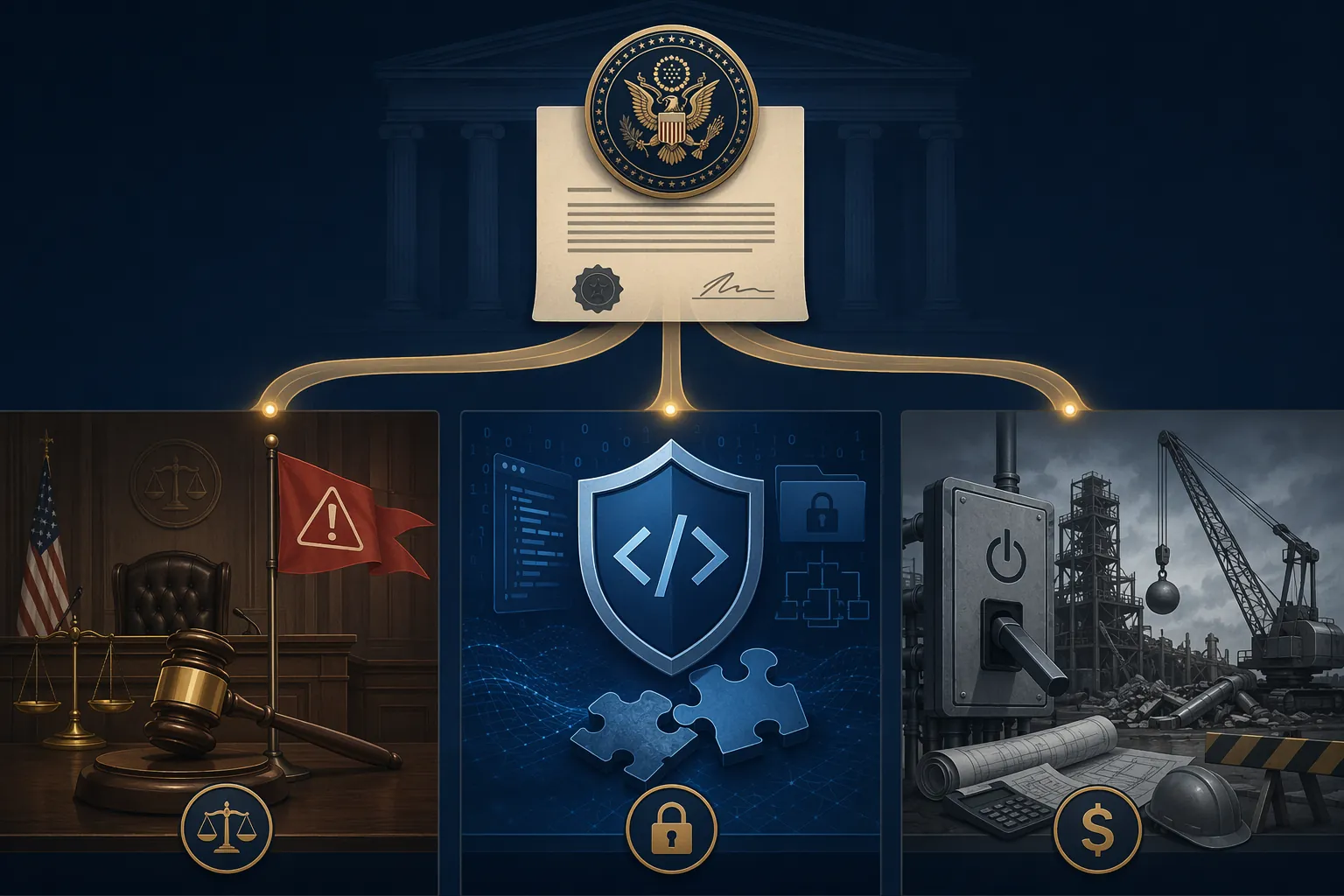
The False Claims Act risk is not theoretical once outputs enter government submissions
The most legible litigation risk is False Claims Act exposure. AI error becomes a contracting problem when an output is used in a claim, certification, report, invoice support, cost justification, technical deliverable, or compliance representation submitted to the government. The contractor does not need to market the AI as flawless for the problem to arise. It is enough that a false or unsupported statement moves through a government-facing submission with the contractor’s name attached.
The bridge from AI hallucination to FCA exposure already exists outside the Oracle record. In October 2025, Bloomberg Law reported on Deloitte’s use of AI-assisted government reports that included fabricated references, treating the episode as a concrete example of why AI policies are needed for government submissions and why hallucinated material can create real FCA risk.[6] That precedent does not prove that every AI-generated error is an FCA violation. It does show that inaccurate AI-assisted content has already crossed from ethics-panel hypotheticals into the world of government deliverables, payment, and enforcement analysis.
Scale sharpens the issue. The DoW reported GenAI.mil usage at more than 1.3 million personnel, tens of millions of prompts, and hundreds of thousands of deployed agents in five months.[3] Those figures measure adoption and operational reach, not effectiveness. They do not show that the system improved decisions, reduced error, or complied with every applicable rule. For counsel, the important point is more prosaic: when a system moves from pilot use to military-wide workflow support, the number of moments in which AI output can be copied, summarized, relied on, or certified also multiplies.
A standard AI disclaimer is a thin defense at that stage. Most service terms warn that generated outputs may be inaccurate and require human review. That may help allocate risk in a commercial dispute between vendor and customer. It does not answer the FCA question if a contractor submits a deliverable containing an unsupported representation, or certifies compliance while relying on an AI workflow it did not adequately validate. The government can have broad lawful-use rights and still demand truthful, accurate, and supported submissions from contractors.
The harder case is government-directed deployment. Suppose an AI system is configured for a lawful DoW purpose, used inside a classified environment, and incorporated into a workflow that produces a contractor-facing task. The contractor may not control the original prompt design, the model adaptation, the retrieval source, or the agency’s internal evaluation standard. Yet the contractor may be the party signing the certification, submitting the invoice support, or correcting the record. That gap between control and responsibility is where “any lawful use” becomes more than a license term.
Bias claims follow a similar path but need narrower treatment. A biased model output is not automatically an FCA event. The exposure appears when the biased output affects a representation that matters to payment, eligibility, contract performance, or compliance. If an AI tool helps screen supplier data, assess labor categories, summarize testing results, or draft required reports, a contractor needs a record showing what was reviewed, what was rejected, and who had authority to override the system. Without that record, “the model produced it” is not a satisfying answer to a government auditor.
The ownership problem sits inside the tuning work
The second exposure is less immediately visible than FCA risk, but it may be harder to unwind. AI deployment on government networks tends to create adaptation: fine-tuning, retrieval configurations, evaluation sets, red-team materials, prompts, agents, connectors, workflow templates, and classified-environment modifications. Commercial AI contracts often separate the base model from customer data and custom developments. That separation is easier to write than to administer when the work happens at IL6/IL7 levels and the government has negotiated broad use rights.
The ownership question is not simply “who owns the model.” It is who owns, can reuse, can audit, can remove, and can restrict each layer created during performance. A base model may remain the vendor’s. A government-specific adapter may be a deliverable. A classified prompt library may be government-controlled. A set of evaluation results may reveal sensitive operational assumptions. A subcontractor’s toolchain may be embedded in a larger prime-controlled environment. Ordinary commercial language about customer content and vendor technology does not resolve those seams unless the federal contract maps them.
This is where the Oracle structure matters. The May 1 agreement places AI on classified networks; the July 23 consolidation gives Oracle a broader software and cloud footprint across dedicated U.S. government regions.[2][4][5] Nothing in the public materials proves a particular IP allocation. But the combination increases the likelihood that model-related work will not remain a clean vendor-hosted service. It will be integrated, adapted, permissioned, logged, and evaluated across government environments.
For subcontractors, the danger is being downstream of a rights grant they did not negotiate. A prime contractor may accept government-use language at the enterprise level, then flow down performance obligations to a smaller AI vendor, data vendor, systems integrator, or compliance tool provider. The subcontractor’s commercial terms may still say its model cannot be used for certain purposes, or that derivative tooling remains its property. Those terms have limited practical value if the upstream award already assumes broader government use and the subcontractor is asked to perform inside that architecture.
Decommissioning is the cost nobody prices well at award
The third exposure appears if the government later determines that a model, agent, workflow, or data pipeline violates required AI principles, including unbiased AI principles. The practical question then becomes who pays to unwind it. Decommissioning an AI capability is not the same as turning off a subscription. The work may require removing agents from workflows, preserving logs, replacing decision support, retraining users, segregating contaminated outputs, rebuilding integrations, and documenting why earlier use did or did not affect contract performance.
A contractor can try to price that risk through change-order language, limitation-of-liability provisions, and acceptance criteria. Under a broad lawful-use framework, those tools may not be enough. If the government used the system as the contract permitted, the vendor may struggle to argue that remediation is caused by unauthorized use. If the contract also requires compliance with evolving AI governance standards, the contractor may face a moving target: permitted use on the front end, expensive correction on the back end.
The classified setting compounds the cost. Outside counsel, insurers, auditors, and technical experts may not be able to inspect the relevant environment without clearance and need-to-know access. A public cloud AI dispute can sometimes be reconstructed from tickets, logs, user activity, and model documentation. A classified deployment narrows who can see the evidence and who can explain what happened. That does not eliminate liability; it makes allocation and proof more difficult.
GSA’s retreat shows this is not just vendor anxiety
The strongest evidence that industry objections are not imaginary comes from a different procurement track. On June 17, 2026, the General Services Administration revised its proposed AI clause after pushback, retreating from original “any lawful Government purpose” language toward a license limited by the scope of work. Public comments are due Aug. 3, 2026.[7][8][9] That revision matters because it shows the federal government is not speaking with one stable voice on AI use rights.
The GSA move does not automatically bind DoW AI contracts. It does, however, expose the split. One procurement path has acknowledged that open-ended government-purpose language can overreach and has moved toward scope-of-work limits. The DoW path, as described in the Jan. 9 memo, still pushes “any lawful use” into AI service contracts.[1] Contractors selling across both channels may find themselves explaining why a restriction is acceptable for civilian acquisition but unavailable, or treated as noncompliant, in defense acquisition.
That split will matter in negotiations. A contractor can point to the GSA revision as evidence that narrower licensing language is administrable. The government can respond that military needs, classified operations, and command discretion justify broader authority. Neither position answers the downstream liability question. If a vendor cannot restrict use, and the agency will not assume responsibility for output consequences, the contract has not solved risk. It has relocated it.
Anthropic is the counterpoint, not the outcome
Anthropic’s dispute shows that safety-policy conflict has already become a procurement barrier. Reporting in May 2026 described Anthropic as banned from DoD work because of tension between its safety policies and the government’s “any lawful use” position, with litigation underway.[10] That is an important signal, but it is not a final legal answer. At the time of writing, the record described in the available materials does not include final court orders resolving the conflict.
The unfinished status matters. It would be too much to treat Anthropic as proof that courts will reject the DoW approach, or proof that vendors must abandon safety policies to compete. The narrower conclusion is more useful: refusal behavior and acceptable-use policies are no longer just product-design choices in federal AI procurement. They can determine whether a company is eligible, whether its terms are acceptable, and whether its risk controls survive contact with the government’s desired license.
Oracle’s other legal weather is not the load-bearing risk
Oracle also faces adjacent legal and market issues, including securities class actions over alleged AI infrastructure spending disclosures and Department of Labor pay-discrimination litigation. Those matters can affect contracting background, eligibility analysis, investor scrutiny, and negotiation leverage. They do not prove the legal implications of the DoW AI software deal. The load-bearing issue here is the government contract framework: broad lawful-use rights, classified deployment, enterprise reach, and the mismatch between operational control and legal responsibility.
That distinction is important because federal AI contracting already attracts enough atmospheric commentary. A stock decline does not explain FCA exposure. A securities complaint does not decide who owns a tuned model inside a classified cloud. A pay-discrimination case does not tell a subcontractor whether its refusal policy survives an upstream DoW license. Those are separate risk streams unless a particular contract, suspension-and-debarment record, or court order connects them.
What contractors should assume now
Under the current DoW framework, contractors should assume they cannot rely on ordinary commercial AI service terms to contain liability once the government has reserved “any lawful use.” That does not mean every DoW AI deployment is unlawful, unsafe, or unmanageable. It means the familiar private-sector allocation—vendor sets the acceptable-use boundary, customer operates within it, vendor suspends violations—does not carry over cleanly.
- Treat acceptable-use policies and refusal behavior as negotiable risk controls, not guaranteed contractual limits.
- Map who reviews AI-assisted material before it enters claims, certifications, reports, invoices, or compliance submissions.
- Separate base models, government data, adapters, prompt libraries, evaluation assets, and custom developments in the rights clause.
- Price and assign responsibility for remediation, replacement, log preservation, and decommissioning before classified deployment begins.
- Check whether prime-contract lawful-use language conflicts with subcontractor model restrictions or third-party tool licenses.
The unresolved questions are now practical ones. Will defense agencies reconcile the DoW mandate with GSA’s narrower direction, or will contractors face two federal AI licensing regimes? Will courts treat government-directed AI outputs as contractor responsibility when the contractor lacked meaningful control over use? And when a model deployed under broad lawful-use authority later requires correction or removal, who pays for the work of making the government environment whole?
Oracle’s announcements do not answer those questions. They make them harder to postpone.
References
- Department of War’s AI-First Agenda: A New Era for Defense Contractors, Holland & Knight, February 2026
- Oracle classified AI agreement announcement, Oracle, May 1, 2026
- Department of War release on Oracle classified AI agreement and GenAI.mil, Department of War, May 1, 2026
- Oracle wins $7 billion Pentagon software contract, CNBC, July 23, 2026
- Oracle signs 10-year Pentagon software consolidation deal, Reuters, July 2026
- AI policies needed after fabricated references in government reports, Bloomberg Law, October 2025
- GSA AI procurement rules analysis, Gibson Dunn, June 2026
- GSA revised AI clause analysis, Crowell & Moring, June 2026
- GSA’s revised AI clause, PilieroMazza, June 2026
- Anthropic banned from DoD work amid AI safety-policy dispute, Breaking Defense, May 2026
Related records
Tool profile
How Meta's AI Spending Reshapes Law Firm ProfitabilityGoverning regulation
Browse the obligations tracker →Preventive workflow
Browse verification workflows →
Report a correction or tip
Spotted an outdated figure, a misstated fact, or a ruling this case record should reflect? Public comments are disabled for this content given the professional cost of a misreported case outcome, penalty amount, or rule text — use the structured correction channel instead.
Report a correction or tip for this record →