
2024 legal developments in the Pan Am 103 bombing case
What happened in the Pan Am 103 bombing prosecution during 2024, with each ruling and filing tied to a primary source. The record runs from the January statute and March scheduling order through the December evidence transfer, deadline suspension, and remote-access memorandum opinion, with confirmed-versus-reported flags.
- Jurisdiction
- US federal (District of Columbia)
- Court
- U.S. District Court for the District of Columbia
- Judge
- Dabney L. Friedrich
- AI tool named
- No AI tool implicated
- Ruling date
- Dec 23, 2024
- Source document
- View primary court order ↗
- Last verified
- Aug 3, 2026
Lex Machina Review is an independent risk-tracking and reference resource. Nothing on this site is legal advice, and using it does not create an attorney-client relationship. Every record is reviewed against primary sources but may not reflect the most current status of a matter — always verify directly against the cited court order, rule text, or a licensed attorney before relying on it.
Companion explanation — secondary to the source document above
Record posture and verification convention
This Risk Digest update treats the 2024 legal developments in the Pan Am 103 bombing case as a procedural record, not as a verdict-watch story. The active federal prosecution is United States v. Abu Agila Mohammad Mas'ud Kheir Al-Marimi, No. 22-cr-392-DLF, in the U.S. District Court for the District of Columbia before Judge Dabney L. Friedrich; the public case-information page and docket sources identify the matter under that posture. [1][2]
| Field | Record value |
|---|---|
| Placement | Risk Digest case-update record; part of the site's Lockerbie / Pan Am 103 legal-procedure cluster |
| Court | U.S. District Court for the District of Columbia |
| Case | United States v. Abu Agila Mohammad Mas'ud Kheir Al-Marimi, No. 22-cr-392-DLF |
| Judge | Dabney L. Friedrich |
| Record window | 2024 developments, with a separate since-2024 note because the prosecution remains active in Q3 2026 |
| Last verified for this article | August 3, 2026, UTC |
| Confirmed | A fact tied to a statute, order, court PDF, DOJ VNS / USAO-DC update, COPFS announcement, or docket source |
| Reported / needs recheck | A fact located in secondary reporting or tracker material, or a schedule claim that must be checked against the current docket before reuse |

The older Lockerbie history matters, but it is not the load-bearing part of this update. For the full multi-decade chronology, use the Lockerbie bombing trial and legal case timeline. For a current posture snapshot, use Where the Pan Am 103 Prosecution Stands Before Trial. The victims roster and compensation background belong in the Pan Am 103 victims list and verified compensation record, and the Scottish conviction and appeals record is covered in Why the Pan Am 103 conviction survived two appeals.
The 2024 chronology
The useful 2024 record is compact. It starts with access legislation, moves through a scheduling order, develops the remote-access record, and then ends the year with evidence-transfer and deadline-administration orders. That is trial architecture. It is not a finding on guilt, not a verdict timeline, and not a reliable substitute for a current docket check.
| Date | Procedural event | Status flag | Primary support / record note |
|---|---|---|---|
| Jan. 19 and Feb. 1, 2024 | DOJ VNS / USAO-DC issued early-2024 case updates to victims and interested parties. | Confirmed as DOJ case-information updates | Use the USAO-DC Pan Am 103 case-information page for the dated VNS update sequence. [1] |
| Jan. 26, 2024 | Public Law 118-37, S.3250, was signed; the statute concerns remote access to court proceedings for victims of the Pan Am Flight 103 attack. | Confirmed by enacted federal statute | GovInfo publishes the public law text and identifies the law as signed Jan. 26, 2024, 138 Stat. 11. [3] |
| Mar. 13, 2024 | The court entered a scheduling order; DOJ's Mar. 18 update also reported that a previously set Apr. 4 status conference was vacated. | Confirmed by DOJ update; underlying order should be checked for deadline-by-deadline use | The Mar. 18 VNS update is the public DOJ anchor for the scheduling event and vacated conference. [1] |
| May 31, Jun. 17, and Jun. 24, 2024 | The remote-access issue was briefed through a motion cycle that included a 66-page motion and five declarations, followed by opposition / response activity. | Confirmed in DOJ materials; tracker useful for locating filings, not a substitute for the docket | Use DOJ's 2024 case-information materials first; PA103LL's Terrorist Trial Tracker is secondary locator material. [1][4] |
| Dec. 6, 2024 | Scottish authorities announced transfer of physical evidence to the FBI for trial, including the reconstructed fuselage. | Confirmed by COPFS announcement and DOJ VNS update | COPFS announced the Scotland-to-FBI evidence transfer; DOJ also issued a Dec. 6 update. [1][5] |
| Dec. 17, 2024 | The court suspended pretrial deadlines in light of the defendant's medical treatment; DOJ reported the treatment period as approximately 90 to 120 days from Nov. 15, 2024. | Confirmed by DOJ VNS update; medical-treatment description should not be enlarged beyond the update | The Dec. 19 DOJ VNS update is the public source for the deadline suspension and reported treatment window. [1] |
| Dec. 23, 2024 | The court issued a memorandum opinion on remote access. | Confirmed by court PDF; docket-number references should be rechecked | The operative source is the Dec. 23 memorandum-opinion PDF. Secondary commentary is useful for issue-spotting but not for quoting the order. [6][7] |
January to March: the statute and the schedule did the heavy lifting
Public Law 118-37 is the first event in 2024 that changed the shape of the prosecution. It was signed on Jan. 26, 2024, and appears in the Statutes at Large at 138 Stat. 11. Its operative subject was remote access to federal court proceedings for victims of the attack on Pan Am Flight 103 over Lockerbie, Scotland. [3]
That matters because remote access is not a decorative feature in this case. It sits between three pressures that court administration cannot wish away: the geographic dispersion of families, the ordinary limits on broadcasting criminal proceedings, and the need to conduct a federal trial without turning victim access into uncontrolled public transmission. The statute did not produce a verdict. It supplied a legal mechanism that the parties and court then had to operationalize.
The March 13 scheduling order is the second foundation event. DOJ's Mar. 18 VNS update reported that the court entered the scheduling order and vacated an Apr. 4, 2024 status conference. [1] For a litigator or newsroom editor, that is the point at which 2024 becomes more than a series of commemorative references. Deadlines had to be sequenced; motion practice had to be made administrable; a trial date had to be placed on a calendar even though later events could move it.
The safe way to brief the March event is narrow: the court set a schedule, and the scheduled Apr. 4 status conference was vacated. Do not convert that into a promise that trial timing was fixed for all future purposes. Later medical-treatment and scheduling developments altered the posture, and the case remained active well after 2024.
May to June: remote access became a litigated administration problem
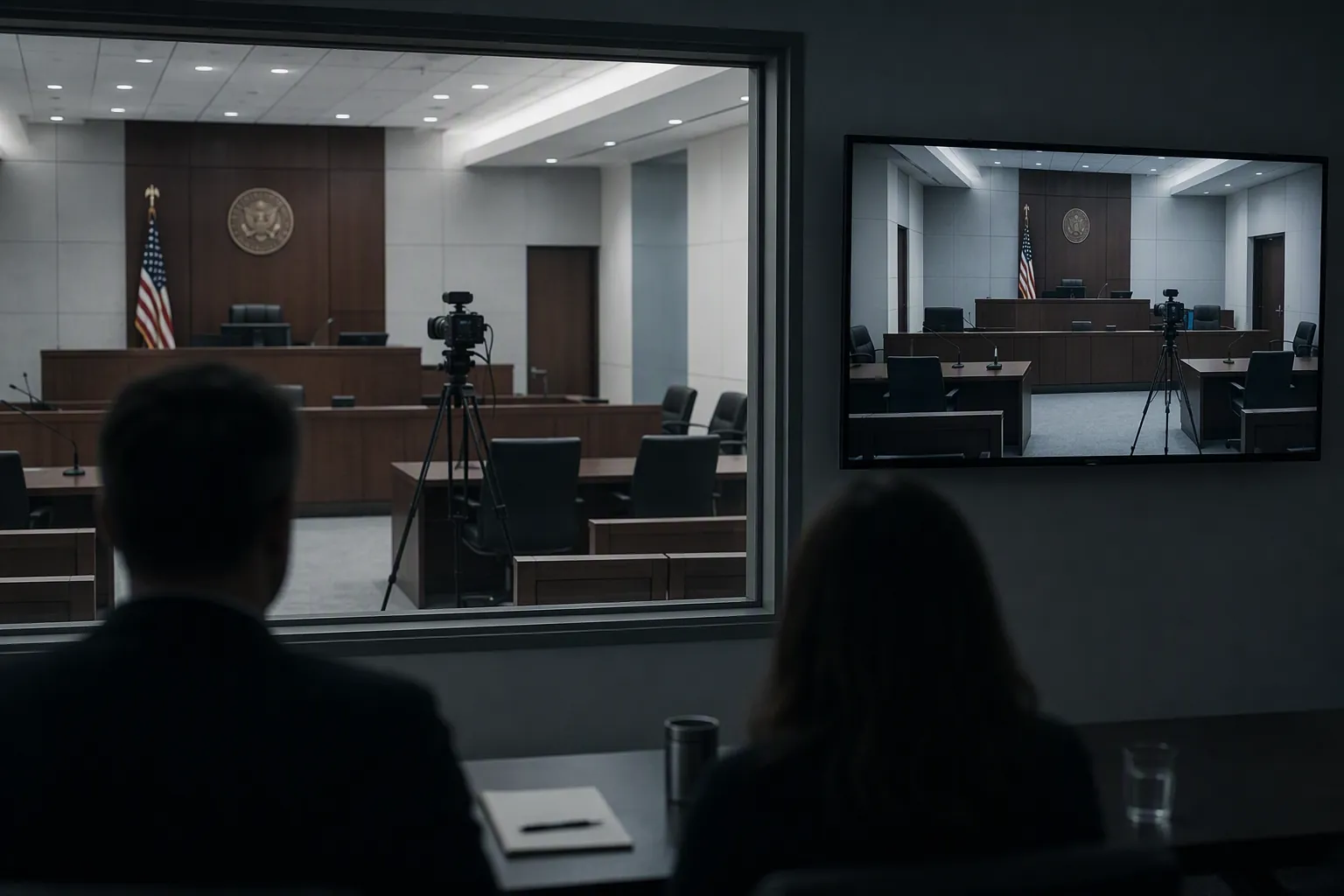
The May–June remote-access cycle is easy to understate because it looks, from a distance, like a victim-services issue. On the docket, it was something more exacting: a process for deciding how people with a direct statutory and personal stake could see proceedings without breaking the trial's procedural constraints.
The available record identifies a May 31, 2024 motion cycle involving a 66-page motion and five declarations, followed by June 17 and June 24 briefing activity. DOJ's 2024 case-information materials are the primary public anchor for the cycle; PA103LL's Terrorist Trial Tracker is useful for locating and sequencing filings, but it should be treated as a tracker, not as the operative order or filing repository. [1][4]
That distinction is not clerical fussing. A tracker can tell a reader where to look. It cannot replace the filed motion, the declarations, the opposition, the reply, or the order that decides the issue. In a live criminal prosecution, especially one with remote access, the difference between a public-law authorization, a party's proposed protocol, and a court-approved protocol is the difference between a lawful access pathway and a headline.
| Remote-access item | How to use it |
|---|---|
| Public Law 118-37 | Use for the existence and date of the statutory authorization; do not infer the final viewing protocol from the statute alone. [3] |
| May–June motion papers | Use for what the parties requested and supported; cite the specific filing when available. |
| Declarations | Use for the evidentiary showing attached to the request; do not treat declarations as judicial findings. |
| Dec. 23 memorandum opinion | Use for the court's ruling and reasoning; quote only from the PDF or a docket copy of the opinion. [6] |
| Secondary commentary | Use to find issues and cross-check docket-number confusion; do not quote it as the court. [7] |
December 6: Scotland transferred physical evidence to the FBI

On Dec. 6, 2024, the Crown Office and Procurator Fiscal Service announced that physical evidence from Scotland had been transferred to the FBI for the U.S. trial. The COPFS announcement specifically included the reconstructed fuselage among the transferred evidence. DOJ issued its own Dec. 6 VNS update on the transfer. [1][5]
The institutional labels matter. COPFS is the Scottish prosecutorial authority announcing the transfer from Scotland. DOJ is the U.S. source communicating the development to victims and the public in the federal case. A careful record should not collapse the two into a generic statement that “the government transferred evidence” without identifying which government actor confirmed which part of the event.
The transfer also should not be written as if it proves admissibility, resolves chain-of-custody disputes, or forecasts the evidentiary rulings at trial. The confirmed 2024 event is narrower and still important: physical evidence long held in Scotland was transferred to the FBI for use in the U.S. prosecution.
December 17 and December 23: deadlines paused, then remote access was addressed by opinion
The year did not close with a straight run toward trial. DOJ's Dec. 19 VNS update reported that, on Dec. 17, the court suspended pretrial deadlines because of the defendant's medical treatment. The update described the treatment period as approximately 90 to 120 days from Nov. 15, 2024. [1]
That is a deadline-administration fact, not a medical diagnosis for public reuse. The verified statement is that deadlines were suspended and that DOJ reported the medical-treatment basis and approximate window. Anything more specific belongs in a sealed or filed medical record only if the court has made it public.
Six days later, the court issued its Dec. 23 memorandum opinion on remote access. The cited PDF is the source to use for the ruling; its heading identifies it as a “MEMORANDUM OPINION.” [6] Secondary analysis published after the opinion is helpful for finding the dispute and noting how commentators read the ruling, but it cannot substitute for the PDF when stating what the court held. [7]
There is a small but consequential sourcing problem around this opinion: secondary sources have varied in referring to the docket number as Doc. 82 or Doc. 83. The safer citation in an article or internal tracker is the date, title, case caption, and PDF link, followed by the docket entry number only after checking the current docket or a court filing system copy. [2][6][7]
The December cluster is the clearest reason not to write 2024 as a trial-countdown story. In the same month, physical evidence moved, pretrial deadlines were suspended, and the court addressed remote access. Those are not cosmetic events. They are the machinery that determines how the prosecution can proceed, who can observe it, and which deadlines remain operative.
What this 2024 update does not prove
It does not prove that the case was close to a verdict in 2024. It does not prove that every family member could view every proceeding from any location. It does not prove that transferred physical evidence was admitted, challenged, or excluded. It does not prove that later trial dates remained fixed. Each of those questions requires a separate, current-status check against the docket and operative orders.
It also does not retell the full Pan Am 103 history. The Scottish conviction, appeals, victims compensation, and evidence-integrity questions are relevant to the larger case cluster, but they are not the answer to the narrower 2024 procedural question. Here, the narrower question is procedural.
Since 2024: separate status note, last verified Aug. 3, 2026
Post-2024 developments should not be backfilled into the 2024 record. DOJ issued additional VNS updates in early 2025, and later reporting and docket materials indicate that the trial schedule moved beyond the original 2025 setting. Because the case remained active in Q3 2026, any statement of the current trial date should be rechecked against the live docket and the site's current Pan Am 103 prosecution status page before publication.
Two later items belong in that separate status file, not in the 2024 chronology. First, BBC reporting in January 2026 described a dispute involving a confession recording said to be lost or destroyed; that is a reported post-2024 development and should be checked against the underlying filings before being treated as an evidentiary ruling. [8] Second, a May 2026 Leagle entry describes a partial dismissal on extraterritorial-jurisdiction grounds; because Leagle is a reproduction / reporting source, the operative order should be verified before updating the counts or trial posture. [9]
For the 2024 record, the dependable statement is narrower: Congress enacted the remote-access statute; the district court set a schedule; the parties briefed remote access; Scottish authorities transferred physical evidence to the FBI; deadlines were suspended for medical-treatment reasons reported by DOJ; and the court issued a memorandum opinion on remote access. That is the legal development record the sources support.
References
- Pan Am 103 Case Information 2024 — U.S. Attorney's Office for the District of Columbia
- United States v. Al-Marimi — CourtListener
- Public Law 118-37 — GovInfo, Jan. 26, 2024
- Terrorist Trial Tracker — PA103LL
- Fuselage of Lockerbie plane transferred to US as evidence for trial — Crown Office and Procurator Fiscal Service, Dec. 6, 2024
- Memorandum Opinion — U.S. Attorney's Office for the District of Columbia, Dec. 23, 2024
- Federal Court Decides on How Lockerbie Crash Victims' Relatives Can View Accused Terrorist's Criminal Trial Remotely — Reason / The Volokh Conspiracy, Dec. 30, 2024
- Lockerbie bombing suspect's confession recording lost or destroyed — BBC, Jan. 6, 2026
- United States v. Al-Marimi — Leagle, May 26, 2026
Related records
Tool profile
How Meta's AI Spending Reshapes Law Firm ProfitabilityGoverning regulation
Browse the obligations tracker →Preventive workflow
Browse verification workflows →
Report a correction or tip
Spotted an outdated figure, a misstated fact, or a ruling this case record should reflect? Public comments are disabled for this content given the professional cost of a misreported case outcome, penalty amount, or rule text — use the structured correction channel instead.
Report a correction or tip for this record →