
Where the Pan Am 103 Lockerbie bombing trial stands now
Docket-sourced status of the first U.S. federal Lockerbie prosecution, United States v. Abu Agila Mas'ud, as of Aug. 4, 2026: charges, custody timeline, and the pretrial rulings that decided the confession-suppression and extraterritorial-jurisdiction challenges. Also covers victim remote access under Public Law 118-37, the July 2026 Pan Am telex ruling, and the pending Aug. 24–25 jury-selection dates.
- Jurisdiction
- United States federal (D.D.C.)
- Court
- U.S. District Court for the District of Columbia
- Judge
- Dabney L. Friedrich
- AI tool named
- No AI tool implicated
- Ruling date
- Jul 16, 2026
- Source document
- View primary court order ↗
- Last verified
- Aug 4, 2026
Lex Machina Review is an independent risk-tracking and reference resource. Nothing on this site is legal advice, and using it does not create an attorney-client relationship. Every record is reviewed against primary sources but may not reflect the most current status of a matter — always verify directly against the cited court order, rule text, or a licensed attorney before relying on it.
Companion explanation — secondary to the source document above
Last verified: Aug. 4, 2026. This status note covers United States v. Abu Agila Mas’ud, D.D.C. No. 22-cr-392-DLF, before Judge Dabney L. Friedrich. It is a docket-status record, not legal advice. The indictment’s allegations remain allegations unless and until proved in court.
The practical answer is that the first U.S. federal Pan Am 103 Lockerbie bombing trial is now approaching jury selection after the major pretrial disputes have been decided. The DOJ’s Pan Am 103 case page identifies the case, charges, court, and filings, and still carries older scheduling material showing an April 20, 2026 trial date; newer reporting says jury selection is now set for Aug. 24–25, 2026, pending court approval, with trial expected to run six to eight weeks. That newer date is the one used here, with the discrepancy flagged rather than silently cleaned up. [1][2]

| Status item | Verified position as of Aug. 4, 2026 |
|---|---|
| Case | United States v. Abu Agila Mas’ud, D.D.C. No. 22-cr-392-DLF, before Judge Dabney L. Friedrich. |
| Charges | Two counts of destruction of aircraft resulting in death and one count of destruction of a vehicle used in foreign commerce by explosive. |
| Custody | Mas’ud has been in U.S. custody since Dec. 11, 2022. |
| Plea | He pleaded not guilty on Feb. 8, 2023. |
| Current trial setting | Jury selection reported for Aug. 24–25, 2026, pending court approval; older agency pages still show April 20, 2026. |
| Pretrial posture | Confession-suppression, extraterritorial-jurisdiction, Daubert, victim-access, and Pan Am Telex issues have been addressed by rulings. |
For readers tracking the broader Pan Am 103 Lockerbie bombing trial and legal aftermath, the live issue is no longer whether the United States has brought a federal case. It has. The narrower question is what kind of case will reach jurors: one built around aviation-destruction statutes, a decades-old evidentiary record, expert testimony fights, documentary baggage evidence, and a 2012 Libyan confession the defense has tried to keep out.
What Mas’ud is charged with
Mas’ud faces three federal counts: two counts of destruction of aircraft resulting in death and one count of destruction of a vehicle used in foreign commerce by explosive. The DOJ’s case page describes this as the U.S. prosecution arising from the Dec. 21, 1988 bombing of Pan Am Flight 103 over Lockerbie, Scotland. [1]
The age of the case matters procedurally more than ceremonially. It affects the evidence record, witness availability, expert proof, and the defense challenge to trying an alleged bombing in Scotland by a Libyan national in a U.S. federal court decades later. That is the legal pressure point the current docket has been resolving.
Mas’ud has been in U.S. custody since Dec. 11, 2022, and pleaded not guilty on Feb. 8, 2023. The custody date was reported when U.S. and Scottish authorities confirmed he was in American hands; the plea appears in the DOJ case record and victim-notice tracking. [3][1][4]
The trial date moved twice, and the newest date controls
The case has not remained on its first calendar. It was previously set for May 12, 2025, then April 20, 2026, before the current Aug. 24–25, 2026 jury-selection dates were reported. The January 2026 delay reporting attributed the move to unforeseen circumstances, and later July 2026 reporting described the August jury-selection dates as pending court approval. [4][5][2]
That date conflict is not cosmetic. Agency pages and case explainers can lag behind docket movement, while journalists and families often work from newer notices. For a live prosecution, the safer status note is to preserve both: April 20, 2026 remains visible on older DOJ/FBI-facing materials, but the most recent sourced reports point to jury selection on Aug. 24–25, 2026. [1][2][5]
This site has treated other live federal matters the same way: the status flag matters as much as the headline. The closest internal analogues are the federal conspiracy-charges docket record, the Trump immunity remand status note, and the Hearn dismissal record: the point is to identify what can be verified now, not to pretend a live docket is static.
The confession ruling is central because the government’s case includes a 2012 Libyan statement
One of the defense’s major pretrial fights was a motion to suppress Mas’ud’s alleged 2012 confession in Libya as coerced. The DOJ docket page lists the filings and rulings in the case, and the current posture reflected in the case materials is that the suppression challenge has been resolved by ruling rather than left for open-ended pretrial uncertainty. [1]
That does not make the statement true. It means the court has addressed the threshold admissibility fight before jury selection. At trial, the defense can still contest the confession’s reliability and weight through the ordinary trial tools available after an admissibility ruling: cross-examination, competing evidence, and argument about the circumstances under which the statement was obtained.
The distinction is easy to lose in a famous terrorism prosecution. A suppression denial, limitation, or other evidentiary ruling is not moral vindication for either side. It is a gatekeeping decision about what the jury may hear and under what constraints.
The extraterritorial-jurisdiction challenge has also been decided
Mas’ud also challenged the prosecution on extraterritorial-jurisdiction grounds: the alleged conduct concerned an aircraft bombing over Scotland, the defendant is Libyan, and the case is being tried in the United States. The government’s theory proceeds under U.S. aviation and foreign-commerce-related criminal statutes, and the defense sought dismissal on the ground that Congress had not supplied the necessary reach for this prosecution. The DOJ case page identifies the case’s current rulings and docket filings, including the jurisdictional litigation. [1]
The practical consequence is that the forum question has not stopped the case from approaching trial. That matters for any lawyer reading the docket because jurisdiction is not merely a background objection. If it had succeeded, the case would not be lining up for jury selection in Washington.
The trial will still test that theory in a broader sense. A denied dismissal motion can clear the legal path to trial without answering whether the government’s proof persuades a jury beyond a reasonable doubt.
Daubert and old aviation evidence: what reaches the jury matters as much as what happened in 1988
The Daubert disputes over prosecution experts belong in the same cluster as the confession and jurisdiction rulings. They determine which expert opinions may be used to explain technical or forensic issues to the jury. In a case involving 37-year-old aviation evidence, expert testimony is not ornamental; it is how the parties may try to translate an old record into admissible proof in a modern courtroom. The DOJ case page identifies Daubert litigation among the docket materials. [1]
The court’s rulings on expert proof do not decide the factual dispute for the jury. They set the boundaries. If expert evidence comes in, the defense may still challenge foundation, methodology, assumptions, and fit. If evidence is limited, the government must work within those limits rather than rely on the historical force of the Lockerbie narrative.

The July 2026 Pan Am Telex ruling partially admits a key baggage document
The July 2026 ruling on the Pan Am baggage Telex is one of the most recent concrete evidentiary developments. Reporting from July 16, 2026 described the court as partially admitting the Telex, a decades-old document connected to Pan Am baggage handling evidence, while also describing the August jury-selection schedule. [2]
A partial admission ruling is the sort of detail that can disappear in general accounts of the Lockerbie case. It should not. The government does not simply get to narrate the whole archive, and the defense does not automatically keep old airline records away from the jury because they are old. The ruling tells the parties which parts of the document may be used and leaves the trial lawyers to build or attack the inferences the document is supposed to support.
For briefing purposes, the Telex ruling also confirms that the case’s evidentiary posture is still changing close to trial. Anyone relying only on older agency summaries would miss that July 2026 development.
Victim access is governed by Public Law 118-37 and a fixed-site ruling
Victim and family access is not a side issue in this case. Congress enacted Public Law 118-37 on Jan. 26, 2024, directing remote video and telephonic access for eligible individuals in criminal proceedings arising from the Pan Am 103 bombing, subject to court control and statutory conditions. [6]
On Dec. 23, 2024, the court issued a memorandum opinion limiting remote access for evidentiary and trial proceedings to designated fixed sites, including courthouses and U.S. embassies, using Zoom for Government. The Legacy Foundation’s trial tracker and DOJ materials reflect the access litigation and notices for victims and families. [4][1]
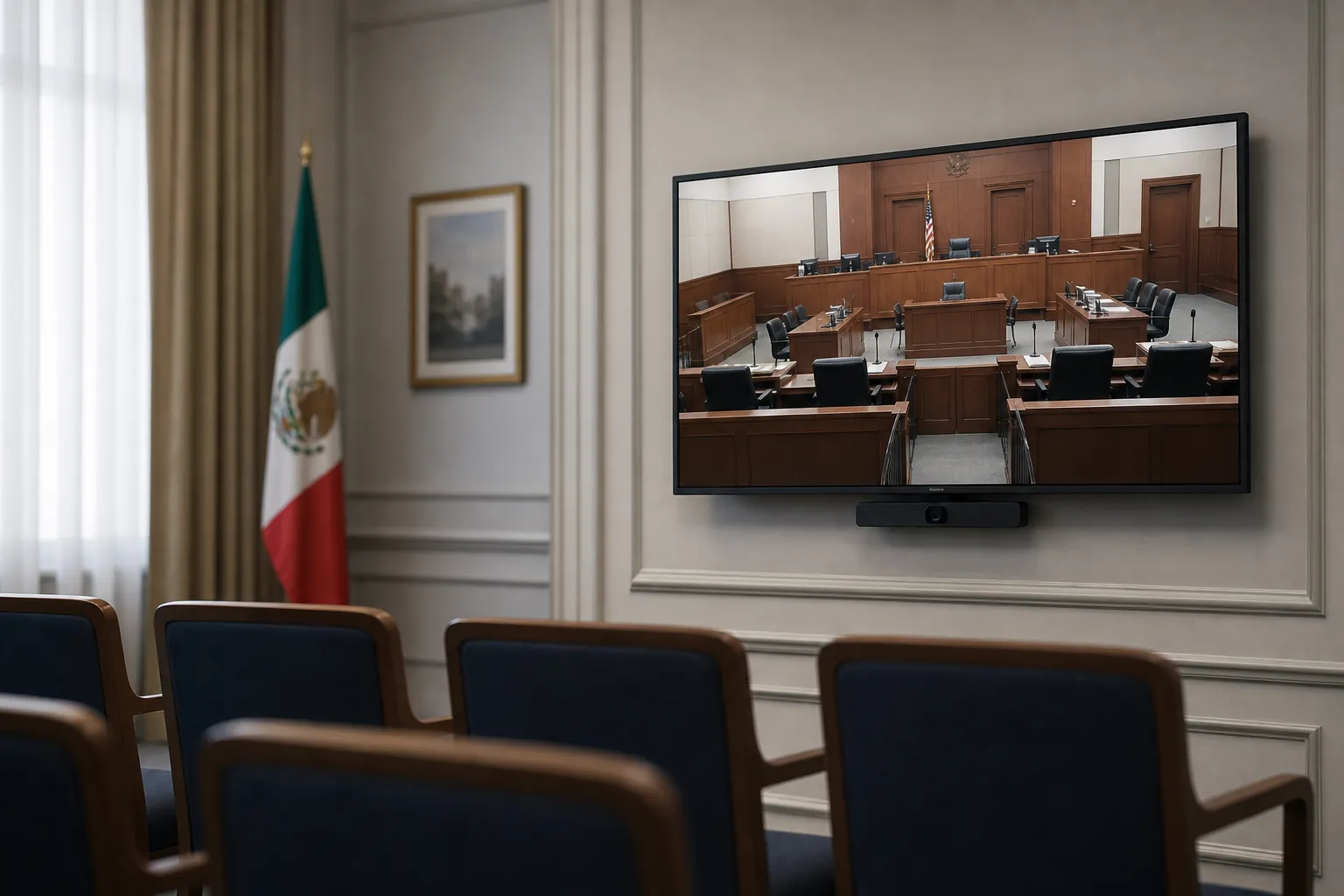
That fixed-site model is a meaningful access decision. It is not the same as a public livestream from home, and it is not a denial of all remote access. It creates controlled viewing locations for eligible observers who may not be able to attend in Washington. For families spread across countries and decades of litigation, the difference is practical rather than technological.
Anyone tracking attendance mechanics should use the victim-notice channel and court-controlled notices rather than assuming that ordinary livestream expectations apply. The site has covered livestream status questions in other criminal matters, including the Lindsay Clancy trial livestream tracker, but Public Law 118-37 creates a more specific statutory access framework for this prosecution.
What remains immediately ahead
The next verified event is jury selection, reported for Aug. 24–25, 2026, pending court approval. The trial is expected to last six to eight weeks. [2]
The rulings so far have not answered the trial question. They have brought the case to it. The confession challenge, jurisdictional challenge, expert disputes, remote-access mechanics, and Pan Am Telex dispute have all been addressed sufficiently for the case to approach jury selection. As verified on Aug. 4, 2026, the coming trial is the practical test of whether this old evidence record, the alleged 2012 confession, and the government’s extraterritorial aviation-statute theory can carry the prosecution in a modern U.S. courtroom.
References
- Attack on Pan Am Flight 103, U.S. Attorney’s Office for the District of Columbia, updated through July 21, 2026.
- Lockerbie Pan Am suspect trial, The National, July 16, 2026.
- Lockerbie bombing: Suspect in US custody, BBC.
- Terrorist Trial Tracker, Pan Am 103 Lockerbie Legacy Foundation.
- Jury selection for accused Pan Am 103 bomb suspect delayed until August, The Daily Orange, January 2026.
- Public Law 118-37, GovInfo, Jan. 26, 2024.
Related records
Tool profile
How Meta's AI Spending Reshapes Law Firm ProfitabilityGoverning regulation
Browse the obligations tracker →Preventive workflow
Browse verification workflows →
Report a correction or tip
Spotted an outdated figure, a misstated fact, or a ruling this case record should reflect? Public comments are disabled for this content given the professional cost of a misreported case outcome, penalty amount, or rule text — use the structured correction channel instead.
Report a correction or tip for this record →