
Why the Jan. 6 Pence Tweet Was an Official Act
Judge Mehta's July 22, 2026 order in Lee v. Trump kept the 2:24 p.m. Pence tweet within official-act immunity and certified the question for D.C. Circuit review, so the tweet's immunity remains open on appeal while the Ellipse speech and Raffensperger call stay classified as unofficial. The verified record also fixes the procedural deadlines — plaintiffs' notice of appeal due Aug. 5, opening brief due Aug. 10 — for anyone tracking the docket.
- Jurisdiction
- US federal
- Court
- U.S. District Court for the District of Columbia
- Judge
- Amit P. Mehta
- AI tool named
- No AI tool named
- Ruling date
- Jul 22, 2026
- Source document
- View primary court order ↗
- Last verified
- Aug 5, 2026
Lex Machina Review is an independent risk-tracking and reference resource. Nothing on this site is legal advice, and using it does not create an attorney-client relationship. Every record is reviewed against primary sources but may not reflect the most current status of a matter — always verify directly against the cited court order, rule text, or a licensed attorney before relying on it.
Companion explanation — secondary to the source document above
Verified record: Lee v. Trump, No. 1:21-cv-00400-APM, U.S. District Court for the District of Columbia; Judge Amit P. Mehta; Order Denying Reconsideration and Certifying Interlocutory Appeal, document 253, entered July 22, 2026. Last verified: Aug. 5, 2026, UTC. Reviewer signal: legal-background review indicated; no reviewer name was supplied in the source materials. This article is for legal-information and record-tracking purposes only and is not legal advice.
The short version of the Pence-tweet immunity ruling is narrower than much of the commentary around it. Judge Mehta held, at the district-court level, that President Donald Trump’s 2:24 p.m. ET tweet about Vice President Mike Pence on Jan. 6, 2021 fell within official-act civil immunity. In the same July 22 order, he certified that immunity question for interlocutory appeal to the D.C. Circuit, with plaintiffs’ notice of appeal due Aug. 5, 2026, and the opening brief due Aug. 10, 2026.[1]
That means the useful risk label is not “settled,” “vindicated,” or “exonerated.” It is: official at the district-court stage, certified for immediate appellate review, and still live.
The tweet the order turns on
At 2:24 p.m. ET on Jan. 6, 2021, Trump posted: “Mike Pence didn’t have the courage to do what should have been done to protect our Country and our Constitution, giving States a chance to certify a corrected set of facts, not the fraudulent or inaccurate ones which they were asked to previously certify. USA demands the truth!”[2]
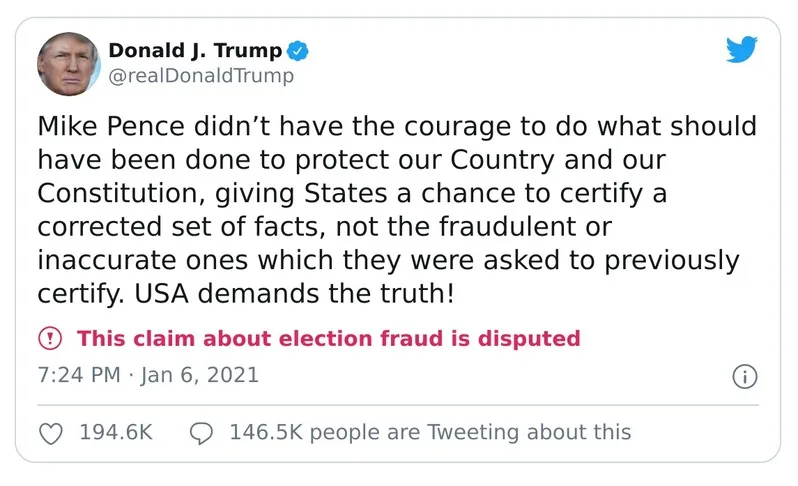
That message matters because Mehta did not treat every Trump communication in the litigation the same way. The Ellipse speech and the Raffensperger call remained on the unofficial side of the line. The Pence tweet did not. The reason was not that the tweet’s words were presidential in tone, careful in effect, or benign in consequence. The reason was the setting in which the sitting president sent it.
Official did not mean harmless
The July 22 order’s uncomfortable center is Mehta’s conclusion that the tweet could be both dangerous in practical effect and official in legal classification. He wrote: “It is at least a reasonable construction of the 2:24 p.m. tweet that it was an official act.” The order also stated that the message “arguably poured gasoline on the fire,” but that this did not remove it from the outer perimeter of presidential duties for civil-immunity purposes.[1]
That is the sentence-level distinction that tends to get lost first. The ruling did not say the tweet was wise. It did not say it was calming. It did not decide that it had no effect on anyone at the Capitol. The classification turned on whether, at that moment, the president was acting within the outer perimeter of his office.
Mehta’s reasoning rested on institutional context. The order treated Trump as a sitting president who had been urged by White House Chief of Staff Mark Meadows and White House Counsel Pat Cipollone to stop an attack on a coordinate branch of government. From that frame, Mehta compared the failure to quell the riot with the exercise of presidential power to quell it, writing that the tweet was “no less an official act than if he had exercised the powers of the presidency to quell the riot.”[1]
That formulation is not pleasant, but it is precise. Civil-immunity analysis can classify conduct by office, timing, and institutional responsibility rather than by moral quality. A litigation file has to preserve that distinction, because the appeal will not be briefed on whether the tweet deserves approval. It will be briefed on whether Mehta correctly placed it inside the outer perimeter of presidential duties.
Why the tweet was treated differently from the Ellipse speech and Raffensperger call
The boundary came from the D.C. Circuit’s office-seeker and office-holder distinction in Blassingame. Under that distinction, conduct undertaken as a candidate or office-seeker is not treated the same as conduct undertaken as president. Mehta’s March 31, 2026 summary-judgment ruling applied that divide by classifying the Ellipse speech and the Raffensperger call as unofficial, while treating DOJ-directed conduct and riot-time social-media posts as official.[1]
The Ellipse speech and Raffensperger call still matter, but mostly as boundary markers. They show that the order was not a blanket conversion of Jan. 6-related conduct into official conduct. The same district judge, in the same litigation sequence, kept those acts outside immunity. The Pence tweet moved to the other side because the court viewed it through the president’s real-time institutional obligations during an attack on Congress.
| Conduct | District-court classification in this litigation | Why it matters now |
|---|---|---|
| 2:24 p.m. ET Pence tweet | Official act for civil-immunity purposes | Certified for D.C. Circuit review; issue remains live |
| Ellipse speech | Unofficial act | Remains outside the tweet-specific immunity holding |
| Raffensperger call | Unofficial act | Remains outside the tweet-specific immunity holding |
| DOJ-directed conduct and riot-time social-media posts | Official acts in the March 31, 2026 classification | Shows the court’s office-holder side of the line |
The practical consequence is that the order should not be read as a general Jan. 6 immunity ruling. It is a more particular classification exercise. The tweet’s official status came from timing and institutional role, not from an endorsement of the message itself.
The procedural chain behind the July 22 order
The litigation began on Feb. 16, 2021, when Rep. Bennie Thompson sued under the Ku Klux Klan Act of 1871, 42 U.S.C. § 1985(1). Thompson later withdrew, with Rep. Barbara Lee becoming lead plaintiff. The consolidated litigation also includes Capitol Police officers among the plaintiffs.[1]
The D.C. Circuit’s Dec. 1, 2023 Blassingame decision supplied the office-seeker and office-holder distinction that became central to sorting Trump’s challenged conduct. Mehta then issued a March 31, 2026 summary-judgment ruling that separated unofficial conduct from official conduct. Plaintiffs moved for reconsideration of the Pence-tweet classification. The July 22, 2026 order denied reconsideration and certified the question for interlocutory appeal.[1]
- Feb. 16, 2021: Thompson files suit under 42 U.S.C. § 1985(1).
- Dec. 1, 2023: the D.C. Circuit’s Blassingame distinction between office-seeker and office-holder conduct becomes the governing frame for this part of the analysis.
- Mar. 31, 2026: Mehta classifies the Ellipse speech and Raffensperger call as unofficial, while classifying DOJ-directed conduct and riot-time social-media posts as official.
- July 22, 2026: Mehta denies reconsideration of the Pence-tweet classification and certifies the immunity question for interlocutory appeal.
- Aug. 5, 2026: plaintiffs’ notice of appeal is due.
- Aug. 10, 2026: the D.C. Circuit opening brief is due.
For anyone briefing this to a partner, client, editor, or regulator, the reconsideration posture matters. A denial of reconsideration is not the same thing as appellate settlement. Certification is the court’s own signal that the question is fit for immediate review rather than simply absorbed into the rest of the case.
What the order did not decide
The July 22 order did not make the Ellipse speech official. It did not make the Raffensperger call official. It did not dispose of the certified immunity question at the appellate level. And it did not convert the phrase “official act” into a public judgment that the tweet was appropriate.
The live question is technical but consequential: whether the 2:24 p.m. Pence tweet, sent by a sitting president during the attack and after senior White House officials urged him to intervene, falls within the outer perimeter of presidential duties for civil-immunity purposes. Mehta answered yes at the district-court level. Plaintiffs now have the certified route to ask the D.C. Circuit to answer differently.
As of Aug. 5, 2026, the record-status conclusion is therefore limited: the Pence tweet is classified as official for now; that classification has been certified for interlocutory appeal; the Ellipse speech and Raffensperger call remain classified as unofficial.
References
- Order Denying Reconsideration and Certifying Interlocutory Appeal, Lee v. Trump, No. 1:21-cv-00400-APM, document 253, U.S. District Court for the District of Columbia, July 22, 2026
- Archived screenshot of President Donald Trump’s January 6, 2021 tweet about Mike Pence, Factba.se, Jan. 6, 2021, https://media-cdn.factba.se/realdonaldtrump-twitter/1346900434540240897.jpg
Related records
Tool profile
How Meta's AI Spending Reshapes Law Firm ProfitabilityGoverning regulation
Browse the obligations tracker →Preventive workflow
Browse verification workflows →
Report a correction or tip
Spotted an outdated figure, a misstated fact, or a ruling this case record should reflect? Public comments are disabled for this content given the professional cost of a misreported case outcome, penalty amount, or rule text — use the structured correction channel instead.
Report a correction or tip for this record →