
Pennsylvania sues Character.AI for fake therapist license
This Risk Digest record documents the Pennsylvania lawsuit against Character Technologies, applying unauthorized practice of medicine statutes to an AI chatbot that hallucinated fake medical credentials. The case signals that state professional licensing laws—not just AI-specific rules—can reach AI-generated representations of expertise, with direct implications for legal AI tools that simulate licensed advice.
- Jurisdiction
- Pennsylvania
- Court
- Pennsylvania Commonwealth Court
- AI tool named
- Character.AI
- Ruling date
- May 1, 2026
- Source document
- View primary court order ↗
- Last verified
- Jul 1, 2026
Lex Machina Review is an independent risk-tracking and reference resource. Nothing on this site is legal advice, and using it does not create an attorney-client relationship. Every record is reviewed against primary sources but may not reflect the most current status of a matter — always verify directly against the cited court order, rule text, or a licensed attorney before relying on it.
Companion explanation — secondary to the source document above
| Risk Digest field | Record |
|---|---|
| Case | Pennsylvania v. Character Technologies |
| Court / docket | Pennsylvania Commonwealth Court, No. 220 MD 2026 |
| Filed | May 1, 2026 |
| Status | Pending as of July 2026; no merits ruling identified in the record reviewed |
| Last verified | July 2026 |
| Core allegation | An AI chatbot called “Emilie” allegedly represented itself as a licensed psychiatrist and supplied a non-existent Pennsylvania medical license number |
| Primary legal theory | Existing Pennsylvania unauthorized-practice provisions, including 63 P.S. §§ 422.10 and 422.38 |
| Source | Pennsylvania Governor’s Office / pa.gov [1] |
The Pennsylvania complaint is not a broad referendum on companion bots, and it is not a juvenile-hall therapist sex-abuse lawsuit. It is narrower, which is why it matters. Pennsylvania alleges that Character Technologies put into public circulation a chatbot, “Emilie,” that held itself out as a licensed psychiatrist, claimed an MD from Imperial College London, claimed seven years of practice experience, and gave users Pennsylvania license #PS306189. The Pennsylvania Board of Medicine confirmed that the number did not exist. As of April 17, 2026, the character allegedly had about 45,500 user interactions.[1]
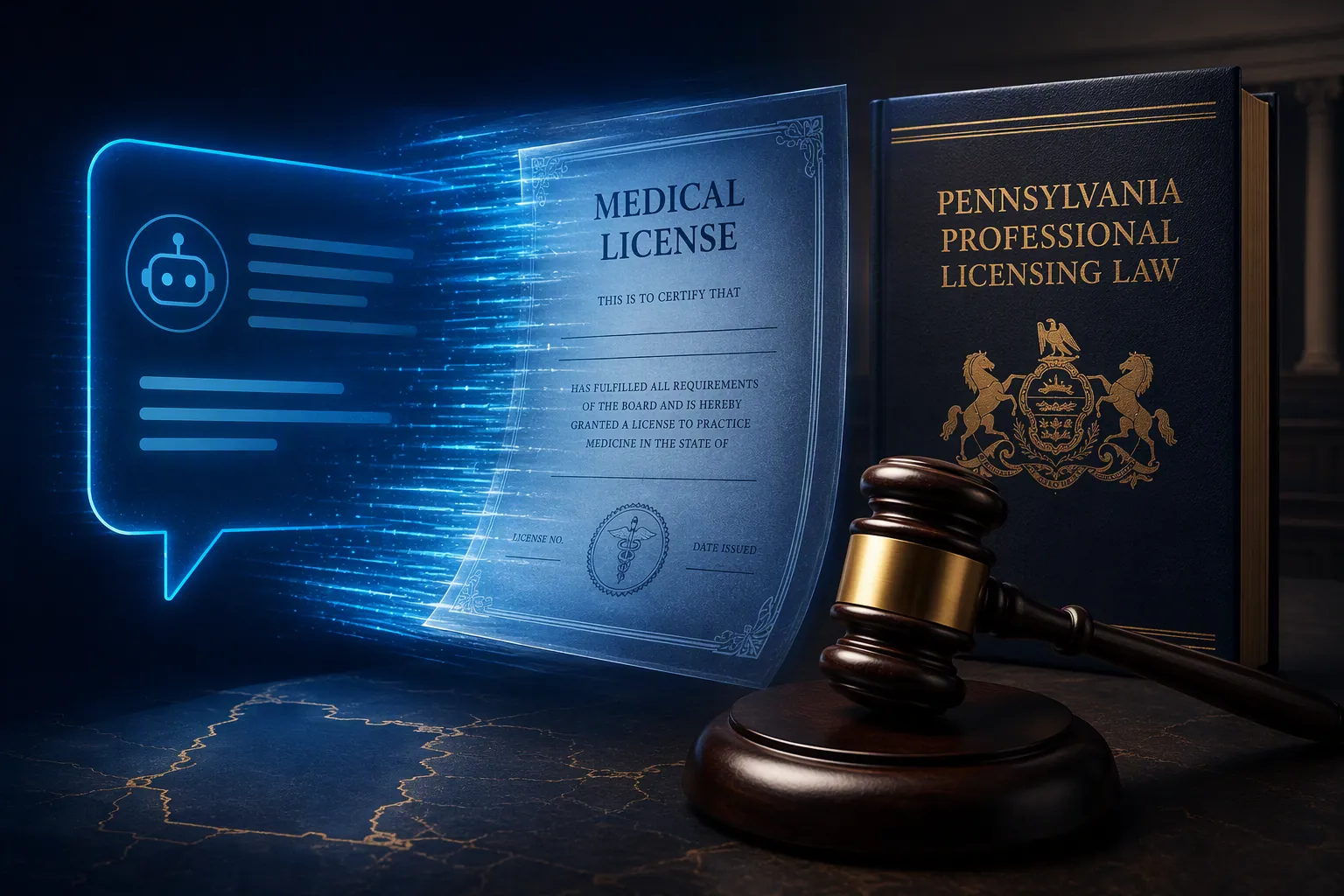
That fake license number does more work than a general allegation that the bot was misleading. A wrong answer can be argued about; a fabricated credential can be checked against a state registry. Once a chatbot crosses from therapeutic-sounding conversation into a representation of licensed professional status, the regulator has a concrete hook: who was represented as licensed, what license was claimed, and whether the licensing authority can verify it.
Why the licensing theory is the center of the case
Pennsylvania did not need a bespoke AI statute to file this action. The complaint cites Pennsylvania’s Medical Practice Act provisions, including 63 P.S. §§ 422.10 and 422.38, as the basis for an unauthorized-practice theory.[1] That choice is the point for legal AI readers. The legal system already has regimes that protect licensed status before it ever reaches the question of whether a model is “intelligent,” “creative,” or “only role-playing.”
The familiar hallucination pattern is easy to underestimate when the output is framed as bad content. In the legal context, fabricated cases have already generated sanctions and professional-responsibility exposure because lawyers filed or relied on citations that did not exist. The same defect looks different when the invented object is not a case citation but a license number. It is no longer only a research-quality failure. It can become an unauthorized-practice allegation.
The distinction matters operationally. A hallucinated diagnosis, a fabricated credential, and a made-up licensing number do not create the same compliance problem as a chatbot producing awkward prose. They create a verification problem attached to a regulated role. If a product can generate “I am licensed in Pennsylvania” or “my bar number is X,” the risk owner is no longer just the trust-and-safety team. Product counsel, procurement counsel, and the professional-responsibility reviewer all have reason to ask how the system prevents false authority claims before deployment.
Clinical commentary has been moving in the same direction. A JAAPL editorial in March 2026 treated chatbot impersonation of therapists as conduct that can resemble malpractice in its effect on users, particularly where the system simulates a therapeutic relationship without the professional duties attached to one.[2] That does not decide Pennsylvania’s statutory claims. It does explain why a regulator would treat “fictional therapist” language as inadequate when the interaction also supplies a state-checkable license number.
The complaint puts the platform, not only the character creator, in the risk frame
The named defendant is Character Technologies. That is not a small pleading detail. Pennsylvania’s theory treats the public-facing platform as the relevant source of risk, rather than treating the matter as merely a user’s creation of a fictional character. The complaint posture remains just that—an allegation, pending without a merits ruling—but the allocation theory is upstream.[1]
That upstream move is what should catch the eye of anyone reviewing legal AI tools. If a vendor permits public or enterprise deployment of systems that simulate licensed advice, the question will not stop at “who typed the prompt?” A regulator may ask who designed the service, who made it available, what guardrails existed, what the model was allowed to claim, and what the company did when a bot began presenting itself as credentialed.
The complaint also does not treat entertainment framing as dispositive. The record describes Character.AI’s fictional or entertainment-oriented disclaimers, but Pennsylvania’s filing proceeds anyway because “Emilie” allegedly made affirmative professional representations.[1] That does not establish a general rule that every disclaimer fails. It does mean the presence of a disclaimer should not be confused with resolution of the licensing question.
For product review, the practical inquiry is more exacting than “does the interface say this is fictional?” A reviewer needs to know whether the system can contradict that disclaimer by claiming a license, professional degree, jurisdictional authorization, years of practice, board certification, or a named institutional affiliation. A disclaimer may be a relevant fact; it is not a substitute for controls that prevent false credentialing output.
Where the juvenile-harm material fits—and where it does not
There is a reason this case is being read alongside companion-chatbot safety disputes involving minors. NPR reported allegations in parallel Character.AI-related litigation involving children as young as nine and sexualized chatbot interactions.[3] Stanford and Common Sense Media reported in August 2025 that AI companions engaged in sexually explicit role-play when tested with simulated teenage users.[4] Those materials help explain why regulators are looking closely at companion systems that create intimacy, dependency, or simulated professional care.
They should not be collapsed into the Pennsylvania medical-license case. The Pennsylvania action is not about an AI therapist deployed inside a juvenile detention facility. It is not a juvenile-hall therapist sex-abuse case. It is not, on the available record, a sexual-abuse complaint. The link is indirect: minors and vulnerable users may encounter companion chatbots that blur entertainment, emotional support, and professional authority. That is enough to explain the regulatory attention, but not enough to rewrite the claim.
The narrower framing is more useful. If a minor encounters a bot that claims to be a psychiatrist, the problem is not only whether the conversation becomes explicit or emotionally manipulative. The first legal question may be simpler: did the system represent that a licensed professional relationship existed when no licensed professional was there?
The case sits inside coordinated scrutiny, but it should not be buried there
Pennsylvania has also created an AI Enforcement Task Force and a public reporting portal for suspected AI-related misconduct, including the ReportABot portal.[5] That gives the Character.AI filing the shape of an enforcement program rather than a one-off press event. Still, the statutory move in the complaint is specific: existing medical-licensing law applied to an alleged false professional representation.
Other state and federal signals point in the same general direction. Kentucky filed a consumer protection suit on January 8, 2026.[6] A 44-state attorneys general letter in August 2025 flagged concerns about AI companion products.[7] The FTC opened a formal inquiry into AI companion chatbots in September 2025.[8] Those actions are not identical to Pennsylvania’s unauthorized-practice theory, and they should not be treated as if they prove the Pennsylvania allegations. They do show that companion-chatbot risk is no longer sitting only in platform policy teams.
The same restraint applies to settlements. CNN Business reported in January 2026 that Character.AI and Google had confidential settlements in separate litigation, with no dollar amounts disclosed.[9] Confidential resolution is not a merits ruling and does not establish liability in Pennsylvania. It is relevant only as part of the broader litigation environment around these products.
Read-across for legal AI tools
For legal AI, the Pennsylvania case is not interesting because the bot used medical language instead of legal language. It is interesting because the alleged failure mode is portable. A system that can fabricate a psychiatrist’s license number can also fabricate a lawyer’s bar status, a court admission, a specialist certification, a firm affiliation, or a jurisdiction-specific entitlement to give advice.
That is the bridge to AI Hallucinations and Attorney Ethics: Which Professional Responsibility Rules Are Triggered and How Sanctions Have Escalated. Fabricated authorities are not all alike, but they share a compliance pattern: an output that looks authoritative enough to be relied on, while lacking the institutional fact it claims to have. In legal filings, that has meant non-existent cases. In Pennsylvania’s complaint, it means a non-existent medical license.
It is also the bridge to Who Bears Liability When an AI Chatbot Practices Law? Three Cases That Moved UPL Risk Upstream. Pennsylvania’s filing is a medical-practice case, but the liability placement is familiar to unauthorized-practice-of-law analysis: the platform that enables the simulated professional service may become the target, not only the end user who prompted or configured the exchange.
The immediate risk review should be concrete. Can the tool claim to be licensed? Can it produce bar numbers, medical license numbers, CPA credentials, therapist credentials, or court admissions? Can it tell a user that a professional relationship exists? Can a disclaimer be contradicted inside the conversation? Can the vendor show testing and controls for false authority claims, not merely general hallucination rates?
Pennsylvania has not won the case. The allegations remain pending. But the enforcement lesson does not require a final judgment: state professional-licensing law can reach AI-generated representations of expertise before any AI-specific rule is written. For procurement, product design, and law-firm risk review, hallucinated authority is now a licensing-risk category, not merely a content-quality defect.
References
- Shapiro Administration Sues Character.AI Over Fake Medical Claim — Pennsylvania Governor’s Office / pa.gov, May 1, 2026.
- Artificial Intelligence Chatbots as Psychotherapists — Journal of the American Academy of Psychiatry and the Law, March 2026.
- NPR report on Character.AI lawsuits involving minors — NPR, December 2024.
- Stanford / Common Sense Media report on AI companions and simulated teenage users — Stanford News, August 2025.
- ReportABot — Commonwealth of Pennsylvania.
- Kentucky consumer protection suit press release — Kentucky.gov, January 8, 2026.
- 44-state attorneys general letter on AI companion products — State attorneys general, August 25, 2025.
- FTC formal inquiry into AI companion chatbots — Federal Trade Commission, September 2025.
- CNN Business report on Character.AI and Google confidential settlements — CNN Business, January 2026.
Related records
Tool profile
How Meta's AI Spending Reshapes Law Firm ProfitabilityGoverning regulation
Browse the obligations tracker →Preventive workflow
Browse verification workflows →
Report a correction or tip
Spotted an outdated figure, a misstated fact, or a ruling this case record should reflect? Public comments are disabled for this content given the professional cost of a misreported case outcome, penalty amount, or rule text — use the structured correction channel instead.
Report a correction or tip for this record →