
PJM Disconnect Exposes Legal Vacuum in AI Power Grid Regulation
The July 22, 2026 mass data center disconnect on PJM triggered voltage disturbances across the Mid-Atlantic and exposed a regulatory vacuum. This article identifies the four liability vectors counsel must track: ratepayer cost-shifting at FERC, reliability complaints, contract disputes over backup generation, and jurisdictional litigation over load reduction authority.
- Jurisdiction
- US Federal
- Court
- FERC
- AI tool named
- AI workloads
- Ruling date
- Jul 22, 2026
- Source document
- View primary court order ↗
- Last verified
- Jul 25, 2026
Lex Machina Review is an independent risk-tracking and reference resource. Nothing on this site is legal advice, and using it does not create an attorney-client relationship. Every record is reviewed against primary sources but may not reflect the most current status of a matter — always verify directly against the cited court order, rule text, or a licensed attorney before relying on it.
Companion explanation — secondary to the source document above
On July 22, more than 3 GW of data center load in northern Virginia disconnected nearly simultaneously after a transmission outage, producing voltage disturbances reported from Washington, D.C., to Chicago and requiring about ten minutes for the PJM system to stabilize.[1] That is the part that matters first: not a forecast, not a lobbying chart, and not a generalized anxiety about artificial intelligence demand, but an operational event large enough to leave a record.
Three days later, the record is still thin. The public account rests on PJM operations data and Dominion Energy statements as reported by Reuters; there is not yet a formal PJM investigation report, FERC order, or adjudicated finding assigning fault.[1] That matters. A disturbance record is not a negligence finding. It is also not something counsel can wave away as ordinary load growth.
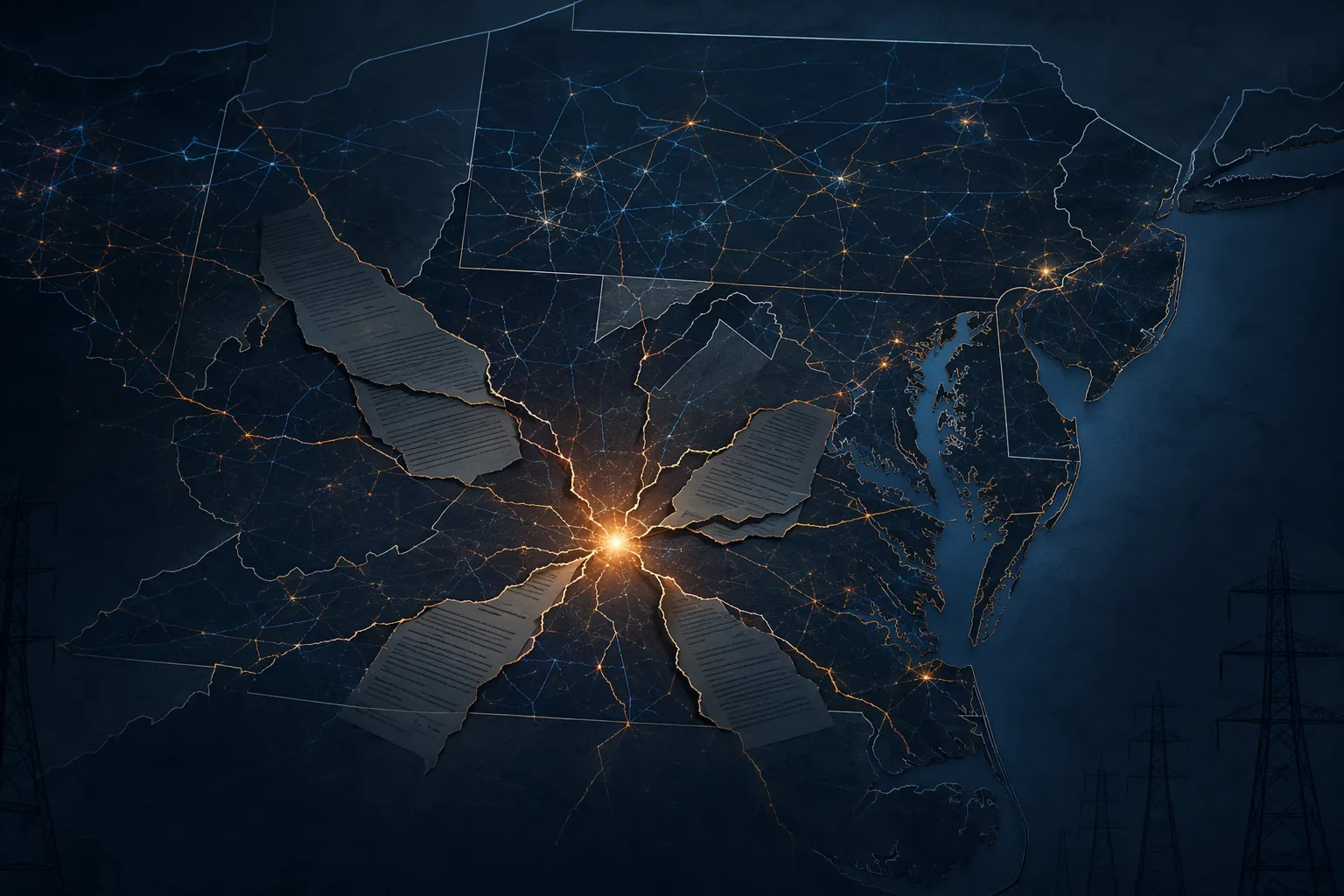
The legal difference is the missing rule. PJM has interconnection procedures, emergency operating practices, capacity-market rules, and stakeholder processes for large loads. FERC has just-and-reasonable authority over wholesale rates and transmission service. States retain siting, retail-service, and environmental authority. None of those instruments, as of this event, supplies a clean rule for mass simultaneous data center disconnection or a settled answer to who may require large-load reduction before the system is already in trouble.
The Gap Is Procedural Before It Is Ideological
FERC had already moved the issue out of conference-room speculation before July 22. On June 18, 2026, the Commission issued show-cause orders directing grid operators to revise or justify their interconnection rules for data centers and other large loads, with reforms grouped around large-load interconnection processes, study requirements, financial commitments, operational obligations, and protections against cost shifts.[2] That proceeding gives counsel a forum, but not yet a governing standard for the July 22 facts.
The distinction is not academic. A show-cause order asks whether existing tariffs remain just and reasonable and whether changes are needed. It does not, by itself, tell an operator what authority it had at the moment thousands of megawatts of load disappeared. Nor does it decide whether a data center customer, a utility, a transmission owner, or PJM itself carried a duty to coordinate a staged reduction rather than absorb a near-simultaneous drop.
The Department of Energy had also supplied temporary emergency authority. On May 19, 2026, DOE issued an emergency order under Federal Power Act § 202(c) allowing PJM to curtail data centers and other large loads during hot-weather reliability conditions.[3] Temporary permission is useful in a control room. It is less useful as a durable liability architecture. An emergency order can answer a narrow reliability need without resolving whether PJM, FERC, or the states may build a standing customer-type curtailment regime into the tariff.
Four Exposure Tracks Now Run in Parallel
The July 22 disconnect is best read as opening four exposure tracks, not as proving one liability theory. Each track has a different forum, evidary burden, and defendant profile.
| Exposure track | Likely forum | What counsel will need to prove or resist |
|---|---|---|
| Ratepayer cost shifting | FERC and state public utility commissions | Whether data center-driven system costs are being socialized through capacity prices, transmission upgrades, or retail rates without adequate cost causation |
| Reliability-based complaints | FERC | Whether PJM's addition or accommodation of large loads is unjust and unreasonable when those loads cannot be reliably served or controlled |
| Contract disputes over backup generation | Commercial arbitration, state courts, utility commission proceedings, or tariff proceedings depending on contract structure | Whether backup-generation obligations, runtime assumptions, emissions limits, and curtailment rights align |
| Jurisdictional litigation over curtailment authority | FERC, federal appellate courts, and state proceedings | Whether federal transmission and wholesale-market authority can support data center load-reduction rules without invading state retail and siting authority |
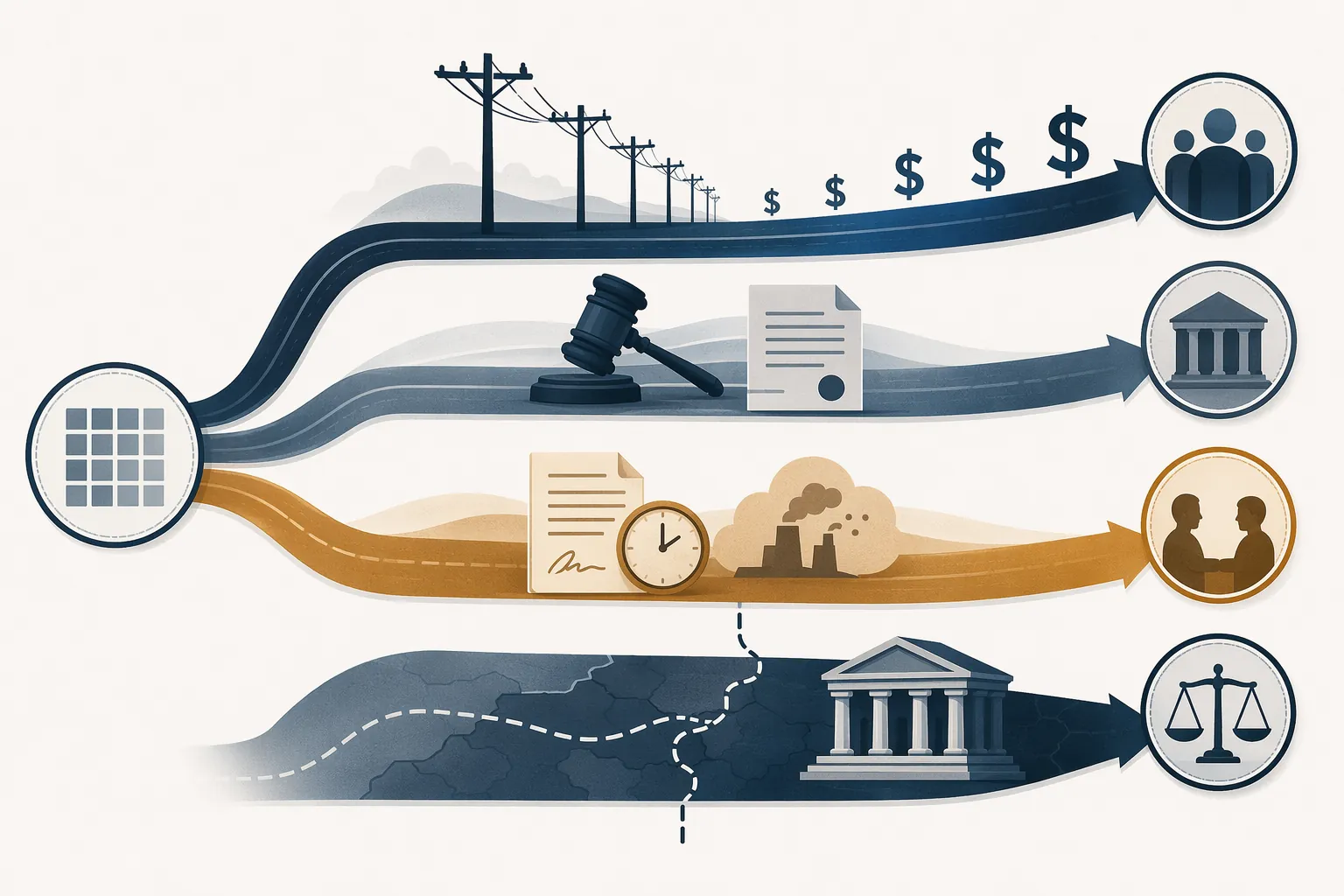
Those tracks will overlap. A state commission looking at retail bill impacts may cite the same capacity-market evidence that a ratepayer advocate places before FERC. A utility defending a backup-generation contract may point to the same environmental restriction that PJM says prevents reliable load management. The point is not that one forum will absorb the others. It is that no single forum presently owns the whole problem.
Cost-Shifting Claims Have the Clearest Evidentiary Starting Point
The strongest early ratepayer claims will not begin with the July 22 voltage disturbance. They will begin with capacity prices, cost causation, and who pays when large-load additions change the resource adequacy picture faster than the interconnection and planning machinery can adapt.
Monitoring Analytics, PJM's independent market monitor, has attributed 63% of capacity auction price increases to data center load, equal to $9.3 billion in a single year.[6] That figure is more useful in litigation than a generalized claim that AI is expensive. It identifies a market outcome, attributes a quantified share to a class of load, and comes from the independent market monitor rather than from a party whose ordinary role is advocacy.
Other numbers will still enter the record, but they should not be treated as interchangeable. IEEFA reported a PJM capacity-price trajectory from $28.92/MW-day to $329.17/MW-day and framed projected data center growth as a driver of a tenfold increase.[7] NRDC's Sustainable FERC Project projected $100 billion in extra costs through 2033 and an average family bill increase of $70 per month by 2028, with 80% of capacity costs falling on the public.[8] Those estimates are relevant because they show where ratepayer arguments are likely to form. They are not the same kind of evidence as the market monitor's attribution.
That distinction affects pleading strategy. A FERC complaint can ask whether existing tariff provisions remain just and reasonable if capacity costs caused by concentrated large-load growth are broadly socialized. A state PUC proceeding can ask whether a utility's retail customers should carry upgrade costs or procurement risk for load whose benefits are not distributed across the same customer base. The same facts may be relevant in both places, but the legal theories are not the same.
Cost-shifting claims will also run into causation problems. A capacity-price increase may reflect load growth, retirement risk, reserve requirements, generator bidding behavior, transmission constraints, and market design. The market monitor's 63% attribution gives ratepayer counsel a serious starting point; it does not eliminate the need to show which costs were caused by which loads and which tariff provisions allowed those costs to move onto other customers.
Reliability Complaints Were Already Waiting for an Event Record
Monitoring Analytics had already filed a FERC complaint in November 2025 arguing that it is not just and reasonable for PJM to add data centers unless they can be reliably served.[6] July 22 does not prove that complaint. It does, however, give future reliability arguments a concrete operational episode to attach to: a large, concentrated class of load disconnected in a way that produced visible system disturbance across a broad footprint.
The reliability question is narrower than much of the public debate. It is not whether data centers are good or bad customers. It is whether PJM's tariff and operating rules let it maintain reliability when large loads can appear, ramp, island, switch to behind-the-meter supply, or disconnect in patterns that do not resemble ordinary retail demand.
That is where the July 22 record could matter most if investigation materials show coordination failures, telemetry limits, inadequate notice, or conflicting instructions. At present, those facts are not public. Counsel should resist drafting allegations that assume them. The responsible allegation today is that the event exposed the absence of a direct tariff rule governing mass simultaneous data center disconnection, not that it already establishes who breached one.
The Jurisdictional Fault Line Is Still Open
PJM has already tested how far it can go. In earlier large-load discussions, it advanced and then abandoned a proposal that would have given it customer-type curtailment authority, after objections that the proposal raised Federal Power Act jurisdictional concerns.[4] That retreat is more revealing than a white paper. It shows that the reliability operator may see a need for controllable load reduction while doubting that its tariff authority can cleanly support a customer-class curtailment rule.
The Supreme Court cases that lawyers will reach for do not line up neatly. Oneok leaves room for state regulation when the target is retail conduct even if wholesale markets feel the effect. Hughes v. Talen warns states not to condition state programs in ways that impermissibly tether compensation to FERC-jurisdictional wholesale market outcomes. FERC v. EPSA gives FERC room to regulate practices directly affecting wholesale rates, even where retail-side behavior is implicated. Those principles point in different directions when the conduct is data center load reduction: retail consumption on one side, transmission reliability and wholesale market consequences on the other.
A standing PJM rule requiring certain data centers to reduce load during defined reliability conditions would invite several questions at once. Is the rule transmission service, wholesale-market administration, emergency operations, retail load management, or discrimination among end-use customers? Does it apply because the customer is a data center, because it exceeds a threshold size, because it has backup generation, because it is co-located, or because it can respond quickly? Each design choice changes the jurisdictional defense.
DOE's § 202(c) order does not erase that problem. Emergency authority can temporarily authorize actions to meet reliability conditions; it does not supply the ordinary-course tariff basis that FERC and reviewing courts will expect for recurring curtailment, cost allocation, and customer obligations.[3] If anything, reliance on emergency authority may strengthen the argument that the standing rulebook is incomplete.
Co-location makes the authority question harder, not cleaner
PJM's co-location proposals show why the old boundary lines are under pressure. In March 2026, PJM proposed new services for co-located data centers, including a Bring Your Own Generation expedited track, three new transmission service types, behind-the-meter generation rules, and a 50 MW materiality threshold.[5] Those mechanics are sensible attempts to sort real configurations. They also multiply the legal character of the customer.
A data center paired with on-site generation can look like a retail load, a transmission customer, a behind-the-meter generator, a reliability resource, or a curtailment candidate depending on the hour and the document being read. If the same facility depends on PJM transmission service during one interval and backup generation during another, a curtailment rule cannot be analyzed only as a retail matter or only as a wholesale matter. That is why the abandoned customer-type proposal is likely to remain central in briefs even if PJM never revives it in the same form.
Backup Generation Is a Contract Problem Wearing a Reliability Jacket
The practical contract disputes will be less elegant than the jurisdictional briefs. Utilities and data center operators have been negotiating service arrangements in which backup generation, co-location, or customer-supplied resources make a large load appear more manageable. The difficulty is that a contract can assume backup runtime that air permits, local rules, fuel logistics, noise limits, or emissions restrictions make unavailable when the grid actually needs it.
That produces several ordinary but expensive disputes. A utility may say the customer promised to reduce grid draw or run backup units during constrained conditions. The customer may answer that environmental limits, permit conditions, or equipment warranties capped what it could do. PJM may have planned around the availability of that response without being a party to the relevant commercial promises. Ratepayers may then ask why the cost of that mismatch should appear in rates.
Counsel reviewing these agreements should not stop at the curtailment clause. The operative provisions are more likely scattered across interconnection milestones, backup-fuel obligations, notice windows, telemetry requirements, force majeure language, emissions compliance covenants, liquidated damages, and tariff-incorporation clauses. If the July 22 investigation identifies any failure of coordination between customer load, backup resources, and system operator instructions, those clauses will become evidence.
Political Pressure Will Not Pick the Forum
The broader PJM politics are real, but they are not a substitute for legal authority. AEP and Pennsylvania officials had threatened to leave PJM, and FERC Chair Laura Swett warned that a breakup of the country's largest power grid would be a "catastrophic failure," according to the Los Angeles Times.[9] Those threats explain why every data center ruling now carries regional consequences. They do not decide whether a particular tariff term is just and reasonable or whether a particular state may block cost recovery.
That is the danger in treating PJM as either villain or weather system. PJM did not create AI demand, and it cannot wish away physics. But it also operates the market and reliability structures through which costs and risks are assigned. When an operator lacks clear authority to prevent or stage a large-load event, someone else will eventually ask whether the gap was foreseeable, who benefited from tolerating it, and who paid when it became visible.
What Counsel Should Track Next
The next useful documents are not press quotes. They are filings, compliance submissions, investigation records, and rate orders. Several should be watched together because each answers only part of the problem.
- FERC compliance filings under the June 18 show-cause orders, especially any proposed operational obligations for large loads, cost-causation protections, and financial commitment requirements.[2]
- PJM's Connect and Manage and CIFP process, including any revisions before the July 31, 2026 effective date noted in the current stakeholder timeline.
- Any PJM, NERC, regional entity, utility, or FERC investigation record concerning the July 22 disconnect, including telemetry, notice, operator instructions, and sequencing of the load drop.
- State PUC proceedings over retail rate recovery, special contracts, line extensions, and utility procurement tied to data center service.
- Disputes over backup generation obligations, especially where contracts assume runtime or responsiveness that environmental permits may restrict.
The July 22 disconnect did not settle the law. It made the absence of settled law operational. Until a tariff, order, or judgment assigns authority more cleanly, counsel will have to track several forums at once: FERC for just-and-reasonable tariff design, state commissions for retail cost recovery, contract forums for backup-generation promises, and courts for the boundary between federal reliability authority and state control over retail load.
References
- Massive disconnect of power roils largest US electric grid, Reuters, July 22, 2026.
- FERC orders grid operators to promptly revise or justify interconnection rules for data centers and large loads, White & Case, June 25, 2026.
- PJM gets emergency approval to curtail data centers, large loads during hot weather, Utility Dive, May 19, 2026.
- PJM Tackling Data Center Demand Requires Federal, State Juggling, Bloomberg Law.
- PJM proposes to carve out new services for co-located data centers, White & Case, March 2026.
- No more PJM data centers unless they can be reliably served: market monitor, Utility Dive, November 2025.
- Projected data center growth spurs PJM capacity prices by factor of 10, IEEFA, 2026.
- Solving PJM's data center problem, Utility Dive / NRDC, 2026.
- AI data center boom threatens breakup of America's biggest power grid, Los Angeles Times, June 4, 2026.
Related records
Tool profile
How Meta's AI Spending Reshapes Law Firm ProfitabilityGoverning regulation
Browse the obligations tracker →Preventive workflow
Browse verification workflows →
Report a correction or tip
Spotted an outdated figure, a misstated fact, or a ruling this case record should reflect? Public comments are disabled for this content given the professional cost of a misreported case outcome, penalty amount, or rule text — use the structured correction channel instead.
Report a correction or tip for this record →