
What Are the Legal Consequences of Police Flock Misuse?
A verified consequence record for police misuse of Flock and other ALPR systems: criminal charges, termination or forced resignation, civil liability, and agency-level fallout, each with named cases, charges, and confirmed-vs-reported status. It gives litigators and in-house counsel a way to benchmark which legal consequences attach to a given officer-misuse fact pattern — and shows how dramatically outcomes vary across jurisdictions.
- Jurisdiction
- United States
- Court
- U.S. District Court for the Eastern District of Virginia
- AI tool named
- Flock Safety
- Ruling date
- Jan 27, 2026
- Source document
- View primary court order ↗
- Last verified
- Aug 25, 2026
Lex Machina Review is an independent risk-tracking and reference resource. Nothing on this site is legal advice, and using it does not create an attorney-client relationship. Every record is reviewed against primary sources but may not reflect the most current status of a matter — always verify directly against the cited court order, rule text, or a licensed attorney before relying on it.
Companion explanation — secondary to the source document above
Last verified: August 25, 2026. This is a legal-risk record, not legal advice. In this article, “confirmed” means the consequence is tied to a charge, plea, judgment, official employment action, complaint, contract term, or comparable record identified in the cited source. “Reported” means a news report or database entry describes the allegation or consequence but the available material does not itself establish an adjudicated outcome. “Charged,” “pleaded,” “indicted,” “terminated,” “resigned,” “sued,” “dismissed,” and “pending appeal” are not interchangeable.
For a police Flock or ALPR misuse fact pattern, the documented consequence stack is now broad enough to cite, but not broad enough to flatten. Officers have faced criminal charges, job loss or forced resignation, civil suits, access revocation, policy changes, contract penalties, and contract cancellations. The same general behavior — running a plate for a romantic interest, ex-spouse, private curiosity, journalist, protester, or non-law-enforcement purpose — has produced outcomes ranging from a 100-count felony indictment to a two-day suspension. That spread is the point.
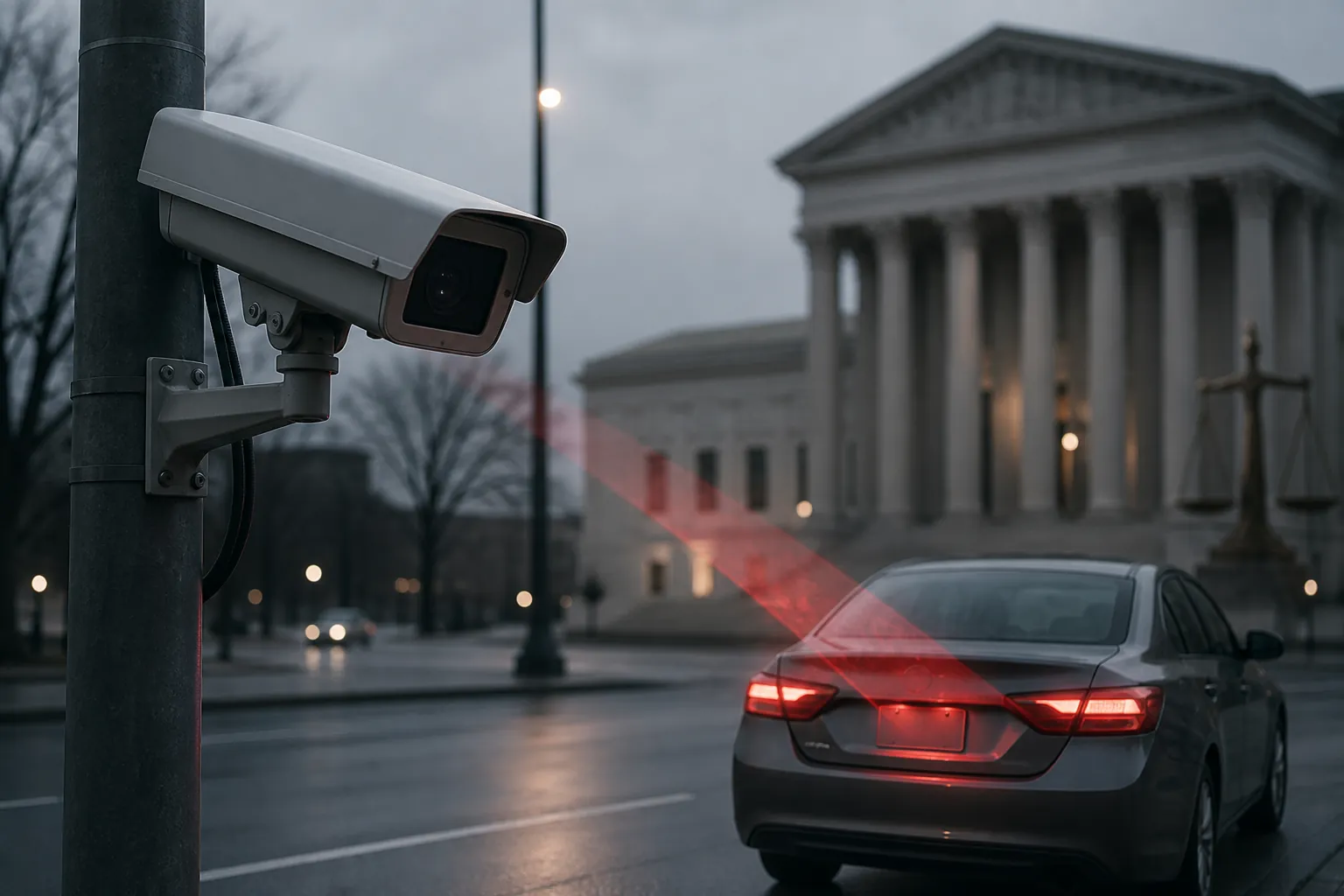
The consequence stack, before the technology story
| Consequence track | What has been documented | How confidently to cite it |
|---|---|---|
| Criminal | Official misconduct, stalking, computer crime or unauthorized access, evidence tampering, oath-of-office violations, and state license-plate-reader misuse statutes. | Strongest when tied to named charges, pleas, sentences, indictments, or pending criminal dockets; weaker when the source only reports an accusation. |
| Employment | Termination, resignation, forced resignation, suspension, access revocation, or internal discipline. | Strongest when the source identifies the officer and disposition; do not assume job loss from a criminal allegation unless the record says so. |
| Civil | Class action theories, statutory privacy claims, constitutional claims, wrongful-arrest-style claims, and suits against officers, cities, or vendors. | Strongest when the posture is stated: complaint filed, summary judgment granted, appeal pending, settlement, dismissal, or statutory damages provision. |
| Agency and procurement | Contract cancellation, policy overhaul, out-of-state sharing restrictions, vendor terms changes, audit-assistance procedures, and contract penalties. | Useful for risk screening, but not proof that misuse has been solved or that a court accepted liability. |
| Detection | Audit logs, public-record requests, third-party lookup tools, victim discovery, litigation discovery, and press review. | Crucial for causation and notice. Auditability is not the same as internal enforcement. |
The Institute for Justice’s ALPR-abuse database reported 172 documented incidents as of August 2026, including 45 romantic-stalking cases; IJ treats that database as an undercount, not a universe of all misuse. [1]
That distinction matters. A database count may show repeat patterns; it does not tell counsel whether the next case will support a felony theory, a personnel action, a statutory damages claim, or only an administrative correction. The better use is to match the fact pattern to named records, then keep the procedural posture attached.
This article is limited to Flock and other automated license plate reader systems. The nearby but distinct facial-recognition and police-surveillance-AI record is covered separately in The legal issues with police surveillance AI, explained. Plate-reader cases turn on different vendors, statutes, audit fields, retention periods, and search facts.
Criminal and employment consequences: the charge menu is wider than “misuse”
The criminal track is where the records most often become citable in a serious way. But the legal theory varies. Some prosecutors charge official misconduct or misconduct in public office. Others use stalking, computer crime, unauthorized access, evidence tampering, oath-of-office violations, or state statutes written specifically for license-plate-reader misuse. That variation is not cosmetic; it affects mens rea, available defenses, sentencing exposure, plea leverage, and indemnity posture.
IJ’s separate review of romantic-stalking cases found that nearly all officers in that subset were criminally charged and lost their jobs, but that is a subset finding, not a conclusion that every ALPR misuse allegation produces criminal prosecution and termination. [2]
| Record | Alleged or proven misuse pattern | Criminal theory or count | Employment or disposition signal | Citation status |
|---|---|---|---|---|
| Lufkin, Texas | ALPR misuse alleged across a large set of searches. | 100-count felony indictment. | Indictment establishes charged exposure, not conviction. | Reported/charged record. |
| Menasha, Wisconsin | Officer misuse associated with personal stalking conduct. | Misconduct in public office. | Jail plus three years’ probation in a withheld sentence. | Reported disposition. |
| West Chester, Ohio | Misuse-related investigation involving evidence handling. | Evidence tampering. | Five years’ probation. | Reported disposition. |
| Savannah, Georgia | License-plate-reader misuse allegations. | Two counts of LPR misuse plus oath-of-office violation. | Criminal charges establish exposure; employment result must be checked separately. | Reported/charged record. |
| Costa Mesa, California | ALPR misuse allegations involving police access. | Guilty pleas reported in April 2026. | Plea posture stronger than accusation; sentence and employment terms require record-specific review. | Reported plea record. |
| Key West, Florida | Deputy accused of improper database or system access. | Computer-crime theory. | Use as a criminal-theory comparator, not a universal ALPR rule. | Reported/charged record. |
| Kechi, Kansas | Lieutenant accused in stalking-related misuse. | Guilty plea to computer crime plus stalking. | Plea links database misuse to stalking theory. | Reported plea record. |
| Fort Bend County, Texas | Misuse allegation producing minimal discipline. | No heavy criminal consequence identified in the briefed record. | Two-day suspension. | Reported employment record. |
The Lufkin record is useful because it shows a ceiling for charged severity: a 100-count felony indictment. It should not be cited as proof that high-count indictments are common. The Fort Bend County suspension is useful for the opposite reason. It prevents a complaint, demand letter, or board memo from implying that every misuse record ends in termination or prison exposure. [1]
The criminal theories also signal what fact development matters. A stalking theory usually needs a pattern, target, and personal motive. A computer-crime or unauthorized-access theory may turn on credentialed access used outside a permitted purpose. Official misconduct and oath-of-office theories place more weight on the officer’s public role and duty limits. A state LPR-misuse statute, where available, can reduce the need to retrofit older database-access law to a newer surveillance tool.
ABC News, 404 Media, and Mother Jones each reported named examples across that charge menu, including criminal charges, guilty pleas, probationary outcomes, and officers losing jobs or facing firing proceedings. [3][4][5]
The Washington Post reported that at least 50 officers had been charged with or accused of using the Flock network for personal purposes. Because that investigation is partially paywalled and the figure mixes charged and accused statuses, it is safest to use it as a corroborating national signal alongside IJ and other reported case records, not as the sole numeric foundation for a legal memo. [6]
Employment loss is often paired with prosecution, but not guaranteed
For counsel, the employment line belongs next to the charge line. It changes damages narratives, municipal notice arguments, indemnity decisions, Brady/Giglio review, public-record strategy, and settlement posture. An officer who pleaded to stalking and computer crime is not in the same risk bucket as an officer who received a short suspension after an internal finding.
The safest record format is mechanical: officer name if available, agency, system used, target relationship, search purpose field if available, date range if available, charge filed, plea or sentence if available, employment disposition, civil docket if any, and last verification date. That is the same discipline used in other verified-record work, including The Verified Record of the Joe Felz Fullerton DUI Case.
Civil exposure: vendor, city, officer, and statutory routes do different work
Civil liability does not simply follow the criminal record. A guilty plea can help a plaintiff frame misuse, but the civil defendant may be the officer, the city, the vendor, or some combination. The theory may be statutory privacy, constitutional search, negligent supervision, wrongful arrest, disclosure, or a state-law surveillance claim. The posture is often more important than the headline.
Gibbs Mura has described a California class action against Flock tied to California’s ALPR statutory regime, including a private right of action with minimum statutory damages of $2,500 per violation under Cal. Civ. Code §§ 1798.90.x. [7]
That is a different civil route from a one-off officer stalking case. A statutory damages theory may turn on collection, sharing, retention, notice, access controls, or disclosure practices rather than proof that a single officer used the system to monitor an ex-partner. It also changes the scale of exposure: the unit of violation matters, and the statutory minimum becomes a settlement and class-certification pressure point.
California’s attorney general also sued El Cajon over out-of-state ALPR data sharing in October 2025, while Schmidt v. City of Norfolk produced summary judgment for the city in the Eastern District of Virginia on January 27, 2026, and then moved to a Fourth Circuit appeal with amicus briefing reported in April 2026. [8]
Those two matters should not be merged. California AG v. El Cajon is an institutional data-sharing enforcement path. Schmidt is a constitutional challenge to warrantless ALPR searching that, at least at summary judgment, went in favor of the city and remains on appeal. A plaintiff-side risk screen can cite Schmidt as an open frontier; a defense-side screen can cite the summary judgment posture. Neither side should cite it as a final national rule.
Wrongful-arrest and mistaken-identity theories sit beside this record but should be verified with the same care. A plate-reader hit can become part of a stop, detention, or arrest narrative, but the liability question then depends on what officers did after the alert, what corroboration existed, and whether the plaintiff can connect the technology to the seizure. The verification approach used in How to verify a Pima County sheriff wrongful arrest lawsuit is a better fit than treating every ALPR hit as a completed constitutional violation.
Agency fallout is real, but it is not the same thing as accountability
The institutional track has become harder for procurement counsel to ignore. StateScoop reported contract cancellations or backlash in 23 states, and The Marshall Project reported more than 30 cities canceling or reconsidering Flock contracts in early 2026. [9][10]
Contract cancellation is a procurement consequence, not an adjudication of officer liability. It may reflect privacy concerns, out-of-state sharing, community politics, vendor terms, statutory uncertainty, or accumulated misuse reports. Still, it belongs in the risk record because it affects notice, renewal leverage, board approvals, insurance questions, and future public-record exposure.
Arlington Heights’ contract terms reportedly included unauthorized-access penalties ranging from $22,000 to $70,000 per incident. [10]
That kind of clause is useful in two ways. First, it gives agencies a contractual price tag for misuse that is separate from criminal prosecution or civil damages. Second, it shows that some buyers no longer treat audit logs and user policies as adequate remedies by themselves. The penalty still has to be enforced; a number in a contract is not a paid sanction.
Flock announced an August 13, 2026 terms overhaul that the company described as including seven-day default retention, mandatory case numbers, Evidence Mode, and standardized Audit Assistance. [11]
Those are vendor-described controls. They may reduce some misuse opportunities, and they may improve after-the-fact review, but they should be labeled as company claims unless independently tested. The ACLU objected that Flock’s Audit Assistance has not been independently evaluated and argued that the updated system remains a major civil-liberties threat. [12]
The same treatment applies to vendor statements about permanent audit logs, rarity of misuse, accuracy, flagged-alert rates, and user scale. They are relevant to diligence. They are not a substitute for independent validation. The vendor-claim distinction is similar to the one used in Do SITA OptiFlight AI fuel-savings claims carry legal risk?: quote the claim, identify the claimant, and then ask what independent record supports it.
Detection reality: audit logs do not prosecute anyone by themselves
The practical weakness in the record is not that ALPR systems lack logs. It is that logs must be reviewed, understood, requested, produced, and acted on. IJ reported that only a few romantic-stalking cases in its set were initially discovered internally. [1][2]
That fact should change how counsel evaluates notice and causation. If a victim learned about the search through a public-record request, litigation, HaveIBeenFlocked.com audit data, a reporter, or an outside advocate, the agency’s audit capability did not itself prevent the intrusion. It may still help prove who searched, when, and under what stated reason.
The Milwaukee Ayala and Stow, Massachusetts examples are useful for that reason: they show victims using external audit data to surface searches rather than relying only on internal agency detection. [1]
Norfolk adds a different warning. In litigation, the top three search reasons reportedly covered about one-third of 230,000 searches, and one officer entered “la la la la” as a search reason without immediate detection. [1]
For a misuse case, that kind of record can matter more than a vendor brochure promising permanent audit logs. A nonsense search reason, a repeated target, or a missing case number may support an inference that controls existed on paper but were not meaningfully enforced. The inference still has to be tied to local policy, training, supervision, and the actual audit trail.
The statutory patchwork controls the remedy
ALPR law remains state-specific. The Brennan Center has treated automatic license plate readers as a distinct legal-status and policy problem, and NCSL tracks state statutes addressing automated license plate readers. [13][14]
That patchwork explains why the same officer behavior may produce different consequences by jurisdiction. In one state, the best fit may be a dedicated LPR-misuse statute. In another, prosecutors may reach for general computer-crime or official-misconduct law. In California, a civil plaintiff may look closely at the ALPR statutory damages regime. In a jurisdiction without a strong statutory hook, the case may turn on internal policy, constitutional theory, or common-law claims.
For a broader statutory-patchwork approach, the site’s Regulation & Ethics coverage, including Save America Act fact check, is the right comparison point: the operative question is not whether surveillance feels nationally controversial, but which text creates a remedy in the jurisdiction at issue.
How to cite the record without overstating it
A defensible record should preserve status labels. The following language is usually safer than a broad trend claim:
- “Officer was indicted on 100 felony counts” rather than “officer was guilty of 100 violations.”
- “Officer pleaded guilty to computer crime and stalking” rather than “Flock misuse is always charged as stalking.”
- “Agency reportedly imposed a two-day suspension” rather than “misuse usually results in termination.”
- “Class action alleges statutory ALPR violations with a minimum statutory damages provision” rather than “Flock is liable for $2,500 per scan.”
- “Summary judgment was granted for the city and appeal is pending” rather than “warrantless ALPR searches are constitutional.”
- “Vendor says its terms now require case numbers and seven-day default retention” rather than “new controls prevent misuse.”
The important missing field is often how the misuse surfaced. If the record was discovered by the target, a journalist, a public-records tool, or litigation rather than by routine internal review, that belongs in the chronology. It bears on notice, supervision, punitive-damages arguments, contractual audit promises, and the credibility of any “rare misuse” assurance.
The unresolved warrantless-search frontier
The officer-misuse record and the warrantless-search record overlap, but they are not the same claim. Misuse cases usually start with a named user exceeding a permitted purpose. Warrantless-search challenges ask whether routine or retrospective ALPR searching itself violates constitutional limits even when the user had a law-enforcement purpose.
Schmidt v. City of Norfolk is the live ALPR marker in this record: summary judgment for the city, Fourth Circuit appeal pending. Chatrie, involving geofence-style location data rather than ALPR, remains an analog counsel may see in briefing, but it should not be treated as a plate-reader holding. [8]
The current benchmark is therefore narrower and more useful: documented Flock and ALPR misuse has produced criminal prosecution, job loss or forced resignation, civil litigation, contract penalties, cancellations, and policy changes. Those consequences are real, uneven, and often externally triggered. Cite the named record, the jurisdiction, the statute or claim, the disposition, and the verification date; do not cite a single national trend line as if it resolved the next case.
References
- The IJ Database of ALPR Abuse, Institute for Justice
- Police Have Reportedly Used License Plate Readers to Stalk Romantic Interests at Least 14 Times in Recent Years, Institute for Justice
- Massachusetts officer facing firing charges as controversy continues surrounding Flock cameras, ABC News
- Cops Keep Getting Arrested for Using Flock to Stalk People, 404 Media
- Police Are Losing Jobs Over Flock Cameras and ALPRs, Mother Jones, July 2026
- How police officers used vast network of cameras to spy on their exes, The Washington Post, August 2, 2026
- Flock Safety License Plate Reader Cameras Lawsuit, Gibbs Mura
- Flock Safety faces lawsuit over privacy rights, KTVU
- Flock backlash prompts cities, states to revisit ALPR policy laws, StateScoop
- Police Camera Backlash Hits Wisconsin, California and Colorado, The Marshall Project, March 7, 2026
- What Happens If Law Enforcement Misuses the Flock System?, Flock Safety, August 13, 2026
- Despite New Updates, Flock’s Creepy Cameras Remain Major Civil Liberties Threat, ACLU
- Automatic License Plate Readers: Legal Status and Policy Recommendations, Brennan Center for Justice
- Automated License Plate Readers: State Statutes, National Conference of State Legislatures
Related records
Tool profile
Browse tool evaluations →Governing regulation
Browse the obligations tracker →Preventive workflow
Browse verification workflows →
Report a correction or tip
Spotted an outdated figure, a misstated fact, or a ruling this case record should reflect? Public comments are disabled for this content given the professional cost of a misreported case outcome, penalty amount, or rule text — use the structured correction channel instead.
Report a correction or tip for this record →