
The legal issues with police surveillance AI, explained
A primary-source-linked record of the documented legal issues with police facial recognition surveillance: the known wrongful arrests, the recurring failure pattern behind them, and the settlements, court-imposed duties, and state statutes that now bind police use. Use it to screen a case for facial-recognition involvement, Brady/notice problems, or procurement risk.
- Jurisdiction
- US
- Court
- Multiple U.S. courts
- AI tool named
- Clearview AI
- Ruling date
- Mar 20, 2025
- Source document
- View primary court order ↗
- Last verified
- Aug 5, 2026
Lex Machina Review is an independent risk-tracking and reference resource. Nothing on this site is legal advice, and using it does not create an attorney-client relationship. Every record is reviewed against primary sources but may not reflect the most current status of a matter — always verify directly against the cited court order, rule text, or a licensed attorney before relying on it.
Companion explanation — secondary to the source document above
This record is for issue-spotting and legal-risk review, not legal advice. It concerns U.S. police use of facial recognition as a surveillance and identification tool; it does not cover every police AI system, every biometric tool, or every jurisdiction’s discovery law. Record status: last checked against the cited source set on August 5, 2026. The wrongful-arrest count used here is the ACLU’s April 14, 2026 count and should be rechecked before filing, advising, or publishing from it.
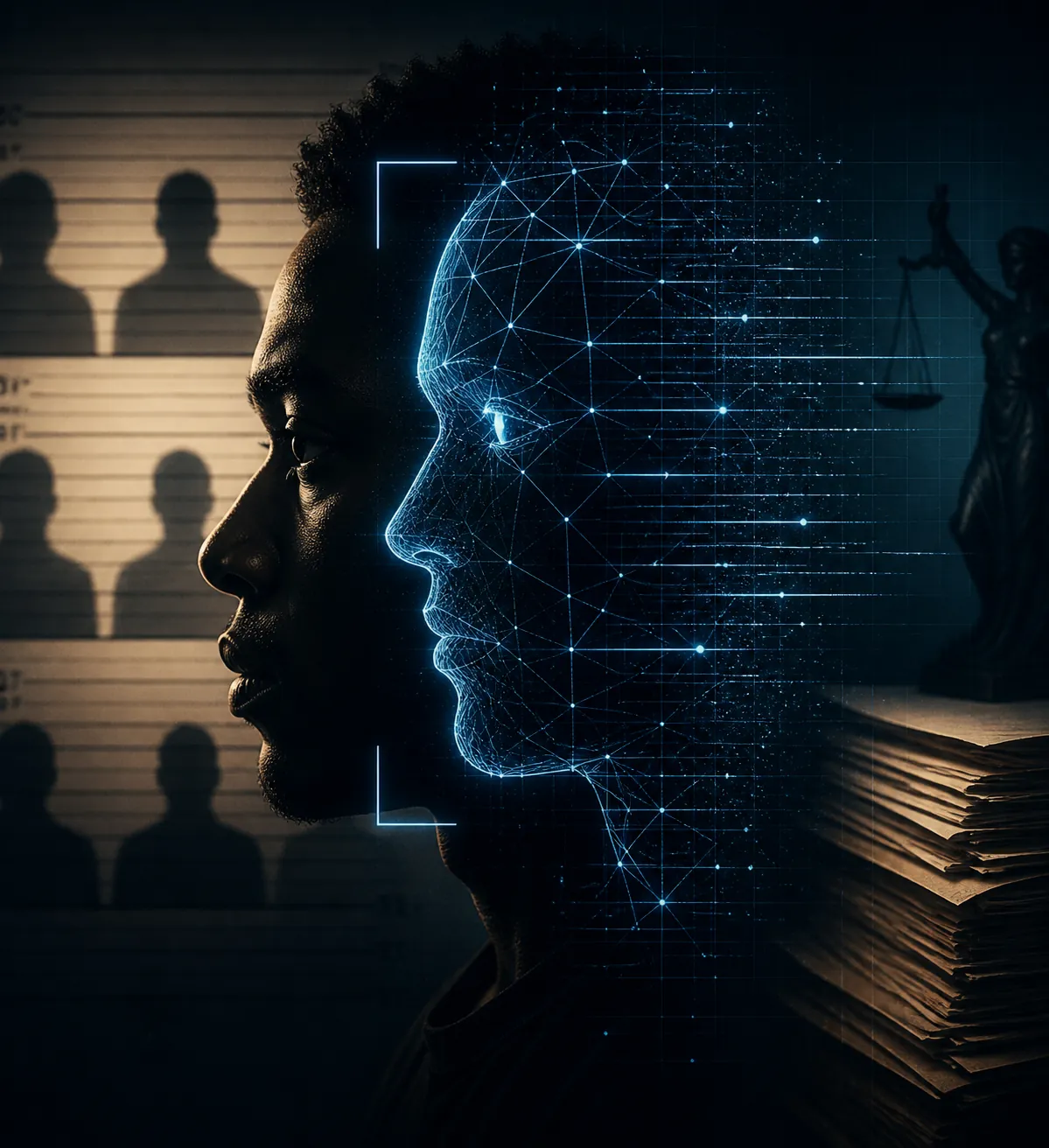
The practical screening question is simple: was facial recognition used, and if so, did the government disclose enough for the defense to test what happened? In the cases that now define the legal risk, the disputed step is often not a dramatic dragnet. It is a quieter conversion: an algorithm returned a candidate, the person became a suspect, a photo lineup appeared to confirm the suspicion, and the warrant paperwork made the identification look more settled than the underlying process justified.
Police facial recognition usually means that an agency submits an image — from surveillance video, a still photo, social media, or another source — to a system that searches a database of faces and returns possible candidates. That output is a lead. It is not, by itself, an eyewitness identification, a forensic match, or probable cause. The legal trouble begins when the file stops preserving that distinction.
Facial recognition has become the most litigated form of police surveillance AI because it touches the ordinary machinery of criminal procedure: suspect selection, lineups, arrest warrants, Brady and due-process disclosure, suppression practice, municipal policy, procurement, and civil-rights damages. Predictive policing and automated license-plate readers raise serious issues too, but facial recognition has already produced a public record of mistaken arrests and concrete guardrails.
The known wrongful-arrest record
As of the ACLU’s April 14, 2026 count, at least 14 people in the United States were publicly known to have been wrongfully arrested after police relied on erroneous facial recognition results. The fourteenth person identified in that record was Kimberlee Williams, who spent six months in jail on Maryland warrants even though she had never been to Maryland. [1]
That number is not a national error rate. It is a public-case count. It depends on a mistake being discovered, challenged, reported, and connected back to facial recognition. The more useful lesson is the repeatable failure pattern inside the known cases.
| Stage | What the file may say | What counsel needs to test |
|---|---|---|
| Image search | A person was “identified” or “developed as a suspect.” | Was there an algorithmic candidate list? What probe image was used? Which database was searched? What rank, score, or analyst note existed? |
| Lineup | A witness selected the suspect from a photo array. | Was the suspect inserted because of the facial-recognition return? Were fillers selected after the search? Was the lineup treated as independent corroboration? |
| Warrant | The affidavit describes a witness identification or investigative lead. | Did the affidavit disclose the facial-recognition role accurately, thinly, or not at all? |
| Discovery | The defense receives reports, photos, and ordinary police paperwork. | Were search logs, vendor material, analyst notes, rank/score data, and policy documents produced? |
| Post-arrest challenge | The government argues probable cause rested on other evidence. | Were the later steps tainted by the original algorithmic candidate, and did any witness confirmation truly arise independently? |
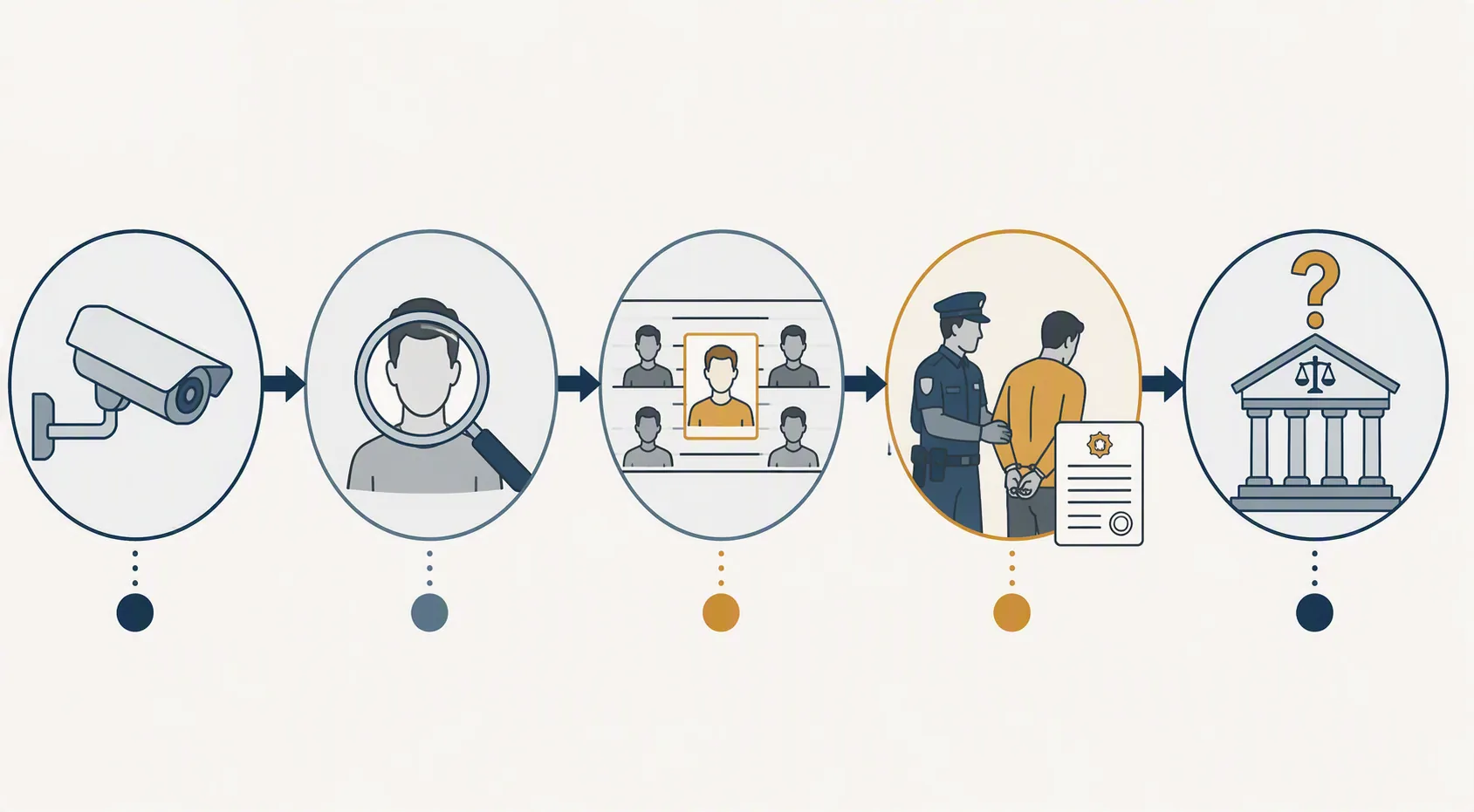
The photo lineup is the step that deserves more attention than it often gets. The ACLU reports that at least seven of the known wrongful arrests involved tainted photo lineups. It also reports that Black people account for at least eight of ten wrongful arrests based on faulty matches. [1]
Those figures do not prove that every agency uses facial recognition the same way, or that every mistaken candidate will become an arrest. They do show why “a human reviewed it” is not the end of the inquiry. If the human review selects a person from an algorithmic candidate list, and the same person is then placed before a witness in a lineup, the later witness selection may carry the appearance of independence without actually breaking the chain.
Robert Williams and the policy obligations that followed
Robert Williams’s Detroit arrest in January 2020 is often described as the first publicly reported wrongful arrest caused by facial recognition. The significance of the case is not only that it became public. It produced operational obligations that other agencies, litigators, and procurement reviewers can now read against their own files. [2]
The June 28, 2024 settlement with Detroit produced what the ACLU described as the nation’s strongest police-department facial recognition policy. The policy bars arrests based solely on facial-recognition results, bars lineups conducted directly after a facial-recognition search, requires corroboration, requires training, and requires an audit of all facial-recognition-linked warrants since 2017. [3]
Those terms matter because they target the actual points of failure. A “no sole basis” rule addresses the moment the algorithmic lead is treated as proof. The lineup restriction addresses the moment a candidate is laundered through a witness procedure. Corroboration and training address the people inside the agency who decide whether the search result remains a lead or becomes the spine of an arrest. The warrant audit addresses the paper trail after the fact.
For defense screening, Williams supplies a useful comparison question: if the agency’s current or historical policy would not satisfy the Detroit settlement terms, what extra disclosure is needed to understand how the identification was generated? The answer may include the probe image, search date, database, candidate list, analyst communications, lineup construction records, warrant drafts, and communications with any outside agency or vendor.
The recurring procedural problem: a lead becomes a cleaner record than it deserves
A bad facial-recognition result rarely walks into court labeled as a bad facial-recognition result. It arrives inside ordinary documents: an incident report, a supplemental report, a lineup form, a warrant affidavit, a probable-cause statement. By then, the vocabulary may have changed. “Returned as a possible candidate” becomes “identified.” “Investigative lead” becomes “suspect.” “Facial-recognition search followed by witness selection” becomes “the witness picked the defendant.”
That vocabulary shift creates legal risk in several places at once. It can affect probable cause if the warrant judge was not told what actually generated the suspect. It can affect due process if the defense cannot test whether the lineup was tainted. It can affect Brady if exculpatory or impeachment material about the search, the candidate list, the analyst’s uncertainty, or the system’s limits was not disclosed. It can affect municipal liability if the agency’s practice allowed an uncorroborated or poorly documented search result to drive an arrest.
The narrow but important point is not that every facial-recognition search is unlawful. It is that criminal procedure depends on knowing what step did what. A witness identification after a facial-recognition-driven lineup is different from a witness who independently named a suspect. A warrant affidavit that says police “identified” a person is different from one that tells the judge the person was an algorithmic candidate later placed in a lineup. A discovery packet that omits the search logs forces the defense to litigate blind.
Clearview: restrictions and settlement are separate legal events
Clearview AI appears in facial-recognition legal-risk discussions for more than one reason, and the proceedings should not be collapsed. In the ACLU of Illinois settlement, Clearview was barred nationwide from selling access to its faceprint database to private actors and barred for five years from selling to Illinois entities, including police. [4]
A separate class settlement, approved on March 20, 2025, gave class members a 23 percent equity stake valued at about $51.75 million. [5]
For procurement review, the distinction matters. One track restricts sales and access in ways that can affect whether an agency, contractor, or private partner may use a particular faceprint database. The other resolves class claims through an equity-based settlement structure. Both are relevant to legal exposure; they answer different questions.
Notice duties are emerging, but they are not national law
In New Jersey v. Arteaga, the New Jersey Appellate Division recognized a disclosure duty requiring defendants to be notified when police used facial recognition, grounding the obligation in due-process and Brady concerns. [6]
Arteaga is important because it treats facial-recognition use as something the defense must be able to test, not as a background investigative convenience that can disappear from the file. It is also bounded. It is a New Jersey appellate decision, not a federal rule and not a nationwide discovery statute. Outside a jurisdiction with a comparable duty, counsel may still need to force the issue through targeted discovery demands, subpoenas, motions to compel, Brady requests, suppression motions, public-records work, or cross-examination.
The most useful request is often not a broad demand for “AI materials.” It is a request tied to the identification path: all facial-recognition searches, probe images, candidate lists, analyst notes, communications with outside agencies, vendor or database access records, lineup materials, warrant drafts, and policies governing whether a search result may be used to create a lineup or support probable cause.
Milwaukee’s “for now” ban shows the procurement side of the same risk
Milwaukee police banned facial recognition in February 2026 after public hearings. Reporting on the measure described the ban as “for now,” and ACLU records requests showed the term appearing in 196,688 department emails from 2020 through 2025. [7]
The email figure does not establish how often the department used facial recognition in arrests, and it should not be treated as a use count. Its value is different: it shows why procurement and policy review cannot stop at the formal purchase order. Facial-recognition involvement may run through emails, trials, outside-agency requests, vendor demonstrations, task-force access, or informal references long before a clean policy file exists.
For agencies, the lesson is recordkeeping. For defense counsel, it is search-term discipline. If the case contains a suspiciously sudden identification from poor video or a still image, requests limited to the final police report may miss the material that explains how the suspect entered the case.
The state-law floor is real, incomplete, and moving

By the end of 2024, 15 states had enacted limits on facial-recognition surveillance, up from 12 in 2022. That is a dated floor, not a complete Q3 2026 national map. State bills move quickly, and any live matter needs current statutory and legislative checking. [8]
The existing limits do not all regulate the same risk. Montana, in 2023, and Utah, in 2024, became the first warrant states. Maryland’s 2024 law includes a serious-crime limit and a prosecutor disclosure requirement. Seven states have a rule that facial recognition cannot be the sole basis for certain police action. Oregon’s 2017 law was first but limited to body cameras, and California’s AB 1215 body-camera moratorium has expired. [8]
| Guardrail type | What it targets | Why it matters in a case file |
|---|---|---|
| Warrant requirement | Pre-search or pre-use judicial authorization in covered circumstances | Creates a threshold question: was the use authorized, and did the application accurately describe the search? |
| Serious-crime limit | Use only for specified categories of offenses | May make the legality of the search depend on the charged or investigated offense. |
| Prosecutor disclosure | Notice from police/prosecutors when facial recognition was used | Directly affects Brady, due process, and defense ability to challenge the identification. |
| No-sole-basis rule | Prohibits treating a face match as enough by itself | Forces review of what corroboration existed before arrest, lineup, or warrant. |
| Body-camera limits | Use of facial recognition on body-worn camera footage | Important, but narrower than limits covering all image sources or databases. |
| Moratorium or ban | Temporary or categorical suspension | Requires careful date checking; an expired moratorium is not a current prohibition. |
This patchwork matters because the same investigative act can be routine in one state, restricted in another, and undisclosed in a third unless counsel asks. There is no federal floor. Most states remain unregulated. A department policy, settlement obligation, or state statute may supply a concrete rule, but absence of a rule does not resolve the constitutional questions created by a hidden or overstated identification process.
How to screen a case that may involve facial recognition
Start with the moment the suspect first appears in the file. If the police had an image but no name, and then the reports quickly settle on one person, assume facial recognition is possible until the record accounts for the identification path. The same is true when the image quality looks poor, the witness did not previously know the suspect, or the affidavit uses passive language such as “was identified” without saying by whom and how.
- Ask whether any facial-recognition search was run by the investigating agency, another law-enforcement agency, a fusion center, a task-force partner, a vendor, or a private actor.
- Demand the probe image, search date, database searched, candidate list, rank or score information if retained, analyst notes, and communications about candidate selection.
- Compare the search timeline to the lineup timeline. A lineup conducted after an algorithmic candidate was selected should be tested for taint.
- Read the warrant affidavit for verbs. “Identified,” “matched,” “confirmed,” and “developed as a suspect” can hide different levels of certainty.
- Request agency policies in effect on the search date, not only current policies.
- Check state law, local policy, settlement obligations, and any court-created notice rule in the jurisdiction.
- Preserve procurement and vendor questions: what tool or database was used, under what contract or access arrangement, with what retention and audit terms?
For a working checklist, this record should sit next to a broader Verification Workflows process: identify the claim being made, locate the source artifact, test whether the artifact supports the claim, and document the gap. In facial-recognition cases, the recurring gap is the difference between an algorithmic candidate and an identification fit to support arrest.
Procurement review should use the litigation record, not vendor comfort language
A procurement reviewer does not need to predict every future civil-rights claim to spot the obvious controls. The contract and policy package should say whether the tool may be used to generate a lineup, whether an arrest can proceed without independent corroboration, what search artifacts are retained, who can access the database, how outside-agency searches are logged, and how the prosecutor and defense will be notified.
The Detroit settlement terms provide one concrete benchmark. The Clearview restrictions show that database access and customer category matter. Arteaga shows that a court can treat notice as a due-process and Brady issue. The state-law floor shows that warrant rules, offense limits, prosecutor disclosure, no-sole-basis rules, and body-camera restrictions may all apply depending on where and how the tool is used.
Reliability review also needs to be separated from adoption review. The fact that an agency has access to a tool does not show it works well enough for a particular investigative use. The fact that a vendor markets human review does not show the human reviewer had enough information, training, or independence to prevent a bad candidate from entering the warrant chain. Error-rate material belongs in Tool Reliability Evaluations; disclosure and chain-of-custody questions belong in the case file.
The current risk map
The guardrails are no longer theoretical. Detroit has a settlement policy addressing arrests, lineups, corroboration, training, and warrant audits. Clearview faces restrictions from one proceeding and a separate class settlement from another. New Jersey has an appellate notice duty. Milwaukee has a ban described as “for now.” At least 15 states had enacted some facial-recognition limits by the end of 2024.
They are also incomplete. Most states remain without a facial-recognition statute, and there is no federal floor. Any criminal case with a suspicious identification should be checked for facial-recognition involvement, notice defects, Brady material, lineup taint, warrant omissions, and vendor or procurement exposure before the clean version of the arrest hardens into the only version in the record.
References
- More than a Dozen Wrongful Arrests Due to Police Reliance on Facial Recognition Technology, ACLU, April 14, 2026.
- Williams v. City of Detroit, ACLU.
- Civil Rights Advocates Achieve the Nation's Strongest Police Department Policy on Facial Recognition Technology, ACLU, June 28, 2024.
- In Big Win, Settlement Ensures Clearview AI Complies With Groundbreaking Illinois Biometric Privacy Law, ACLU of Illinois.
- Judge OKs Loevy's Innovative $51.75 Million Settlement in Clearview AI Class Action Lawsuit, Loevy + Loevy.
- The Dangers of Unregulated AI in Policing, Brennan Center.
- Public outcry over facial recognition technology leads Milwaukee police to ban it, for now, Route Fifty / Wisconsin Examiner, February 9, 2026.
- Status of State Laws on Facial Recognition Surveillance: Continued Progress and Smart Innovations, TechPolicy.Press / CDT, January 6, 2025.
Related records
Tool profile
How Meta's AI Spending Reshapes Law Firm ProfitabilityGoverning regulation
Browse the obligations tracker →Preventive workflow
Browse verification workflows →
Report a correction or tip
Spotted an outdated figure, a misstated fact, or a ruling this case record should reflect? Public comments are disabled for this content given the professional cost of a misreported case outcome, penalty amount, or rule text — use the structured correction channel instead.
Report a correction or tip for this record →