
Judge's ruling lets Presidio border wall proceed for now
Judge Walton's Aug. 2, 2026 ruling in Presidio Municipal Development District v. DHS denied PMDD's motion to stay, so DHS may proceed with the border wall plan for now. This record explains why the ruling is narrow, whether construction is halted, and what remains open — the government's Aug. 21 answer, the parallel Ruidosa Church waiver challenge, and Texas's cease-and-desist.
- Jurisdiction
- US - District of Columbia
- Court
- U.S. District Court for the District of Columbia
- Judge
- Reggie B. Walton
- AI tool named
- No AI tool implicated
- Ruling date
- Aug 2, 2026
- Source document
- View primary court order ↗
- Last verified
- Aug 4, 2026
Lex Machina Review is an independent risk-tracking and reference resource. Nothing on this site is legal advice, and using it does not create an attorney-client relationship. Every record is reviewed against primary sources but may not reflect the most current status of a matter — always verify directly against the cited court order, rule text, or a licensed attorney before relying on it.
Companion explanation — secondary to the source document above
Status record — last verified Aug. 4, 2026 (UTC)
| Field | Current record |
|---|---|
| Case name | Presidio Municipal Development District v. Department of Homeland Security |
| Docket number | No. 1:26-cv-02146 |
| Court | U.S. District Court for the District of Columbia |
| Judge | Reggie B. Walton |
| Ruling date | Aug. 2, 2026 |
| Current posture | Motion to stay denied; underlying case remains pending [1][2] |
| Source order | PMDD injunction denial, Aug. 2, 2026 [1] |
| Docket link | CourtListener docket for No. 1:26-cv-02146 [2] |
| Construction halted? | No. The Aug. 2 order does not block DHS from proceeding for now; it is not a final merits judgment [1][2] |
| Next fixed docket checkpoint | Government answer due Aug. 21, 2026 [2] |
This is a docket-status record, not legal advice. It is meant to answer the immediate status question behind the search for a Presidio border wall judge ruling: whether Judge Walton’s order presently blocks construction, and what the order actually decided.
- Source order: PMDD injunction denial [1].
- Docket: Presidio Municipal Development District v. Department of Homeland Security, 1:26-cv-02146 [2].
- Original waiver determination: Feb. 17, 2026 Federal Register determination [3].
- Waiver amendment: July 2, 2026 Federal Register determination [4].
- PMDD pleading: PMDD v. DHS Complaint [5].
- Parallel docket: Friends of the Ruidosa Church v. Mullin, 3:26-cv-01099 [6].
The short answer is narrow. Judge Walton denied Presidio Municipal Development District’s request for a stay on Aug. 2, 2026, so DHS is not presently blocked by that order from moving forward with the Presidio border wall plan. The same order did not dismiss the case, did not finally resolve all statutory or constitutional issues, and did not adjudicate every disputed fact about the levee system [1][2].
The procedural spine
| Date | Event | Why it matters |
|---|---|---|
| Feb. 17, 2026 | Secretary Kristi Noem issued an IIRIRA §102(c) waiver determination for border-barrier work [3]. | This is the first waiver in the chain relevant to the Presidio dispute. |
| Apr. 16, 2026 | Friends of the Ruidosa Church v. Mullin was filed in the Western District of Texas [6]. | That parallel case challenges the waiver authority on constitutional grounds. |
| Jun. 17, 2026 | PMDD filed its complaint against DHS in the District of Columbia [5]. | This is the case in which Judge Walton later denied interim relief. |
| Jul. 2, 2026 | DHS amended the waiver determination to add the Rivers and Harbors Act, including 33 U.S.C. §§ 403 and 408 [4]. | That amendment became central to the stay denial. |
| Jul. 21, 2026 | The court held a jurisdiction hearing [1][2]. | The order later addressed the court’s ability to hear the dispute despite the waiver framework. |
| Aug. 2, 2026 | Judge Walton denied PMDD’s stay motion [1]. | This is the ruling now being described, too loosely in some places, as letting the wall proceed. |
| Aug. 21, 2026 | The government’s answer is due [2]. | That is the next fixed pleading deadline on the D.D.C. docket. |
What the Aug. 2 order did
The order denied interim relief. That matters because PMDD was asking the court to stop the challenged federal activity while the case proceeded. A denial of that request changes the practical posture: DHS may proceed for now. It does not turn the docket into a final judgment for DHS, and it does not erase the pending complaint [1][2].
The distinction is not pedantic. A lawyer checking the docket needs to know whether an injunction or stay is in place. A reporter needs to know whether the judge has decided the whole case. A local official or property owner needs to know whether the levee question has been resolved. On this record, the answer to the first question is no; the answer to the second and third is also no.
Judge Walton’s reasoning turned on two practical points: the July 2 waiver amendment, which added the Rivers and Harbors Act to the laws waived for the project, and the court’s view that PMDD had not alleged an actual impact on the levee system itself. Those points were enough to deny a stay. They are not the same thing as a final judicial blessing of every design choice, construction step, or future agency action [1][4].
The Rivers and Harbors Act problem after the July 2 amendment
PMDD’s stay request depended in part on the Rivers and Harbors Act. The timing then became decisive. After PMDD filed suit, the July 2 Federal Register determination amended the earlier waiver to include the Rivers and Harbors Act provisions at 33 U.S.C. §§ 403 and 408 [4].
Judge Walton treated that amendment as legally fatal to the Rivers and Harbors Act theory at the interim-relief stage. The order states that the July 2 waiver “defeats any claim that the defendants violated” the Rivers and Harbors Act [1]. That sentence is the load-bearing part of the ruling; it is also the part most likely to be flattened into an overbroad headline.
The waiver mechanism comes from IIRIRA §102(c), which allows the Secretary of Homeland Security to waive legal requirements that the Secretary determines are necessary to ensure expeditious construction of border barriers and roads. The February determination set the initial waiver frame; the July amendment added the Rivers and Harbors Act provisions that PMDD had invoked [3][4].
The Federal Register determinations also recite agency enforcement figures for the Big Bend Sector for FY2021 through FY2025, including more than 89,000 apprehensions and seizures of 87,574 pounds of marijuana, 867 pounds of cocaine, 1,156 pounds of methamphetamine, and 94 pounds of fentanyl [3][4]. Those are agency recitations in the waiver determinations. They are not findings made by Judge Walton in the Aug. 2 stay order.
The levee allegation gap
The other central point was factual, or more precisely, pleading-related. Judge Walton wrote that “conspicuously absent from the plaintiff’s allegations is a claim that there has been any action that has actually impacted the levee system itself” [1].
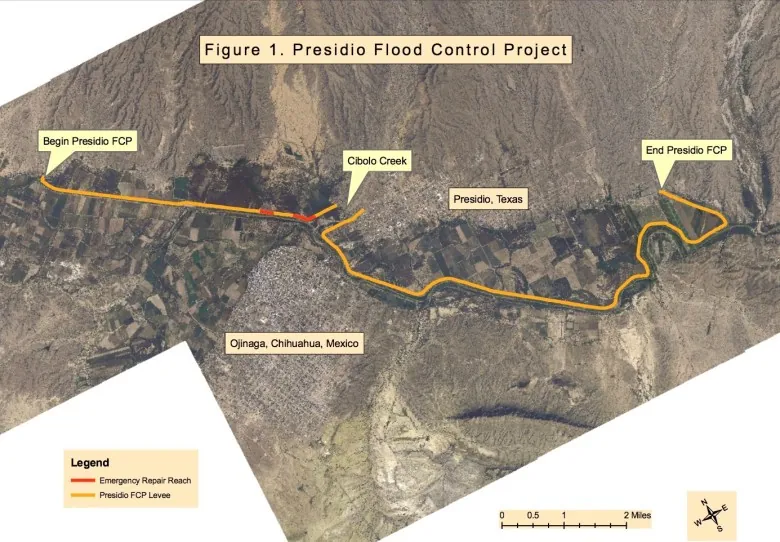
That finding does not say the levee issue is imaginary. PMDD’s complaint describes the Presidio levee system as central to local flood protection and alleges that the proposed border-wall work threatens that system [5]. But the order drew a line between allegations about threatened or anticipated harm and an allegation that federal action had already actually affected the levee system. For interim relief, that line mattered [1].
PMDD has described the system as involving 12.75 miles of levee and protecting 52 square miles from flooding; those figures are party allegations, not judicial findings in the stay order [5]. The Aug. 2 ruling should therefore be read as a decision about the stay record before the court, not as a final engineering determination about the levee.
Jurisdiction was not the same as relief
The order also addressed jurisdiction. Judge Walton did not simply say that the waiver framework made the courthouse unavailable for every issue. The order treated Congress’s limits on review as important, but not as a total bar to the court’s consideration of the dispute presented at this stage [1].
That is why the posture needs two sentences rather than one. The court could address the stay request, and it denied that request. PMDD still has a pending case to litigate [1][2].
What remains open
The first open item is ordinary but important: the government’s answer is due Aug. 21, 2026 [2]. Until then, the D.D.C. case is in the post-stay-denial, pre-answer posture. Any statement that the lawsuit is “over” is not supported by the docket.
The second open item is the parallel Western District of Texas case, Friends of the Ruidosa Church v. Mullin. That case was filed April 16, 2026, and remains a separate challenge tied to the same waiver regime [6]. The Clearinghouse case entry identifies constitutional theories including major questions, nondelegation, Take Care Clause, and Fifth Amendment due process claims [7]. Those claims were not finally resolved by Judge Walton’s Aug. 2 stay denial in PMDD’s D.D.C. case.
The third open item is state action. On July 31, 2026, the Texas General Land Office sent a cease-and-desist letter to CBP and Barnard Construction concerning clearing on a state border tract in Presidio County, according to Texas Tribune reporting [8]. That state dispute is not the same as PMDD’s federal stay motion, but it is part of the current operating environment around the Presidio work.
The fourth open item is design status. DHS stated in its July 1 response to PMDD that the Presidio design was not finalized [9]. That statement should not be converted into a promise about what the final design will be, or into proof that no levee impact can occur. It does mean that readers should be careful about treating the Aug. 2 order as if it reviewed a complete, locked construction plan.
| Safe status statement | Overstatement to avoid | Why |
|---|---|---|
| Judge Walton denied PMDD’s stay motion on Aug. 2, 2026. | Judge Walton finally upheld the Presidio wall. | The order denied interim relief; the case remains pending [1][2]. |
| DHS may proceed for now because no stay currently blocks the work in this case. | Construction has been permanently cleared by the court. | A stay denial is not a final merits judgment [1][2]. |
| The July 2 waiver amendment defeated PMDD’s Rivers and Harbors Act argument at the stay stage. | The Rivers and Harbors Act never mattered. | The Act mattered enough that the July 2 amendment was central to the court’s reasoning [1][4]. |
| The court found no allegation of actual impact on the levee system itself. | The court found the levee is safe. | The order addressed the allegations before it, not a final engineering record [1][5]. |
| The government’s answer is due Aug. 21, 2026. | There is nothing left to watch on the D.D.C. docket. | The answer deadline remains the next fixed procedural checkpoint [2]. |
The ruling in one usable sentence
Judge Walton’s Aug. 2, 2026 order lets DHS proceed for now because PMDD did not obtain a stay, with the court relying on the July 2 IIRIRA §102(c) waiver amendment and the absence of an alleged actual impact on the levee system itself; the underlying case remains pending, the government’s answer is due Aug. 21, and related waiver and state-land disputes remain active [1][2][4][6][8].
The next verification points are the Aug. 21 answer in No. 1:26-cv-02146, any new order in Friends of the Ruidosa Church v. Mullin, and any documented movement in the Texas GLO cease-and-desist dispute [2][6][8].
References
- PMDD injunction denial (Aug. 2, 2026 order, Judge Reggie B. Walton), DocumentCloud, Aug. 2, 2026.
- Presidio Municipal Development District v. Department of Homeland Security, 1:26-cv-02146 (D.D.C.), CourtListener.
- Determination Pursuant to Section 102 of the Illegal Immigration Reform and Immigrant Responsibility Act of 1996, as Amended, Federal Register, Feb. 17, 2026.
- Determination Pursuant to Section 102 of the Illegal Immigration Reform and Immigrant Responsibility Act of 1996, as Amended, Federal Register, July 2, 2026.
- PMDD v. DHS Complaint, Democracy Forward, June 17, 2026.
- Friends of the Ruidosa Church v. Mullin, 3:26-cv-01099 (W.D. Tex.), CourtListener.
- Friends of the Ruidosa Church v. Mullin, Civil Rights Litigation Clearinghouse.
- Texas land commissioner orders feds to stop illegally clearing state border tract, Texas Tribune, July 31, 2026.
- DHS response to PMDD, DocumentCloud, July 1, 2026.
Related records
Tool profile
How Meta's AI Spending Reshapes Law Firm ProfitabilityGoverning regulation
Browse the obligations tracker →Preventive workflow
Browse verification workflows →
Report a correction or tip
Spotted an outdated figure, a misstated fact, or a ruling this case record should reflect? Public comments are disabled for this content given the professional cost of a misreported case outcome, penalty amount, or rule text — use the structured correction channel instead.
Report a correction or tip for this record →