
Elaine Escoe's Prior Fraud Conviction Was a Missed Escalation Signal
This article examines how Elaine Escoe's 2024 wire fraud conviction, though adjudicated after her COVID relief scheme had concluded, was a public-record indicator of fraud capability that screening frameworks missed — and what counsel can learn from the escalation pattern.
- Jurisdiction
- US-Federal
- Court
- U.S. District Court, Southern District of Florida
- AI tool named
- No AI tool implicated
- Ruling date
- May 1, 2024
- Source document
- View primary court order ↗
- Last verified
- Jul 27, 2026
Lex Machina Review is an independent risk-tracking and reference resource. Nothing on this site is legal advice, and using it does not create an attorney-client relationship. Every record is reviewed against primary sources but may not reflect the most current status of a matter — always verify directly against the cited court order, rule text, or a licensed attorney before relying on it.
Companion explanation — secondary to the source document above
The Escoe COVID relief case is easy to misread if it begins with the fugitive ending. The safer starting point is the date sequence. Elaine Angene Escoe’s alleged COVID relief conduct ran from May 2020 through November 2021, while the fraud conviction that now looks like a public-record warning signal came later, with a May 2024 jury verdict for submitting altered bank statements to obtain a business line of credit for RBA Global.[1][2] That makes the prior conviction useful in hindsight, but not as proof that a 2024 punishment failed to deter a scheme that had already been substantially completed.
This is a Risk Digest companion analysis, not legal advice. The available record summarized here does not implicate an AI tool. The question is narrower and more ordinary: what should counsel, risk teams, and screening vendors do with a prior fraud adjudication when the larger suspected conduct overlapped the earlier case and was adjudicated later?
The chronology prevents the wrong story
The arrest in Jamaica matters procedurally. It does not explain the fraud-risk signal by itself. The load-bearing facts are the sequence of alleged conduct, adjudication, supervision, appearance failure, and capture.
| Point in sequence | Date or period | Why it matters |
|---|---|---|
| Alleged COVID relief scheme | May 2020–November 2021 | The charged relief-fraud conduct allegedly involved more than 90 applications across PPP, EIDL, RRF, and SVOG programs, using fabricated tax documents and bank records.[2][3] |
| Wire-fraud conviction | May 2024 | A jury convicted Escoe in a separate case involving altered bank statements submitted to obtain a business line of credit for RBA Global.[1] |
| Reported sentence in the prior case | Aug. 14, 2024 | Secondary case materials describe a six-month federal prison sentence; that date and term should be verified against the docket before publication or operational reliance. |
| Arrest warrant and appearance failure | May 22, 2025; June 5, 2025 | An arrest warrant was issued, and Escoe later failed to appear, changing the posture from charged fraud to fugitive risk.[4] |
| Most Wanted Fraudsters designation | June 2026 | The FBI identified Escoe among the initial group tied to its Most Wanted Fraudsters initiative, increasing the public fugitive profile of the case.[5] |
| Capture in Jamaica | July 2026 | Federal and local reporting says Escoe was captured in Jamaica while using the alias “Harley Newman.”[4][6] |
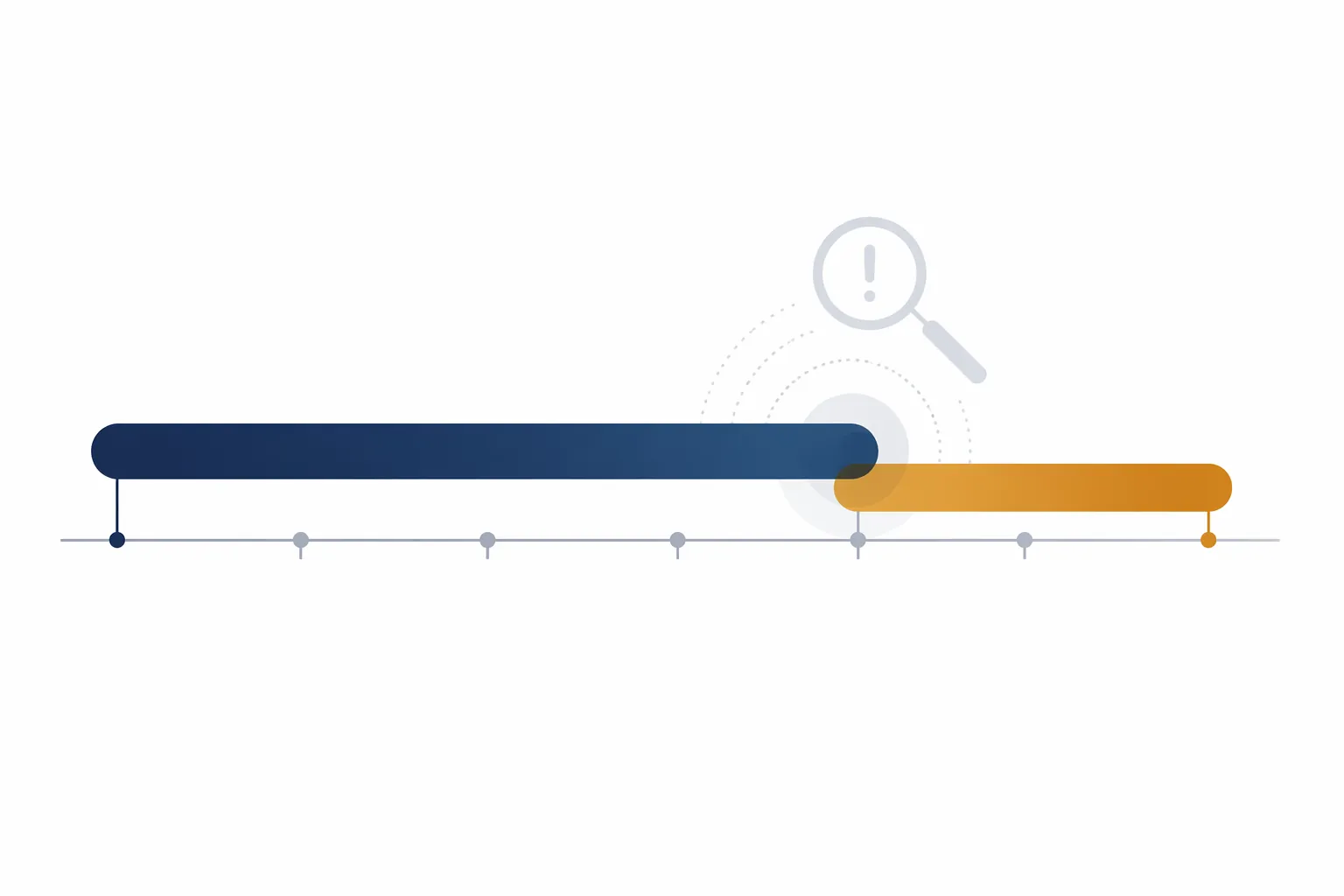
That table blocks a tempting but inaccurate deterrence narrative. The available public materials do not support a simple sentence such as “Escoe was convicted of fraud in 2024 and then committed a larger COVID relief fraud.” The alleged COVID relief conduct came first. The conviction came later. The more useful formulation is that a 2024 public adjudication exposed a fraud-document capability that, in hindsight, resembled conduct alleged in a larger, earlier-running relief scheme.
For readers who need the straight case record before the risk-signal analysis, the companion background is available in Elaine Escoe Captured After Orchestrating $34M COVID Relief Fraud. The point here is not to relitigate every charge. It is to identify what the public record could and could not have signaled.
What the 2024 conviction actually showed
The prior case should be kept narrow. DOJ described a wire-fraud conviction based on altered bank statements submitted to fraudulently obtain a business line of credit for RBA Global.[1] That is not a conviction for COVID relief fraud. It is not, by itself, proof of the later allegations. It is a public-record finding that a jury accepted evidence of altered financial records used to obtain credit.
For a screening framework, that distinction matters. A conviction can be treated as a binary disqualifier: convicted or not convicted, reportable or not reportable, within lookback period or outside it. But fraud-risk work often needs a second layer. What kind of paperwork behavior did the adjudicated case involve? Was the conduct about identity, bank records, tax records, revenue representations, entity ownership, loan proceeds, or appearance compliance? A prior record does not answer the whole risk question, but it can tell counsel where to look next.
Here, the useful signal was not merely “fraud conviction.” It was altered financial documentation used to obtain institutional money. That signal was adjudicated after the alleged relief scheme, so it could not have served as an early-screening block for most of the COVID applications. It still mattered once it became public, especially for supervision, appearance risk, sentencing exposure, and any later due-diligence review involving Escoe or related entities.
The alleged escalation was documentary, not cinematic
The later allegations are larger in scale, but their significance for risk design is not just the dollar figure. Public reporting and FBI materials describe more than 90 allegedly fraudulent applications across the Paycheck Protection Program, Economic Injury Disaster Loan program, Restaurant Revitalization Fund, and Shuttered Venue Operators Grant program.[2][3] The reported program-level disbursement figures include approximately $29.1 million in PPP funds, $1.2 million in RRF funds, and $3.8 million in SVOG funds, while public summaries have also described the case as a $32 million COVID relief fraud scheme.[2][3]
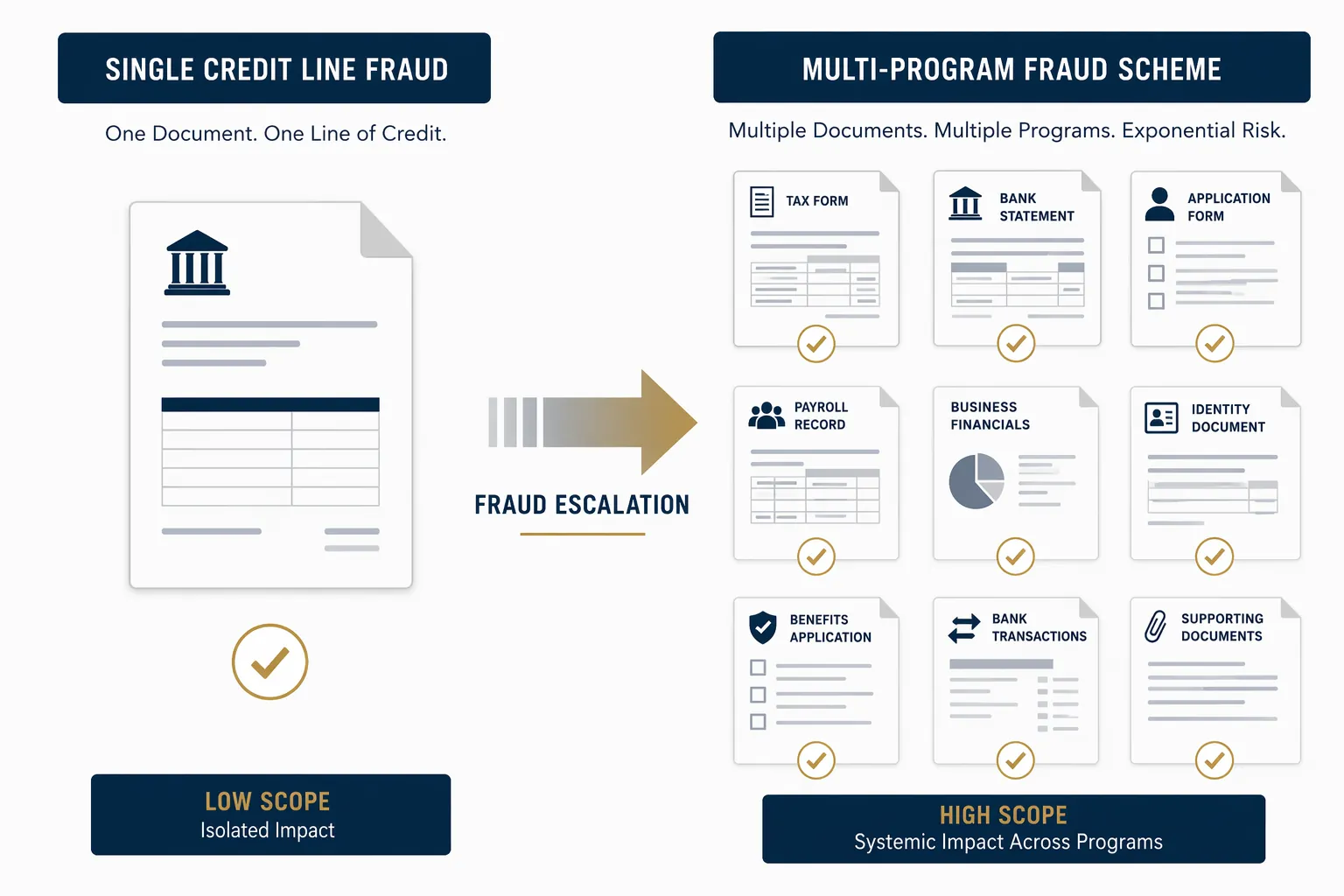
The alleged method also matters. The later case reportedly involved fabricated tax documents and bank records, plus alleged kickback arrangements to co-defendants of up to 50%.[2][3] That does not make the prior conviction a miniature version of the charged relief scheme. It does make the overlap visible: both records center on financial-document manipulation aimed at obtaining money from institutions.
That is where a counsel-facing risk framework should become more precise than a background-check dashboard. A prior conviction for altered bank statements may not predict a later federal-benefits case in any statistically reliable way. But when a later investigation involves fabricated bank records, fabricated tax records, multiple business entities, and repeated applications, the earlier adjudication becomes relevant pattern evidence for risk review, supervision arguments, and sentencing narratives—subject, always, to evidentiary limits and the presumption of innocence on the new charges.
Why the Jamaica capture belongs in the procedural column
The capture facts are serious, but they should not become the center of the fraud analysis. Escoe was reported captured in Jamaica in July 2026 and returned to the United States after being sought by the FBI; Fox News reported that she had been using the alias “Harley Newman.”[4] WPBF also reported on her return to face charges in West Palm Beach.[6]
Those facts speak most directly to flight risk and procedural exposure. The FBI said Escoe was one of the first eight fugitives tied to its Most Wanted Fraudsters list, launched in June 2026 under Director Kash Patel.[5] Once a defendant has an appearance failure, an alias allegation, international capture, and a high-profile fugitive designation, counsel has a different bail and sentencing-risk problem than a defendant who appears on summons and contests the fraud counts in ordinary course. For more on that exposure layer, see How FBI Most Wanted Fraudster Status Escalates Criminal Exposure.
Co-defendant outcomes add another procedural benchmark, not a prediction. The Jamaica Observer reported sentences of 235 months for Alfred Davis, 87 months for Cher Davis, 70 months for Latoya Clark, 46 months for Jourdan, and 42 months for McGhow.[7] If Escoe is convicted, prosecutors may point to those sentences when framing exposure, relative culpability, and loss-driven guidelines arguments. Defense counsel would be expected to contest the fit of any comparison that does not account for role, plea posture, cooperation, criminal history, acceptance of responsibility, and proof at trial.
The screening lesson is chronology plus conduct type
A static “prior conviction” field would not have prevented the alleged COVID relief scheme from beginning in 2020. The conviction did not exist yet. That is the basic chronological limit that any serious legal-tech or compliance discussion has to respect.
But once the conviction did exist, a better risk review would not stop at the label “wire fraud.” It would ask what the adjudicated conduct revealed: altered bank statements, a business credit product, an operating entity, and financial representations made to obtain funds. Those details are more useful than the conviction category alone because they help counsel compare conduct patterns without pretending that one case proves another.
For in-house counsel or law-firm risk teams, the practical review is not complicated, but it is easy to skip:
- Place the alleged conduct period, indictment, conviction, sentence, supervision status, warrant, and appearance failures on one timeline before drawing deterrence or recidivism conclusions.
- Separate adjudicated facts from charged allegations, especially when the later case remains pending.
- Code the fraud conduct by document type and transaction type, not only by statute name.
- Treat fugitive facts as bail, supervision, and sentencing-exposure facts unless the government proves they also bear on the underlying fraud.
- Avoid after-the-fact prevention claims unless the relevant record actually existed before the screened transaction.
That last point is where many screening narratives become too neat. A public-record hit discovered in 2026 may show that a person had a fraud capability marker in 2024. It does not show that a lender, agency, employer, vendor, or counsel could have acted on that conviction in 2020 or 2021. The defensible criticism is narrower: once a fraud adjudication becomes public, systems that flatten it into a yes-or-no field may miss the conduct pattern that matters most.
A signal, not a shortcut
Escoe’s 2024 conviction was a detectable public-record signal in hindsight. It showed adjudicated financial-document fraud involving altered bank statements and institutional credit. The alleged COVID relief case, however, had already run from May 2020 to November 2021. That timing makes the conviction a temporally overlapping capability marker, not proof that punishment failed to deter later conduct.
For counsel, the disciplined use of the record is to let the prior adjudication prompt deeper chronology and pattern analysis while preserving the legal boundary around the pending charges. The COVID relief counts remain allegations unless and until adjudicated.
References
- Jury Convicts Woman of Wire Fraud for Submitting Altered Bank Statements for Business Line of Credit — U.S. Attorney’s Office, Southern District of Florida
- Miami woman charged in $32M COVID relief fraud scheme captured in Jamaica — NBC Miami
- Elaine Angene Escoe — FBI
- Exclusive: Alleged $32M COVID-19 fraud fugitive captured in Jamaica, returned to US, FBI says — Fox News
- Statement from FBI Director Patel on Most Wanted Fraudster Arrest — FBI
- Florida woman on FBI's Most Wanted Fraudsters list faces charges in West Palm Beach — WPBF 25
- Jamaican woman wanted by FBI for US$32-million COVID relief funds scam returned to US — Jamaica Observer
Related records
Tool profile
How Meta's AI Spending Reshapes Law Firm ProfitabilityGoverning regulation
Browse the obligations tracker →Preventive workflow
Browse verification workflows →
Report a correction or tip
Spotted an outdated figure, a misstated fact, or a ruling this case record should reflect? Public comments are disabled for this content given the professional cost of a misreported case outcome, penalty amount, or rule text — use the structured correction channel instead.
Report a correction or tip for this record →