
How a Past Cyclospora Outbreak Shapes Current Product Liability
This article examines how plaintiffs in the 2026 cyclospora outbreak litigation are using Taylor Farms' 2013 outbreak history to allege prior knowledge, supporting negligence claims that could pierce strict-liability caps. Risk managers and procurement counsel can use this analysis to evaluate supplier exposure and counterparty liability in future contracting.
- Jurisdiction
- US Federal - Eastern District of Michigan
- Court
- United States District Court for the Eastern District of Michigan
- AI tool named
- No AI tool
- Ruling date
- Jul 17, 2026
- Source document
- View primary court order ↗
- Last verified
- Jul 24, 2026
Lex Machina Review is an independent risk-tracking and reference resource. Nothing on this site is legal advice, and using it does not create an attorney-client relationship. Every record is reviewed against primary sources but may not reflect the most current status of a matter — always verify directly against the cited court order, rule text, or a licensed attorney before relying on it.
Companion explanation — secondary to the source document above
The allegation in Parrish v. Taco Bell is not merely that shredded iceberg lettuce was contaminated. The more consequential allegation is that Taylor Farms “had prior knowledge of the risks of Cyclospora contamination given prior foodborne illness outbreaks involving its produce,” a claim reported when counsel announced the July 17, 2026 filing in the Eastern District of Michigan.[1] Local reporting on the Michigan couple’s lawsuit likewise places Taco Bell and Taylor Farms in the same litigation frame: a restaurant defendant facing customer illness claims and a produce supplier facing allegations tied to contaminated lettuce.[2]
That sentence is doing different work from a case-count allegation. It is aimed at knowledge, foreseeability, and the reasonableness of controls before the 2026 outbreak was public. For readers tracking which complaint was filed where, the active docket roundup is better handled in Taylor Farms Cyclospora outbreak spawns five lawsuits in a week. The narrower question here is why one historical fact, if proved and connected cleanly enough, may change the loss picture.
The 2026 outbreak is large, but scale is not the only exposure driver
As of July 24, 2026, CDC’s confirmed outbreak frame already gives defense counsel, insurers, and procurement teams a serious baseline: more than 1,644 linked confirmed cyclosporiasis cases, 94 hospitalizations, and patients across 27 states.[3] CNN’s reporting describes broader seasonal and state-level counts, including Michigan probable-plus-confirmed figures and a larger universe of cases under laboratory analysis, but those numbers are not the same measure as CDC-confirmed linked outbreak cases.[4]
That distinction matters in product liability review. A confirmed CDC-linked number is not just a public-health statistic; it helps define the likely claimant pool tied to the investigated vehicle. Probable state counts and seasonal totals may matter for surveillance and reserves, but they require more sorting before they carry the same evidentiary weight in a supplier-specific lawsuit.
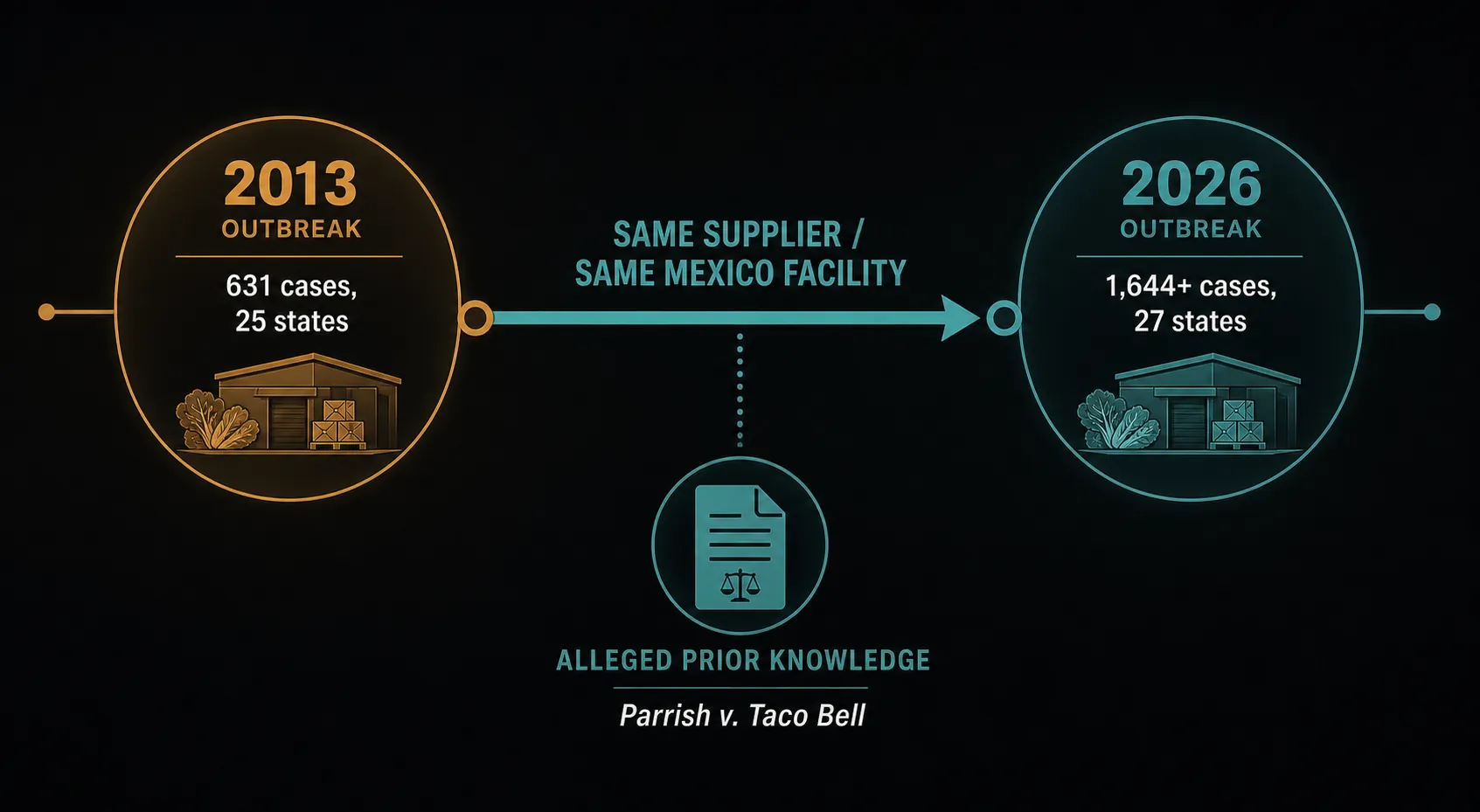
The FDA investigation gives the supplier analysis its sharper edge. FDA identified Taylor Farms de Mexico as the single supplier of shredded iceberg lettuce used in the implicated products and reported a recall covering more than 140 stock-keeping units distributed across 27 states, with use-by dates from July 16 through August 3, 2026.[5] CDC’s outbreak page also ties the investigation to iceberg lettuce, placing the agency traceback and epidemiology in the same lane.[6]
Why plaintiffs are reaching back to 2013
The 2013 outbreak is the fact plaintiffs will want to keep in the case if they can. The Parrish-side theory points to a prior cyclospora outbreak involving Taylor Farms produce, with 631 confirmed cases across 25 states and CDC materials tracing the outbreak to salad mix processed at Taylor Farms’ Mexico facility; most ill persons reported eating at Olive Garden and Red Lobster.[1]
That is not useful to plaintiffs simply because it sounds bad. Prior incidents are often contested on relevance, similarity, notice, prejudice, and admissibility. The useful feature is the alleged overlap: cyclospora, produce, Taylor Farms, and a Mexico facility nexus. If plaintiffs can anchor the 2026 lettuce traceback to the same supplier/facility history, the 2013 event becomes more than background industry risk. It becomes a possible notice document.
The difference is practical. A generic warning that fresh produce can carry parasites may support basic food-safety obligations. A prior outbreak traced to the same supply system can support a harder question: after 2013, what did the supplier change, audit, test, document, reject, insure, or disclose?
Strict liability asks one set of questions; prior knowledge opens another
In a foodborne illness case, strict product liability can be relatively direct. Was the product defective or adulterated? Did it reach the plaintiff? Did it cause the illness? The plaintiff does not need to prove that a supplier’s executive read a particular outbreak notice years earlier to make that basic claim.
Negligence and punitive-damages theories are less forgiving of vague proof. They depend more heavily on what the defendant knew or should have known, what preventive measures were reasonable in light of that knowledge, and whether the defendant’s conduct moved from ordinary failure into something a court or jury could view as reckless or willful. No court has ruled that the 2013 history proves negligence in the 2026 cyclospora cases. The point is that plaintiffs are pleading toward that door, and the FDA traceback gives them a supplier-specific route to try to reach it.
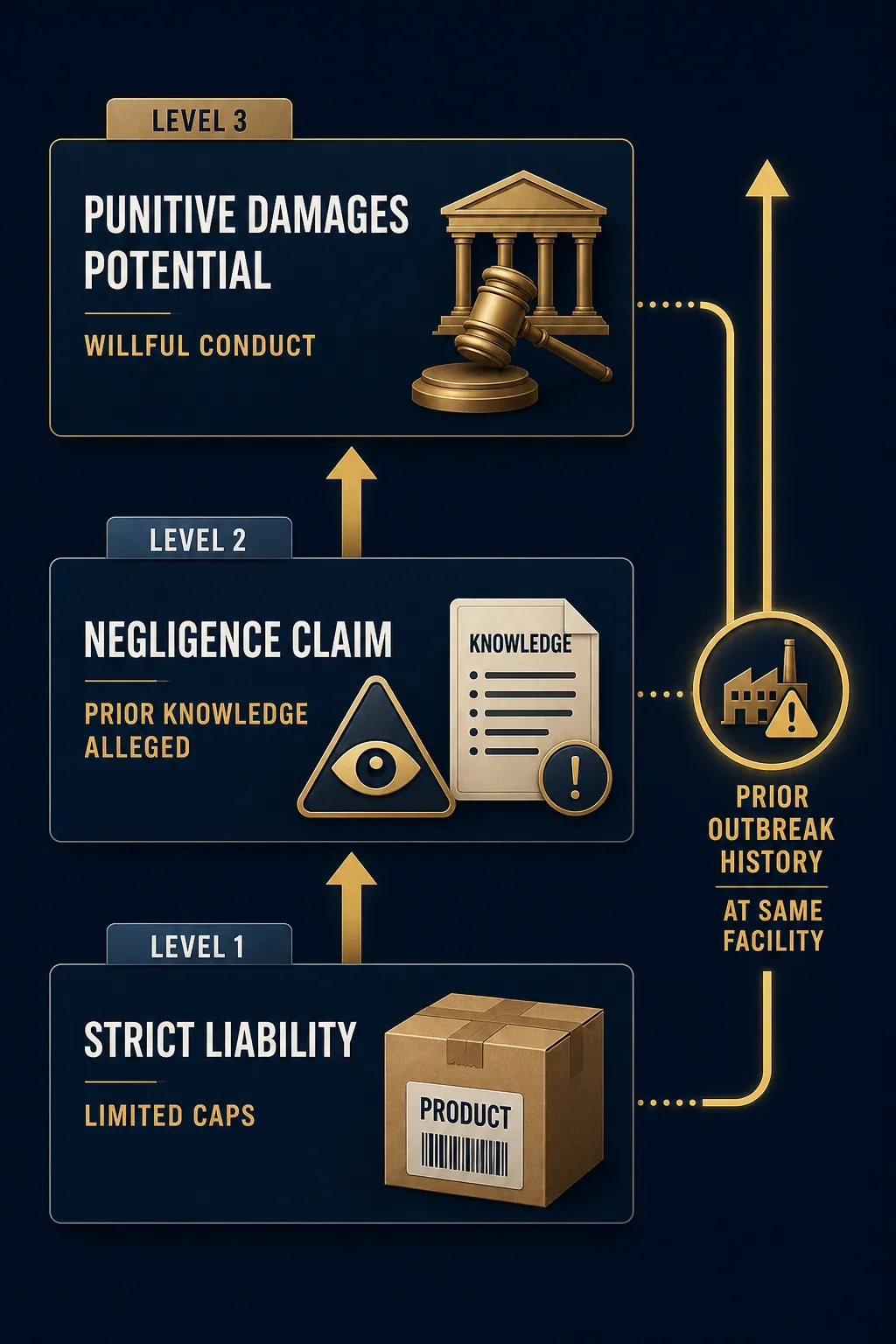
For risk managers, this is where ordinary vendor review becomes too thin. A supplier with a prior outbreak history is not automatically negligent in a later outbreak. But if the earlier event involved the same pathogen category, the same produce type or processing channel, and the same facility network, a buyer’s file should show that somebody asked more than whether the supplier’s certificate of insurance was current.
The documents that become exhibits later
In a procurement dispute, the damaging record is often not the recall notice. It is the pre-outbreak exchange showing what the buyer asked, what the supplier disclosed, and what the contract treated as routine. A prior cyclospora event tied to the same supplier nexus should push review into at least five places:
- Supplier questionnaires: whether they ask about prior outbreaks by pathogen, facility, country of origin, and corrective action, rather than only asking for open recalls.
- Audit rights: whether the buyer can inspect records tied to water, sanitation, field controls, processing controls, and corrective actions after prior contamination events.
- Indemnity language: whether caps, carveouts, defense obligations, and consequential-damage exclusions treat foodborne illness claims differently from ordinary commercial disputes.
- Insurance review: whether additional insured status, recall coverage, contamination coverage, and punitive-damages treatment match the real exposure.
- Counterparty monitoring: whether the buyer tracks agency outbreak pages, supplier recalls, and litigation filings after contract execution, not only during onboarding.
The traceback convergence is what makes the history harder to ignore
A prior outbreak involving a large produce supplier can be treated as industry noise if the later case points somewhere else. The 2026 materials are different because FDA’s investigation identifies Taylor Farms de Mexico as the single supplier of the shredded iceberg lettuce under review.[5] When that sits beside the 2013 allegation involving salad mix processed at Taylor Farms’ Mexico facility, the dispute stops being only about whether fresh produce is inherently difficult to control.
That does not eliminate causation defenses, apportionment fights, or arguments about restaurant handling, distribution, testing, or individual exposure. It does narrow the document requests that will matter. Plaintiffs will look for post-2013 corrective action records, facility-level risk assessments, supplier communications with restaurant customers, audit findings, water and sanitation controls, and executive-level notice. Defendants will try to separate the events by product, season, process, source inputs, and intervening controls.
That is the litigation value of the 2013 fact. It gives both sides a map for discovery. It also gives nonparties a reason to reassess their own supplier files before a tender letter or reservation-of-rights letter forces the review under time pressure.
What the outbreak numbers do, and do not, prove
The 2026 scale will influence settlement pressure, insurance notice, and litigation coordination. A confirmed multi-state outbreak with hospitalizations has a different claims-handling profile from a handful of sporadic illnesses. But size alone does not prove punitive exposure. Punitive theories need a knowledge-and-conduct bridge.
| Fact pattern | Liability significance |
|---|---|
| Confirmed outbreak cases linked by CDC | Supports the existence and scope of an outbreak claimant pool |
| FDA traceback to a single supplier | Focuses causation, tender, indemnity, and supplier-defense analysis |
| Recall of more than 140 SKUs across 27 states | Expands the commercial and insurance review beyond one restaurant location |
| Prior outbreak allegedly tied to the same supplier/facility nexus | Supports notice, foreseeability, negligence, and punitive-damages arguments if proved |
| Different probable, confirmed, and seasonal case counts | Requires careful reserve modeling and avoids treating surveillance numbers as identical to litigated cases |
Foodborne mass-tort history already shows why defendants fight prior-knowledge evidence hard. Peanut Corporation of America and Jensen Farms are often invoked as examples where prior conditions, warnings, or safety failures helped turn contamination events into broader culpability narratives. The current research record here does not support importing those cases as direct analogues. They are better understood as caution signs: once plaintiffs can plausibly plead that a defendant knew of a recurring food-safety hazard and failed to act, the case can move beyond a contaminated-product claim.
How this changes supplier due diligence now
The immediate procurement consequence is not that buyers should blacklist every supplier that has ever appeared in an outbreak file. That would be a crude rule in a supply chain where large processors handle high volumes and public-health investigations evolve. The better question is whether the supplier can show the afterlife of the prior event: root-cause analysis, corrective action, verification, buyer notification, insurance response, and facility-level controls.
A buyer renewing a lettuce supply agreement after the 2026 outbreak should not treat prior-history questions as reputational diligence. They are claim-allocation questions. If a supplier had a documented prior cyclospora event and a later cyclospora traceback converges on the same supplier network, the buyer’s contract file should be able to answer who accepted that risk and on what terms.
- Ask for prior outbreak disclosures by facility and pathogen, not just by corporate name.
- Tie indemnity carveouts to foodborne illness, regulatory recall, and alleged willful or reckless conduct.
- Require prompt notice of agency inquiries, not only confirmed recalls.
- Check whether insurance responds to contamination, recall expense, defense costs, and punitive-damages allegations.
- Preserve audit and corrective-action records long enough to matter in later outbreak litigation.
Insurers have a parallel problem. If underwriting files treat the 2013 event as stale simply because more than a decade has passed, they may miss the more relevant variable: whether the same facility or supplier system later appears in FDA traceback. Time reduces some risks. It does not erase a prior-knowledge allegation when the pleaded hazard recurs.
The safe conclusion is procedural, not predictive
As of July 24, 2026, the 2026 cyclospora litigation remains active, and the complaint language reported publicly should be verified against docket filings before anyone treats it as a complete pleading record. No court has ruled that Taylor Farms’ 2013 outbreak history proves negligence, supports punitive damages, or defeats contractual limits in the 2026 cases.
The risk signal is already documentable, though. Plaintiffs have identified a prior cyclospora history involving Taylor Farms produce; FDA has identified Taylor Farms de Mexico as the single supplier in the 2026 shredded iceberg lettuce investigation; and the current outbreak has a confirmed multi-state footprint large enough to draw serious indemnity, insurance, and reserve attention.[1][3][5] That combination is enough for supplier due diligence to move from ordinary recall tracking to prior-knowledge review.
References
- Ron Simon & Associates Files First Cyclospora Lawsuit Against Taco Bell and Taylor Farms in One of the Largest Food Poisoning Outbreaks in U.S. History, PR Newswire, July 17, 2026.
- Michigan couple sues Taco Bell, Taylor Farms over cyclospora outbreak linked to contaminated lettuce, WDIV ClickOnDetroit, July 21, 2026.
- HAN Archive - 00531, Centers for Disease Control and Prevention.
- Cyclospora cases count, CNN, July 21, 2026.
- Investigation of 5-State Outbreak of Cyclospora Illnesses: Iceberg Lettuce, July 2026, U.S. Food and Drug Administration, July 2026.
- Cyclosporiasis Outbreak Linked to Iceberg Lettuce, Centers for Disease Control and Prevention.
Related records
Tool profile
How Meta's AI Spending Reshapes Law Firm ProfitabilityGoverning regulation
Browse the obligations tracker →Preventive workflow
Browse verification workflows →
Report a correction or tip
Spotted an outdated figure, a misstated fact, or a ruling this case record should reflect? Public comments are disabled for this content given the professional cost of a misreported case outcome, penalty amount, or rule text — use the structured correction channel instead.
Report a correction or tip for this record →