
Why the Professor's Profane Story Firing Isn't an AI Case
A docket-verified record of Prabhakar v. Hawkins (S.D. Fla.), the lawsuit over a professor's firing for a profane story. It confirms the First Amendment and Fla. Stat. § 1004.097(4)(a) claims — and confirms no AI tool or AI-generated content is implicated, making the case a boundary example rather than an AI-risk incident.
- Jurisdiction
- US-FL
- Court
- U.S. District Court for the Southern District of Florida
- AI tool named
- No AI tool implicated
- Ruling date
- Jul 29, 2026
- Source document
- View primary court order ↗
- Last verified
- Aug 3, 2026
Lex Machina Review is an independent risk-tracking and reference resource. Nothing on this site is legal advice, and using it does not create an attorney-client relationship. Every record is reviewed against primary sources but may not reflect the most current status of a matter — always verify directly against the cited court order, rule text, or a licensed attorney before relying on it.
Companion explanation — secondary to the source document above
Risk Digest classification: confirmed negative for AI-tool implication. Prabhakar v. Hawkins is a docket-verified public-employment speech and academic-freedom lawsuit, not an AI incident record. The verified materials reviewed as of August 3, 2026 show no AI tool, no AI-generated content, no AI-assisted filing issue, no AI moderation system, no hallucinated citation problem, and no tool-accuracy dispute. That negative classification should be revisited only if later responsive pleadings or docket entries introduce AI-related facts.
| Field | Record |
|---|---|
| Case | Prabhakar v. Hawkins et al |
| Court | U.S. District Court for the Southern District of Florida |
| Docket number | 2:26-cv-14274 |
| Filing date | July 29, 2026 |
| Nature of suit | 440 — Other Civil Rights |
| Claims identified in the verified record | 42 U.S.C. § 1983 First Amendment retaliation; Fla. Stat. § 1004.097(4)(a) |
| Procedural status | Filed; no responsive pleading reflected in the verified materials as of August 3, 2026 |
| AI-implicated flag | Negative |
| Last verified | August 3, 2026 |
| Review posture | Legal-background review for Risk Digest classification; not legal advice |
The docket metadata places the case in the Southern District of Florida under docket number 2:26-cv-14274, filed July 29, 2026, with nature-of-suit code 440 for Other Civil Rights. The verified record identifies claims under 42 U.S.C. § 1983 and Fla. Stat. § 1004.097(4)(a), and no responsive pleading was reflected as of the August 3, 2026 review date. [1]
What the lawsuit is actually about
Headlines about a “professor fired for profane story” point to the public controversy, but the legally useful record is narrower. The complaint frames the dispute as a public-employment First Amendment retaliation case and a Florida academic-freedom statutory claim. The plaintiff is not asking the court to evaluate an AI system, a classroom technology platform, or a generated text artifact. The asserted injury, as reflected in the verified case record, arises from employment consequences allegedly imposed after speech in an academic setting.
The federal claim proceeds through 42 U.S.C. § 1983, the usual vehicle for alleging that a state actor violated federal constitutional rights. In practical briefing terms, that means the case turns on public-employee speech doctrine rather than product-liability, platform-governance, or legal-tech reliability questions. A court evaluating a First Amendment retaliation theory ordinarily has to look at the plaintiff’s protected-speech theory, the alleged adverse action, and the causal connection asserted between the two. The verified record supports describing the claim at that level; it does not support any AI-risk characterization.
The state-law component is also important, but for a different reason. Fla. Stat. § 1004.097(4)(a) is identified in the verified materials as the statutory basis for an academic-freedom private cause of action. That makes the case potentially relevant to lawyers tracking Florida public-higher-education litigation and campus-speech disputes. It does not, by itself, make the dispute technology-related.
That distinction matters. A case can be culturally visible and still be useless as evidence of an AI litigation trend. It can also be legally important without belonging in an AI-incident database. Prabhakar fits that boundary: civil-rights code, constitutional and statutory speech claims, public-employment posture, no AI fact alleged in the reviewed record.
Why the AI-risk flag is negative
The negative AI determination is not a comment on the merits of the professor’s claims. It is a taxonomy decision. The verified materials reviewed do not allege that anyone used an AI tool to create the disputed story, evaluate the professor’s conduct, recommend discipline, moderate content, generate a filing, or supply a false legal citation. They also do not identify a tool-accuracy failure, model hallucination, automated content-classification problem, or procurement issue.
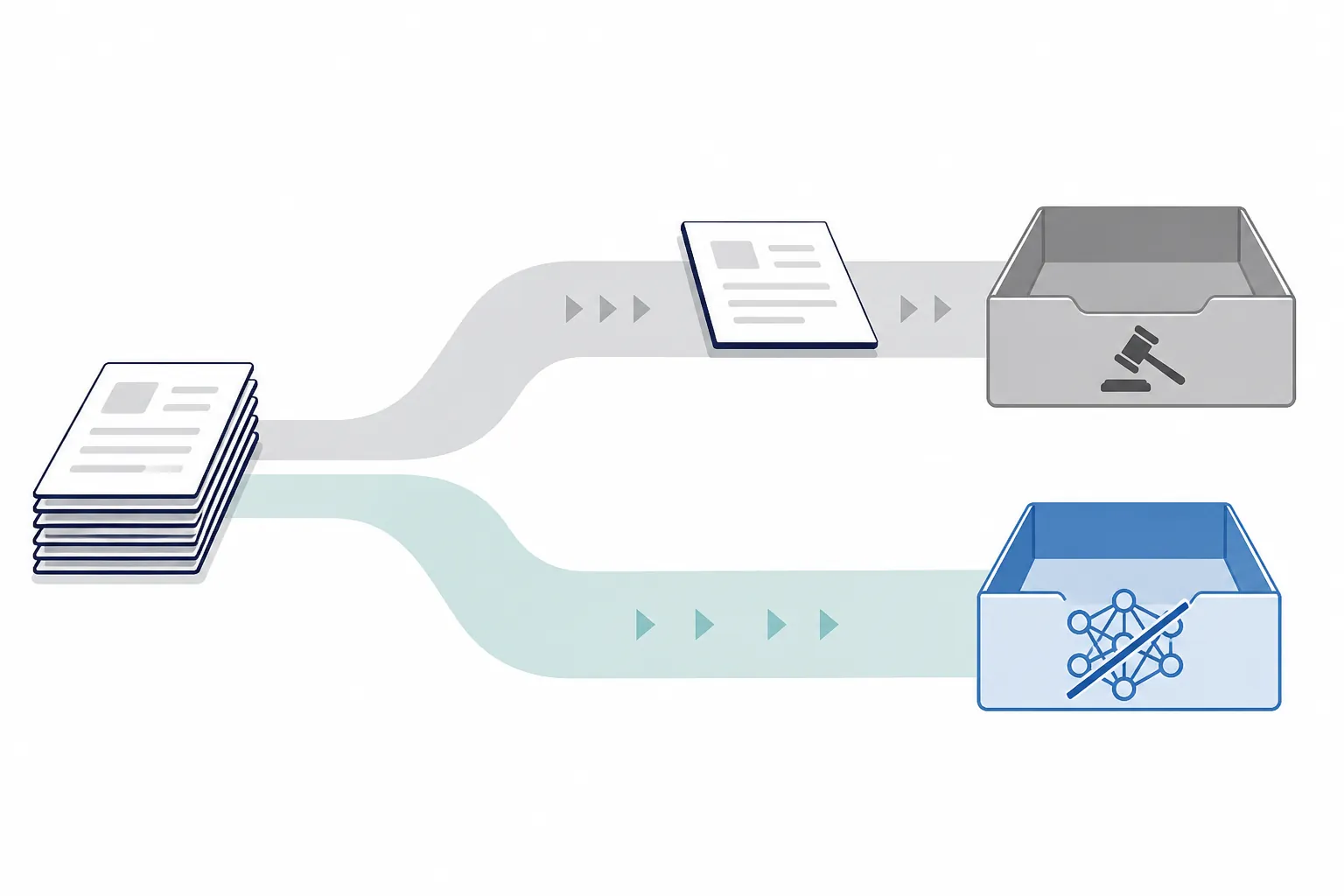
For risk tracking, that absence is load-bearing. If a database admits every lawsuit touching education, speech, technology culture, or public controversy, the dataset stops answering the question it was built to answer. A lawyer looking for AI moderation disputes should not have to filter out a campus-speech firing case merely because the news cycle around it was loud. Likewise, an in-house lawyer preparing an AI procurement memo should not cite this case as evidence of AI-tool litigation unless later pleadings change the record.
The record also does not show an AI-assisted litigation problem. There is no verified indication that the complaint relies on AI-generated allegations, fabricated authorities, or tool-created legal analysis. That point is separate from whether the underlying speech was protected or whether the defendants will dispute the facts. As of the current review, the case is not about artificial intelligence at the classroom level, administrative level, or litigation-practice level.
| Potential AI-risk category | Verified record status |
|---|---|
| AI-generated classroom content | Not implicated in the reviewed materials |
| AI moderation or automated discipline | Not implicated in the reviewed materials |
| AI-assisted employment decision | Not implicated in the reviewed materials |
| AI-generated legal filing or hallucinated citation | Not implicated in the reviewed materials |
| AI tool accuracy, bias, or procurement dispute | Not implicated in the reviewed materials |
Procedural posture and what is still open
The case was filed on July 29, 2026, and the verified record did not reflect a responsive pleading as of August 3, 2026. [1] That posture limits what can responsibly be said. The complaint supplies the plaintiff’s pleaded theory; it does not supply the defendants’ answer, defenses, factual admissions, or motion-to-dismiss arguments. Any prediction about how the defendants will characterize the speech, the employment decision, or the Florida statutory claim would be outside the current verified record.
For citation purposes, the useful formulation is precise: Prabhakar v. Hawkins is a newly filed Southern District of Florida civil-rights case asserting First Amendment retaliation and Florida academic-freedom statutory claims after a professor’s firing. It is not, on the materials reviewed, an AI case.
The update trigger is straightforward. Recheck the classification when an answer, motion to dismiss, amended complaint, exhibit, declaration, sanctions motion, or court order appears. If a later filing says an AI system generated the disputed material, assisted the employment decision, moderated the content, produced litigation work product, or otherwise becomes part of the pleaded facts, the AI-implicated flag should be revisited. Until then, changing the label would add noise rather than information.
Risk Digest classification
As of August 3, 2026, Prabhakar v. Hawkins belongs in Risk Digest only as a confirmed-negative AI-tool boundary case. The docket-verified record supports tracking the lawsuit for public-employment First Amendment and Florida academic-freedom purposes. It does not support treating the matter as an AI-risk incident.
References
- PACER Monitor docket for PRABHAKAR v. HAWKINS et al — PACER Monitor.
Related records
Tool profile
How Meta's AI Spending Reshapes Law Firm ProfitabilityGoverning regulation
Browse the obligations tracker →Preventive workflow
Browse verification workflows →
Report a correction or tip
Spotted an outdated figure, a misstated fact, or a ruling this case record should reflect? Public comments are disabled for this content given the professional cost of a misreported case outcome, penalty amount, or rule text — use the structured correction channel instead.
Report a correction or tip for this record →