
Seattle-area active shooter legal timeline and AI evidence ruling
This record tracks the full legal-investigation timeline of the September 2021 Seattle-area shooting that produced the first U.S. criminal-court exclusion of generative-AI-enhanced video evidence under the Frye standard, including the trial conviction, life sentence, and the currently pending Washington Court of Appeals appeal.
- Jurisdiction
- Washington (state)
- Court
- King County Superior Court
- AI tool named
- Topaz Video AI
- Ruling date
- Mar 1, 2024
- Source document
- View primary court order ↗
- Last verified
- Jul 27, 2026
Lex Machina Review is an independent risk-tracking and reference resource. Nothing on this site is legal advice, and using it does not create an attorney-client relationship. Every record is reviewed against primary sources but may not reflect the most current status of a matter — always verify directly against the cited court order, rule text, or a licensed attorney before relying on it.
Companion explanation — secondary to the source document above
| Risk field | Verified record |
|---|---|
| Jurisdiction | Washington state criminal prosecution; King County Superior Court |
| Court and case number | State v. Puloka, King County Superior Court No. 21-1-04851-2-KNT [1] |
| AI tool named in the ruling | Topaz Video AI [1] |
| Frye ruling | March 2024 exclusion of generative-AI-enhanced video evidence [1] |
| Current status | Trial-court exclusion, jury conviction, and sentence have been imposed; Washington Court of Appeals, Division I appeal remains pending after June 11, 2026 oral argument, with no published appellate opinion located as of July 27, 2026 (UTC). |
| Primary source | Frye hearing findings of fact and conclusions of law [1] |
| Last verified | July 27, 2026 (UTC) |
The Seattle Center search term points to a different legal record
A search for “seattle center active shooter timeline legal investigation” can now point in two directions. One is the reported July 25–26, 2026 Seattle Center/Bite of Seattle incident. As of this verification date, there is no public legal proceeding or investigation timeline available for that reported incident to track in court-record form. The other is State v. Puloka, a Des Moines, Washington shooting case in the Seattle area with a criminal docket, a Frye order, a trial record, a sentence, and a pending appeal.
This record covers Puloka because it is the legally trackable matter. It should not be cited as a procedural timeline for the Seattle Center/Bite of Seattle report unless and until public investigative or court materials for that separate incident exist.
Procedural timeline
| Date or stage | What the record shows | Why it matters |
|---|---|---|
| September 26, 2021 | A shooting occurred outside La Familia Sports Pub and Lounge in Des Moines, Washington. The victims identified in later reporting were Angelia Derae Hylton, Ezra Taylor, and Antoine Darryl Matthews. [2][3] | This is the incident underlying the criminal prosecution, not the July 2026 Seattle Center report. |
| Investigation and charging period | Investigators had surveillance video and other evidence. Puloka later asserted self-defense at trial. [2][3] | The video evidence became important, but the disputed AI-enhanced version was not the only proof available to the State. |
| Pretrial evidence dispute | The defense sought to use video processed with Topaz Video AI. [1] | The admissibility fight was about the AI-enhanced version, not whether the original surveillance footage could be considered. |
| March 2024 | King County Superior Court excluded the AI-enhanced video under Frye. [1] | The order is the central AI-evidence ruling in the case. |
| Trial | The jury rejected Puloka’s self-defense claim and convicted him on all eight counts, using the original unenhanced video and other evidence rather than the excluded AI-enhanced footage. [3] | The exclusion did not prevent the prosecution from obtaining convictions. |
| Sentencing | Puloka was sentenced to life in prison without parole. [3] | The case now has a final trial-court judgment for appellate review. |
| June 11, 2026 | Oral argument occurred before Washington Court of Appeals, Division I, based on calendar materials reviewed for this update. | The Frye issue is no longer only a trial-court ruling, but there is still no appellate merits decision to cite. |
| July 27, 2026 | No published appellate opinion was located as of the last verification date. | The case is important to monitor, but its rule value remains provisional. |
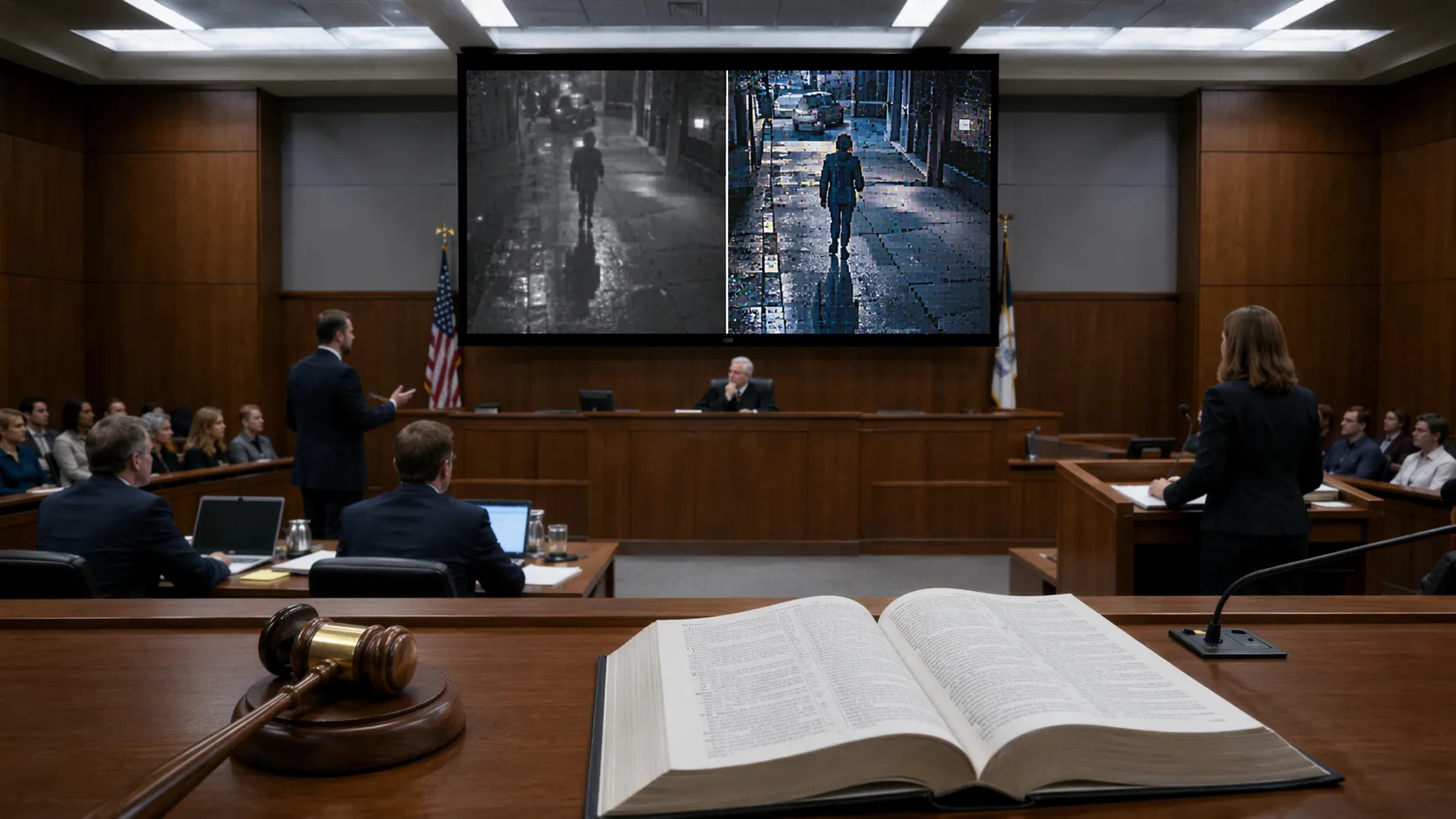
The Frye order did not treat “enhanced” as a synonym for reliable
The March 2024 order is the load-bearing document. The court did not exclude every video exhibit, and it did not decide that all AI-assisted imagery is inadmissible. It addressed a narrower offer: a version of surveillance footage processed through Topaz Video AI, proposed for use in a criminal trial. [1]
Under Frye, the court had to ask whether the technique was generally accepted in the relevant scientific community. The order framed that community around forensic video analysis and related image-science expertise, not around ordinary viewers, commercial video editors, or users impressed by a cleaner-looking clip. [1]
That framing mattered. The defense’s proposed expert was a videographer, but legal analyses of the hearing noted that he could not explain Topaz’s training data or the algorithmic process by which the software generated the enhanced result. [4][5] That inability is not a side issue. If the proponent cannot explain how the tool turns the original input into the offered output, the court cannot meaningfully test whether the output is a faithful clarification of recorded information or a newly generated image with forensic-looking detail.
The State’s forensic-video showing was more specific. Grant Fredericks, described in secondary coverage as a certified forensic video analyst with more than 30 years of experience and FBI training work, testified for the prosecution. [4][5] Credentials alone would not answer the Frye question, but the court had more than credentials in front of it: the State demonstrated that the Topaz-processed output added roughly sixteen times the original pixel count, generated detail that had not been recorded by the camera, and removed some recorded information. [1]
That is the part of the order that gets lost when the case is summarized as an “AI video” ruling. The problem was not merely that the image looked better than the source. The problem was that the apparent improvement came from a generative process the court found could add and subtract information in ways the witness could not fully account for. A clearer-looking frame can be less useful for proof if the clarity comes from generated content rather than recoverable source data.
The court also relied on a vendor-side warning. Topaz Labs’ own materials, quoted in the order, recommended against use of its AI technology for forensic or legal purposes. [1] That statement should be read with product discipline: the footage in Puloka was processed with Topaz Video AI. The order does not create a record about every Topaz product or every possible AI-assisted imaging workflow.
What the exclusion changed at trial
The exclusion changed the evidentiary record, not the availability of a prosecution. The jury did not see the Topaz-enhanced version as evidence. It did receive the original unenhanced video and other proof, and it convicted Puloka on all eight counts after rejecting his self-defense theory. [3]
That sequence is important for anyone treating the case as an admissibility precedent. Puloka is not an example of a court throwing out a prosecution because AI evidence was unreliable. It is an example of a court excluding a proposed AI-enhanced exhibit while the criminal case proceeded on admissible evidence. The later conviction does not cure or undermine the Frye ruling; it shows that the disputed AI-enhanced video was not necessary to reach a verdict.
Sentencing then fixed the trial-court judgment posture. FOX 13 Seattle reported that Puloka received life in prison without parole. [3] With conviction and sentence imposed, the legal question moved from pretrial admissibility into appellate review.
Why Puloka is being tracked beyond Washington
Puloka has drawn attention because legal commentators have treated it as a first U.S. criminal-court ruling excluding generative-AI-enhanced video evidence under Frye. [4][5] That label should be handled carefully. It does not mean every court will follow the same path, and it does not mean every AI-assisted enhancement will fail. It means this is the clearest known criminal trial-court record where a generative video enhancement was tested under Frye and excluded.
The case has also entered institutional evidence-rule discussion. The U.S. Judicial Conference Advisory Committee on Evidence Rules included Puloka in its May 2026 agenda materials, a sign that the case is being watched as part of broader judicial administration concerns about AI and proof. [6] The American Judicature Society’s December 2025 executive summary likewise listed Puloka with the appeal pending. [7]
The broader technical concern is not exotic. Criminal Legal News, discussing challenges to AI-enhanced video evidence, pointed to the tension between perceptual quality and forensic reliability: an image can become easier for a human to interpret while becoming less dependable as a record of what the camera actually captured. [8] Puloka gives that concern a criminal-court procedural shape.
Appellate status as of July 27, 2026
The Washington Court of Appeals status is the point most likely to be misreported. The trial-court Frye order exists. The conviction and sentence exist. Oral argument before Division I occurred on June 11, 2026, based on calendar materials reviewed for this update. But no published appellate opinion affirming or reversing the AI-evidence exclusion was located as of July 27, 2026.
That distinction controls the case’s present use. A lawyer can cite the King County Superior Court order for what that court found and concluded. A lawyer should not describe the exclusion as appellate-approved unless Division I issues a decision doing so. The absence of a published appellate opinion also means there is no appellate holding yet on how Washington courts should treat generative-AI video upscaling under Frye.
There is one additional verification limit. The appellate docket could not be independently crawled for this record update, so the appellate-status note is deliberately narrow: oral argument is calendar-derived, the appeal is treated as pending, and no published opinion was found by the verification date.
Current risk-digest takeaway
Puloka matters because it is a court-recorded sequence, not because it supplies a finished national rule. A Seattle-area shooting led to a criminal prosecution. The defense offered Topaz Video AI-enhanced footage. The trial court excluded that version under Frye after findings about pixel multiplication, generated detail, lost recorded information, unexplained training data and algorithms, and the vendor’s own warning against forensic or legal use. The jury then convicted on all eight counts using the original unenhanced video and other evidence. A life-without-parole sentence followed.
For AI-evidence monitoring, this is the leading U.S. criminal-court admissibility record to watch. Its appellate rule value remains provisional until Washington Court of Appeals, Division I issues a decision.
References
- Washington v. Puloka (No. 21-1-04851-2-KNT) (Sup. Ct. WA 2024) — NACDL, 2024
- Washington state judge blocks use of AI-enhanced video evidence — NBC News
- Joshua Puloka sentenced to life in prison — FOX 13 Seattle
- Judge’s AI Video Rejection Evokes Broader Tech Evidence Issues — Bloomberg Law
- Washington Court Rejects Novel Use of AI-Enhanced Video in Trial — Greenberg Traurig, May 2024
- 2026-05 Evidence Rules Agenda Book — U.S. Judicial Conference Advisory Committee on Evidence Rules, May 2026
- Impacts of AI on the Judiciary — American Judicature Society, December 1, 2025
- When AI Invents the Pixels: Challenging AI-Enhanced Video Evidence in Criminal Cases — Criminal Legal News, January 2026
Related records
Tool profile
How Meta's AI Spending Reshapes Law Firm ProfitabilityGoverning regulation
Browse the obligations tracker →Preventive workflow
Browse verification workflows →
Report a correction or tip
Spotted an outdated figure, a misstated fact, or a ruling this case record should reflect? Public comments are disabled for this content given the professional cost of a misreported case outcome, penalty amount, or rule text — use the structured correction channel instead.
Report a correction or tip for this record →