
Remdesivir patent revocation at UPC shifts obviousness standard
The Unified Patent Court revoked Gilead's remdesivir patent in May 2026, introducing a 'no fear of failure' standard for the skilled person that tightens obviousness analysis for second-medical-use patents. This ruling raises the litigation risk for pharmaceutical patents claiming known compounds against newly identified indications where prior art suggests the class.
- Jurisdiction
- EU
- Court
- UPC Central Division, Milan
- AI tool named
- No AI tool implicated
- Ruling date
- May 4, 2026
- Source document
- View primary court order ↗
- Last verified
- Jul 30, 2026
Lex Machina Review is an independent risk-tracking and reference resource. Nothing on this site is legal advice, and using it does not create an attorney-client relationship. Every record is reviewed against primary sources but may not reflect the most current status of a matter — always verify directly against the cited court order, rule text, or a licensed attorney before relying on it.
Companion explanation — secondary to the source document above
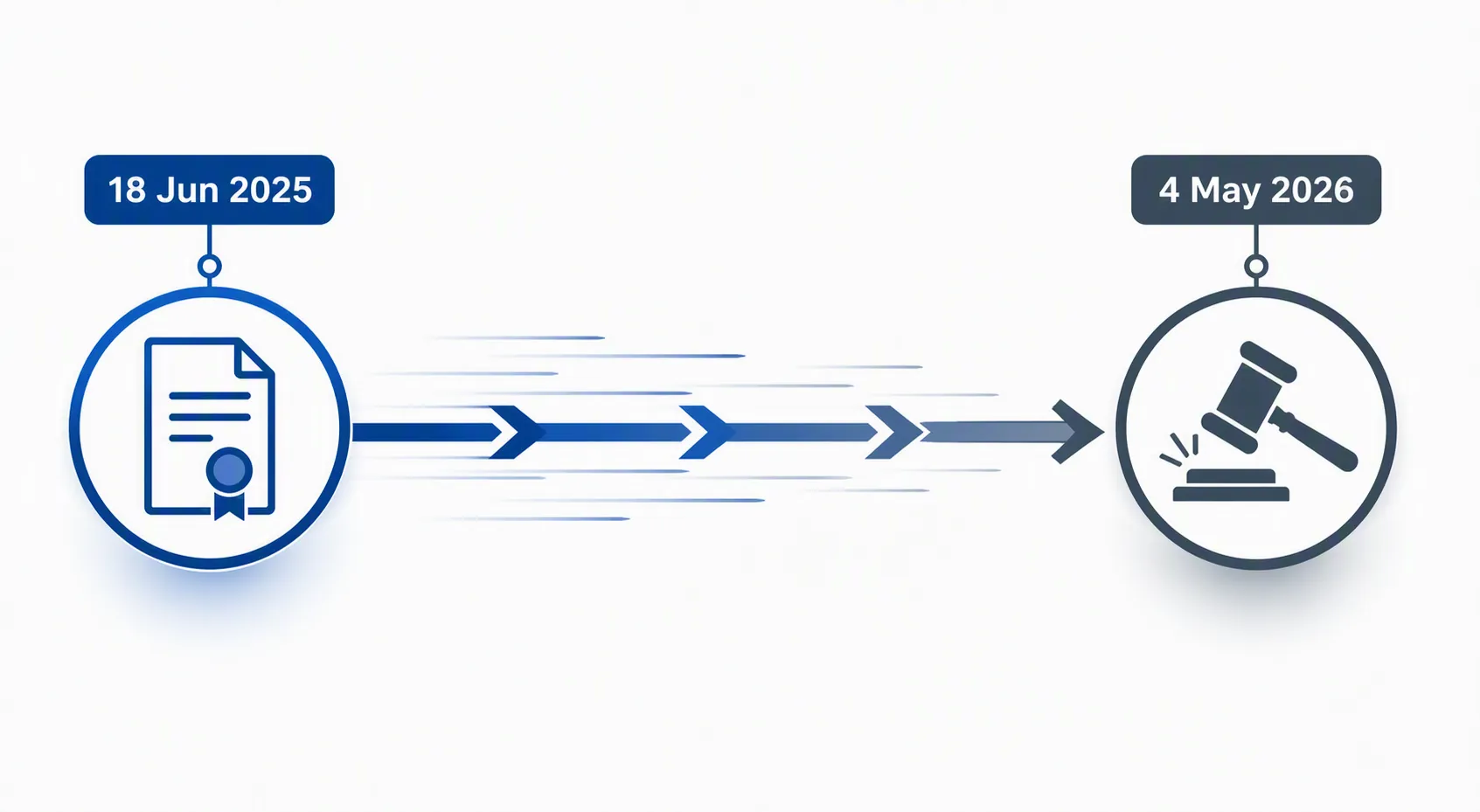
Risk record, not legal advice: on May 4, 2026, the UPC Central Division in Milan revoked EP 3854403 in Gilead v. AMMS, a remdesivir second-medical-use case brought as a revocation action on the day the patent was granted, June 18, 2025; the action reached a first-instance decision in under 11 months, with a reported €20 million dispute value and €800,000 costs figure. The patent also was not opted out of the UPC system. [1][2][3]
The immediate pharma-law implication is narrower, and more useful, than a generic warning that COVID-era patents are vulnerable. The UPC did not merely revoke a remdesivir patent. It used the revocation to say something operational about obviousness: a skilled person may follow a scientifically valid pointer without being treated as legally deterred by ordinary uncertainty or a subjective “fear of failure.” [1]

| Case signal | Verified point |
|---|---|
| Court and division | UPC Central Division, Milan |
| Decision date | May 4, 2026 |
| Patent | EP 3854403 |
| Outcome | Unitary patent revoked |
| Timing | Grant on June 18, 2025; revocation decision on May 4, 2026 |
| Procedural choice | Gilead filed on the day of grant and did not opt out |
| Reported dispute value and costs | €20 million dispute value; €800,000 costs |
| Live qualifications | First-instance UPC ruling; possible appeal; parallel EPO opposition pending |
The procedural posture is part of the signal
A same-day revocation filing is not just chronology. For an in-house team assessing UPC exposure, it says the claimant was prepared to put validity before the UPC immediately rather than wait for a slower, more familiar route. The absence of an opt-out matters for the same reason: this patent remained available to centralized attack, and that attack produced a revocation decision before the first anniversary of grant. [1][3]
That timing should not be oversold into a general forecast that all pharmaceutical patents will fall faster at the UPC. It is still one first-instance decision on a second-medical-use patent. But for portfolio triage, the procedural lesson is concrete: where a commercially relevant unitary patent rests on a new therapeutic use of a known compound or class, a claimant willing to move immediately can obtain a centralized validity ruling on a timetable that changes settlement leverage.
How the court made obviousness do the work
The load-bearing part of the ruling is the obviousness chain. The Milan Central Division framed the objective technical problem in modest terms: finding a drug with antiviral activity. Once the problem was set at that level, prior-art pointers toward the remdesivir compound became highly significant. The court treated the path from the prior art to the claimed use as one a skilled person could rationally pursue, rather than one blocked by the possibility that the experiment might fail. [1][2]
That framing matters because many second-medical-use disputes turn on how ambitious the problem is allowed to become. A problem defined as achieving a specific clinical success can make the patentee’s uncertainty arguments feel weighty. A problem defined as finding a drug with antiviral activity leaves less room for advocacy built around downstream unknowns, especially where the prior art already points to the relevant compound or class.
Headnote 2 is the phrase practitioners will keep returning to: the skilled person “does not display a fear of failure.” The same headnote indicates that the skilled person will not reject a scientifically valid pointer because of subjective concerns about possible failure. [1]
That is not the same as saying every uncertain experiment is obvious. The sharper distinction is between a reasonable expectation of success and a mere hope of success. The UPC drew on the Court of Appeal’s Amgen v. Sanofi/Regeneron headnotes: reasonable expectation requires scientific data indicating that a positive result is probable, while mere hope rests on sheer assumptions or sits against contradictory information. [1][4]

The practical effect is to make the patentee identify what kind of uncertainty it is invoking. If the record contains data pointing positively toward the compound, ordinary unresolved questions may not be enough. If the record contains contrary science, missing mechanistic support, or assumptions untethered from data, the case looks different. The court’s language is therefore not anti-patent rhetoric; it is a demand that reluctance be evidential rather than atmospheric.
Why the adjective “modest” changes portfolio triage
The objective technical problem often decides how much work the prior art has to do. In this ruling, the problem was not inflated into proving the eventual therapeutic outcome in all its later clinical detail. It was kept modest. That modesty allowed prior-art pointers to carry more weight because they only had to make pursuit of antiviral activity scientifically plausible, not guarantee ultimate success.
For second-medical-use claims, that is the uncomfortable part. These claims often survive on the gap between an earlier compound disclosure and a later therapeutic indication. The gap remains meaningful where the prior art does not point toward the new use, or where the science teaches away. It becomes thinner where the earlier literature already directs attention to the same compound class for the same broad biological direction.
What this exposes in second-medical-use portfolios
The ruling is most relevant to claims that combine three features: a known compound or compound class, a later-claimed medical indication, and prior art that already makes the class look scientifically plausible for that indication or a closely related biological activity. In that setting, a defense built mainly on the skilled person’s caution now has a more difficult UPC audience.
The vulnerability is not that the compound was known. Second-medical-use protection exists because a new therapeutic use can still be patentable. The vulnerability appears when the evidential route to that use was already signposted, and the patentee asks the court to treat unresolved experimental risk as a deterrent. After this decision, a UPC validity panel may ask a more disciplined question: was the skilled person facing a mere hope, or was there scientific data making success probable enough to pursue?
That question affects both sides of a validity fight. A revocation claimant will want to assemble the prior-art chain so that it looks like a data-supported pointer, not a hindsight reconstruction. The patentee will need more than a list of unknowns. It will need to show why those unknowns were grounded in contrary science, contradictions, or an absence of reliable support, rather than in the normal fact that pharmaceutical research can fail.
| Portfolio feature | UPC risk after the remdesivir ruling |
|---|---|
| Known compound with a later-claimed use | Not automatically vulnerable, but exposed if prior art already points toward the biological activity |
| Prior art identifies a relevant class | Higher obviousness pressure where the claimed compound sits within the signposted class |
| Defense relies on general uncertainty | Weaker if uncertainty is framed as subjective hesitation rather than contrary scientific evidence |
| Defense relies on contradictory data or teaching away | Potentially stronger, because the ruling preserves the line between reasonable expectation and mere hope |
| Broadly framed technical problem | May be challenged if a more modest problem better reflects the technical contribution |
The prosecution file will not carry vague reluctance forever
For prosecution teams, the decision is a reminder that arguments useful before grant may not age well in centralized litigation. A statement that development was uncertain, difficult, or risky may be true and still legally insufficient. The more useful record distinguishes between uncertainty that every skilled team would expect and uncertainty that would have made the prior-art pointer scientifically unreliable.
For in-house counsel reviewing a second-medical-use family, the first review should not begin with the commercial importance of the indication. It should begin with the pre-priority literature: what was already known about the compound class, what data pointed toward the relevant activity, whether any source taught away, and whether the claimed contribution changed the evidential picture or merely confirmed a direction already made plausible.
A hypothetical example shows the difference. If prior art identifies a class of compounds as promising against a viral target and the claimed compound is one of the better-supported candidates in that class, a later second-medical-use claim may struggle if the patentee’s answer is only that clinical work remained uncertain. If, instead, the same prior art contains inconsistent results or a reason to expect the claimed compound would not work, the patentee has a different kind of obviousness answer. The first is hesitation; the second is contrary science.
Litigation consequences at the UPC
The claimant-side playbook becomes clearer. A revocation action should show the court a scientifically coherent route from prior art to claimed use, then resist attempts to recast each unresolved development question as a legal barrier. The remdesivir decision gives that argument a compact doctrinal form: the skilled person has no fear of failure, and a reasonable expectation of success is different from mere hope. [1][4]
The patentee-side playbook becomes less forgiving. It is no longer enough to collect the uncertainties that existed before priority and present them as a cloud. The court will likely want to know whether those uncertainties would have defeated the scientific pointer. If the answer is only that drug development is unpredictable, the defense risks sounding like the kind of subjective reluctance Headnote 2 rejects.
Costs and speed also affect behavior. A reported €800,000 costs figure attached to a revocation decision delivered in under 11 months gives both sides a more tangible model for UPC exposure in high-value pharmaceutical validity disputes. [1][3] That does not mean every second-medical-use patent should be litigated centrally. It does mean the UPC is now a credible venue for a focused obviousness attack where the prior art is clean enough.
What not to read into the decision
The ruling should not be converted into a broad claim that pharmaceutical patents are now weaker as a category. The decision concerns a second-medical-use patent, not a first-medical-use claim or a product patent. Its reasoning may matter by analogy in other life sciences cases, but the present risk signal is strongest where the claim depends on a newly identified indication for a known compound and the prior art already points in that direction.
Nor is the last word necessarily written. This is a first-instance UPC decision, and an appeal could refine or limit the “no fear of failure” formulation. The parallel EPO opposition against the same patent also remains pending, with AMMS’s response deadline reported as June 30, 2026. [2] Those qualifications are not procedural housekeeping; they are part of the validity-risk assessment.
The calibrated takeaway is therefore specific. Second-medical-use patents are more exposed at the UPC where prior art points to the relevant compound class and the patentee’s obviousness defense depends on hesitation rather than contrary science. The remdesivir revocation is important because it gives that exposure a court-tested vocabulary: modest problem, valid pointer, no fear of failure, reasonable expectation rather than mere hope.
References
Related records
Tool profile
How Meta's AI Spending Reshapes Law Firm ProfitabilityGoverning regulation
Browse the obligations tracker →Preventive workflow
Browse verification workflows →
Report a correction or tip
Spotted an outdated figure, a misstated fact, or a ruling this case record should reflect? Public comments are disabled for this content given the professional cost of a misreported case outcome, penalty amount, or rule text — use the structured correction channel instead.
Report a correction or tip for this record →