
When Are Retailers Liable in a Salmonella Egg Recall?
Maps retailer legal exposure in the July 2026 Midwest Poultry salmonella egg recall across the six affected states. It shows why passive sellers are largely shielded in Texas, Louisiana, and Mississippi, why Arkansas, Oklahoma, and New Mexico still expose any chain-of-distribution seller to strict liability, and how post-notice conduct can defeat even a passive-seller defense.
- Jurisdiction
- US (TX, LA, MS, AR, OK, NM)
- Court
- No court proceedings identified
- AI tool named
- No AI tool implicated
- Ruling date
- Jul 22, 2026
- Source document
- View primary court order ↗
- Last verified
- Jul 31, 2026
Lex Machina Review is an independent risk-tracking and reference resource. Nothing on this site is legal advice, and using it does not create an attorney-client relationship. Every record is reviewed against primary sources but may not reflect the most current status of a matter — always verify directly against the cited court order, rule text, or a licensed attorney before relying on it.
Companion explanation — secondary to the source document above
Last verified: July 31, 2026. This Risk Digest record is an information map for recall and product-liability risk; it is not legal advice.
The notice that starts the liability clock
The legal analysis starts with the recall notice, not with the most alarming outbreak number. On July 22, 2026, Midwest Poultry Services, L.P. announced a voluntary recall of 1,589,577 dozen white shell and brown cage-free shell eggs because of possible Salmonella Enteritidis contamination. The relevant cartons bear codes P-1950 or 0840962, Julian dates 157–184, and sell-by or best-by dates from July 20 through August 17, 2026. The eggs were shipped to foodservice and retail customers in Texas, Oklahoma, and Louisiana, and were sold at Kroger stores in Texas and Louisiana, Brookshire Grocery stores in Texas, Oklahoma, Arkansas, Louisiana, New Mexico, and Mississippi, and smaller outlets under Kroger, Simple Truth, Brookshire’s, Country Morning, and Cal-Maine Sunups brands.[1]

Two days later, FDA’s outbreak update linked shell eggs to 98 illnesses across 17 states, including 26 hospitalizations and no deaths. Reported illness-onset dates ran from November 21, 2025 through June 30, 2026. Of 44 ill persons with information available, 40 reported eating eggs. FDA also reported that whole-genome sequencing results from Midwest Poultry’s third-party laboratory matched the outbreak strain and were shared with FDA on July 21. The agency identified Midwest Poultry through traceback as a likely source, while also stating that the recalled eggs “do not account for all illnesses.”[2]
That last sentence matters. It keeps the retailer-liability question tied to the recalled identifiers rather than to the outbreak in the abstract. A plaintiff who ate eggs during the outbreak period still has to connect the illness, the product, the seller, and the governing law. A retailer evaluating exposure has to ask a narrower first question: did the store, warehouse, restaurant, or foodservice kitchen handle eggs with P-1950 or 0840962 and Julian dates 157–184 after it had reason to stop?
The sequence: chain position, notice conduct, state law
For retailer liability in the 2026 salmonella egg recall, the working sequence is simple, but the answers are state-specific. Retailer exposure turns first on where the defendant sat in the chain of distribution, second on whether the defendant kept selling or serving recalled eggs after the July 22 notice, and third on the law of the state governing the sale.
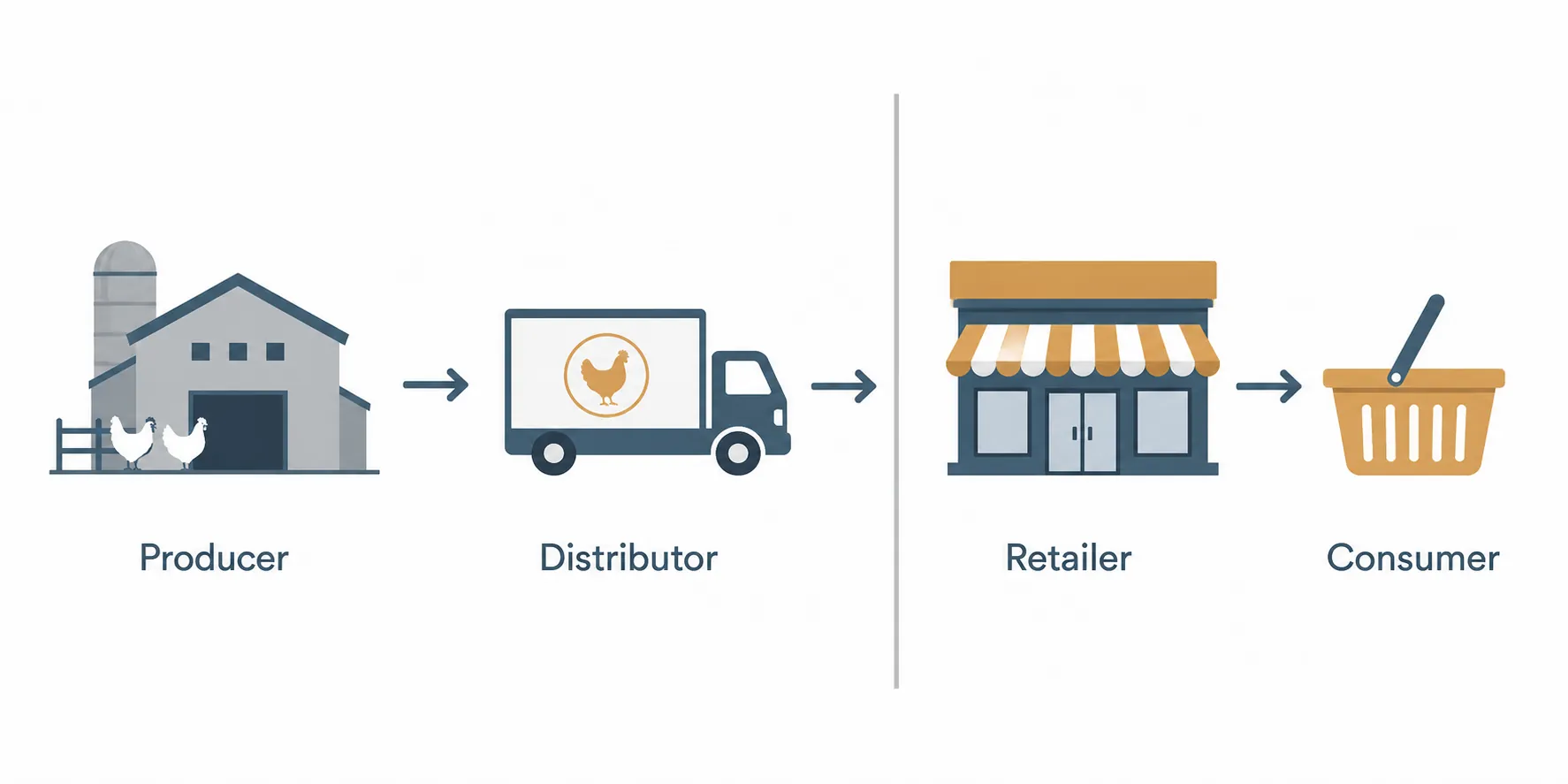
The chain-of-distribution framework explains why “sold by” and “made by” cannot be collapsed. Marler Clark’s general product-liability explanation states the conceptual split this way: food manufacturers are strictly liable for defective food, most states do not hold a retail seller liable for merely selling a contaminated product it did not manufacture unless there is negligence, and some states still impose strict liability on any entity in the chain of distribution. It also notes that indemnity contracts and insurers often decide who ultimately bears the cost after a seller is named.[3]
The July 22 notice changes the negligence analysis. FDA and CDC instructed retailers and restaurants in Arkansas, Louisiana, Mississippi, New Mexico, Oklahoma, and Texas not to sell or serve recalled eggs and to clean and sanitize surfaces and containers that may have contacted them.[2][4] After that instruction is in the file, a store or restaurant cannot treat itself as a purely passive conduit if recalled cartons move through a register, enter a recipe, sit on a buffet line, or remain available in a cooler that should have been pulled.
What the retailer is actually defending against
A sealed-carton sale before notice is the retailer’s strongest fact pattern. The retailer did not raise the hens, pack the eggs, create the contamination risk, generate the P-code, or perform the environmental or laboratory work later described by FDA. In a passive-seller state, that fact pattern usually points away from strict liability and toward the producer or manufacturer.
A post-notice sale is different. Once the recall identifies the exact codes, date range, affected brands, and affected retail geography, the operational question is no longer whether the retailer manufactured a defective egg. It is whether the retailer had a functioning stop-sale process, whether recalled inventory was quarantined, whether foodservice staff were told not to use the eggs, and whether cleaning and sanitizing occurred where the eggs had been stored or handled.
That is where a passive-seller defense can become beside the point. A plaintiff does not need to prove that the retailer manufactured the product if the claim is that the retailer negligently failed to remove known recalled inventory, served eggs after notice, or failed to warn consumers when it had a practical opportunity to do so. The defect may have originated upstream, but the breach alleged against the retailer would be local, dated, and operational.
Foodservice accounts add another layer. A grocery store that sells an intact carton has one exposure profile; a restaurant, deli, bakery, hotel breakfast operation, or prepared-foods counter that cracks eggs into food has another. The recall notice still identifies the product, but the later evidence may turn on recipe logs, receiving records, line checks, batch records, trash pulls, cleaning logs, and employee communications after July 22.
The six-state split
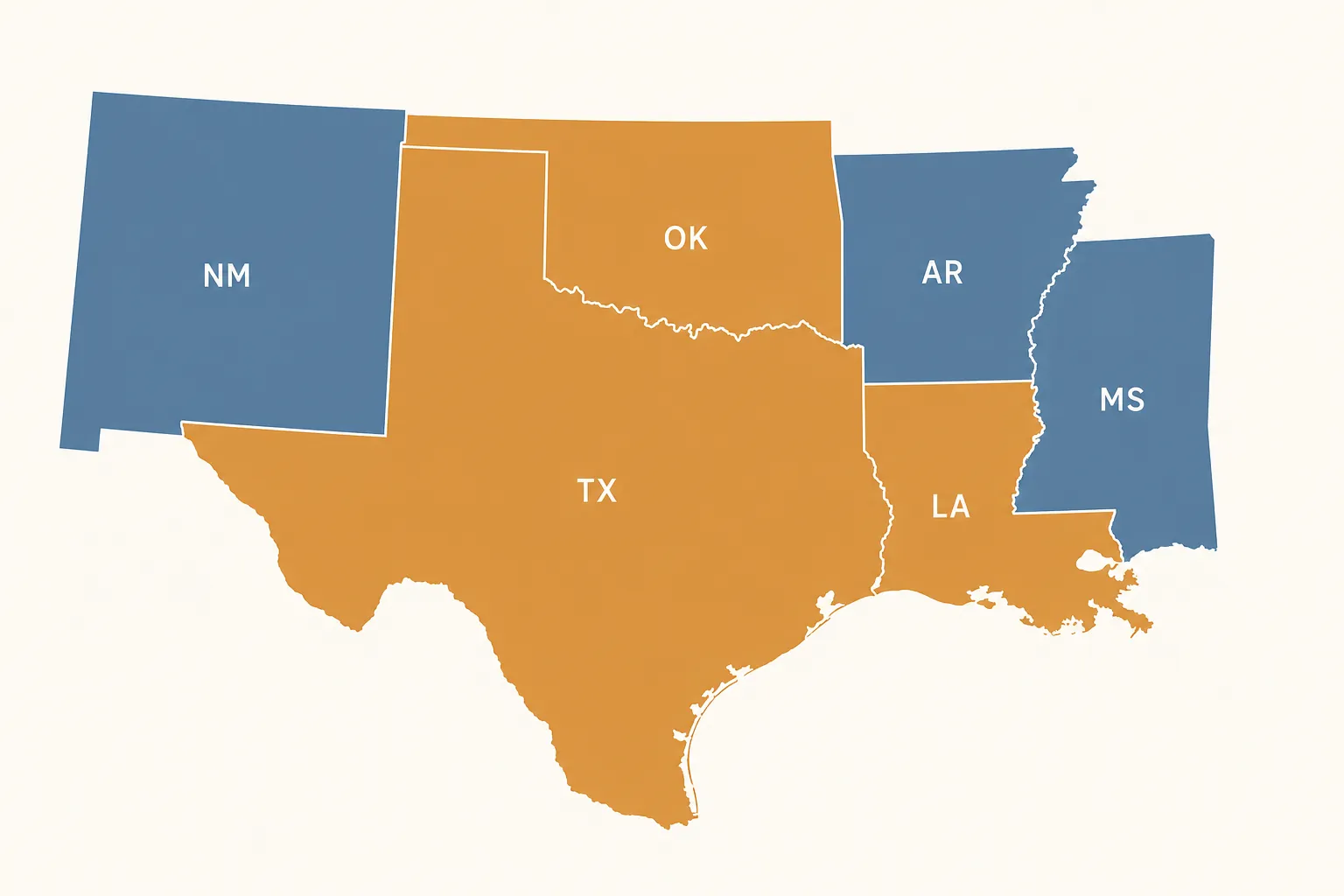
The affected retail states do not give the same answer. Texas and Louisiana need separate treatment because current primary statutes, not a generalized 50-state summary, drive the analysis. Mississippi is treated here as a shielded-passive-seller state based on the mere-conduit rule identified in the CRS survey, but that survey is old and should be checked against current Mississippi authority before any filing or coverage position is taken. Arkansas, Oklahoma, and New Mexico appear on the exposure side in the 2005 CRS survey, but that is also a re-verification item, not a substitute for current-law research.
| State | Baseline retailer exposure for passive sale | Practical recall consequence | Verification posture |
|---|---|---|---|
| Texas | Largely shielded for a nonmanufacturing seller under Chapter 82, subject to statutory exceptions.[5] | A sealed-carton retailer has a strong passive-seller defense; post-July 22 sale or service of identified P-codes creates a separate negligence problem. | Use current Texas statute and current case law. |
| Louisiana | Largely shielded under the Louisiana Products Liability Act framework, which centers product-liability responsibility on manufacturers.[6] | A retailer’s better defense is passive sale; exposure rises if it continued selling, serving, repackaging, or failing to pull recalled eggs after notice. | Use current LPLA authority, not an old national survey. |
| Mississippi | Treated as shielded for a mere conduit under the CRS survey.[7] | Passive retail sale is materially different from post-notice handling or foodservice use. | Re-check current Mississippi statutes and controlling cases. |
| Arkansas | CRS survey places seller strict-liability exposure on the chain-of-distribution side.[7] | A retailer may face strict-liability naming risk even without proof it manufactured the eggs. | CRS is from 2005; current Arkansas law must be verified. |
| Oklahoma | CRS survey places seller strict-liability exposure on the chain-of-distribution side.[7] | Retailer dismissal may be harder if state law still treats sellers in the chain as strictly liable. | CRS is from 2005; current Oklahoma law must be verified. |
| New Mexico | CRS survey places seller strict-liability exposure on the chain-of-distribution side.[7] | A passive retailer has more naming and settlement exposure than in Texas or Louisiana if the CRS classification remains current. | CRS is from 2005; current New Mexico law must be verified. |
Texas: strong passive-seller posture, weak excuses after notice
Texas is the cleanest example of why the retail defendant’s role has to be separated from the producer’s role. Texas Civil Practice and Remedies Code § 82.003 addresses nonmanufacturing sellers and generally protects them from liability for harm caused by a product unless the claimant can fit the case within a statutory exception.[5] For a Texas grocery chain that sold a sealed carton before the July 22 recall, the statute is central.
The statute does not make a recall notice irrelevant. If a Texas store received the notice, could identify P-1950 or 0840962 with Julian dates 157–184, and still allowed those cartons to be scanned, stocked, picked for delivery, or used in foodservice, the case starts to look less like strict liability for someone else’s product and more like negligence after a known stop-sale event. That is the factual hinge Texas retailers should be documenting now: when the notice was received, how it was routed, when registers blocked the UPCs or items, when inventory was pulled, and who verified the pull.
Louisiana: LPLA treatment keeps the manufacturer question central
Louisiana should not be analyzed from a generic “seller liability” chart alone. The Louisiana Products Liability Act framework uses statutory manufacturer concepts, and the relevant definitional provision is La. R.S. § 9:2800.53.[6] On the facts supplied by the recall notice, a retailer that merely sold Midwest Poultry eggs under the listed brands is not automatically the entity that created the product defect.
That does not end the Louisiana risk review. A retailer or foodservice operator can still create its own exposure through conduct after the recall became actionable inside the business. The sharper questions are whether Louisiana locations stopped sale promptly, whether foodservice units stopped using the eggs, whether affected areas were cleaned and sanitized, and whether any consumer-facing warning obligation arose from records showing recalled product had already been sold to identifiable customers.
Mississippi: mere-conduit treatment, but verify before relying on it
Mississippi belongs on the shielded-passive-seller side for this risk map, but the support in the supplied materials is the 2005 CRS survey’s treatment of a mere-conduit rule.[7] That is enough for a digest-level flag. It is not enough for a complaint, a motion, a denial letter, or a reservation-of-rights position without checking current Mississippi statutes and case law.
For Brookshire Grocery locations in Mississippi, the practical distinction is still the same. A pre-notice sealed-carton sale gives the retailer a passive-seller argument. A post-notice failure to pull or a prepared-foods use of recalled eggs supplies a different theory, one that does not need to pretend the retailer was Midwest Poultry.
Arkansas, Oklahoma, and New Mexico: higher naming risk if chain-of-distribution liability remains current
Arkansas, Oklahoma, and New Mexico are the harder states for retailers because the CRS survey places them on the side of seller strict-liability exposure for entities in the chain of distribution.[7] If that remains current, a plaintiff may have a more direct path to naming a retailer even without evidence that the retailer caused the contamination.
The age of the survey is the limitation. It was published in October 2005, and product-liability statutes and case law can move quietly through amendments and appellate decisions. A current Arkansas, Oklahoma, or New Mexico analysis should confirm whether passive sellers remain exposed, whether any innocent-seller protection has been enacted or narrowed, and whether food products receive any distinctive treatment.
Even under a chain-of-distribution rule, post-notice conduct still matters. It may affect comparative fault, punitive framing, insurance reporting, indemnity tender, and settlement value. A retailer that can show a same-day recall pull, register block, kitchen hold, and sanitation record is in a different posture from one that cannot reconstruct what happened after July 22.
The post-notice file retailers should expect to produce
FDA and CDC’s do-not-sell, do-not-serve, clean-and-sanitize instructions make July 22 more than a public-relations date.[2][4] It becomes the date around which the retailer’s evidence will be organized. In a later claim, the useful records are not broad food-safety policies sitting in a binder. They are the documents and system logs showing what happened to the affected P-codes.
- Recall-notice receipt records showing when corporate, distribution, store, and foodservice teams received the July 22 notice.
- Inventory and receiving records identifying whether P-1950 or 0840962 eggs with Julian dates 157–184 were present at a location.
- Point-of-sale or ordering-system blocks showing when affected products could no longer be sold, picked, or delivered.
- Pull, quarantine, destruction, or return records for recalled cartons.
- Foodservice production records showing whether shell eggs were used after notice in prepared foods.
- Cleaning and sanitizing logs for shelves, coolers, containers, prep surfaces, utensils, and other areas that may have contacted recalled eggs.
- Customer-notification records if loyalty data, delivery records, or account sales made direct notice feasible.
Those records matter on both sides of the docket. A plaintiff’s lawyer screening a claim will look for a sale date, store location, brand, carton code, illness onset, and medical testing. Defense counsel will look for the same dates in reverse: when the product entered the chain, when the notice arrived, when sale stopped, and whether the illness timeline fits the particular purchase.
Indemnity and insurance answer a different question
Being named is not the same as ultimately paying. A retailer in a strict-liability chain state may still tender the claim upstream to a supplier, distributor, producer, or that party’s insurer. A retailer in a passive-seller state may still spend money getting out of a case if the complaint includes negligent recall handling, failure to warn, or foodservice conduct. Marler Clark’s liability overview captures the practical point: indemnity contracts and insurers often allocate the burden after the legal theory determines who can be sued.[3]
The contract file should therefore sit next to the recall file. Supply agreements, vendor indemnity clauses, additional-insured endorsements, recall-expense coverage, contamination exclusions, notice-of-claim provisions, and tender deadlines will shape the real cost of a retailer’s involvement. None of those provisions changes whether a consumer became ill, but they may decide whether the retailer, the upstream seller, the producer, or an insurer funds the defense and settlement.
Litigation status as of July 31, 2026
No publicly reported lawsuits against Midwest Poultry or the named retailers were identified in the materials reviewed for this record as of July 31, 2026. That is not a certified docket search, and it should not be read as a statement that no claim has been prepared, noticed, or filed in a court not captured by public reporting.
Plaintiff-side activity has already begun. Food Poison Journal reported on July 26, 2026 that Marler Clark was investigating the Salmonella outbreak tied to Texas-produced Midwest Poultry eggs; the reported “73 of the 98 sickened are Texans” figure should be treated as snippet-level information requiring live re-verification before it is relied on.[8]
The disciplined risk conclusion is narrow. Passive retailers in Texas, Louisiana, and likely Mississippi have stronger defenses to strict-liability theories for sealed-carton sales of eggs they did not manufacture. Retailers in Arkansas, Oklahoma, and New Mexico may face greater chain-of-distribution exposure if the CRS classifications remain current after re-checking present law. Across all six states, the most damaging retailer fact would be simpler than any 50-state survey: recalled P-1950 or 0840962 eggs with Julian dates 157–184 were still sold, served, or left in use after the July 22 notice.
References
- Midwest Poultry Services, L.P. Recalls Shell Eggs Due to Possible Salmonella Enteritidis Contamination — U.S. Food and Drug Administration, July 22, 2026.
- Outbreak Investigation of Salmonella: Eggs (July 2026) — U.S. Food and Drug Administration, July 24, 2026.
- Strict Liability and Negligence and when they apply… and chain of distribution liability — Marler Clark.
- Salmonella Outbreak Linked to Shell Eggs — Centers for Disease Control and Prevention.
- Texas Civil Practice and Remedies Code § 82.003 — Justia.
- Louisiana Revised Statutes § 9:2800.53 — Justia.
- State Product Liability Laws: A 50-State Survey — Congressional Research Service, October 2005.
- Marler Clark Investigating Salmonella Outbreak Tied to Texas Produced Midwest Poultry Eggs; 73 of the 98 Sickened are Texans — Food Poison Journal, July 26, 2026.
Related records
Tool profile
How Meta's AI Spending Reshapes Law Firm ProfitabilityGoverning regulation
Browse the obligations tracker →Preventive workflow
Browse verification workflows →
Report a correction or tip
Spotted an outdated figure, a misstated fact, or a ruling this case record should reflect? Public comments are disabled for this content given the professional cost of a misreported case outcome, penalty amount, or rule text — use the structured correction channel instead.
Report a correction or tip for this record →