
The two-tier AI standard in Roberto Guzmán's deportation appeal
Roberto Guzmán's July 2026 deportation denial in Santa Ana immigration court illustrates how EOIR warns attorneys against AI hallucinations while deploying AI to draft rulings without disclosure — a transparency gap that affects due process for respondents.
- Jurisdiction
- US-Federal
- Court
- Immigration Court (Santa Ana)
- AI tool named
- Generative AI
- Ruling date
- Jul 29, 2026
- Source document
- View primary court order ↗
- Last verified
- Jul 29, 2026
Lex Machina Review is an independent risk-tracking and reference resource. Nothing on this site is legal advice, and using it does not create an attorney-client relationship. Every record is reviewed against primary sources but may not reflect the most current status of a matter — always verify directly against the cited court order, rule text, or a licensed attorney before relying on it.
Companion explanation — secondary to the source document above
The date matters in Roberto Guzmán’s deportation appeal. The public denial now driving the appeal question was reported on July 29, 2026, when a Santa Ana immigration judge refused to halt the deportation order against Mexican chef Roberto Guzmán and left him with a 30-day window to appeal.[1]
That denial is a real procedural event, but the public record is thin. No immigration judge decision, Board of Immigration Appeals filing, or full administrative record was located in the available public materials. The case is publicly known through Univision reporting, not through an accessible merits decision. That distinction is not a technicality. It is exactly the condition under which transparency rules matter: the respondent must decide what to challenge, preserve, and argue while the most important paper in the case may not be publicly inspectable.
There is also no direct evidence in the available materials that an AI hallucination, AI-generated evidence, or AI-drafted passage appeared in Guzmán’s own file. The stronger and narrower concern is systemic: EOIR has told lawyers, in precise terms, to police their own AI use, while its workforce planning materials contemplate AI assistance in adjudicatory drafting without an equivalent party-facing disclosure rule.
The warning runs in one direction
EOIR Policy Memorandum 25-40, issued August 8, 2025, is direct about attorney-side risk. It warns practitioners that generative AI can produce false citations, fabricated facts, and other hallucinated material, and it places responsibility on representatives to verify submissions made in immigration court proceedings.[2] The memo also links those duties to the familiar enforcement background of professional responsibility and possible sanctions.[2]
There is nothing unreasonable about requiring lawyers to verify work product. A respondent should not lose a case because counsel filed a brief padded with fake cases. The problem is the adjacent silence. PM 25-40 speaks to representatives as if AI risk is a filing-side contamination problem. It does not answer the question a respondent would ask after receiving a denial: did any AI tool help draft, summarize, structure, or otherwise shape the adjudicatory document that now starts the appeal clock?
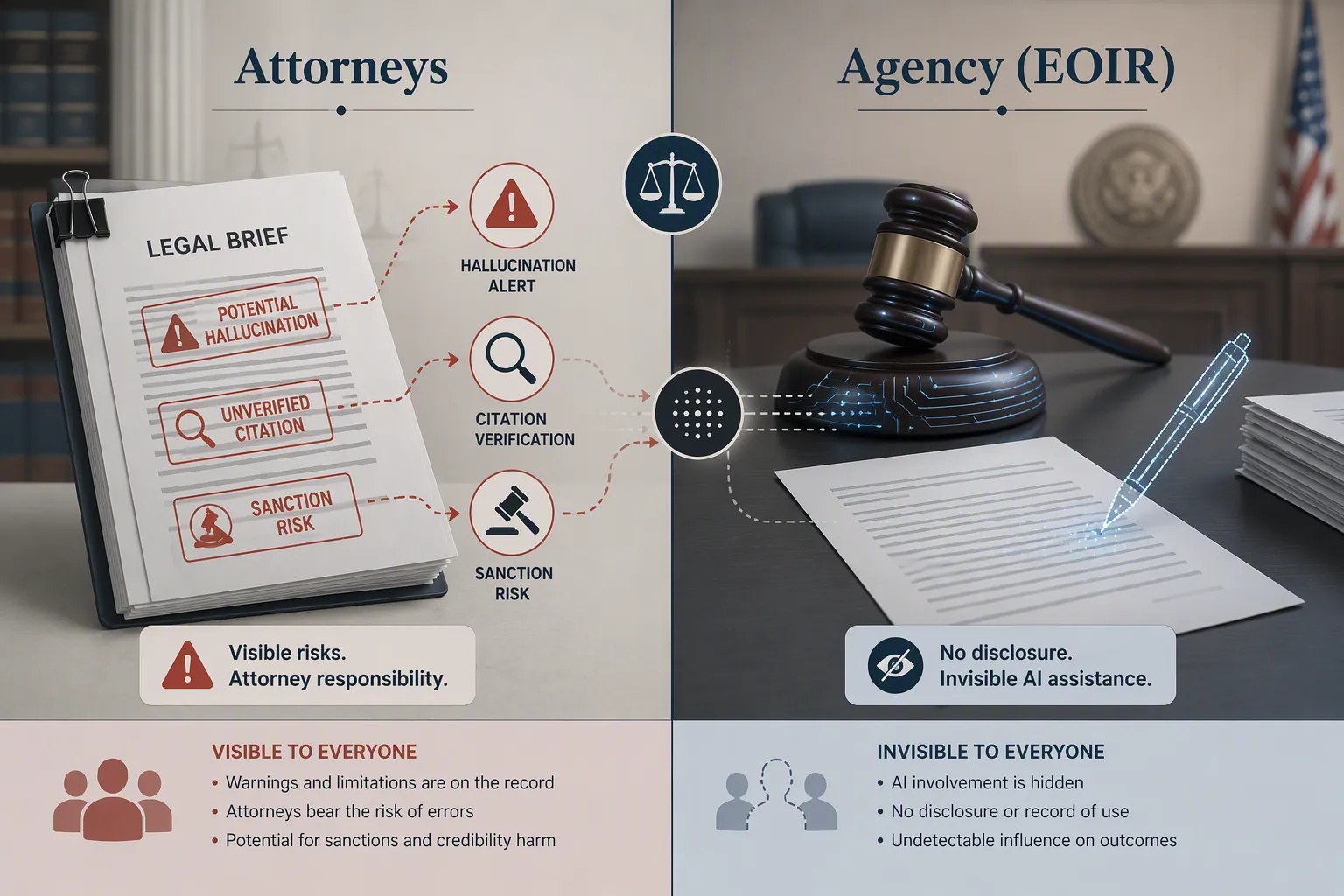
That omission becomes harder to treat as accidental when read beside EOIR’s own planning posture. A Hoppock Law Firm analysis quotes EOIR’s 2024 Strategic Workforce Plan as identifying AI as a “key strategy” for addressing resource gaps, including use in “drafting adjudicatory documents.”[3] The workforce-plan point does not prove that AI touched Guzmán’s ruling. It does show that judge-side or agency-side AI assistance is not a remote hypothetical floating outside EOIR’s institutional plans.
Once an agency contemplates AI in adjudicatory drafting, a disclosure rule is not a luxury add-on. It is the mechanism that lets the losing party decide whether there is anything to examine. Without notice, a respondent cannot ask whether a model summarized testimony, imported an unsupported fact, distorted the standard, or merely helped format a routine section. Those possibilities are not all equally serious. But a party cannot separate the harmless from the harmful if the use is invisible.
California’s Judicial Council model policy shows that disclosure is administratively imaginable. Effective September 1, 2025, that model policy requires disclosure when judicial officers use generative AI in their work.[4] It is not a complete answer to every evidentiary or appellate problem. It does, however, reject the premise that judge-side AI use is too sensitive, too mundane, or too operational to be disclosed at all.
Why the gap matters more in a compressed appeal environment
The asymmetry would matter in any adjudicatory system. It matters more when the respondent has a short appeal window and the appellate forum is itself under pressure. Univision reported that Guzmán had 30 days to appeal after the July 29 denial.[1] In that period, counsel has to identify appealable issues, protect the record, and decide how to frame legal and factual errors without access to the internal drafting path of the decision.
The Board of Immigration Appeals is not operating in a quiet background. NPR reported in March 2026 that the BIA had been reduced from 28 judges to 15, that its backlog exceeded 200,000 cases, and that it published a record 70 precedent decisions in 2025.[5] Those figures do not establish bias in any individual appeal. They do explain why process defects have practical force. When a system is smaller, busier, and producing more precedent-setting output, the burden of finding an error shifts even more sharply to the party trying to challenge the decision.
The Hoppock analysis also cites EOIR statistics for a 97% government win rate in BIA appeals in 2025.[3] That number should not be read as a prediction of Guzmán’s appeal or as proof that any particular panel will rule for the government. Its relevance is narrower: in a forum where respondents already face long odds, undisclosed authorship assistance on the decision below is not a small administrative detail. It affects what counsel can test.
Guzmán’s attorney, in Univision’s reporting, cited a 4% approval figure for the form of relief at issue.[1] That figure has not been independently verified against EOIR or USCIS statistical reports in the materials reviewed here, and it may refer to a particular relief category rather than immigration relief generally. Used carefully, it still belongs in the story: it reflects the way the case was publicly explained to the respondent’s community and the stakes counsel believed were attached to the application.
| Fact | What it does and does not show |
|---|---|
| July 29, 2026 denial with 30-day appeal window | Shows the immediate procedural pressure on Guzmán; does not reveal the judge’s drafting process. |
| EOIR PM 25-40 warning attorneys about AI hallucinations | Shows express attorney-side verification duties; does not create a parallel party-facing disclosure rule for agency AI use. |
| EOIR workforce-plan language, as quoted by Hoppock, about AI and “drafting adjudicatory documents” | Shows contemplated agency-side AI use in adjudicatory work; does not prove AI was used in Guzmán’s decision. |
| BIA reduction from 28 to 15 judges and backlog above 200,000 cases | Shows institutional pressure on appeals; does not decide the merits of any appeal. |
| Reported 97% government win rate in BIA appeals in 2025 | Shows the respondent’s appellate environment; does not establish the outcome of Guzmán’s appeal. |
The appeal record cannot challenge what it cannot see
The practical harm from nondisclosure is not that every AI-assisted judicial draft is unreliable. Some uses may be clerical. Some may amount to preliminary drafting that a judge heavily revises. Some may produce no appealable issue at all. But due process is not satisfied by asking the respondent to trust that the undisclosed use was harmless.
In an immigration appeal, the record is the terrain. If counsel believes the judge misunderstood testimony, overlooked evidence, misstated the burden, or relied on an unsupported factual premise, counsel must point to the record and explain the legal error. If an AI tool participated in summarizing testimony or drafting findings, and no disclosure is made, counsel may never know whether an odd formulation in the decision came from human reasoning, template language, model output, or some mixture of the three.
That uncertainty changes litigation behavior. A lawyer can object to a hallucinated citation in the government’s filing. A lawyer can correct their own draft before filing it. A lawyer can withdraw or amend an AI-tainted submission once discovered. But a respondent cannot move with the same precision against an adjudicatory document whose AI involvement is neither disclosed nor logged for party review.
This is the two-tier standard. Attorneys are told that AI use creates verification duties and sanction exposure. The agency, according to the workforce-plan language quoted by Hoppock, treats AI as a tool for resource gaps and adjudicatory drafting.[2][3] Between those two positions sits the missing notice: the simple statement that would tell the parties whether AI assisted the decision they are now expected to accept or appeal.
Guzmán’s public timeline adds pressure, not proof
Univision’s earlier coverage placed Guzmán in a broader personal timeline, including an account of detention at Adelanto and a separate interview in which he spoke about alleged “mala práctica.”[6][7] Those reports help explain why his case became visible. They should not be treated as findings by a court, a bar authority, or the BIA. No formal ineffective-assistance ruling or disciplinary finding was identified in the materials reviewed for this article.
The same restraint applies to the AI issue. Guzmán’s denial should not be turned into a claim that an immigration judge used AI, that an AI tool hallucinated a fact, or that the outcome would have changed with disclosure. The point is more limited and more durable: his case is the kind of case in which nondisclosure matters because the respondent must act quickly, with incomplete information, inside a system that has already articulated AI duties for one side and AI ambitions for the other.
There is also an upstream AI context, though it should not be overstated. A Cozen O’Connor alert in April 2026 described growing AI-driven screening in U.S. immigration adjudications and connected that development to higher requests for evidence and denial rates.[8] That kind of screening may affect a case before it reaches immigration court. It does not establish anything specific about Guzmán’s file. Its relevance is that immigration adjudication is becoming a chain of automated or AI-assisted review points, while disclosure obligations remain uneven.
Resource pressure explains the temptation, not the silence
EOIR’s resource problem is real enough to appear in its workforce planning. A heavy docket, staffing constraints, and the demand for faster adjudication make drafting tools attractive. No serious analysis has to pretend that judges and agency staff work in ideal conditions.
But resource pressure does not answer the procedural question. The agency can decide that AI helps manage workload and still disclose when AI assists an adjudicatory document. Disclosure need not reveal confidential deliberations or source code. It can be limited to the existence and general category of use: summarization, translation support, drafting assistance, citation checking, formatting, or none. The point is not to punish use. The point is to make authorship traceable enough that a party can decide whether to challenge it.
That is where the California model is useful even outside California courts. Its importance is not that state judicial administration has solved immigration adjudication. Its importance is that it treats disclosure as an ordinary governance choice rather than an impossible demand.[4] EOIR could do the same while still warning attorneys about hallucinations and maintaining verification duties for filings.
The narrow due-process risk in Guzmán’s deportation appeal is therefore not that AI necessarily changed the denial. The risk is that a respondent facing removal cannot detect, evaluate, or challenge judge-side AI influence when the agency imposes AI discipline outward while withholding comparable disclosure inward.
References
- Juez niega detener orden de deportación del chef mexicano Roberto Guzmán; tiene 30 días para apelar — Univision, July 29, 2026.
- EOIR Policy Memorandum PM 25-40 on Use of Generative AI in EOIR Proceedings — AILA, August 8, 2025.
- Generative AI in Immigration Court: One Standard for Attorneys, Another for the Agency — Hoppock Law Firm.
- Model Policy on the Use of Generative Artificial Intelligence by Judicial Officers and Court Staff — Judicial Council of California, effective September 1, 2025.
- Trump administration shakes up immigration appeals board amid deportation push — NPR, March 20, 2026.
- Entrevista con el chef mexicano que ayuda a inmigrantes detenidos en centro de ICE: “No están solos” — Univision, February 26, 2026.
- Hispano relata su detención en centro migratorio de Adelanto — Univision.
- Growing Use of Artificial Intelligence in U.S. Immigration Adjudications Is Driving Higher RFE and Denial Rates — Cozen O’Connor, April 2026.
Related records
Tool profile
How Meta's AI Spending Reshapes Law Firm ProfitabilityGoverning regulation
Browse the obligations tracker →Preventive workflow
Browse verification workflows →
Report a correction or tip
Spotted an outdated figure, a misstated fact, or a ruling this case record should reflect? Public comments are disabled for this content given the professional cost of a misreported case outcome, penalty amount, or rule text — use the structured correction channel instead.
Report a correction or tip for this record →