
What does the open container add to Tony Romo's OWI charges?
Tony Romo's open-container citation is legally minor in Wisconsin — a civil forfeiture carrying no demerit points — but it is the evidentiary hinge of his OWI file, and an identical fact pattern would materially escalate a DWI under Texas law, raising mandatory jail time from three days to six. The key is separating what the citation carries in Wisconsin from what the same conduct would carry in his home state.
- Jurisdiction
- Wisconsin, USA
- Court
- Milwaukee County Circuit Court
- AI tool named
- No AI tool implicated
- Source document
- View primary court order ↗
- Last verified
- Aug 3, 2026
Lex Machina Review is an independent risk-tracking and reference resource. Nothing on this site is legal advice, and using it does not create an attorney-client relationship. Every record is reviewed against primary sources but may not reflect the most current status of a matter — always verify directly against the cited court order, rule text, or a licensed attorney before relying on it.
Companion explanation — secondary to the source document above
For readers trying to sort out Tony Romo’s OWI citation and the open-container item, the open-container item does two different jobs. As a Wisconsin citation, it is a minor civil-forfeiture matter carrying no demerit points. As a fact inside the OWI file, the reported passenger-side bottle is not minor at all: it gives officers and prosecutors a physical object to point to when explaining why the OWI case has traction. This analysis is limited to the reported Wisconsin citation and the statutory materials discussed below; it is not legal advice, and Texas law does not govern the Wisconsin citation merely because Romo resides in Texas.
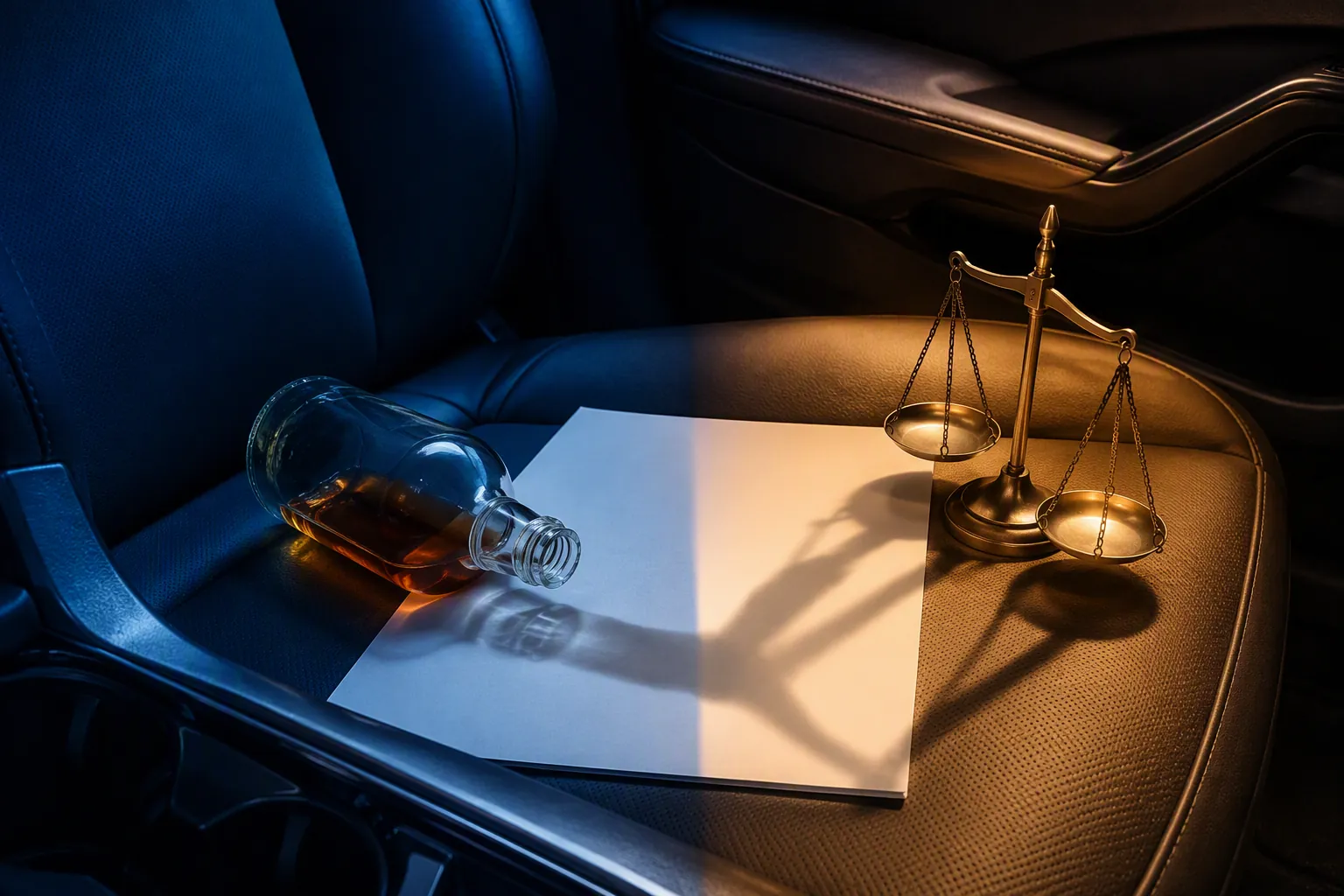
The bottle is a small citation and a large fact
The reported file detail that matters is not celebrity color or the golf-outing backdrop. It is that a deputy found an “open bottle of an alcoholic beverage” on the passenger side of Romo’s Jeep during a pre-tow vehicle inventory, according to the MCSO citation as reported by the New York Post; the open-container amount listed on the citation was $267. [1]
That fact should not be inflated into a separate major Wisconsin offense. It also should not be dismissed as meaningless paperwork. An inventory discovery gives the state a concrete item in the vehicle, separate from observations about driving, field sobriety, odor, statements, or chemical testing. In an OWI file, a bottle in the passenger area can become the simplest narrative bridge between suspected drinking and operation of the vehicle.
For defense triage, that distinction is the starting point. The open-container line item does not carry the punishment profile of an OWI. But the same line item may shape how the OWI file is described, negotiated, or perceived, because it is easy to understand and hard to unsee once it is in the report.
What Wisconsin law does with the open-container citation
Wisconsin’s open-container statute, Wis. Stat. § 346.935, is aimed at alcohol beverages in the passenger area of a motor vehicle on a highway. The statute addresses drinking in a vehicle and possession of an alcohol-beverage container when it has been opened, its seal has been broken, or some of its contents have been removed. It also contains limits and exceptions, including sealed-container and vehicle-class exemptions rather than a blanket rule for every vehicle setting. [2]
The legally important part is classification. In Wisconsin, this is handled as a civil forfeiture, not as the OWI charge itself. A forfeiture citation means money exposure, not the same criminal consequences that attach to an impaired-driving conviction. Wisconsin’s demerit-point materials also do not assign demerit points to this open-container citation. [3]
The money number can look inconsistent because sources are talking about different things. A Wisconsin practice-page estimate places open-container forfeitures in the $175 to $263 range, plus a $93 court surcharge, while Romo’s reported citation listed $267. [4][1] That difference is not the legal story by itself; the legal story is that the Wisconsin open-container item remains a low-level forfeiture rather than an added criminal alcohol-driving count.
| Question | Wisconsin answer for the open-container item |
|---|---|
| Is it the OWI charge? | No. It is separate from the OWI allegation. |
| Is it criminal punishment by itself? | The cited Wisconsin open-container item is treated as a civil forfeiture. |
| Does it add demerit points? | No demerit points are assigned to this open-container citation. |
| Why does the state care? | The passenger-side bottle is physical evidence that can support the OWI narrative. |
| Does Texas law control because Romo resides there? | No. The citation is a Wisconsin matter. |
What the open-container citation does not prove
An open bottle in a passenger area is not the same thing as proof of impairment. It does not, standing alone, establish a blood-alcohol concentration, unsafe driving, time of consumption, or who drank from the container. If the bottle was on the passenger side, that location may matter to both sides: prosecutors can point to its accessibility and presence in the vehicle, while the defense can press the gap between possession evidence and impairment evidence.
It also does not add demerit points to the Wisconsin driving record. That matters because readers often treat every traffic citation as if it has the same licensing consequence. Wisconsin does not do that here. The licensing and criminal exposure, if any, comes from the OWI case, not from turning the open-container forfeiture into something it is not.
The cleanest way to read the file is to keep the two lanes separate: the citation’s direct punishment is small, but the bottle’s evidentiary usefulness may be substantial.
Why Texas would change the stakes
Texas enters the discussion only as a comparison. It does not convert Romo’s Wisconsin citation into a Texas case. But the comparison is useful because Texas treats the same open-container fact much more seriously when it is paired with a DWI.
Under Texas Penal Code § 49.04, a DWI is generally a Class B misdemeanor with a minimum term of confinement of 72 hours. If the person had an open container of alcohol in the person’s immediate possession at the time of the offense, the offense remains a Class B misdemeanor, but the minimum term of confinement rises to six days. [5]

That is the sharp jurisdictional difference. In Wisconsin, the reported open-container item is a minor forfeiture with no demerit points. In Texas, an open container attached to a DWI changes the mandatory jail floor from three days to six. The same physical fact can be administratively light in one state and materially harsher in another.
The bounded legal answer
The open-container item adds little direct punishment to Romo’s Wisconsin exposure: it is a civil forfeiture, carries no demerit points, and should not be confused with the OWI charge. Its importance is evidentiary. The reported passenger-side bottle gives the OWI file a concrete alcohol-related object inside the vehicle, which is why the state is unlikely to treat it as mere clutter.
Texas law shows how different the answer could have been in another jurisdiction, but it does not govern this citation. Importing Texas consequences into a Wisconsin OWI file would be a category error; ignoring the bottle because the Wisconsin forfeiture is small would be another one.
References
- Tony Romo OWI citation report, New York Post
- Wis. Stat. § 346.935, Wisconsin Legislature
- Wisconsin Demerit Point System, Wisconsin Department of Transportation
- Wisconsin Open Container Laws, Grieve Law
- Texas Penal Code § 49.04, Texas Constitution and Statutes
Related records
Tool profile
How Meta's AI Spending Reshapes Law Firm ProfitabilityGoverning regulation
Browse the obligations tracker →Preventive workflow
Browse verification workflows →
Report a correction or tip
Spotted an outdated figure, a misstated fact, or a ruling this case record should reflect? Public comments are disabled for this content given the professional cost of a misreported case outcome, penalty amount, or rule text — use the structured correction channel instead.
Report a correction or tip for this record →