
Who Is Liable After a School Van Accident in Kanpur?
After a school-van accident in Kanpur, liability runs through the driver, the registered owner, the school, and the insurer — and litigating the claim now carries an added risk: unverified AI-generated citations are treated as advocate misconduct in Indian courts. This Risk Digest record maps the full liability chain and the verification duty it imposes on counsel.
- Jurisdiction
- India
- Court
- Supreme Court of India
- AI tool named
- AI drafting tool
- Ruling date
- Jul 2, 2026
- Source document
- View primary court order ↗
- Last verified
- Aug 3, 2026
Lex Machina Review is an independent risk-tracking and reference resource. Nothing on this site is legal advice, and using it does not create an attorney-client relationship. Every record is reviewed against primary sources but may not reflect the most current status of a matter — always verify directly against the cited court order, rule text, or a licensed attorney before relying on it.
Companion explanation — secondary to the source document above
A school van reportedly overturned near Jainpur, also described as Atal Nagar, on Mughal Road in Rajpur town, Kanpur Dehat, on 3 August 2026. Amar Ujala reported that eight children were injured, three were referred onward in critical condition, and the driver fled after the crash.[1] At the time this record was last verified in August 2026, the available material did not confirm the school name, FIR sections, vehicle registration details, or insurer.
This is an Indian-law risk record, not legal advice. Its narrow question is the one parents, counsel, and claims staff ask first after a school van accident in Kanpur: who remains in the liability chain if the driver has vanished from the scene?
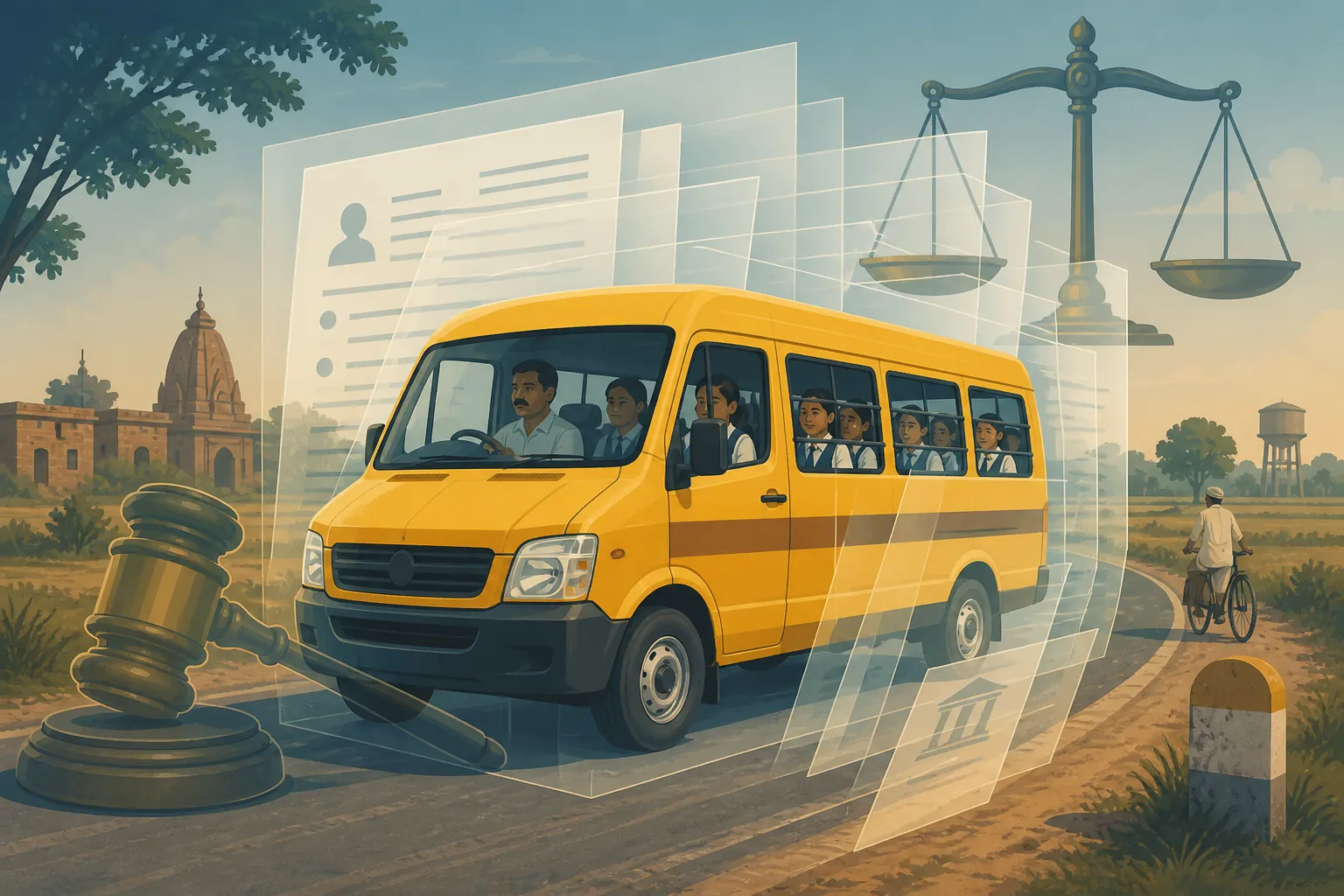
The Van Driver Is Only the First Name in the File
In a Kanpur school-van liability analysis, the absconding or rash driver matters, but the inquiry does not end there. A Motor Accident Claims Tribunal, or MACT, is concerned with compensation. The police file is concerned with offences. The transport authorities are concerned with permits, fitness, insurance, and school-vehicle compliance. Those records overlap, but they do not answer the same question.
- Driver: possible criminal exposure where rash or negligent driving, injury, grievous injury, or death is supported by the FIR and evidence.
- Registered owner: civil liability normally remains in issue because the vehicle was being operated through that ownership record.
- Possessor or deemed owner: where the vehicle is held under hire-purchase, lease, or hypothecation, Indian motor-vehicle law can treat the person in possession as the owner for liability purposes.
- School or school authorities: liability depends on pleaded and proved facts showing use, control, engagement, or school-transport function.
- Insurer: if a valid policy responds, the insurer stands behind the award, subject to statutory defences and any pay-and-recover issues that must be checked on the policy and pleadings.
- Regulators: permit, fitness, driver-verification, GPS, CCTV, and school-vehicle compliance failures can supply evidence, enforcement action, or both.
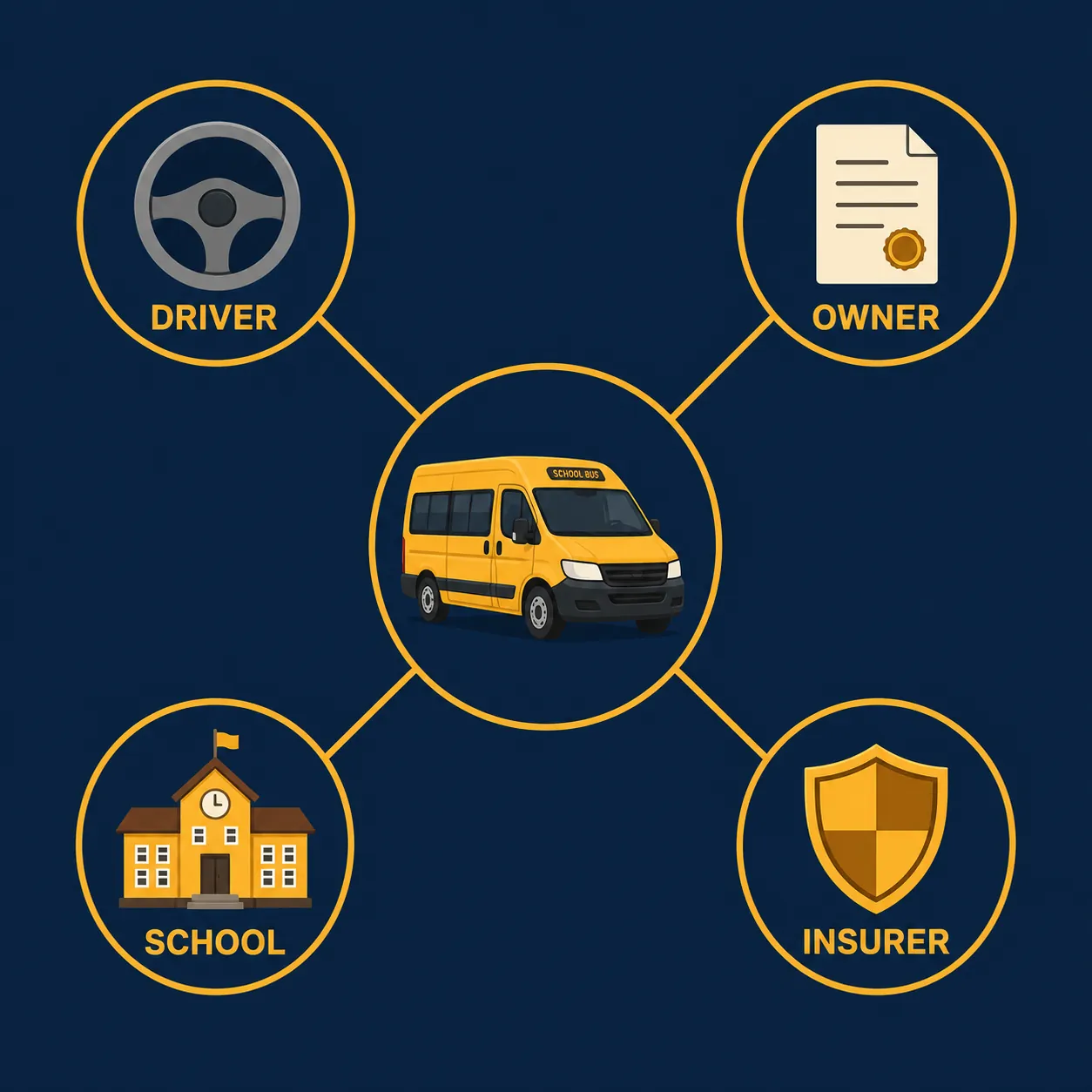
That chain is not a pleading luxury. If the school is dropped too early, if the registered owner is misdescribed, or if the insurer is not put to notice, the child’s claim can become harder to repair later. The cleaner course is to preserve the full chain until the primary record justifies narrowing it.
The 2024 Araul Crash Shows Why Report Discipline Matters
The better-documented Kanpur comparator is the 8 February 2024 Araul/Bilhaur crash, reported about 60 km west of Kanpur. The broad account is common across reports: a school van carrying children was involved in a serious collision, one child died, and several children were injured.[2][3][4] The details, however, do not line up neatly.
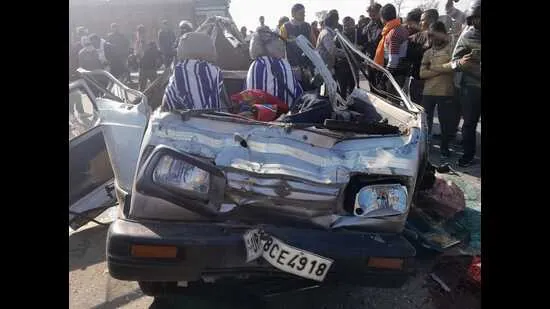
| Issue | Reported Variants |
|---|---|
| Child who died | TOI reported a 13-year-old; Hindustan Times and Free Press Journal reported a 9-year-old child named Yash.[2][3][4] |
| Number injured | TOI reported eight injured students; Hindustan Times reported 10 others injured; Free Press Journal reported several children injured and also referred to 10 or 11 injured in the report text.[2][3][4] |
| School name | TOI named Soney Lal Patel Education Centre; Hindustan Times and Free Press Journal used GPRD Memorial School or College.[2][3][4] |
| Driver name | TOI reported Hariom Katiyar; Hindustan Times reported Hari Om.[2][3] |
| Vehicle status | TOI and Hindustan Times reported that the CNG van was registered to a private individual, not as a commercial school vehicle, though it was being used commercially.[2][3] |
Those conflicts are not cosmetic. A MACT claim may need the child’s correct particulars, the school’s legal name, the vehicle registration, the policy, the route, the driver’s licence status, and the exact FIR allegations. Blending press accounts into one smooth narrative is how a record begins to drift.
The 2024 reports still show the shape of the liability file. TOI reported an FIR against the van driver, a loader driver, a truck driver, and the school principal and manager, with offences including Indian Penal Code provisions for rash driving, causing hurt, causing grievous hurt, and causing death by negligence.[2] Hindustan Times reported that the school van driver did not have a licence and that the van was privately registered while being used for school transport.[3]
Criminal Booking, Civil Compensation, and Regulatory Breach Are Separate Tracks
Indian crash records often carry three tracks at once. The first is criminal: the FIR may name a driver or other persons under the Indian Penal Code, or IPC, depending on the allegation and injury. The second is civil compensation: the injured child or family may proceed before the MACT under the Motor Vehicles Act, or MV Act. The third is regulatory: transport and school-vehicle authorities may act on permit, fitness, insurance, and operational violations.
A police booking does not itself prove civil liability. Nor does a regulatory breach automatically resolve the compensation award. But each track can feed the others. An unlicensed driver, a private vehicle used commercially, a missing school-vehicle permit, or a vehicle operated outside the approved school-transport regime may become evidence in a negligence and control inquiry.
Driver negligence remains the factual center
The driver’s conduct is still the first factual question: speed, control, route, overloading, licence, medical fitness, and what happened immediately after the collision. In the 2026 Kanpur Dehat report, the driver’s alleged flight is important, but it is not a substitute for the FIR, site plan, mechanical inspection, licence record, medical papers, and witness statements.[1]
Owner liability travels with control and use
For compensation purposes, the vehicle owner cannot be treated as a background character. In Mukkathil Bhaskaran v. Ravindran, the Kerala High Court held that when an accident is caused by rash and negligent driving, vicarious liability is cast on the vehicle owner.[5] That principle matters in school-van cases because the injured child usually had no role in choosing the driver, checking the licence, or inspecting the vehicle.
The registered owner question becomes more difficult when the paper owner, school, financer, or possessor are not the same person. In a 2022 Punjab and Haryana High Court report, Sanawar Model Senior Secondary School tried to be deleted from a MACT claim involving its school bus. The court refused, relying on the MV Act 1988 s.2(30) definition under which a person in possession under hire-purchase, lease, or hypothecation can be treated as the owner.[6]
That is the point often missed in hurried pleadings. The registration certificate matters, but it may not be the whole answer. If a school uses, controls, hires, routes, or presents the vehicle as school transport, counsel should be slow to delete it from the case before the vehicle documents, contract documents, transport permissions, and school records are examined.
The insurer is not just an afterthought
The insurer’s role is practical as well as legal. A compensation award is only useful if it can be satisfied. In school-transport cases, the insurer may raise policy defences tied to licence, permit, vehicle use, or breach conditions. Those defences do not justify omitting the insurer; they make the policy, registration class, permit, and driver record more important at the start.
Uttar Pradesh’s 2026 School-Vehicle Drive Supplies a Compliance Checklist
The Uttar Pradesh regulatory context is recent and concrete. Hindustan Times reported that Additional Chief Secretary Partha Sarthi Sen Sharma issued directions on 30 March 2026 for strict enforcement of school-transport norms, including a 1-15 April 2026 statewide checking drive.[7] News18 also reported the statewide crackdown and seizure threat for unfit school vehicles.[8]
| Compliance Point | Why It Matters in a Claim |
|---|---|
| Permit | A missing or improper permit may support arguments that the vehicle was not lawfully operating as school transport. |
| Fitness certificate | Fitness status can become evidence on whether the vehicle should have been on the road. |
| Insurance | Policy status affects recovery and insurer defences. |
| Pollution-under-control certificate | PUC status is a regulatory marker, though usually not the core injury-causation issue. |
| GPS and CCTV | These records can help reconstruct route, timing, and vehicle operation if preserved. |
| Vehicle age | The 2026 reports refer to a maximum vehicle age of 15 years for school vehicles.[7][8] |
| Driver experience and verification | The reported regime calls for drivers with at least five years of experience, police verification, and medical fitness.[7][8] |
| UPISVMP upload | Reported uploading to upisvmp.com creates a record trail that counsel should request where relevant.[7] |
For the 3 August 2026 Kanpur Dehat incident, none of those compliance points can be assumed from the single available video report. They are document requests, not established facts. The record to ask for includes the registration certificate, insurance policy, permit, fitness certificate, driver licence, police verification, medical fitness record, school transport register, route assignment, CCTV or GPS data, and the FIR.
The New Litigation Risk: AI Drafting Can Damage the Claim File
No material reviewed for this record identifies an AI-hallucinated citation in a Kanpur school-van claim. The risk is not that this 2026 accident already has an AI-citation problem. The risk is that a lawyer drafting a MACT petition, insurer memo, school-defence note, or compensation brief now works in an Indian litigation environment where fake AI-generated authorities have already produced recall, quashing, costs, and misconduct consequences.

The sharpest marker is Pooja Ramesh Singh v. J&K Bank Ltd., 2026 INSC 668, decided by the Supreme Court of India on 2 July 2026. The iPleaders record describes the decision as adopting a zero-tolerance approach: citing non-existent authorities was treated as misconduct by an advocate, and an order touched by even an iota of hallucinated material was treated as no decision in the eyes of law.[9]
That is a procedural-cleanliness rule with teeth. A school-van compensation claim may use familiar propositions: rash driving, vicarious liability, owner definition, insurer liability, pay-and-recover, school-transport compliance. Those familiar propositions are exactly where an AI drafting tool can insert a case name that looks normal enough to survive a tired first read.
| Indian Fake-Citation Event | Risk Signal |
|---|---|
| Buckeye Trust, ITAT Bengaluru, 30 December 2024 | The iPleaders record describes recall after reliance on AI-hallucinated material.[9] |
| Bombay High Court faceless-assessment matter, October 2025 and January 2026 | The iPleaders record describes quashing and an INR 50,000 costs order tied to fake-citation use.[9] |
| Vijayawada junior-judge matter, reported 3 March 2026 | BBC reported Supreme Court anger after a junior judge cited fake AI-generated orders.[10] |
| Supreme Court observations, 26 March 2026 | The Hindu reported concern over the growing menace of citing AI-generated non-existent judgments, including reference to a non-existent Jyoti w/o Dinesh Tulsiani case.[11] |
| Pooja Ramesh Singh v. J&K Bank Ltd., 2026 INSC 668, 2 July 2026 | The iPleaders record describes formal advocate-misconduct consequences and an iota-contamination rule.[9] |
The point is not to ban AI from repetitive personal-injury work. A school-van claim does have repeatable drafting parts: party descriptions, injury schedules, vehicle particulars, policy details, standard statutory references, and document checklists. But a draft that is useful as a starting aid is not a draft fit for filing. Every cited case must be opened, matched to the proposition, checked for court, date, paragraph, status, and citation, and then tied back to the facts actually pleaded.
Draft AI court regulations reported in 2026 remain consultation material, not binding law on this record. The Bar Council of India committee direction associated with Pooja Ramesh Singh was also pending as of the research crawl. Neither point weakens the immediate filing risk: courts have already reacted to fake citations without waiting for a complete AI code.
What Counsel Should Preserve Before Narrowing the Case
A careful Kanpur school-van pleading should resist the impulse to choose one defendant too early. The driver may be the visible wrongdoer. The registered owner may hold the vehicle record. The school may have arranged or controlled the transport. The insurer may be the entity from which compensation is realistically recovered. The regulator may hold the compliance trail.
- Do not treat the driver’s flight as proof of the whole case; secure the FIR, licence record, medical papers, and witness statements.
- Do not assume the registration certificate alone settles ownership; check possession, hire-purchase, lease, hypothecation, and school-control documents.
- Do not drop the school until the transport arrangement, fee record, route assignment, and vehicle-use facts are verified.
- Do not plead insurance in general terms only; obtain the policy, endorsements, permit class, and breach documents.
- Do not cite a case because an AI draft supplied it; open the authority and verify the proposition before filing.
For the present 3 August 2026 Kanpur Dehat report, the responsible position is limited: a school van accident with injured children has been reported, the driver reportedly fled, and the primary legal record is not yet available in the materials reviewed.[1] If it becomes a claim, counsel should preserve the driver-owner-school-insurer chain unless verified facts justify narrowing it. After Pooja Ramesh Singh, counsel should also treat citation verification before filing as mandatory risk control, not a courtesy edit.
This Risk Digest record is designed to be source-traceable for later MACT, Indian fake-citation, and school-transport entries. Related operational material belongs in the site’s Verification Workflows hub for the verify-before-cite rule and in the Regulation & Ethics tracker for Pooja Ramesh Singh, draft AI-court materials, and any Bar Council follow-through.
References
- कानपुर देहात: अनियंत्रित स्कूल वैन पलटी, आठ बच्चे घायल, तीन रेफर, Amar Ujala, 3 Aug 2026.
- Drivers, school authorities booked for kid's death in van (Kanpur), Times of India, 11 Feb 2024.
- Schoolkid dies in Kanpur mishap, 10 others injured, Hindustan Times, 8 Feb 2024.
- Kanpur Road Accident: One Child Killed, Several Injured As School Van Hits Truck On Highway, Free Press Journal, 8 Feb 2024.
- Mukkathil Bhaskaran vs Ravindran And Ors. on 9 March, 1990, Indian Kanoon.
- School can't escape liability in case of accident involving its bus: Punjab and Haryana high court, Hindustan Times, May 2022.
- School transport: UP orders strict enforcement of norms; 15-day checking drive from April 1, Hindustan Times, 30 Mar 2026.
- Uttar Pradesh Orders Statewide Crackdown On School Vehicles; Unfit Buses To Be Seized, News18, 31 Mar 2026.
- AI-hallucinated case law: how fake citations are getting lawyers sanctioned in India (and how to avoid it), iPleaders, last verified 6 Jul 2026.
- India's top court angry after junior judge cites fake AI-generated orders, BBC, 3 Mar 2026.
- Supreme Court voices concern over growing 'menace' of citing AI-generated non-existent judgements, The Hindu, 26 Mar 2026.
Related records
Tool profile
How Meta's AI Spending Reshapes Law Firm ProfitabilityGoverning regulation
Browse the obligations tracker →Preventive workflow
Browse verification workflows →
Report a correction or tip
Spotted an outdated figure, a misstated fact, or a ruling this case record should reflect? Public comments are disabled for this content given the professional cost of a misreported case outcome, penalty amount, or rule text — use the structured correction channel instead.
Report a correction or tip for this record →