
Sean Combs' Prison Fight: Quantified BOP Sanction Risk
Sean Combs' July 2026 fight at FCI Fort Dix triggers a Code 201 (Fighting) infraction under 28 CFR § 541.3, exposing him to quantifiable sanctions including good conduct time forfeiture, FSA time credit loss, and disciplinary segregation. This article walks through the regulatory framework and repeat-offender escalation that could impact his projected February 2028 release date.
- Jurisdiction
- US Federal
- Court
- Bureau of Prisons (Disciplinary Hearing Officer)
- AI tool named
- No AI tool implicated
- Ruling date
- Jul 24, 2026
- Source document
- View primary court order ↗
- Last verified
- Jul 25, 2026
Lex Machina Review is an independent risk-tracking and reference resource. Nothing on this site is legal advice, and using it does not create an attorney-client relationship. Every record is reviewed against primary sources but may not reflect the most current status of a matter — always verify directly against the cited court order, rule text, or a licensed attorney before relying on it.
Companion explanation — secondary to the source document above
The legal consequence of Sean Combs’ reported prison fight starts with a regulation, not with the fight scene. Under 28 CFR § 541.3, “Fighting with another person” is prohibited act Code 201, a High-severity offense. For a first High-severity offense, the Bureau of Prisons may forfeit good conduct time, impose disciplinary segregation, remove privileges, and order other sanctions. If the July 24, 2026 incident is treated as a second offense within the applicable lookback period, Table 2 can move the exposure into a higher sanction band.[1]
That is why the November 2025 phone write-up matters. CBS News reported, based on prison documents, that Combs was written up on Nov. 3, 2025 for an unauthorized three-way phone call, four days after arriving at FCI Fort Dix, and that the Unit Disciplinary Committee processed it as a Moderate-severity phone-abuse infraction with recommended sanctions of 90 days without phone and commissary privileges.[2] The public record does not confirm the final sanction, but the timing places that write-up within 18 months of the July 2026 fight.
The current public release-date question is narrower than many headlines make it. People reported that Combs’ projected release date had moved to Feb. 23, 2028, after prior shifts in the BOP system.[3] A disciplinary decision could later affect that date, but the BOP locator is a trailing indicator. It is not a real-time docket for incident reports, DHO hearings, good-time forfeitures, or credit recalculations.
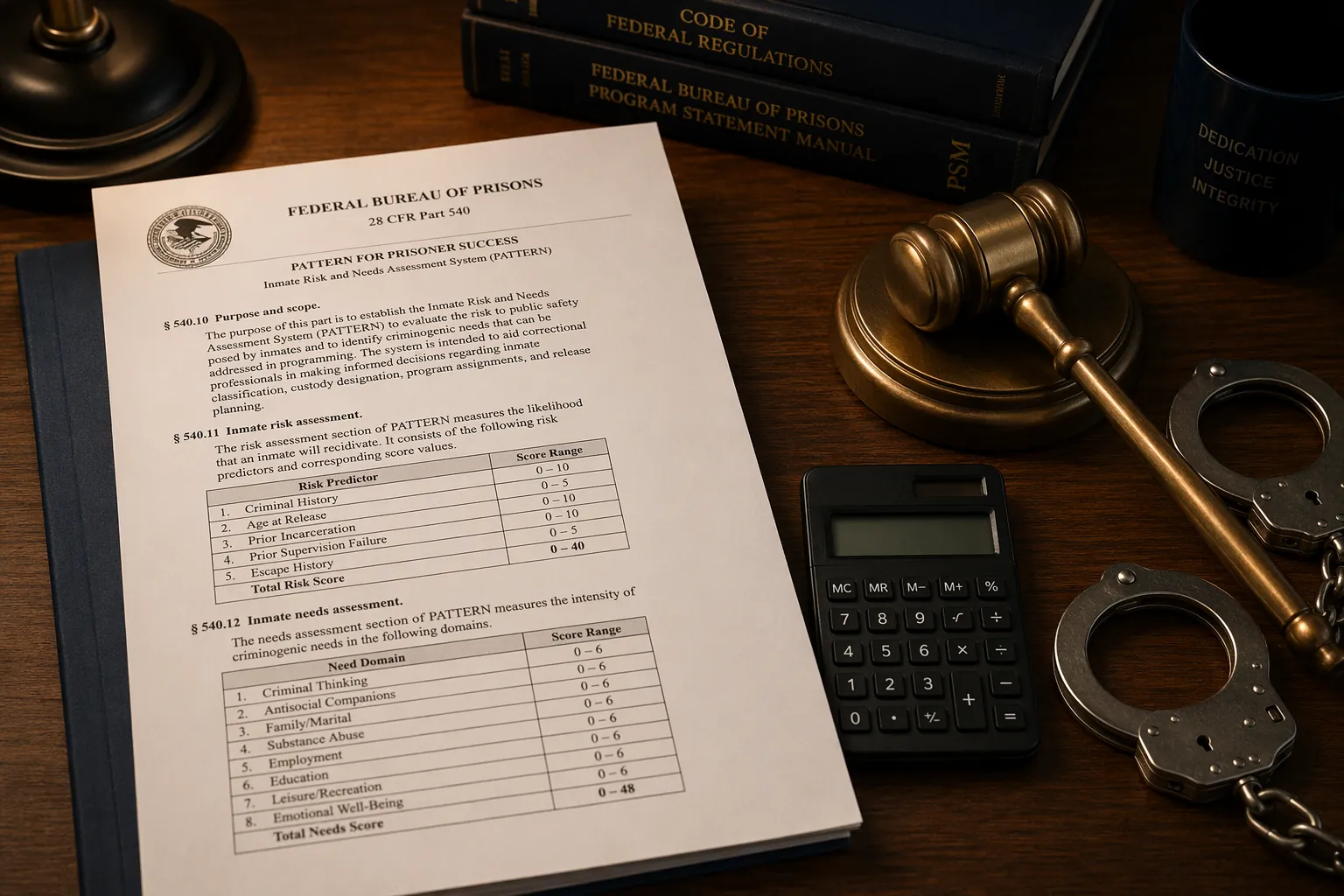
The Starting Code Is 201, Not “Solitary”
NBC News, ABC News, TMZ, Page Six, and NewsNation each reported that Combs was involved in a fight with another inmate at FCI Fort Dix on July 24, 2026 and was placed in solitary confinement or special housing afterward, with the accounts citing BOP-source information and varying on provocation details.[4][5][6][7][8] Those reports are enough to identify the likely disciplinary frame: Code 201. They are not the same thing as a completed Disciplinary Hearing Officer finding.
That distinction is not cosmetic. An incident report, a temporary housing move, a charged prohibited act, a DHO finding, and an updated release date are different administrative events. The BOP’s public posture also matters: the agency generally does not confirm or deny individual disciplinary matters. So the responsible analysis is a sanction model built from the regulation and reported facts, not a declaration that any particular number of days has already been taken.
For the Eighth Amendment analysis of solitary confinement as a conditions-of-confinement claim, see the site’s separate article, “Does Diddy’s Solitary Confinement Violate the Eighth Amendment?” This article addresses the distinct custody-risk question: what the disciplinary code allows the BOP to do if the fight charge is sustained.
Table 1: The First-Offense Code 201 Exposure
Code 201 sits in the High-severity category. For that category, Table 1 of 28 CFR § 541.3 authorizes a set of sanctions that can affect both sentence administration and day-to-day custody. The highest-value number is good conduct time, because forfeiture can push a projected release date later. But segregation and privilege losses matter too, especially for an inmate trying to maintain programming, communications, and lower-risk custody positioning.[1]
| Sanction Type | First High-Severity Offense Exposure |
|---|---|
| Good conduct time | Forfeit and/or withhold earned statutory good conduct time, with a High-severity maximum of up to 60 days; the typical listed forfeiture range is 14 to 27 days.[1] |
| FSA Time Credits | Up to 27 days at risk of forfeiture under the disciplinary-credit consequences described in the research materials. |
| Disciplinary segregation | Up to 6 months for a High-severity offense.[1] |
| Privileges | Loss of privileges for up to 1 year.[1] |
| Other sanctions | Potential monetary restitution, program restrictions, job changes, or related administrative sanctions within the BOP framework.[1] |
The difference between the typical range and the maximum matters. A first sustained Code 201 charge does not automatically mean 60 days of good conduct time are gone. The regulation gives the DHO available sanctions and ranges; it does not require the most severe available result in every case.[1]
Good conduct time and First Step Act time credits also should not be collapsed into one bucket. Good conduct time is the statutory credit most directly visible in a release-date calculation. FSA Time Credits are tied to earned-time mechanisms and BOP administration of programming and risk-and-needs participation. A reader who needs the broader mechanics can compare the site’s explainer on “How Steve McBee Sr. Got Early Release From Federal Prison,” but the practical point here is simple: one disciplinary event can threaten more than one kind of credit.
The November 2025 Write-Up Is the Escalation Problem
The prior phone violation is not legally important because it resembles fighting. It does not. It is important because Table 2 of 28 CFR § 541.3 is a repeat-offender table. It escalates available sanctions when an inmate commits another prohibited act within a specified period after a prior finding or sanction.[1]
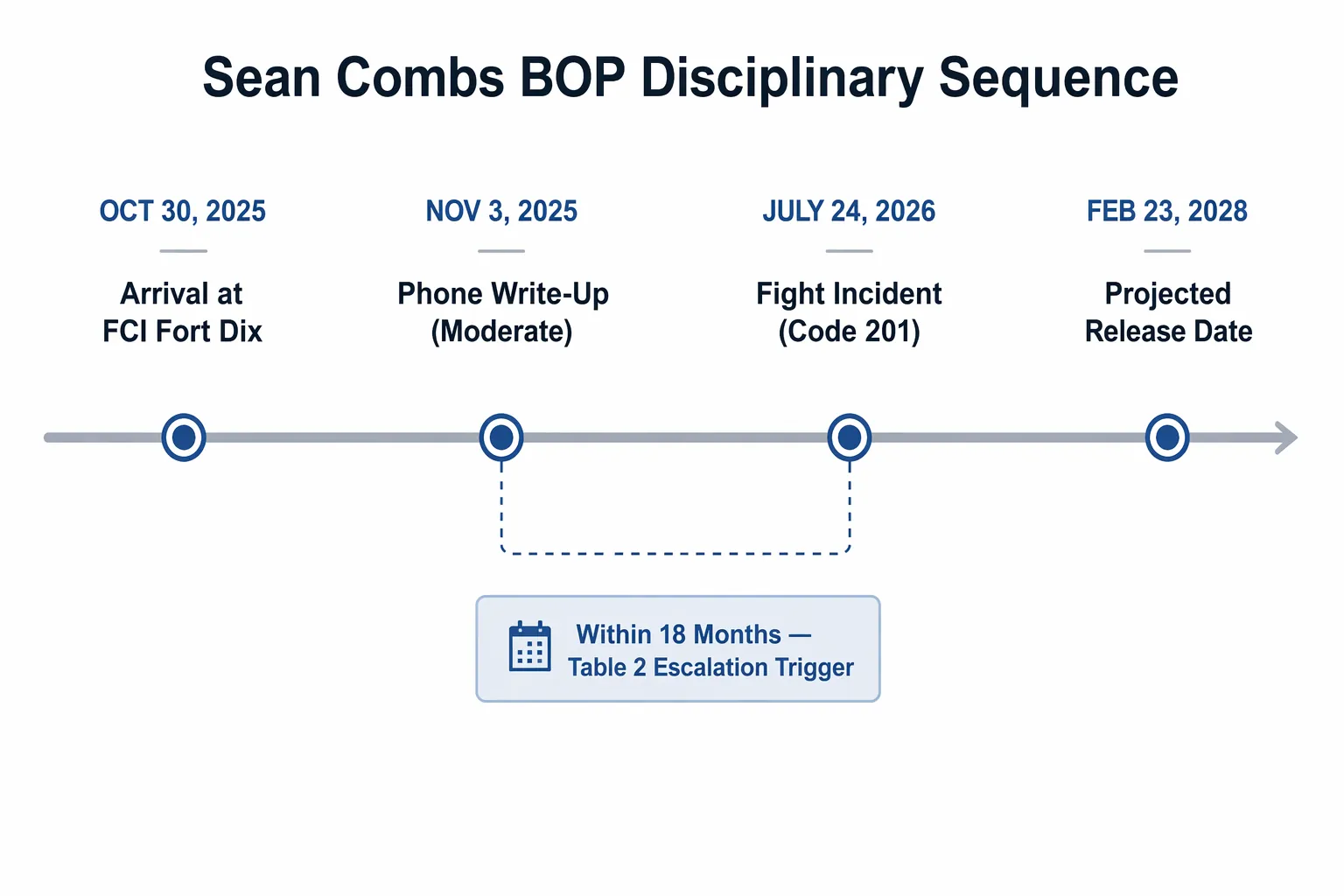
The reported dates line up cleanly for a risk model. Combs arrived at Fort Dix on Oct. 30, 2025. The phone write-up followed on Nov. 3, 2025. The reported fight occurred on July 24, 2026. That is inside an 18-month window. CBS reported the UDC recommendation, but not the final imposed sanction; that missing fact is the main caveat in treating Table 2 as definitively triggered.[2]
If the November incident counts for Table 2 purposes and the July fight is sustained as Code 201, the sanction exposure materially changes. The July event no longer looks like an isolated first High-severity offense. It becomes a second disciplinary event inside the repeat-offender period, with Greatest-level consequences available under Table 2.[1]
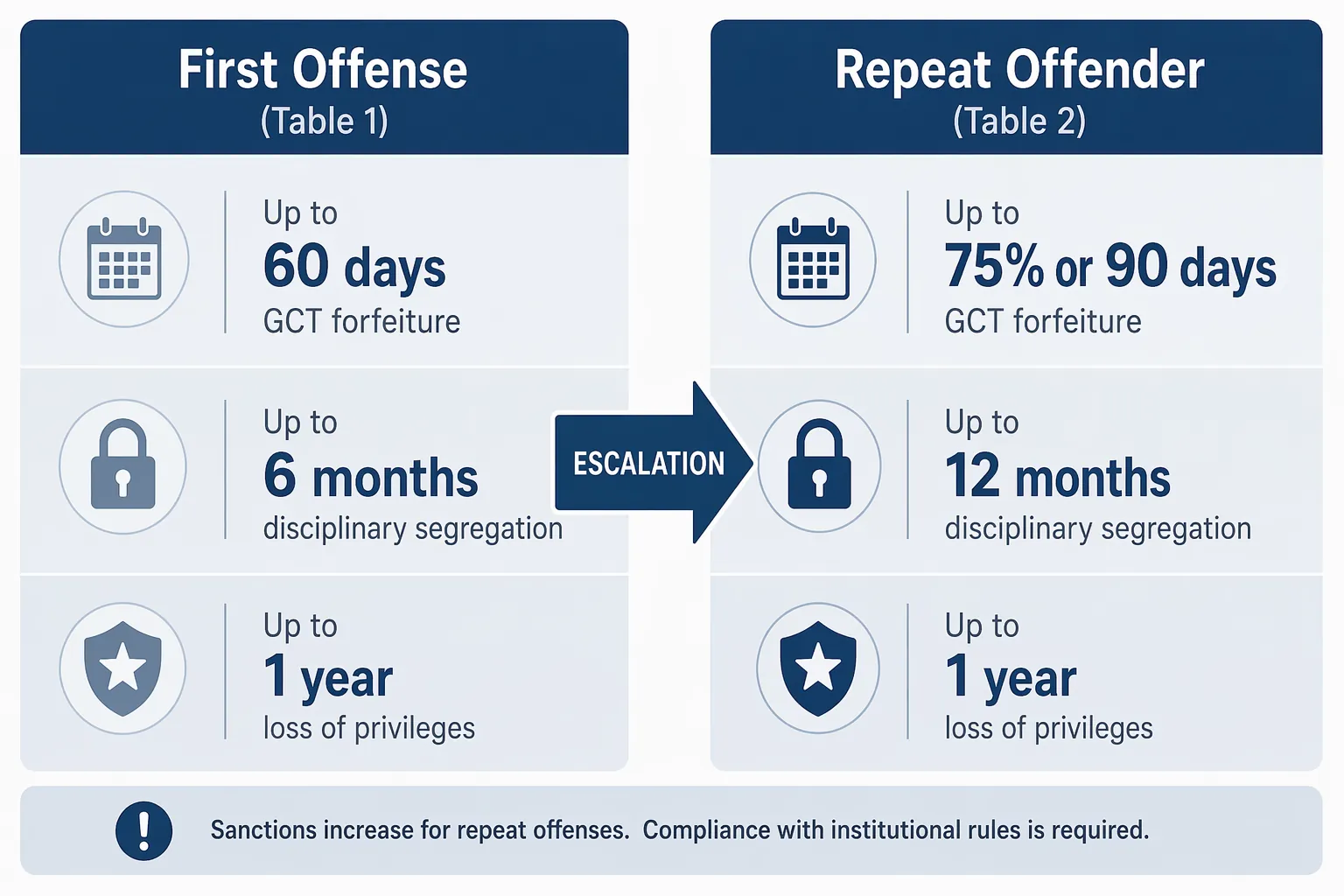
| Scenario | Good Conduct Time Exposure | Segregation Exposure | Why It Matters |
|---|---|---|---|
| First sustained Code 201 offense | Typical range of 14 to 27 days; up to 60 days maximum for a High-severity offense.[1] | Up to 6 months.[1] | This is the baseline if the November 2025 matter does not count for escalation. |
| Repeat-offender escalation applies | Up to 75% or 90 days of good conduct time exposure under Table 2 escalation.[1] | Up to 12 months.[1] | This is the higher-risk model if the prior phone discipline activates the 18-month repeat-offender rule. |
That comparison is the core of the sentence-risk analysis. A 14-to-27-day modeled forfeiture and a 90-day modeled forfeiture are different conversations for counsel, family, and case-management planning. The public record does not yet justify saying which number was imposed. It does justify saying that the repeat-offender question is the hinge.
What Could Happen to the Feb. 23, 2028 Release Date
People reported that Combs’ projected prison release date had moved to Feb. 23, 2028 before the July fight reporting.[3] That date is useful because it gives the public a current anchor. It is not proof that every future change comes from the fight, and it is not proof that the BOP has already processed any sanction.
If the DHO sustains a first-offense Code 201 charge and imposes a typical High-severity good-time forfeiture, the modeled sentence-length effect would be in the 14-to-27-day range. If the DHO reaches the High-severity maximum, the modeled effect could be up to 60 days. If Table 2 escalation applies, the modeled good-time risk can reach up to 75% or 90 days.[1]
Those are not predictions. They are regulatory ceilings and modeled consequences. The BOP may impose lesser sanctions, decline to sustain the highest charge, apply credit rules in a way not visible from public reporting, or later adjust the date through administrative review. A pending appeal in the criminal case could also moot the custody analysis if it produces relief that changes the underlying sentence.
There is also a timing problem. Public release dates can lag behind DHO decisions and credit recalculations. A date that does not move immediately after an incident does not prove no sanction was imposed. A later movement does not prove the fight was the cause, especially where People had already reported multiple pre-fight release-date shifts.[3]
Custody Consequences Beyond the Calendar
Sentence days are only one consequence. A sustained fighting infraction can follow an inmate through custody classification and programming decisions. White Collar Advice describes disciplinary infractions as risk events that can affect security scoring, housing, programming, work assignments, and eligibility for benefits tied to institutional conduct.[9]
The research materials identify a two-year violent-infraction tag as the key classification concern. That tag can make lower-security placement harder, complicate RDAP eligibility, and affect program or work assignments. RDAP can reduce a federal sentence by up to one year for eligible inmates, so a disciplinary record can matter even when the immediate release-date entry has not changed.[9]
Privilege loss is the less cinematic sanction but often the most visible to families. The November 2025 phone incident reportedly carried recommended sanctions of 90 days without phone and commissary privileges.[2] A sustained fight charge can produce another privilege-loss period under the High-severity framework, and Table 1 permits loss of privileges for up to one year.[1]
What Can Be Verified Now
The verified regulatory facts are straightforward: Code 201 is High severity; High-severity sanctions include good-time forfeiture, disciplinary segregation, and privilege loss; Table 2 can escalate sanctions for repeat offenses within 18 months.[1] The verified reported-history facts are narrower: CBS reported a November 2025 phone write-up based on prison documents, and multiple outlets reported a July 24, 2026 fight followed by solitary or special-housing placement.[2][4][5][6][7][8]
The unverified facts are the ones that would settle the exact number. The public materials do not confirm the final November sanction, the exact July charge, the DHO finding, the number of good-conduct days forfeited, the number of FSA credits affected, or whether any administrative appeal will alter the result.
Nolo’s overview of federal good-time rules is useful background on why forfeited good conduct time matters to projected release dates, but it does not answer what happened in this particular DHO process.[10] That answer sits inside BOP records unless it appears through counsel, litigation, an administrative appeal, or a later release-date update.
The Practical Risk Range
On the current public record, the conservative model has two bands. If the July 2026 fight is sustained as a first High-severity Code 201 offense, Combs faces the Table 1 range: a typical 14-to-27-day good-time forfeiture, up to 60 days maximum, up to 6 months of disciplinary segregation, and privilege loss up to 1 year.[1]
If the November 2025 phone write-up counts for Table 2 purposes, the July 2026 fight carries repeat-offender exposure: up to 75% or 90 days of good conduct time and up to 12 months of disciplinary segregation.[1][2] That is the material sentence-risk difference, and it is the reason the prior phone discipline should not be treated as a side note.
The next meaningful signals are not more anonymous descriptions of the fight. They are a BOP locator date change, confirmation of the DHO disposition, documentation of the final November 2025 sanction, or appeal developments that change the underlying sentence.
References
- 28 CFR § 541.3 - Prohibited acts and available sanctions, Cornell Legal Information Institute, https://www.law.cornell.edu/cfr/text/28/541.3
- Sean 'Diddy' Combs gets in trouble in prison over chapel drug rehab phone call, CBS News, https://www.cbsnews.com/news/sean-diddy-combs-prison-chapel-drug-rehab-phone-call/
- Sean 'Diddy' Combs' Projected Prison Release Date Moved Up, People.com, https://people.com/sean-diddy-combs-projected-prison-release-date-moved-up-11998992
- Sean 'Diddy' Combs in solitary confinement after fight in New Jersey federal prison, NBC News, https://www.nbcnews.com/news/us-news/sean-diddy-combs-solitary-confinement-fight-new-jersey-federal-prison-rcna589047
- Sean 'Diddy' Combs involved in prison fight, placed in solitary confinement, ABC News, https://abcnews.com/GMA/Culture/sean-diddy-combs-involved-prison-fight-solitary-confinement/story?id=135052020
- Diddy Involved in Prison Fight, Tossed in Solitary, TMZ, https://www.tmz.com/2026/07/24/diddy-involved-in-prison-fight-tossed-in-solitary/
- Sean 'Diddy' Combs fights with fellow inmate, gets tossed into solitary confinement, Page Six, https://pagesix.com/2026/07/24/celebrity-news/sean-diddy-combs-fights-with-fellow-inmate-gets-tossed-into-solitary-confinement/
- Diddy in solitary after prison fight: Report, NewsNation, https://www.newsnationnow.com/crime/diddy-solitary-fight-report/
- Prison Disciplinary Infractions, White Collar Advice, https://www.whitecollaradvice.com/prison-disciplinary-infractions/
- How Much Time Off for Good Behavior in Federal Prison?, Nolo, https://www.nolo.com/legal-encyclopedia/how-much-time-off-good-behavior-federal-prison.html
Related records
Tool profile
How Meta's AI Spending Reshapes Law Firm ProfitabilityGoverning regulation
Browse the obligations tracker →Preventive workflow
Browse verification workflows →
Report a correction or tip
Spotted an outdated figure, a misstated fact, or a ruling this case record should reflect? Public comments are disabled for this content given the professional cost of a misreported case outcome, penalty amount, or rule text — use the structured correction channel instead.
Report a correction or tip for this record →