
Why Sean Grayson was denied medical release anyway
Meeting the Illinois Medical Release Act's terminal-illness test does not predict release: the board denied nearly two-thirds of medically qualified applicants in the 2023 Injustice Watch/WBEZ review, and Sean Grayson's 3-0 denial followed the same pattern. This explainer walks practitioners through the statute's eligibility thresholds, three-member panel mechanics, and the discretionary public-safety assessment that actually decides a petition.
- Jurisdiction
- Illinois, US
- Court
- Illinois Prisoner Review Board
- AI tool named
- No AI tool
- Ruling date
- Jul 31, 2026
- Source document
- View primary court order ↗
- Last verified
- Aug 2, 2026
Lex Machina Review is an independent risk-tracking and reference resource. Nothing on this site is legal advice, and using it does not create an attorney-client relationship. Every record is reviewed against primary sources but may not reflect the most current status of a matter — always verify directly against the cited court order, rule text, or a licensed attorney before relying on it.
Companion explanation — secondary to the source document above
Editorial note: This is a Regulation & Ethics obligations/process explainer published as an exception in the Risk Digest lane. It is not an AI-sanctions incident record, and it does not repeat the site’s separate status record on the denial.
For a practitioner, the useful update in Sean Grayson’s denied medical release case is not simply that the Illinois Prisoner Review Board voted 3-0 against him. It is that the record reflected an Illinois Department of Corrections medical finding that his cancer met the Medical Release Act’s terminal-illness benchmark, and the panel still had statutory room to say no. Under the Illinois Medical Release Act, also known as the Joe Coleman Act, medical qualification opens the petition. It does not decide it.

That distinction is easy to lose in a headline because “terminal illness” sounds dispositive. The Act is written differently. The Prisoner Review Board’s own Medical Release Act page separates medical eligibility from the board’s release decision: the petition must pass through statutory medical categories, panel review, notice and hearing mechanics, and a decision process that can include public-safety and victim-related considerations before release is granted.[1]
The statute has medical gates, then a discretionary decision
The Act’s two main medical categories are not interchangeable. A person may qualify by terminal illness if the condition is irreversible and incurable and is likely to cause death within 18 months. A separate path, medical incapacitation, turns on functional limitation: the applicant cannot complete more than one activity of daily living without assistance, or confinement no longer adds meaningful restrictions, and the condition is unlikely to improve.[1]
| Medical category | What the category measures | Why it matters in Grayson’s petition |
|---|---|---|
| Terminal illness | An irreversible, incurable condition likely to cause death within 18 months.[1] | The IDOC medical finding reportedly checked this terminal-illness benchmark for Grayson’s Stage 4 colon cancer.[3][4] |
| Medical incapacitation | A functional-capacity standard tied to activities of daily living or the degree to which incarceration adds restrictions, with unlikely improvement.[1] | The medical review answered “No” to the daily-living activity questions, so the record did not show medical incapacitation on that path.[3][4] |
Once a completed application is before the Prisoner Review Board, a three-member panel decides the petition by simple majority. The PRB describes a 90-day decision window for a completed application, a five-year mandatory supervised release term for a person granted release, 30-day victim notice, and the availability of virtual hearings.[1] NPR Illinois also identified the statutory citation as 730 ILCS 5/3-3-14 when reporting on the Grayson decision.[2]
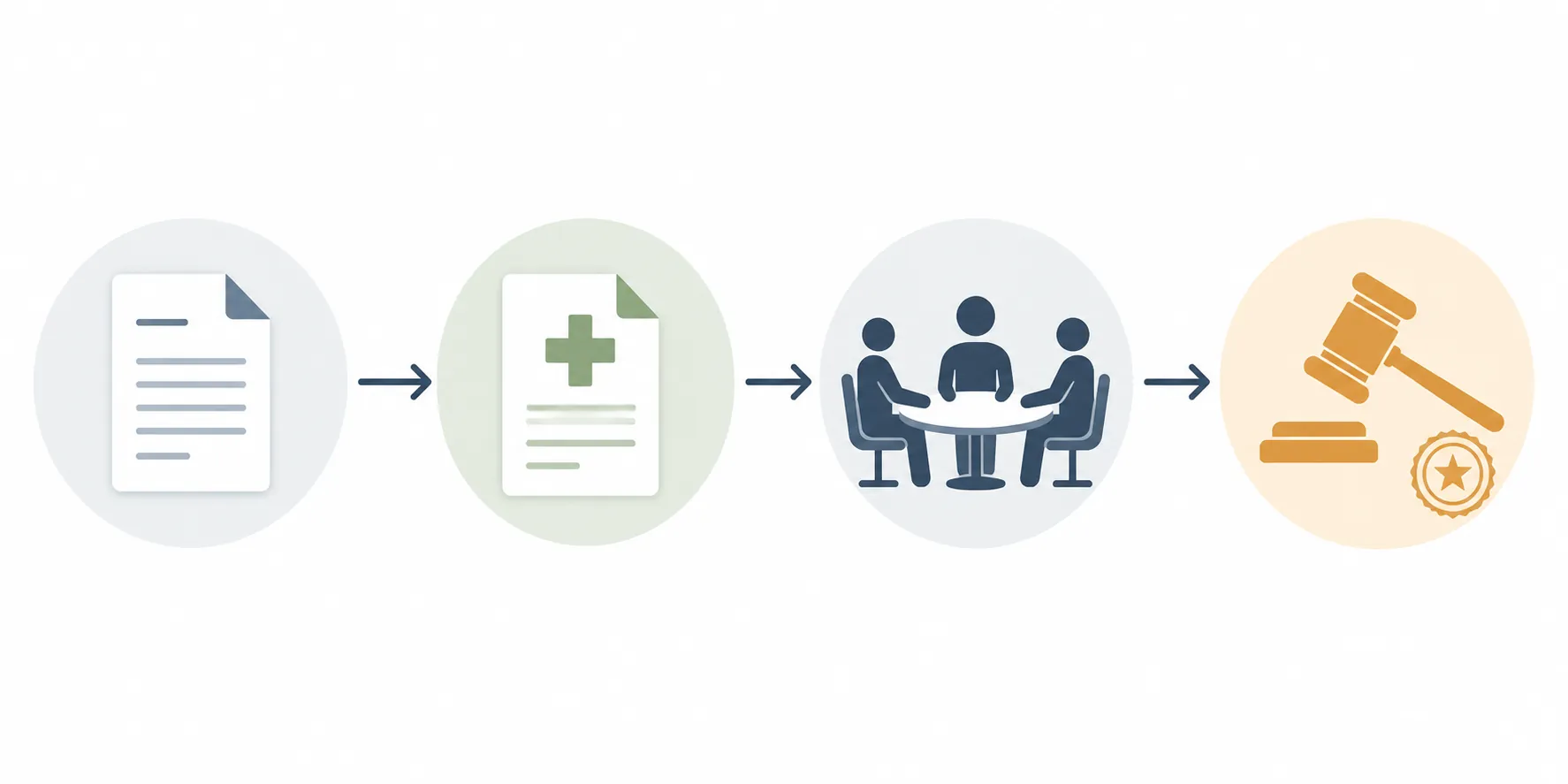
The important drafting point is that none of those mechanics converts the medical box into an automatic order of release. The panel still has to decide whether release is appropriate on the record before it. That record can contain the diagnosis, prognosis, expected recovery, prison medical-care issues, the cost of continued incarceration, victim statements, and the applicant’s present danger to the public.[6]
How the Grayson petition moved through those gates
Grayson’s petition is a useful worked example because the medical threshold and the release outcome point in opposite directions. Capitol News Illinois reported that the IDOC medical examiner checked that Grayson’s Stage 4 colon cancer, which had spread to his liver, lungs and rectum, was irreversible, incurable, and likely to cause death within 18 months.[3] The FOIA-posted application materials reflect the same core medical-release petition record.[4]
The same medical review did not find medical incapacitation. Capitol News Illinois reported that the examiner answered “No” to all eight daily-living-activity questions.[3] In a statutory scheme with two separate medical routes, that matters. The terminal-illness finding could get the petition through one medical doorway; the record did not also carry a functional-incapacity finding.
The applicant’s own presentation also mattered as record material, even if the public cannot know which point was decisive for any panelist. Grayson’s handwritten application did not check the 18-month terminal-illness box himself, according to Capitol News Illinois.[3] More consequentially for a public-danger assessment, the application maintained that Sonya Massey “attacked me with a pot of boiling water,” a claim Capitol News Illinois reported was contradicted by body-camera footage.[3][4]
That is the kind of concrete statement a board member can seize on without resorting to a generalized “public safety” slogan. A terminal diagnosis speaks to prognosis. A petition statement denying or recasting the offense can speak to present danger, accountability, and the board’s confidence in release supervision. Those are not the same question.
The procedural record was also asymmetrical. The available record identifies no counsel appearance for Grayson, no support letters, and no requested public hearing, while four Massey family members read victim-impact statements and Sangamon County State’s Attorney John Milhiser opposed release in writing.[3][5] Milhiser’s reported formulation was blunt: “Cancer does not make him less dangerous.”[3]
That sentence is too compressed as legal analysis; illness is not irrelevant simply because dangerousness remains available. But it captures the statutory gap the panel was allowed to occupy. A qualifying terminal diagnosis did not remove the board’s authority to weigh victim input and present-danger arguments.
The 3-0 vote was fast, but not inexplicable
NPR Illinois reported that the three-member panel deliberated for about 10 minutes before denying release 3-0, and identified the panel as two Republicans and one Democrat.[2] The vote count is the least mysterious part of the file. Once the board had a terminal-illness finding on one side and victim-impact statements, prosecutorial opposition, and Grayson’s own account of the Massey encounter on the other, the panel did not need to reject the medical prognosis to deny the petition.
That is where some coverage of compassionate or medical release becomes misleading. The legal question is not whether the applicant is sick enough to deserve attention. The harder question is what the statute permits the decision-maker to do after medical eligibility is established. In Illinois, the panel’s answer can still be no.
The 2023 denial-rate evidence makes Grayson less of an outlier
The Grayson denial should not be treated as proof that Illinois medical release is categorically unavailable. It also should not be treated as a celebrity-case anomaly. In 2023, Injustice Watch and WBEZ reported that the Illinois Prisoner Review Board had denied nearly two-thirds of medically qualified applicants and had granted only 52 releases in roughly 18 months under the medical-release law.[6]
Those are 2023 findings, not a timeless release rate. They still matter because they describe the same structural feature visible in Grayson’s file: medical qualification did not reliably predict release. The review also reported that three of the four panelists with the highest denial rates were Republicans who voted to deny in more than 70% of cases.[6] That finding should be used carefully. It shows that board composition and voting tendencies can matter; it does not tell us why any one Grayson panelist voted as they did.
For obligation trackers and petition teams, the useful takeaway from the 2023 data is not partisan shorthand. It is variance. A medical-release process administered by small panels, with simple-majority authority and discretionary public-danger review, can produce different outcomes from similar threshold medical facts. That makes the nonmedical record—victim notice, applicant statements, support materials, release plan, and response to dangerousness claims—part of the petition’s core evidence, not decoration.
What the record leaves unresolved
A few source limits are worth keeping visible. NPR Illinois is the source for the reported panel composition and roughly 10-minute deliberation.[2] The 3-0 denial itself is broadly reported, but the composition-and-deliberation detail should not be laundered into a fact from every account. The handwritten-application language rests on the posted application record and press reporting from that record.[3][4]
Reapplication timing is also not clean across the available sources. Injustice Watch’s 2023 investigation described a six-month wait unless the applicant was exempted.[6] NPR Illinois reported in July 2026 that Grayson could reapply as many times as he wanted.[2] For a current tracker, the safer treatment is to check the present PRB page and statute rather than carry forward the older interval as a fixed rule.
The practitioner lesson is in the gap
A medical-release petition in Illinois has to prove the medical threshold, but the petition cannot stop there. Grayson’s record shows why. The IDOC medical finding could satisfy the terminal-illness standard. The lack of a medical-incapacitation finding, the applicant’s own account of the underlying offense, the absence of visible support materials, victim-impact statements, and written prosecutorial opposition all remained available for the panel’s release decision.
- Do not read “terminal illness” as “automatic release.” The statute does not support that shortcut.
- Separate the medical category from the ultimate discretionary decision. Terminal illness and medical incapacitation measure different things.
- Treat applicant statements as risk evidence. A petition narrative can help or harm the public-danger analysis.
- Build the nonmedical record deliberately. Victim statements and prosecutorial opposition may be before the board even when the medical form favors eligibility.
- Use denial-rate data with dates attached. The Injustice Watch/WBEZ figures are 2023 findings, not a standing statistical guarantee.
In Illinois medical release practice, satisfying the terminal-illness test is a threshold finding, not a reliable forecast of release.
References
- Medical Release Act (Joe Coleman Act) — Illinois Prisoner Review Board
- Illinois panel rules cancer-stricken ex-cop convicted of murdering Sonya Massey should stay in prison — NPR Illinois — July 31, 2026
- Sean Grayson seeking medical release from his murder sentence, still maintains Sonya Massey attacked him — Capitol News Illinois
- Grayson-MR0510.pdf — Capitol News Illinois
- Grayson-Sean-MR0510_Redacted_opt.pdf — Capitol City Now
- Illinois medical release law failing — Injustice Watch — 2023
Related records
Tool profile
How Meta's AI Spending Reshapes Law Firm ProfitabilityGoverning regulation
Browse the obligations tracker →Preventive workflow
Browse verification workflows →
Report a correction or tip
Spotted an outdated figure, a misstated fact, or a ruling this case record should reflect? Public comments are disabled for this content given the professional cost of a misreported case outcome, penalty amount, or rule text — use the structured correction channel instead.
Report a correction or tip for this record →