
Slaughter Ruling Lets FTC Treat State AI Compliance as Deception
The Supreme Court's Slaughter decision removed FTC commissioner removal protections, enabling the Republican-led commission to issue a July 1 policy statement that treats compliance with state AI audit laws as potentially deceptive under Section 5. This article examines the resulting compliance whipsaw for legal practitioners using AI tools in states like Colorado, and what the July 31 public comment deadline means for risk assessment.
- Jurisdiction
- US Federal
- Court
- U.S. Supreme Court
- AI tool named
- AI compliance tools
- Ruling date
- Jun 29, 2026
- Source document
- View primary court order ↗
- Last verified
- Jul 24, 2026
Lex Machina Review is an independent risk-tracking and reference resource. Nothing on this site is legal advice, and using it does not create an attorney-client relationship. Every record is reviewed against primary sources but may not reflect the most current status of a matter — always verify directly against the cited court order, rule text, or a licensed attorney before relying on it.
Companion explanation — secondary to the source document above
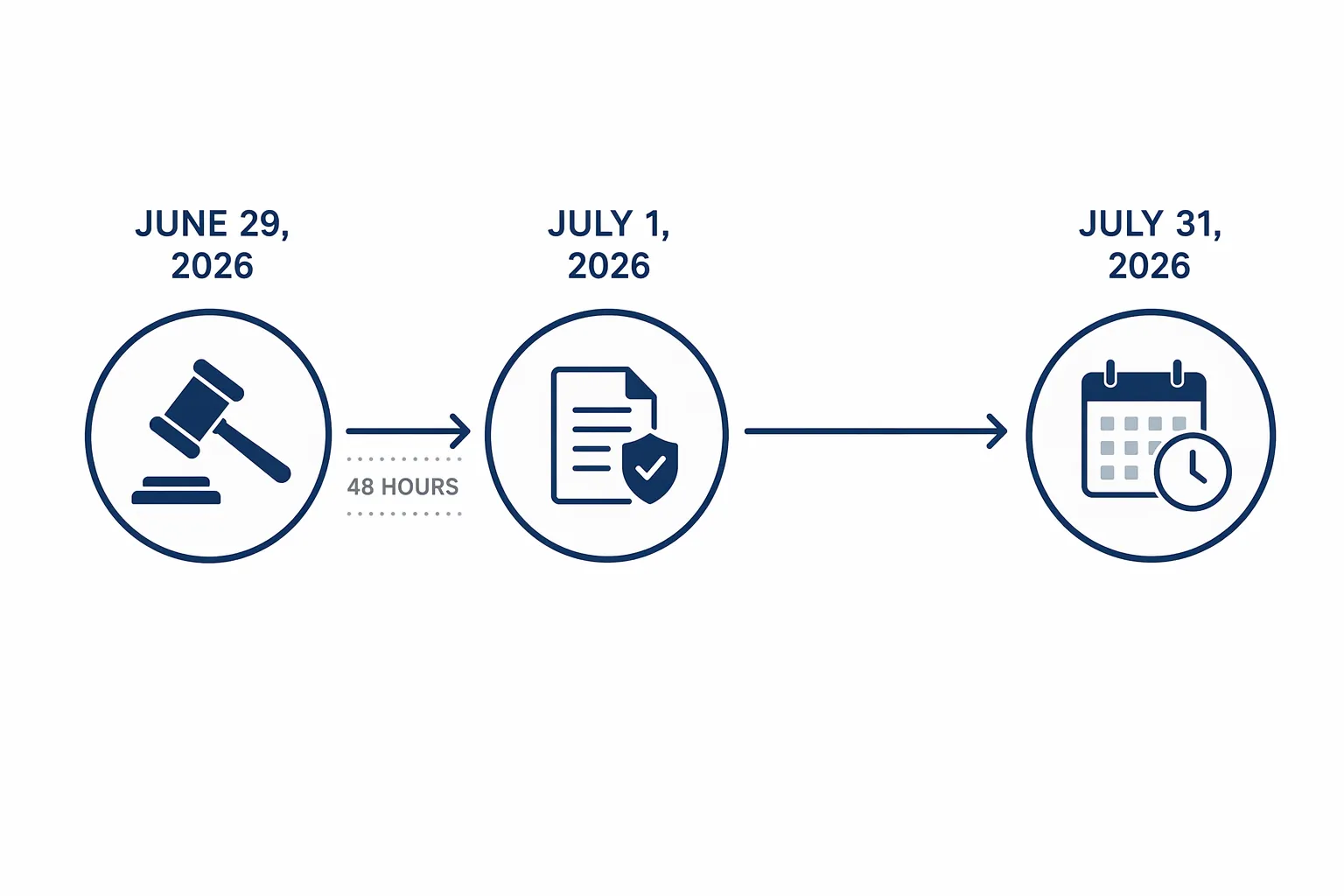
The practical answer changed fast. On June 29, 2026, the Supreme Court held in Slaughter that the president may remove FTC commissioners at will, overruling Humphrey’s Executor and its protection for the commission’s for-cause tenure structure.[1][2] On July 1, a 2-0 Republican FTC, with no Democratic commissioner present to dissent, issued an AI accuracy policy statement under Matter No. P264200.[3] Public comments are due July 31, 2026.[3]
That is the part a procurement memo cannot treat as background noise. The first concrete post-Slaughter act was not a law-school debate about independent agencies. It was an FTC enforcement-position document about AI claims, accuracy, and state compliance representations. The statement reportedly identifies Colorado’s AI Act as an example of a state-law compliance practice that may still create deception risk under Section 5 if a company represents that a tool was audited or compliance-tested and the FTC later views the tool’s outputs as inaccurate.[3]
A Federal Register citation should be added or verified once available. For now, the operative identifier is Matter No. P264200, and the risk question is immediate enough without pretending the statement is something it is not. It is guidance on enforcement posture, not a legislative rule. It has not been tested in court. It does not, by itself, erase Colorado’s requirements or any other state AI law.
For the broader constitutional background, see Humphrey’s Executor Case Explained After the Slaughter Ruling. The narrower point here is what the FTC has now done with the power shift.
What changed after Slaughter
Before Slaughter, FTC commissioners served staggered seven-year terms and could be removed only for cause, traditionally described as inefficiency, neglect of duty, or malfeasance.[4] The Supreme Court’s June 29 decision rejected that protection for FTC commissioners on the ground that the commission exercises executive power through rulemaking, investigation, adjudication, and civil enforcement.[1][2]
The consequence for AI compliance is not that every independent agency has already been judicially reclassified in every respect. The decision discussed the FTC. Law-firm analysis reads the reasoning as likely to matter for other independent agencies, but that broader reach remains analysis, not the holding.[2] The immediate consequence is simpler: the FTC’s personnel structure no longer supplies the same insulation against a rapid presidential-policy turn.
That matters because the July 1 statement did not emerge from a bipartisan commission with a dissenting record. It came from a two-member Republican commission, two days after the removal-protection decision.[3] A lawyer evaluating AI vendors now has to account for enforcement volatility as a feature of the agency’s operating environment, not as a theoretical possibility that might arrive after the next election cycle.
| Date | Event | Risk consequence |
|---|---|---|
| June 29, 2026 | Supreme Court allows at-will removal of FTC commissioners in Slaughter | FTC leadership can shift with less tenure protection |
| July 1, 2026 | FTC issues AI accuracy policy statement, Matter No. P264200 | State-law AI compliance representations become potential Section 5 exposure |
| July 31, 2026 | Public comments due | Practitioners have a short window to identify conflicts in current tools and vendor claims |
The FTC statement targets the representation, not just the model
The hard part is not that the FTC cares about inaccurate AI outputs. That was already foreseeable under Section 5 when companies market tools with claims about performance, reliability, bias reduction, or compliance. The sharper move is the way the July 1 statement reportedly treats state-law audit and compliance claims as possible deception vectors.[3]
A vendor does not need to say “our model is perfect” to create the problem. It may say the tool has been audited, tested, documented, assessed, or configured to comply with a state AI law. Under the FTC’s theory, that representation can become deceptive if the agency concludes that the tool’s outputs are inaccurate despite the audit or compliance process.[3] The enforcement risk attaches to the assurance being sold to the buyer.
That distinction is where legal users get pulled in. A law firm or legal department may not be building the model. It may be selecting an AI document-review tool, intake triage system, contract analyzer, or litigation-support product based on a vendor’s state-law compliance packet. The packet may include audit language, anti-discrimination controls, mitigation processes, and disclosures because a state regime requires or rewards that documentation. The same packet can now be the exhibit a federal investigator reads as an accuracy claim.

Why Colorado-style compliance creates the whipsaw
State AI laws such as Colorado’s require covered actors to perform impact assessments, mitigate algorithmic discrimination, and make disclosures.[3] Those obligations push deployers and vendors toward a visible compliance trail. They create documents. They create certifications. They create statements that someone in procurement, privacy, litigation support, or professional responsibility can put in a file and rely on.
The FTC statement turns that file into something less comfortable. If a tool is promoted as compliant with state audit or anti-discrimination requirements, and the FTC later takes the view that the tool’s outputs are inaccurate, the compliance representation itself may be treated as deceptive under Section 5.[3] The state system tells the deployer to assess, mitigate, and disclose. The federal enforcement posture tells the same market that the resulting representations can create deception exposure.
For a legal AI user, the contradiction is not abstract. Imagine a law firm using an AI document-review platform for matters that touch Colorado-regulated decisions. The firm asks for the vendor’s state AI compliance materials. The vendor provides audit summaries and representations about testing. If the firm ignores those obligations, it may face state-law risk. If it relies on them and repeats them in client-facing or internal approval materials, the FTC’s July 1 theory may frame those same assurances as potentially deceptive if the output is later challenged as inaccurate.
That is not a safe harbor problem in the usual soft sense. It is a no-clean-answer problem. A state compliance program may still be mandatory or prudent. But the existence of that program no longer supplies a clean federal risk answer. The lawyer who writes “vendor is compliant with Colorado AI Act; risk cleared” is now skipping the part that matters most: compliant with what, represented to whom, based on what testing, and with what known limits?
What legal teams need to flag before July 31
The July 31 comment deadline gives legal teams only a short interval to convert the issue from regulatory news into a record. Comments are not just for AI developers. The affected audience includes buyers and deployers whose risk controls depend on vendor attestations, state-law audit language, and internal approval summaries.
The first item to flag is the difference between a process claim and an output claim. “We completed an impact assessment” is not the same statement as “the tool produces accurate results.” “We tested for discriminatory impact” is not the same statement as “the tool will not produce inaccurate or biased outputs in deployment.” Vendor questionnaires often blur those lines because buyers ask broad questions and vendors answer in broad assurance language. The FTC statement makes that blurring more expensive.
The second item is reliance. A law firm may receive a vendor’s audit summary and keep it in a procurement file. An in-house legal department may quote it in a business approval memo. A litigation team may describe the tool’s controls to a client. Each step changes who is speaking and who is being asked to trust the statement. Section 5 risk is not limited to the original technical document if the assurance is repackaged into a broader market or client-facing claim.
The third item is scope. State-law compliance may apply to a covered decision, jurisdiction, or use case. Legal teams routinely take documents drafted for one deployment context and reuse them for another. A discrimination-mitigation assessment for one product workflow may not support a claim about a different workflow, a different dataset, or a different legal task. If the FTC’s focus is accuracy in the represented use, a general compliance badge is a weak substitute for use-specific evidence.
The fourth item is escalation. This is not only a vendor-management issue. Litigators need to know whether a tool’s compliance claims could become discovery material or fodder for a challenge to work product quality. In-house counsel need to know whether business teams are repeating vendor claims in customer materials. Risk managers need to know whether partner-facing summaries still describe state AI compliance as if it eliminates federal enforcement risk.
- Separate audit completion from accuracy claims in vendor and internal documents.
- Identify where state-law compliance representations are repeated beyond procurement.
- Tie any compliance statement to the actual jurisdiction, workflow, dataset, and legal use case.
- Preserve the difference between vendor disclosures, independent testing, and counsel’s own risk judgment.
- Consider whether a comment to the FTC should document the conflict between state-required disclosures and federal deception exposure.
What is settled, and what is not
The settled part is the FTC removal holding. The Supreme Court allowed at-will presidential removal of FTC commissioners and overruled the 1935 Humphrey’s Executor limit as applied to the commission.[1][2] That is why the decision now has a concrete AI compliance consequence: the commission’s enforcement posture can change with personnel control more quickly than many risk programs assumed.
The unsettled part is almost everything a compliance officer would prefer to treat as stable. The July 1 policy statement is not a statute. It is not a judicial decision. Its preemptive force against state AI laws has not been established. A court may narrow, reject, or sustain parts of the FTC’s theory later. Nor does Slaughter conclusively decide the removal structure of every other independent agency in every future context, even if its reasoning is already being read broadly.[2]
There is also a difference between adoption and effectiveness. A vendor’s adoption of a state-required assessment process does not prove the tool is accurate. A completed bias-mitigation review does not prove every future output is reliable. Conversely, a later inaccurate output does not automatically prove that the original compliance process was fake. The FTC’s concern, as reflected in the July 1 statement, is the representation made to the market and whether that representation misleads buyers about what the process actually establishes.[3]
That distinction should make internal language more careful, not paralyzed. Legal teams can still ask for audits, assessments, mitigation documentation, and disclosures. They should. But the memo cannot stop at “state compliant.” It needs to say whether the evidence supports a process conclusion, a performance conclusion, a discrimination-risk conclusion, an accuracy conclusion, or only a vendor assertion that has not been independently tested.
The risk answer now has to be narrower
Before July 1, a legal team evaluating an AI tool under a Colorado-style regime might reasonably have treated state-law audit and mitigation materials as a meaningful risk reducer. After July 1, those same materials still matter, but they are no longer enough to close the federal deception question. They may even identify the claims the FTC would examine first.
The useful answer to clients is therefore narrower than vendors will want and less tidy than procurement forms expect: state AI compliance may reduce one category of risk while increasing the need to police accuracy, scope, and reliance representations under Section 5. That is the whipsaw. Slaughter did not rewrite state AI obligations, and the FTC statement is not yet tested law. Together, they remove any current safe harbor for treating state AI compliance as a clean answer to legal-AI risk.
References
- Court allows Trump to fire FTC commissioner and overturns major restraint on presidential power, SCOTUSblog, June 2026.
- Supreme Court Rules Independent Executive Agencies Unconstitutional, Gibson Dunn.
- FTC Becomes White House Tool for AI Policy, Model Diplomat.
- Supreme Court FTC independent agencies Humphrey’s Executor, NPR, June 29, 2026.
Related records
Tool profile
How Meta's AI Spending Reshapes Law Firm ProfitabilityGoverning regulation
Browse the obligations tracker →Preventive workflow
Browse verification workflows →
Report a correction or tip
Spotted an outdated figure, a misstated fact, or a ruling this case record should reflect? Public comments are disabled for this content given the professional cost of a misreported case outcome, penalty amount, or rule text — use the structured correction channel instead.
Report a correction or tip for this record →