
What legal challenges could stop the Smithsonian warning signs order?
This article maps the constitutional and statutory boundaries constraining the July 24 executive order requiring warning signs outside the National Museum of American History, and evaluates the legal theories most likely to succeed in challenging it — drawing on First Amendment doctrine, the APA, and the Smithsonian's unique trust-instrumentality structure.
- Jurisdiction
- US Federal
- Court
- No court yet
- Judge
- None
- AI tool named
- No AI tool
- Penalty amount
- None
- Ruling date
- Jul 24, 2026
- Source document
- View primary court order ↗
- Last verified
- Jul 25, 2026
Lex Machina Review is an independent risk-tracking and reference resource. Nothing on this site is legal advice, and using it does not create an attorney-client relationship. Every record is reviewed against primary sources but may not reflect the most current status of a matter — always verify directly against the cited court order, rule text, or a licensed attorney before relying on it.
Companion explanation — secondary to the source document above
The legal implications of the National Museum of American History warning signs order turn less on the word “warning” than on the machinery the order sets in motion. The July 24, 2026 executive order directs Interior Secretary Doug Burgum, acting through the National Park Service, to install “temporary exhibits or signage on NPS-maintained sidewalks, walkways, and land” outside the museum, and it separately directs federal officials to identify “all available authorities” to address Smithsonian content the White House views as inaccurate or ideologically distorted.[1]
Those are not the same legal act. A sign placed by the government on land maintained by NPS is one thing. A funding condition, budgetary threat, or executive instruction aimed at changing Smithsonian curatorial judgment is another. The first may be defensible as government speech. The second is where the order begins to create a record that litigators would actually want to read.
Start With The Land, Not The Museum
The order’s most careful drafting choice is its placement instruction. It does not, at least in the operative signage clause, tell the Smithsonian to mount a placard inside an exhibition gallery. It tells Interior, through NPS, to use NPS-maintained sidewalks, walkways, and land outside the National Museum of American History.[1]
That choice matters because sidewalks normally invite a familiar First Amendment objection: public sidewalks are often treated as traditional public forums, and viewpoint discrimination in such spaces is presumptively suspect. But when the government itself installs and controls the message, it will argue that it is speaking in its own voice. The First Amendment Encyclopedia’s July 2026 treatment of the Smithsonian exhibit controversy frames that distinction directly: forum arguments exist because public walkways are involved, but government speech doctrine is likely to be central where the government is adding its own message rather than suppressing a private speaker.[2]
That does not make the signage politically neutral, historically sound, or immune from every statutory challenge. It does mean that a plaintiff who files a clean First Amendment case against the physical presence of the signs alone may run into a threshold problem: the government is usually allowed to express its own view on government-controlled property. The better question is whether implementation stays confined to NPS land and NPS speech.
The Smithsonian Is Not An Ordinary Executive Agency
The order becomes more vulnerable when it moves from outdoor signage to Smithsonian governance. The Smithsonian’s structure has never fit comfortably inside the usual executive-branch box. In Dong v. Smithsonian Institution, the D.C. Circuit held in 2000 that the Smithsonian lacked the authority needed to qualify as an “authority of the Government of the United States” under the Administrative Procedure Act and lacked the “executive department” status needed under FOIA.[3]
That holding does not make the Smithsonian private in every sense. It receives federal appropriations, operates national museums, and has a Board of Regents created by Congress. But it does complicate any executive theory that treats the institution as commandable property of the President. The Yale Law Journal’s April 2026 essay on executive overreach at the Smithsonian relies on that structural awkwardness, and on the institution’s trust-instrumentality character, to argue that Congress should recharter the Smithsonian as a Title 36 corporation if it wants permanent insulation from presidential direction.[3]
The Congressional Research Service has described the Smithsonian as “organizationally separate and distinct from the legislative, executive, or judicial branches,” a characterization discussed in the same legal debate over whether executive officials may direct curatorial or personnel decisions.[2][3] That formulation is not a decorative institutional label. It affects who may give orders, who may accept them, and what kind of paper trail later looks like lawful coordination rather than ultra vires pressure.
For that reason, Smithsonian leadership’s public caution is not just reputation management. If the institution cooperates too broadly, it risks creating a precedent that the White House can use ordinary executive channels to control a congressionally chartered trust instrumentality. If it refuses every point of contact, it may invite a funding or oversight fight on worse terrain. The legally safer posture is narrow implementation: recognize federal control over NPS-maintained exterior land while preserving Smithsonian authority over exhibitions, collections, scholarship, and personnel.
Why “All Available Authorities” Carries The Real Litigation Risk
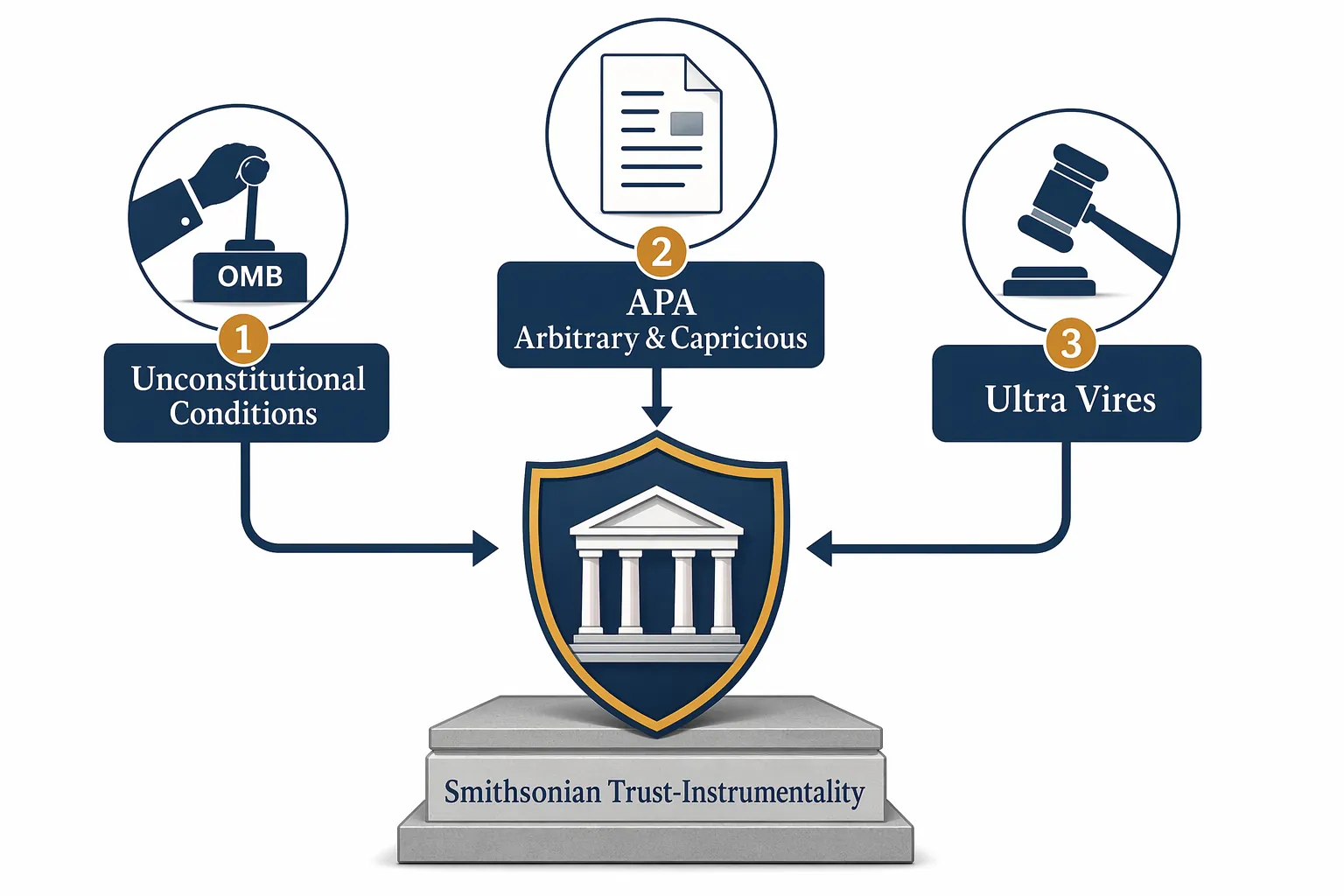
The phrase “all available authorities” is the part of the order most likely to matter in a later complaint. It invites agencies to search for tools beyond the sign itself: appropriations conditions, OMB review, grant terms, facilities control, interagency agreements, personnel leverage, or reporting requirements. Some of those tools may be lawful in isolation. They become riskier if used to accomplish indirectly what the President cannot command directly.
| Implementation choice | Likely legal posture | Main vulnerability |
|---|---|---|
| NPS installs government-drafted signs on NPS-maintained exterior land | Relatively defensible | Forum and statutory objections, but government speech is a strong defense |
| OMB or another federal actor conditions funds on curatorial changes | Materially riskier | Unconstitutional conditions and statutory authority limits |
| Executive officials direct Smithsonian exhibition, personnel, or governance decisions | Highest structural risk | Ultra vires action against a congressionally chartered trust instrumentality |
| Interior or NPS relies on the contested White House report without reasoned explanation | Record-dependent | APA arbitrary-and-capricious challenge |
The unconstitutional-conditions theory is the most obvious funding-route challenge. Congress may attach conditions to federal money within constitutional and statutory limits. Executive officials, however, cannot use appropriated funds as a roving instrument to coerce speech or governance choices that they lack authority to mandate. If OMB or an agency tied Smithsonian funding, project approvals, or operating support to changes in exhibition content, challengers would likely argue that the government is penalizing protected institutional expression or forcing viewpoint conformity through the spending channel.
That theory would require facts. A public order saying “identify authorities” is not the same thing as a written funding condition, a withheld apportionment, or an agency letter demanding that a gallery text be rewritten. The record would have to show coercion, not merely criticism. But the order’s funding language gives future plaintiffs something to watch for: whether budgetary tools are being used as levers against curatorial independence rather than as ordinary fiscal administration.
The APA Claim Depends On Which Agency Acts
An Administrative Procedure Act claim against the Smithsonian itself is complicated by Dong, which held that the institution is not an APA “authority of the Government of the United States.”[3] That does not remove APA risk from the order. It shifts the target. Interior, NPS, OMB, or another executive agency implementing the order may still have to explain its choices in a way that survives arbitrary-and-capricious review.
The record problem is already visible. The July 24 order builds on the administration’s March 27, 2025 executive order on American history, which directed federal attention toward museums, monuments, and public interpretation.[4] It also follows a 162-page White House report titled “Saving America’s Story,” released on July 4, 2026, that criticized Smithsonian historical presentation. The Organization of American Historians rejected that report as “not grounded in an understanding of what museums really do,” according to reporting on the controversy.[5]
That disagreement is not, by itself, an APA violation. Agencies may rely on contested materials. Courts do not sit as museum review boards. The vulnerability appears if an agency treats the report as a conclusive factual predicate while ignoring contrary evidence, failing to identify a statutory basis for action, or offering a rationale so thin that it looks pretextual. In that setting, the dispute over “Saving America’s Story” becomes less a debate about historical interpretation and more a question about reasoned decision-making.
The cleanest APA defendant would probably not be the Smithsonian. It would be the executive agency that takes final agency action: Interior approving the signs, NPS altering interpretive materials, OMB conditioning funds, or another agency issuing a binding directive. Without final agency action, the claim becomes harder. With a written implementation memo, procurement instruction, funding condition, or interpretive directive, the administrative record begins to take shape.
NPCA v. DOI Helps, But Only So Far
The closest live precedent is not a Smithsonian case. It is NPCA v. DOI, the challenge to National Park Service removals and alterations of interpretive materials under the same broader cultural-content campaign. In June 2026, Judge Angel Kelley of the District of Massachusetts issued a preliminary injunction requiring NPS to “restore interpretive materials that have been altered or removed since May 20, 2025,” according to Democracy Forward’s account of the order.[6]
That injunction matters because it shows at least one federal court willing to scrutinize implementation of the administration’s history directives rather than dismissing the dispute as political messaging. It also matters because NPS is the implementing actor in the July 24 signage order, at least for the exterior land component.[1][6]
The limits are just as important. NPCA involved removed or altered interpretive materials, not signs newly added by the government outside a museum. Removal cases more readily implicate censorship, statutory mission, reliance interests, and arbitrary agency reversal. Added government signage gives the government a stronger speech defense. The precedent value is also uncertain because the injunction was later reported to have been partially reversed on appeal, and the full appellate reasoning is not available in the provided record.[7]
For a plaintiff challenging the July 24 order, NPCA is therefore useful as a procedural and factual analog, not as a ready-made answer. It suggests that courts may ask what NPS actually did, what record supported it, and whether the agency complied with governing law. It does not establish that every presidentially prompted museum or park message is unconstitutional.
The Ultra Vires Path Is Narrow But Serious
An ultra vires claim would focus on authority rather than viewpoint. The question would not be whether the President’s historical assessment is wise, fair, or offensive. The question would be whether executive officials acted beyond the powers Congress gave them when they attempted to direct Smithsonian governance, personnel, collections, or exhibition content.
The May 2025 attempt to remove National Portrait Gallery director Kim Sajet is the warning example. Smithsonian regents asserted personnel authority, and Sajet resigned before the issue was litigated.[8] Because no court resolved that dispute, it supplies posture rather than precedent. Still, it shows the same structural fault line: the administration may apply public pressure, but the Smithsonian’s internal governance is not obviously subject to ordinary presidential removal-and-control logic.
That is why the order’s implementation details will matter more than its press coverage. A sign outside the museum can be defended as an NPS land-use and government-speech decision. A White House or agency instruction telling the Board of Regents how to discipline museum staff, rewrite labels, approve exhibitions, or condition leadership decisions would present a different case. The farther implementation moves from exterior federal land and toward Smithsonian institutional judgment, the stronger the ultra vires theory becomes.
Who Could Sue, And What Could They Ask For?
As of July 25, 2026, no lawsuit has been filed specifically challenging the July 24 warning signs order. That matters. Until implementation produces a concrete injury, plaintiffs may face standing, ripeness, and final-agency-action barriers.
The Smithsonian itself would be the most direct institutional plaintiff if executive actors tried to command its internal governance, but it has so far appeared to favor cautious cooperation while preserving claims of independence. That posture may reduce immediate litigation risk while increasing the importance of written reservations, board minutes, and correspondence that avoid conceding presidential control.
Visitors or advocacy groups might try a First Amendment or APA challenge, especially if the signs alter access, crowd control, or interpretive programming. Their strongest claims would likely depend on more than offense at the message. A court would ask whether they suffered a cognizable injury, whether the challenged action is final, and whether the remedy requested would improperly regulate government speech.
A funding recipient, contractor, researcher, or Smithsonian-affiliated program could have a different claim if money is withheld, conditioned, or terminated because of refusal to adopt the administration’s preferred historical framing. That is where unconstitutional-conditions analysis becomes more concrete. The plaintiff would not merely object to a sign; it would identify a benefit lost or threatened because of protected expression or institutional independence.
- Most vulnerable record: a written funding condition or OMB instruction tying federal support to specific curatorial changes.
- Most plausible agency target: Interior or NPS, if they take final action based on a thin or one-sided record.
- Most difficult direct attack: a First Amendment claim aimed only at government-authored signs on NPS-maintained exterior land.
- Most serious structural claim: an ultra vires challenge to executive direction of Smithsonian governance or personnel.
The Risk Ranking
The signs alone are probably not the order’s weakest legal point. If NPS places temporary, government-authored signage on NPS-maintained exterior land, the government has a substantial government-speech defense. Plaintiffs may still test forum, statutory, and procedural theories, but that is not the cleanest challenge.
The funding route is more exposed. If “all available authorities” becomes a mechanism for OMB or another executive actor to discipline Smithsonian content through appropriations pressure, challengers can frame the dispute as coercion rather than counterspeech. That theory would be fact-intensive, but it is the one most likely to convert a symbolic order into a litigable injury.
The structural route may be the most important. The Smithsonian’s trust-instrumentality status, Dong’s treatment of the institution outside ordinary APA and FOIA categories, and CRS’s branch-separation description all make it difficult to treat the Smithsonian as a standard executive agency.[2][3] If implementation respects that boundary, the order may remain mostly a contested government message on federal land. If implementation crosses it, the legal fight will no longer be about warning signs.
References
- Restoring Trust in the Smithsonian Institution — The White House, July 24, 2026
- Control of Smithsonian Institution Exhibits — First Amendment Encyclopedia, updated July 9, 2026
- Fight at the Museum: Executive Overreach and the Future of the Smithsonian Institution — Yale Law Journal, April 2026
- Restoring Truth and Sanity to American History — The White House, March 27, 2025
- Controversial White House report targets Smithsonian: What's going on? — USA Today, July 10, 2026
- Court Blocks Censorship and Erasure of American History and Science at National Parks — Democracy Forward, June 2026
- Trump orders disclaimers outside Smithsonian's Museum of American History — The Hill, July 24, 2026
- White House calls for a 'comprehensive internal review' of 8 Smithsonian museums — NPR, August 12, 2025
Related records
Tool profile
How Meta's AI Spending Reshapes Law Firm ProfitabilityGoverning regulation
Browse the obligations tracker →Preventive workflow
Browse verification workflows →
Report a correction or tip
Spotted an outdated figure, a misstated fact, or a ruling this case record should reflect? Public comments are disabled for this content given the professional cost of a misreported case outcome, penalty amount, or rule text — use the structured correction channel instead.
Report a correction or tip for this record →