
Morgan Stanley Says SpaceX at $100 Means Zero AI Value for Grok
Morgan Stanley analysts argue that SpaceX's stock at ~$100 per share implies the market is assigning zero or negative value to Grok AI, despite the firm's $300 price target attributing over half the value to AI. This article examines what the gap between market price and analyst target — and the looming $123B lockup expiry — means for legal professionals relying on Grok for production workflows.
- Jurisdiction
- United States
- Court
- U.S. Federal
- AI tool named
- Grok
- Ruling date
- Jul 24, 2026
- Source document
- View primary court order ↗
- Last verified
- Jul 28, 2026
Lex Machina Review is an independent risk-tracking and reference resource. Nothing on this site is legal advice, and using it does not create an attorney-client relationship. Every record is reviewed against primary sources but may not reflect the most current status of a matter — always verify directly against the cited court order, rule text, or a licensed attorney before relying on it.
Companion explanation — secondary to the source document above
This Risk Digest analysis is not investment advice. The link between SpaceX valuation pressure and legal workflow risk is an editorial risk-assessment inference for procurement, knowledge-management, and legal-operations teams; it is not a court-derived obligation or a securities recommendation.
As of July 28, 2026, the SpaceX-Grok valuation debate has moved from analyst modeling into an operational calendar problem. Bloomberg reported that Morgan Stanley analyst Adam Jonas has a $300 price target for SpaceX, while warning that a SpaceX share price near $100 would imply that the market is assigning zero value, or potentially negative value, to the company’s AI operations, including Grok, Cursor, and the broader xAI platform.[1] With SpaceX trading around $115 and an expected early-August lockup expiry approaching, that is no longer just a disagreement about upside.
The near-term stress point is the reported lockup expiration: 911.5 million SpaceX shares, worth roughly $123 billion, are expected to become eligible for sale in nine tranches, with the first unlock estimated for T+2 after Q2 earnings, around August 6 if earnings arrive around August 4.[2] The exact timing still depends on the earnings date. But the procurement question does not require perfect timing. If a law firm has already built drafting, research, intake, or review workflows around Grok, the next few weeks create a clean vendor-stability review trigger.

What “zero AI value” means in this model
A sum-of-parts model separates a company into business lines and assigns value to each. In Jonas’s framework, the non-AI parts of SpaceX can be modeled separately from the AI assets. If the stock price falls toward the level Morgan Stanley associates with the legacy or non-AI components, the implication is not that Grok has literally no code, no users, or no strategic relevance. It means the market price is not paying for the AI story in the way the Morgan Stanley target does.
That distinction matters for legal buyers. A valuation signal is not a product review. It does not prove Grok cannot answer a research question, draft a clause, summarize a record, or support an internal workflow. It does, however, tell a procurement committee that the market may be discounting the durability, monetization, or capital intensity of the AI business that supports the tool.
| Valuation point | Operational reading for legal teams |
|---|---|
| Morgan Stanley target: $300 per share, with more than half the value tied to AI under the Bloomberg-reported framework.[1] | The bull case assumes AI becomes a major value driver, not a side project. |
| Market price around $115, with Morgan Stanley describing roughly $100 as implying zero or negative AI value.[1] | The public price signal has not yet validated the AI valuation embedded in the target. |
| Expected lockup: 911.5 million shares, about $123 billion, becoming eligible for sale in early August.[2] | A supply overhang can pressure the stock even if product features do not change that week. |
The lockup matters because it can convert disagreement into forced market discovery. Employees, early investors, and other holders do not all have to sell for a supply overhang to matter. The risk is that enough newly eligible shares come to market, or enough buyers wait for the unlock, that the stock drifts toward the $100 scenario Morgan Stanley described. In that case, the “zero AI value” reading could arrive through mechanics before the underlying AI thesis has been conclusively disproven.
That is the uncomfortable part for legal operations. A firm may experience the same product on Monday and Friday, but the vendor’s parent economics can look materially different by the end of the week. The team that owns the workflow still has to decide whether the tool is a durable dependency or a useful capability that needs a fallback path.
The adoption numbers do not yet carry the bull case
The strongest rebuttal to a zero-AI-value signal would be adoption: paying users, enterprise penetration, retention, revenue scale, and credible evidence that the burn rate is buying durable distribution. The reported Grok numbers are not useless. They are also not yet the kind of numbers that make a $250 billion implied xAI valuation look self-evident.
Fortune reported CFRA analyst Keith Snyder’s view that 71% of SpaceX’s $2 trillion value rested on AI, while Grok’s operating metrics looked thin by comparison: roughly $500 million in annual recurring revenue against about $1 billion per month in cash burn, a 1.6% consumer conversion rate, and 3% enterprise adoption compared with cited adoption around 40% for OpenAI and Anthropic.[3] These are third-party and analyst estimates, not audited xAI or SpaceX disclosures. They should be treated as risk indicators, not as final accounting facts.
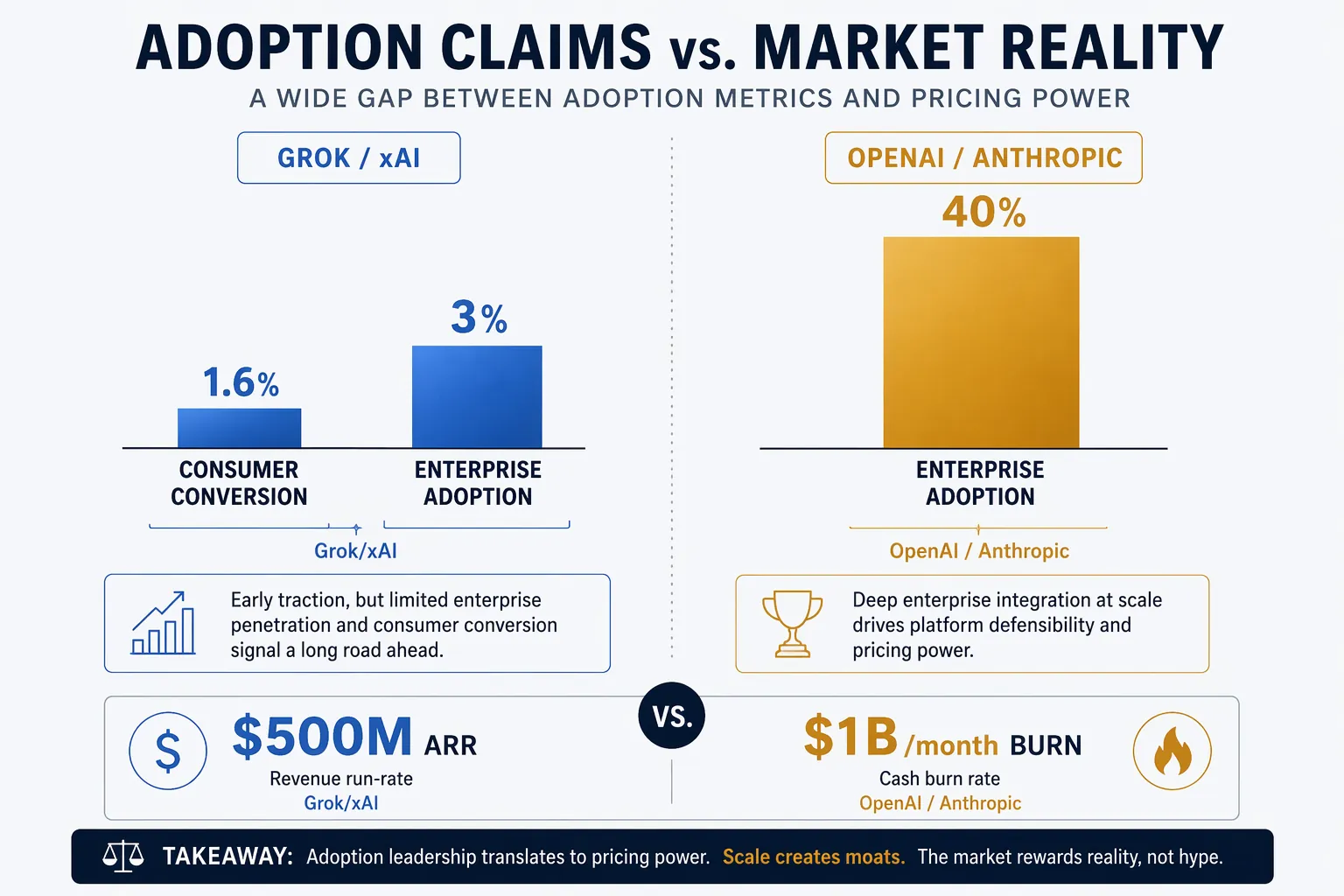
The revenue-and-burn comparison is especially relevant for production legal use. A legal team does not need Grok to be profitable this quarter. Many strategically important AI products are subsidized while they scale. But a workflow owner does need to know whether the vendor can continue serving, supporting, governing, and improving the product under financial pressure. A tool that depends on sustained capital availability asks a different procurement question than a tool whose revenue base already supports its operating footprint.
Conversion is a separate issue from attention. Low consumer conversion does not prove enterprise failure; consumer users and law-firm users buy differently. Still, a 1.6% conversion figure narrows the evidence base for the claim that Grok’s audience has already become a deeply monetizable user base.[3] For a law firm building production workflows, the distinction is practical: a widely discussed model is not the same as a sticky vendor with enterprise-grade renewal behavior.
Enterprise adoption is the sharper procurement metric. The reported 3% figure for Grok, set against cited 40% adoption for OpenAI and Anthropic, suggests that Grok has not yet matched the institutional penetration of the leading general-purpose AI platforms.[3] That does not mean a specific legal department cannot prefer Grok for a specific use case. It does mean that a firm using Grok as a core production dependency is operating ahead of the adoption evidence that would normally make a vendor look de-risked.
Download trends point in the same direction, with an added caveat about source hierarchy. GetPanto.ai reports that Grok monthly downloads fell from 20 million to 8.3 million, while also listing 117 million monthly active users and benchmark figures including 75.0% on SWE-bench and 73.5% on GPQA, compared with Claude at 78.2% on GPQA and 9.0/10 for writing versus Grok’s 6.3/10.[8] Those figures are useful as directional competitive context, not as a substitute for audited retention, enterprise renewal, or service-level performance data.
The merger gave AI a valuation; adoption still has to earn it
The February 2026 xAI-SpaceX merger mechanics help explain why the valuation burden is so large. CNBC reported that the merger valued the combined company at $1.25 trillion and implied a $250 billion value for xAI.[4] That kind of internal transaction can establish a strategic valuation, but it does not by itself show that enterprise customers have accepted the same valuation through spending, renewals, or workflow dependence.
The same caution applies to the enormous addressable-market framing. Fortune reported that SpaceX’s S-1 cited a $28.5 trillion total addressable market, including $26.5 trillion for AI, and that CFRA could not verify how the company derived the figure.[3] That does not make the TAM wrong. It does make it a company claim that should not be treated as independent evidence that Grok’s current adoption supports the bull case.
Morgan Stanley’s longer-term projection is ambitious enough to explain the target. Reuters reported in June that Morgan Stanley expected SpaceX revenue to reach $3.4 trillion in 2040, a projection tied to the broader bull case.[5] A 2040 revenue model can rationalize a high target if the assumptions hold. It is much less helpful to a knowledge manager deciding whether a litigation team should rely on Grok as the only path for a deposition-summary workflow this quarter.
A lockup-driven drop would still matter even if Morgan Stanley is directionally right
One possible mistake is to read the lockup only as a verdict on Grok. It is not. Lockups can create price pressure because supply changes, not because every holder has changed their view of the business. Morgan Stanley reportedly viewed largely unchanged fundamentals around the lockup as creating an attractive entry point, while Morningstar warned of a potential wave of selling.[6] Both views can coexist: the long-term thesis may remain intact while the near-term price becomes unstable.
That distinction is exactly why legal teams should care. A vendor-stability review is not an accusation that the vendor is failing. It is a governance response to a new concentration of uncertainty. If a platform’s parent company may face a large post-lockup supply event, the legal buyer should know which workflows would break, slow down, or require emergency substitution if product support, pricing, roadmap commitments, API access, or data controls changed under pressure.
This is the same pattern Risk Digest has tracked in other AI infrastructure and financing stories. A stock drop or valuation question does not automatically make a product unusable, but it can expose a hidden procurement assumption. We made that point in the CoreWeave infrastructure-risk analysis, in the discussion of Etched’s valuation as a legal-AI diligence signal, and in the analysis of NVIDIA-OpenAI financing fragility. The SpaceX-Grok version is sharper because the Morgan Stanley model gives buyers a specific threshold to watch.
Analyst dispersion is not comfort
The market is not speaking with one voice. Quartz reported a wide analyst target range for SpaceX, from $62 to $800, with 27 of 32 analysts rating the stock Buy despite extreme dispersion.[7] For investors, that range may represent opportunity, disagreement, or volatility. For legal procurement, it means the risk committee should not treat consensus enthusiasm as the same thing as a settled vendor-stability profile.
The law-firm question is narrower than the analyst question. It is not whether SpaceX can become a much larger AI company by 2040. It is whether Grok’s current adoption, revenue, burn-rate, and post-lockup market signal justify deeper dependence without a continuity plan. On the evidence available, they do not.
If Grok is already in production, review the dependency now
A practical review should start with dependency depth. The relevant question is not whether someone at the firm has a Grok account. It is whether Grok sits in a production chain where lawyers, paralegals, knowledge teams, or clients are waiting on its output before work can move. A research assistant used experimentally is one risk profile. A mandatory drafting layer in a high-volume commercial workflow is another.
- Map where Grok is used in production: research, drafting, summarization, intake, document review, internal knowledge retrieval, client-facing prototypes, or API-connected tools.
- Identify which workflows have no substitute if Grok access, pricing, model behavior, or service levels change.
- Separate convenience use from reliance: a tool that saves time is different from a tool that has become the only approved route for completing a task.
- Confirm who owns the fallback decision: knowledge management, legal operations, IT, practice leadership, or the client team.
- Review data-retention, prompt-logging, confidentiality, and continuity assumptions in the governing contract or internal approval memo.
The fallback does not have to be elegant. It has to be real. For some teams, that means a second approved AI platform. For others, it means reverting to manual legal research, template-bank drafting, human review queues, or a narrower use of Grok limited to non-client-critical work. The point is to know before the lockup period begins which path absorbs the work if the vendor picture worsens.
Data and infrastructure questions belong in the same review. Grok is not just a front-end chatbot; it is part of the xAI ecosystem whose infrastructure choices can create their own legal exposure. Teams tracking that layer should also revisit Risk Digest’s coverage of the xAI Southaven data-center dispute and the broader discussion of Alphabet AI market risk for law firms. Financial stability, infrastructure stability, and legal defensibility are separate questions, but they tend to arrive together when a firm moves an AI tool from experiment to production.
For SpaceX-specific legal exposure, the same diligence file should include the firm’s view of government-contract and ethics issues already raised around the company’s AI work, including the SpaceX-Pentagon AI contract enforcement analysis and the SpaceX Pentagon AI ethics-gap review. Those issues do not decide whether Grok performs well inside a firm, but they may affect client comfort, reputational review, and vendor-risk scoring.
Morgan Stanley may be right that the market is undervaluing SpaceX’s AI assets. A founder-led platform with distribution advantages can sometimes outrun ugly early adoption metrics. But legal teams do not need to resolve that stock debate to act prudently. The current market signal, the reported adoption gap, the burn-rate-to-ARR mismatch, and the August lockup all point to the same operational conclusion: do not make Grok the sole production path for legal work unless the firm has already documented how it will continue the work without it.
References
- SpaceX Stock Near $100 Signals No AI Value, Morgan Stanley Says, Bloomberg, July 24, 2026
- SpaceX IPO lockup expiry: $123B in shares set to unlock in early August 2026, Investing.com, July 16, 2026
- 71% of SpaceX's $2T value rests on AI. Grok's numbers are 'almost comical' by comparison, Fortune, June 15, 2026
- Musk's xAI, SpaceX merger valued at $1.25 trillion, the biggest ever, CNBC, Feb 3, 2026
- Morgan Stanley expects SpaceX revenue to hit $3.4 trillion in 2040, Reuters, June 5, 2026
- SpaceX Lockup Expiry: Morgan Stanley Believes 'Largely Unchanged' Fundamentals Create Attractive Entry Point, Yahoo Finance (Morningstar), July 2026
- Goldman Sachs and Morgan Stanley split on SpaceX stock by $1 trillion, Quartz, 2026
- Grok AI Statistics 2026: Users, Revenue & Growth, GetPanto.ai
Related records
Tool profile
Grok's Legal Use Cases, Tiered by RiskGoverning regulation
Browse the obligations tracker →Preventive workflow
Browse verification workflows →
Report a correction or tip
Spotted an outdated figure, a misstated fact, or a ruling this case record should reflect? Public comments are disabled for this content given the professional cost of a misreported case outcome, penalty amount, or rule text — use the structured correction channel instead.
Report a correction or tip for this record →